Most people searching for how to measure cat food portions are already ahead of the curve. They have noticed that the scoop in the bag is a suggestion, that the feeding chart on the side panel is a range wide enough to park a car in, and that their cat has opinions about all of it. The good news is that portioning is arithmetic, not intuition. You need one number for the cat and one number for the food, and the rest is repetition.
The bad news is that almost everything sold to help you with this is designed around convenience rather than accuracy. A scoop is not a unit of measure. A bowl that hides the bottom of the dish makes it hard to see what you poured. A feeder that drops food on a timer without any weight reference will happily over-serve all day long. None of that makes the gear useless. It means you have to know what the gear is actually doing.
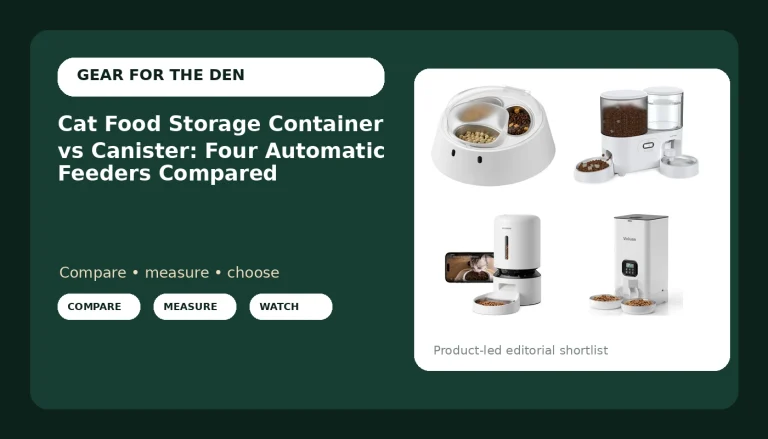
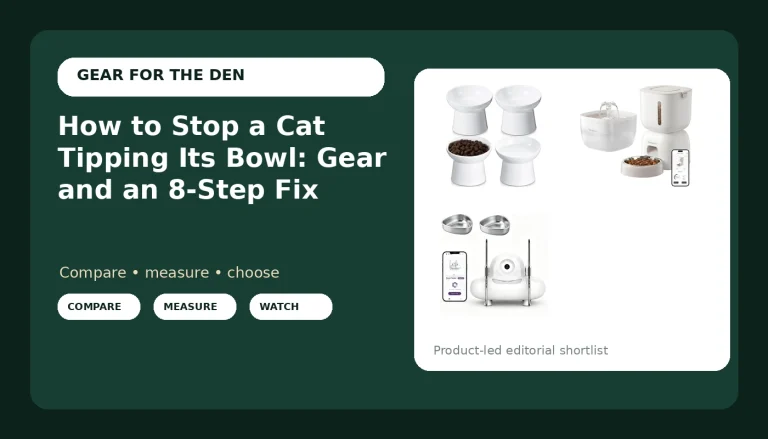
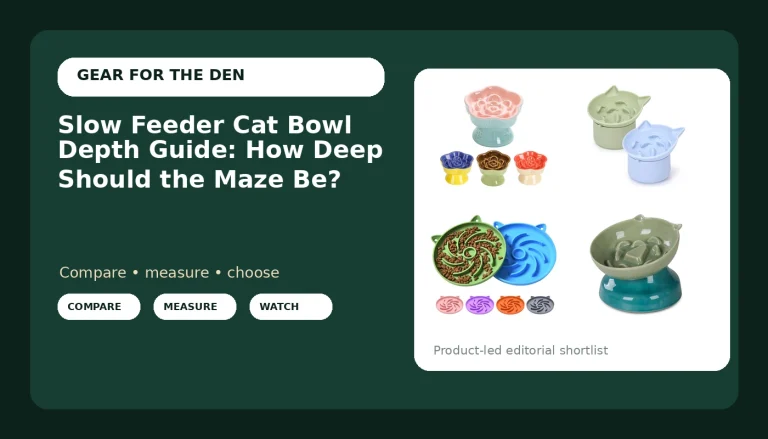
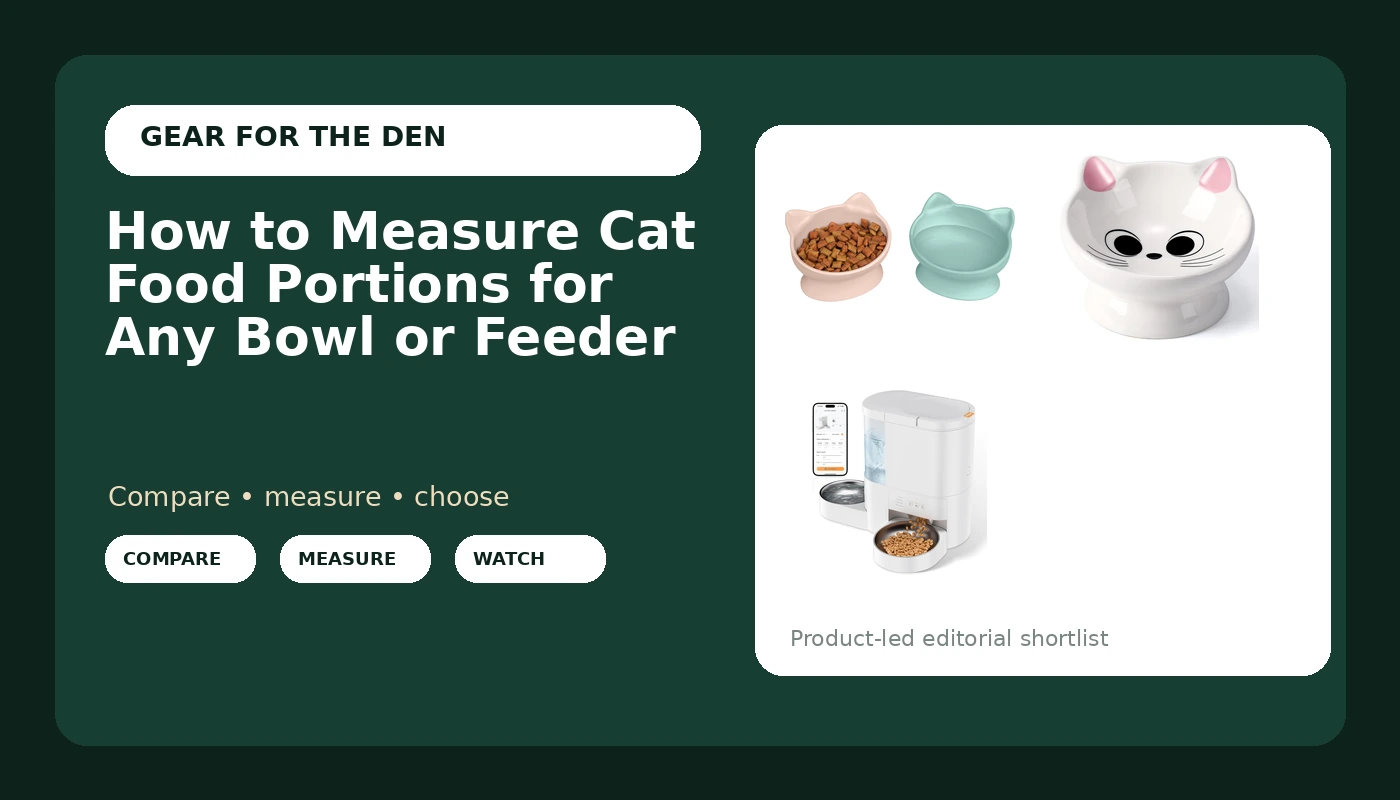
This guide covers both halves: the arithmetic you do once, and the bowls and feeder that make that arithmetic survive a Tuesday morning when you are already late for work. I will show you how to measure cat food portions in eight steps, then walk through the three pieces of gear worth buying to support the process.
Why you should trust me
I write the feeding and water guides for Gear for the Den, which means my week is spent on bag panels, spec sheets, and the fine print that manufacturers would rather you skim. Portion math is where pet food marketing does the most damage: the bag prints a chart, the scoop prints nothing, and the cat's ribs tell a third story.
At home I portion with a digital kitchen scale, the same kind people use for coffee, because a measuring cup of dry food can vary by as much as a third depending on kibble shape and how settled the bag is. I keep a written log for the cats in my house, because memory is a terrible measuring tool, and I recheck body condition with my hands every couple of weeks rather than trusting a number from last spring.
What I will not do is quote star ratings at you or pretend a bowl is a medical device. What I can tell you is which features actually make it easier to measure cat food portions and which features are decoration.
How I picked and how I tested
For this guide I compared three pieces of feeding gear that solve the portioning problem three different ways: a set of elevated pedestal dishes, a tilted ceramic bowl, and a WiFi dry food dispenser. I picked them on the things that matter to portioning rather than on looks. That means listed capacity, how wide and shallow the rim is, whether the dish goes in a dishwasher, and whether the feeder lets you set a portion size in real increments instead of eyeballing a scoop.
The three items below are the gear that helps once you know how to size up cat food portions by weight instead of by eye.
I did not run a lab. The testing in this guide is the portion math, which you can do at home in an evening with a kitchen scale, a measuring cup, a bag of food, and a cat. I weighed a cup of kibble settled and unsettled to see how far the number moves. I checked that each bowl's listed capacity lines up with a real meal for an average adult cat. I read the listings for what they claim and left out anything I could not verify from the product page itself.
What I looked at on each item:
- Bowl width and depth, because a narrow dish pushes a cat's whiskers against the sides, and whisker clearance is the reason some cats eat half a meal and walk away.
- Elevation angle, because a raised dish changes the posture a cat eats in, and a tilt is aimed at cats that eat fast and bring it back up.
- Water capacity, because a dry food schedule and a wet food schedule need different water math, and a dish that holds a full day is one less thing to think about.
- On the feeder: portion size increments, whether the app schedules in grams or ounces, and whether the hopper seals well enough that the food stays fresh between refills.
The numbers I trust in this article are the ones you can verify yourself: the calorie line on the bag, the reading on your scale, and the rib check under your own hands. Everything else is a feature list.
The gear that makes it easier to measure cat food portions
None of these three will do the arithmetic for you, and two of them will not even try. What they do is remove the friction between the number you calculated and the food the cat actually eats. A dish that is easy to fill and easy to see into keeps the measurement honest. A feeder that repeats a set portion makes the plan hold when you are not home.
Budget pick: Kitty City Elevated Cat Bowls (Set of 2), Whisker-Friendly Raised Cat Food & Water Dishes, Modern Pedestal Design, Dishwasher Safe, 6.5 oz Each, Pink & Teal
Budget pick
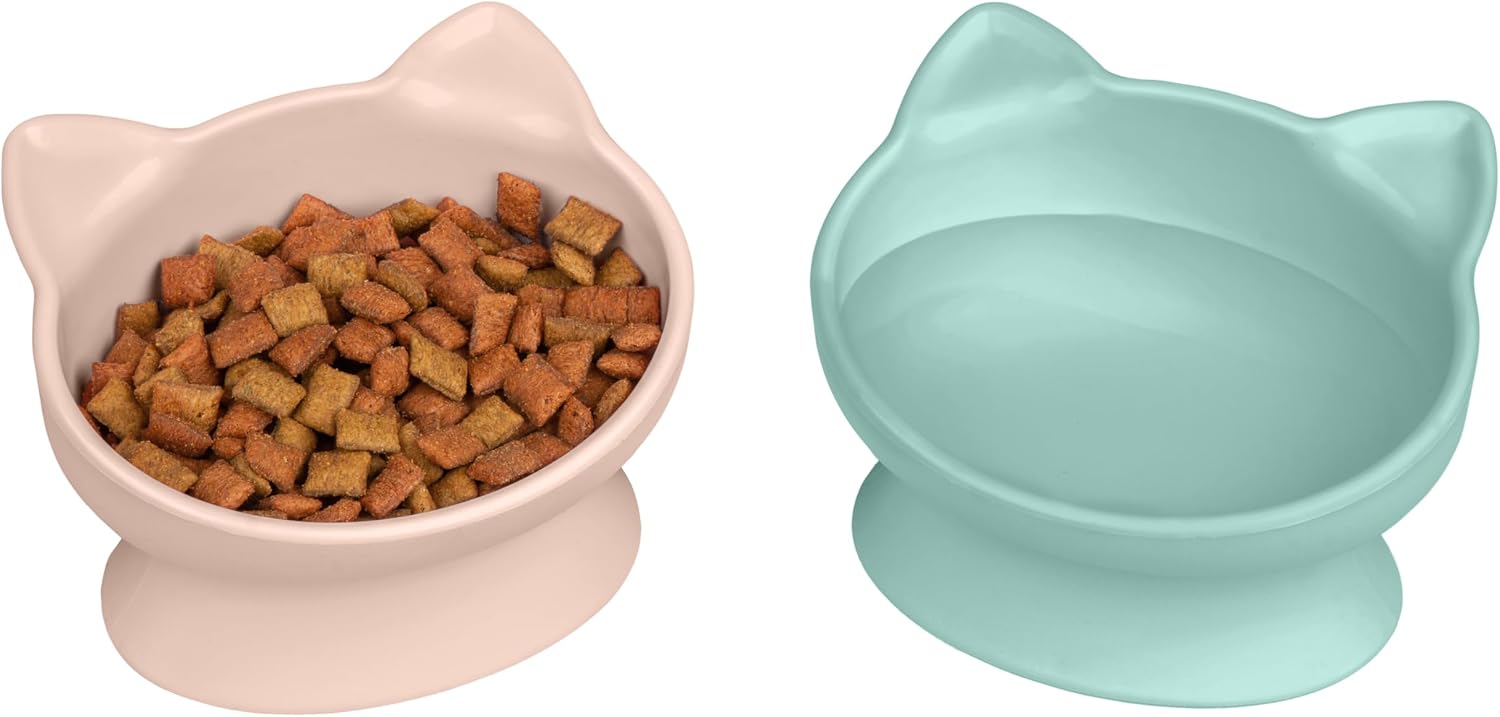
Kitty City Elevated Cat Bowls (Set of 2), Whisker-Friendly Raised Cat Food & Water Dishes, Modern Pedestal Design, Dishwasher Safe, 6.5 oz Each, Pink & Teal
Two dishes on one pedestal, listed at 6.5 ounces each. That is a small meal by design, and for portion work that is a feature rather than a limitation. If you are splitting a daily ration across three or four feedings, a small dish keeps you honest, because you cannot heap a whole day of food into it and call that one sitting.
The rims are wide and shallow rather than narrow and deep, which is the whisker clearance argument in physical form. A cat whose whiskers drag the sides of a narrow bowl eats the middle and walks away, and then you are weighing a portion the cat never finished, which throws off everything downstream. Dishwasher safe matters more than it sounds, too: a dish that is annoying to wash gets rinsed instead, and a greasy rim changes how the next portion settles.
Check current Amazon price.
Flaws but not dealbreakers: The water side is a single small dish, so a cat that drinks heavily will empty it by mid-afternoon. And 6.5 ounces is tight for a cat that eats one large meal a day rather than several small ones.
Multi-cat homes feeding small, frequent meals who want food and water at the same height should start here.
Our pick: Raised Cat Food Bowl Ceramic 15° Tilted Cat Food Bowls Protect Cat's Spine Anti Vomiting Backflow Prevention Bowls for Adult Kitty, Kitten, and Small Dogs, Pink
Our pick
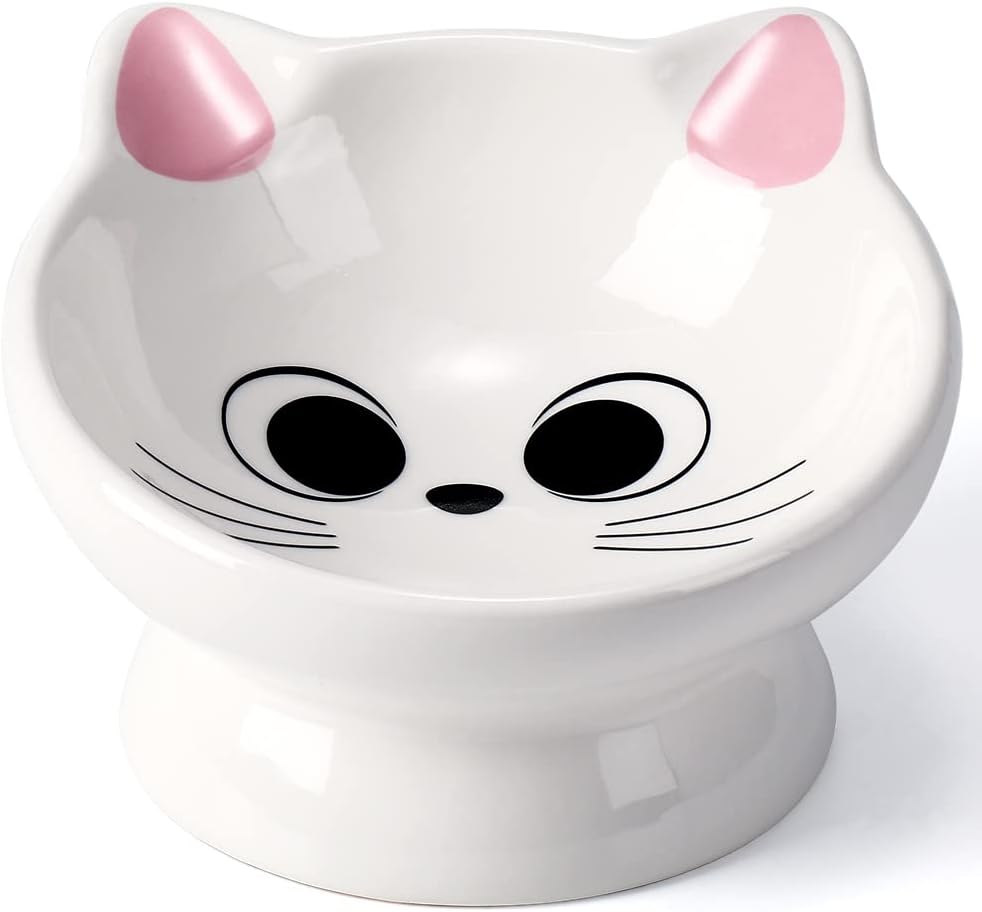
Raised Cat Food Bowl Ceramic 15° Tilted Cat Food Bowls Protect Cat's Spine Anti Vomiting Backflow Prevention Bowls for Adult Kitty, Kitten, and Small Dogs, Pink
A single ceramic dish with a 15 degree tilt. The listing's pitch is spine comfort and less backflow after eating. I will not tell you a bowl fixes vomiting, because a bowl cannot fix a medical problem. What the elevation angle does change is the posture a cat eats in, and cats that bolt their food and then bring it back up are the ones this shape is aimed at.
Ceramic is the reason to pick it over the pedestal set. It is heavier, so it stays where you put it, and a glazed surface does not hold onto oils the way a scratched plastic dish does, which matters when you are trying to keep the dish from smelling like last night's dinner. That weight is also what makes it easy to tare on a scale and fill without the dish sliding around.
Check current Amazon price.
Flaws but not dealbreakers: One bowl, not a set, so you are buying twice if you want a matching water dish. Ceramic chips if you drop it on tile, and a chipped rim is a cut waiting to happen.
Anyone with a cat that eats fast, eats flat to the floor, or needs a dish heavy enough to stay put should look here first.
Upgrade pick: Automatic Cat Feeder and Water, 5G WiFi App Control Cat Dry Food Dispenser
Upgrade pick
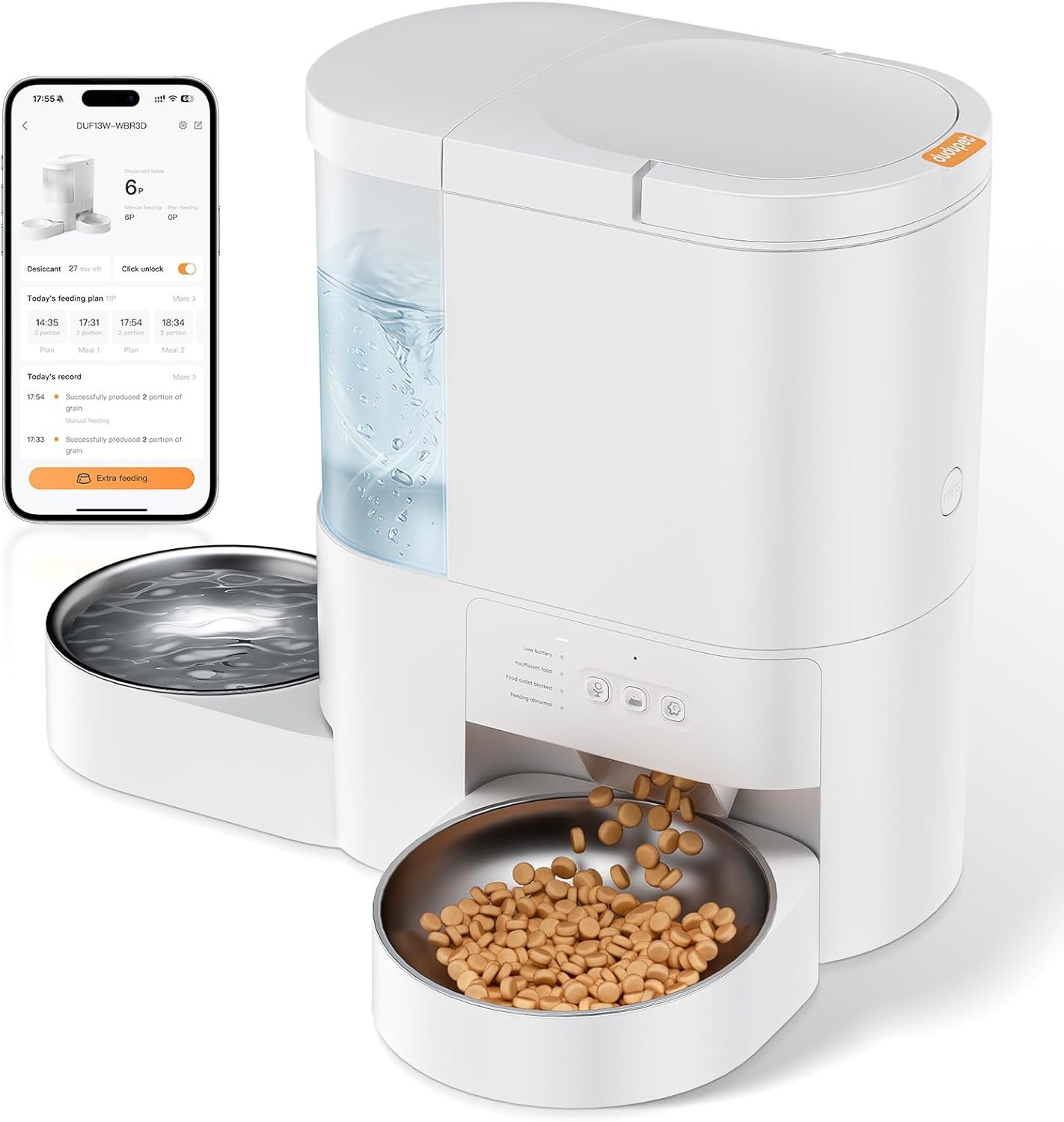
Automatic Cat Feeder and Water, 5G WiFi App Control Cat Dry Food Dispenser
This is the only item on the list that takes the measurement out of your hands. It is a WiFi dry food dispenser with app control, and it covers water as well, so you are not juggling a separate fountain to keep the other side of the station full. For portion work the app is the point: you set a portion size, you schedule the drop, and the feeder repeats it whether you are home or stuck in traffic. That is the difference between a plan and a habit.
The limits are the same limits this category always has. Most dispensers at this level portion by volume per drop rather than by weight, so the number in the app is a target and your kitchen scale is still the referee. It handles dry kibble, which means a wet food rotation still happens at the bowl. And a hopper full of food is a hopper that can go stale, so buy a size you will finish in a few weeks.
Check current Amazon price.
Flaws but not dealbreakers: App control means an account, a password, and a network that behaves. If your WiFi drops while you are away, the schedule is the thing you miss most.
Anyone who works long days, feeds several small meals, or wants the same portion delivered at 6 a.m. without setting an alarm should start here.
The actual portioning workflow
Here is the process, start to finish. It takes one evening the first time and about two minutes a day after that.
Step one: Weigh the cat, not the food. Everything starts with a number you did not guess. Stand on a bathroom scale holding the cat, then stand on it alone and subtract. Do that three days running and average it, because a cat that just ate or just used the box will swing the reading. While you are there, run your hands down the ribs. You should feel them under a thin layer of padding without pressing. That rib check matters more than the scale.
Step two: Find the calorie target. Most adult indoor cats land somewhere around 20 to 25 calories per pound of ideal body weight per day, with kittens, seniors, and very active cats sitting outside that range. Your vet can give you the number for your specific cat in one visit, and it is the cheapest part of this entire project. Write it down. A target you keep in your head is a target you will drift away from.
Step three: Read the calorie line on the bag, not the feeding chart. Every complete cat food prints calories, usually as kcal per kilogram and kcal per cup or can. That line is the only number on the package you actually need. The feeding chart beside it is a range built for an average cat, and the average cat does not live at your address. If the bag lists only kcal per kilogram, you can still work with it. You just need the weight of the food, which is the next step.
Step four: Convert calories into grams with a kitchen scale. Divide your cat's daily calorie target by the calories per cup or per kilogram to get the daily amount, then set the bowl on a digital kitchen scale, tare it, and weigh that amount. Grams are the unit that does not lie. A cup of one kibble and a cup of another can differ by a third in weight, and the scoop that came free in the bag is not a standard cup at all.
Step five: Measure the bowl you actually feed from. Fill the dish with the weighed portion and look at where the food line lands. A wide, shallow bowl shows you the portion at a glance, which is why bowl width and depth are worth paying attention to before you buy. A deep narrow dish hides the food at the bottom, and a cat that has to press its whiskers against the sides may leave a third of the meal behind, which quietly breaks every measurement you made. If the portion fills the bowl to the rim, the bowl is too small for the schedule you are running.
Step six: Split the daily total across meals on a clock. Two meals a day is the floor for most adult cats. Three or four is better for cats that beg, and kittens need more than either. Divide the daily weight by the number of meals so every serving is identical. This is the step where an automatic feeder earns its place, because the mid-afternoon meal is the one that gets skipped when you are at work.
Step seven: Count everything else that goes in the mouth. Treats, table scraps, the dog's leftovers, and the food you use to get a pill into the cat all come out of the same daily total. A small handful of treats can be a tenth of a cat's daily calories without looking like much on the counter. Water is separate: keep it fresh, keep it away from the food dish if your cat prefers that, and remember that a cat on dry food drinks far more than a cat on wet.
Step eight: Re-measure every two weeks and adjust. Weigh the cat again, check the ribs again, and move the daily amount by roughly ten percent in whichever direction the body condition tells you to go. Then write the new number down. A cat that gains steadily on a portion that was correct six months ago is a cat whose portion is no longer correct, and the only way to catch that is to keep measuring.
The competition and why it lost
Three products cannot cover every feeding setup, so here is what I left out and why.
Water fountains are the obvious missing category. A fountain solves water capacity in a way a bowl cannot, and plenty of cats drink more from moving water. It did not make this guide because the maintenance does not touch portion math. Pump noise and filter type are the two things that decide whether a fountain is worth owning, and neither one changes how many calories your cat eats. If you want one anyway, the best cat water fountains for picky drinkers covers the pump and filter question in detail.
Microchip feeders are the other gap. In a multi-cat house where one cat is on a diet and another is not, a feeder that opens only for a set microchip range is the only real answer, and no dish on this list will do it. I left them out because the good ones cost more than everything here combined, and because setting one up is a guide of its own.
Gravity feeders lost for a simpler reason: a hopper that refills itself is the opposite of measuring. Slow-feed mats lost too, because they change how fast a cat eats, not how much. And the pedestal set and the tilted ceramic bowl overlap enough that most homes need one or the other, not both.
What this all costs
The two bowls are the cheapest part of this list, and they cost roughly the same as each other. The automatic feeder is the one real purchase, and it is the one that changes your mornings. Check current Amazon price on each before you commit, because pricing in this category moves around.
The piece of gear doing the actual work is not on the list at all: a digital kitchen scale. If you do not own one, that is the first thing to buy, and it will outlive every bowl in this article. A cheap postal scale or coffee scale with one-gram resolution is enough.
Then there is the cost you do not pay in dollars. Twenty minutes once to find the calorie target and weigh a first portion. Two minutes a day to repeat it. A recheck every two weeks that takes about as long as it takes to pick up the cat. You do not have to size up cat food portions by feel once the target number and the scale are in place.
Over a year, the difference between eyeballing a scoop and weighing the food is the difference between a cat that holds its weight and a cat that slowly does not. The math is the easy part. The twenty minutes is the part people skip.
Do it once, write the number on the lid of the food bin, and let the scale do the arguing.