A senior dog rarely falls because he is clumsy. He falls because the kitchen floor is slick, the tailgate is a hop down, and the couch is a jump he still believes he can make. If you want to protect a senior dog from falls, you change the surfaces and the heights, not the dog.
This is how to protect a senior dog from falls in a house and a car you already own: three pieces of gear that carry the load, and an eight step routine you can finish over a weekend.
The four places a senior dog goes down are almost always the same. The side of the car. The top or bottom of the stairs. The hard floor around the food and water bowls. The edge of the bed or the couch. Three of those are height problems and the fourth is a traction problem, which means all four are fixable without a renovation.
Why you should trust me
I write about pet gear for a living, and I have spent the last several years outfitting a house for an aging dog who lost his confidence on the stairs before he lost the strength in his back end. I am not a veterinarian and I do not play one here. What I am good at is the boring part: reading a weight capacity label, checking whether a non slip backing actually grips a tile floor, and figuring out which gear a dog will really use on a Tuesday morning when nobody is watching.
The advice below comes from three places: my own house, the questions readers send after their dog's first bad landing, and the checklist my vet hands out for joint mobility and hip support in older large breed dogs. When those three disagree, I say so.
How I picked and how I tested
The three products here are not a list of everything a senior dog needs. They solve the specific falls I keep seeing: the jump out of a tall SUV, the step down from a lower car, and the scramble after a bowl that slides across a hard floor.
For the ramp and the steps I care about four things. Weight capacity, and whether it leaves real headroom above your dog's weight, because you want margin for the day he needs help. Ramp angle at the tailgate height it will actually be used at, since a ramp that is too steep is a ramp the dog refuses. Surface texture, because a smooth ramp with a pretty pattern on it is worse than no ramp at all. And folded size, because gear that does not fit in the cargo area stays in the garage.
For the bowl, I care about whether it moves. A senior dog on a slick floor who lunges after a sliding bowl is one bad step from a split. A heavy ceramic base with a slow feeder pattern inside solves two problems at once: it stays where you put it, and it slows the eating that makes a dog gulp air and then bounce around on a full stomach.
I also evaluate the dog, not just the gear. A senior dog with sore hips will use a ramp with a shallow angle and a wide walking surface. He will refuse a narrow one no matter how good the specs look. Watch your dog on the first three tries and believe what you see.
Gear that helps protect a senior dog from falls
Every fall I have watched came down to a transition: ground to car, floor to bed, standing to lunging. Here is what I would buy first, in the order that removes the biggest risks.
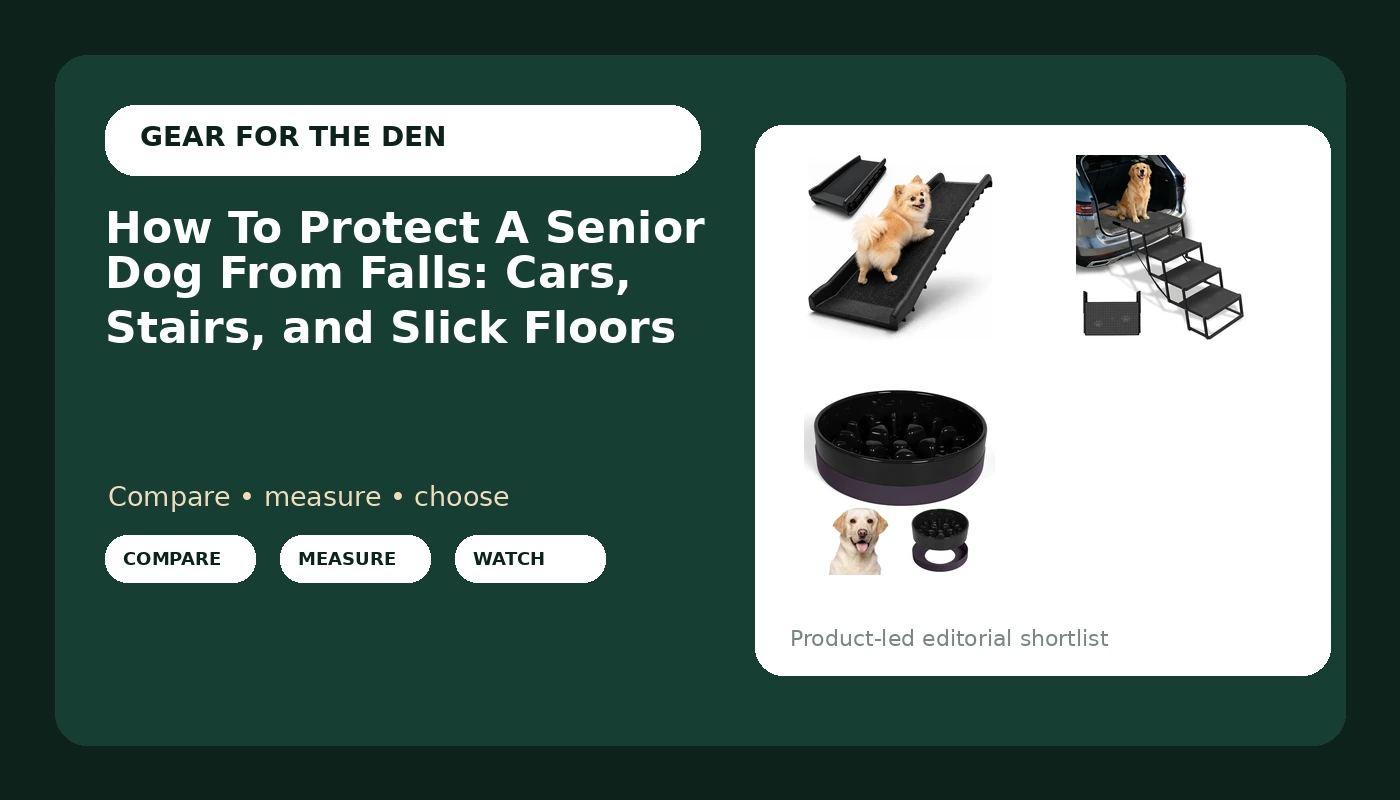
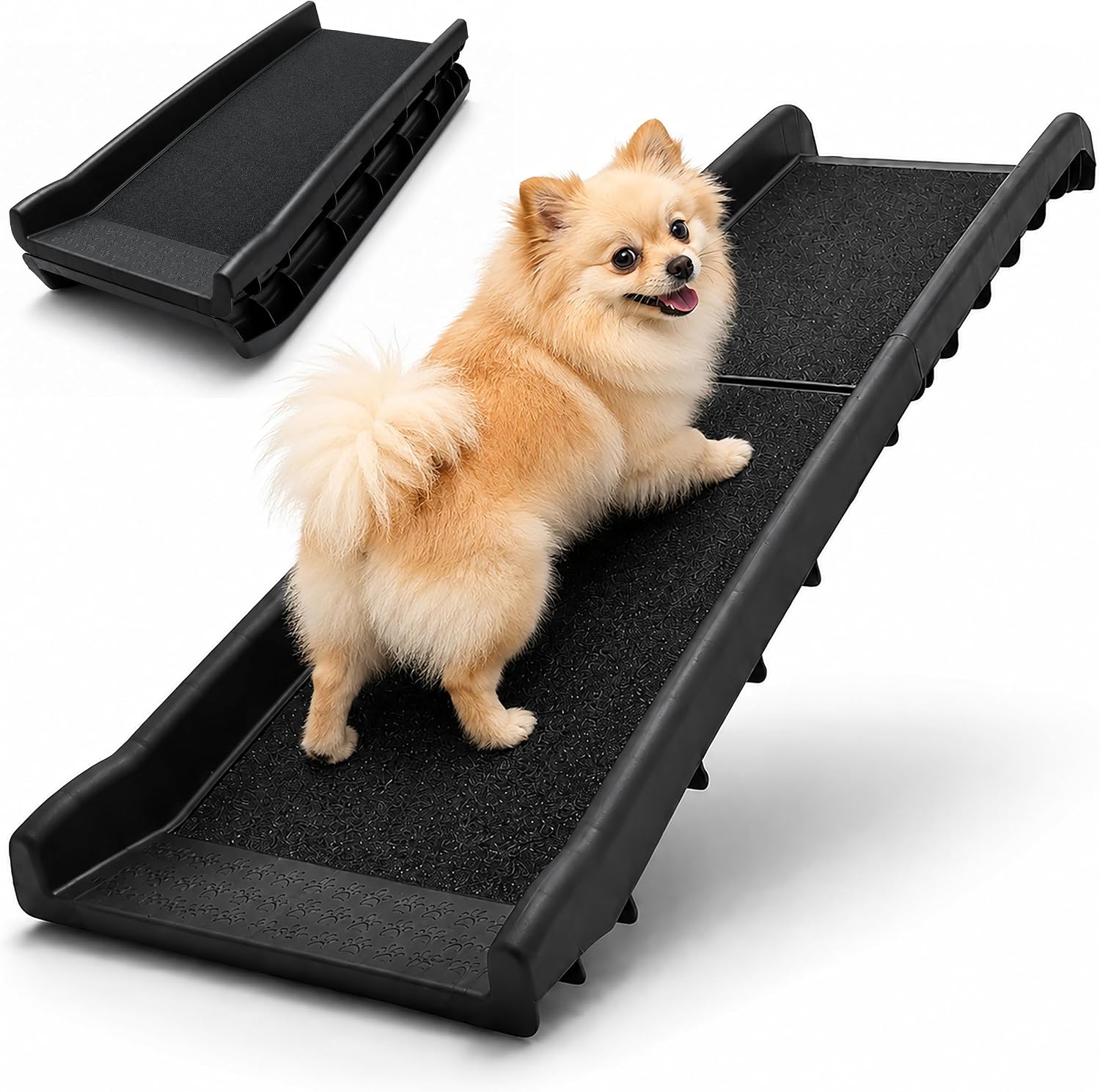
The ramp: Dog Ramp for Car, 62" Long & 16" Wide Portable Dog Ramps
The ramp
Dog Ramp for Car, 62" Long & 16" Wide Portable Dog Ramps
The ramp is the first thing I would buy for a large senior dog and a tall vehicle. Length controls ramp angle, and 62 inches is enough to keep the climb shallow on most SUV and truck tailgates. The 16 inch width matters more than people expect. A dog with weak hips drifts sideways on the way up, and a narrow ramp gives him nowhere to correct.
Portability is the other half of the job. A ramp that folds and lives in the cargo area is a ramp you actually use at the trailhead instead of lifting a big dog into the back seat. Check the listed weight capacity and leave yourself room above your dog's current weight, because over the next few years you will be lifting less and he will be carrying more.
Check current Amazon price. Keep it folded flat, keep the hinge area clean, and do not leave it sitting in standing water or full sun all summer.
Flaws but not dealbreakers: It eats cargo space when it is folded, and it needs a level spot to sit on. If your dog will not walk a plank, no ramp fixes that. Train it with treats in a parked car first.
Anyone with a large senior dog and an SUV or a truck should start here.
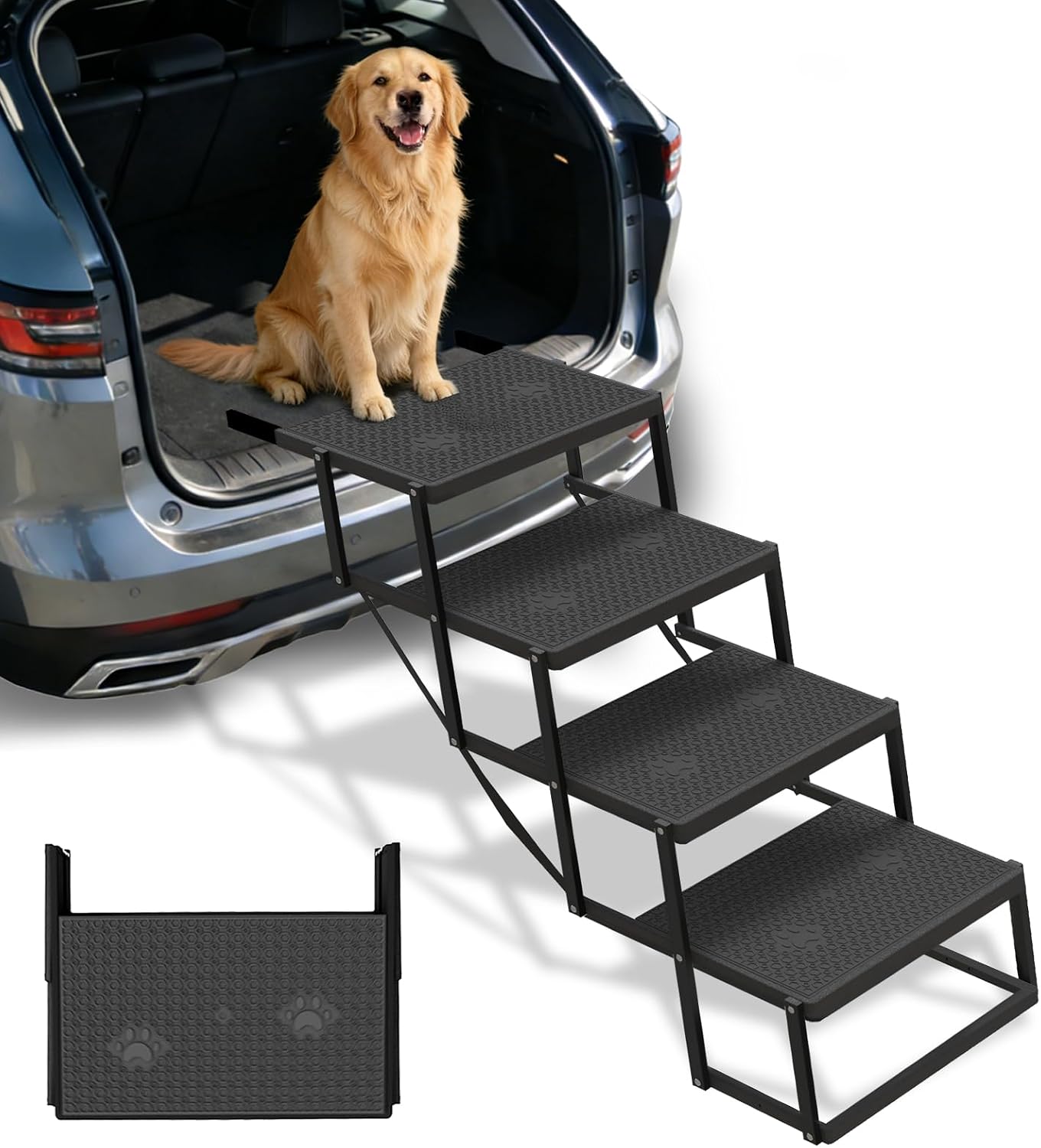
The steps: Dog Steps for Car, SUV with Upgraded Non-Slip Surface, 4 Steps
The steps
Dog Steps for Car, SUV with Upgraded Non-Slip Surface, 4 Steps
Steps are the better answer when the height is moderate: a car, a low crossover, the foot of a bed, the couch. Four steps divide the same climb into smaller rises, and each smaller rise is a shorter fall if the dog misses one. For a dog who can still lift a leg but has hip support trouble, steps feel more like a staircase and less like a balance beam.
The upgraded non slip surface on each tread is the feature to check first. Look for a texture that grips a paw pad even when the tread is wet, and a base wide enough that the whole unit does not tip when a big dog pushes off the second step. On thick carpet, a light set of steps can rock, so set it on a mat or a board.
Check current Amazon price. Fold it and stand it in the cargo area or beside the couch, wherever the dog needs it that week.
Flaws but not dealbreakers: Steps take up floor space and want a level, hard surface underneath. Carrying them up a flight of stairs to the car every morning gets old fast.
Anyone with a mid size or large senior dog and a normal car height should look here first.
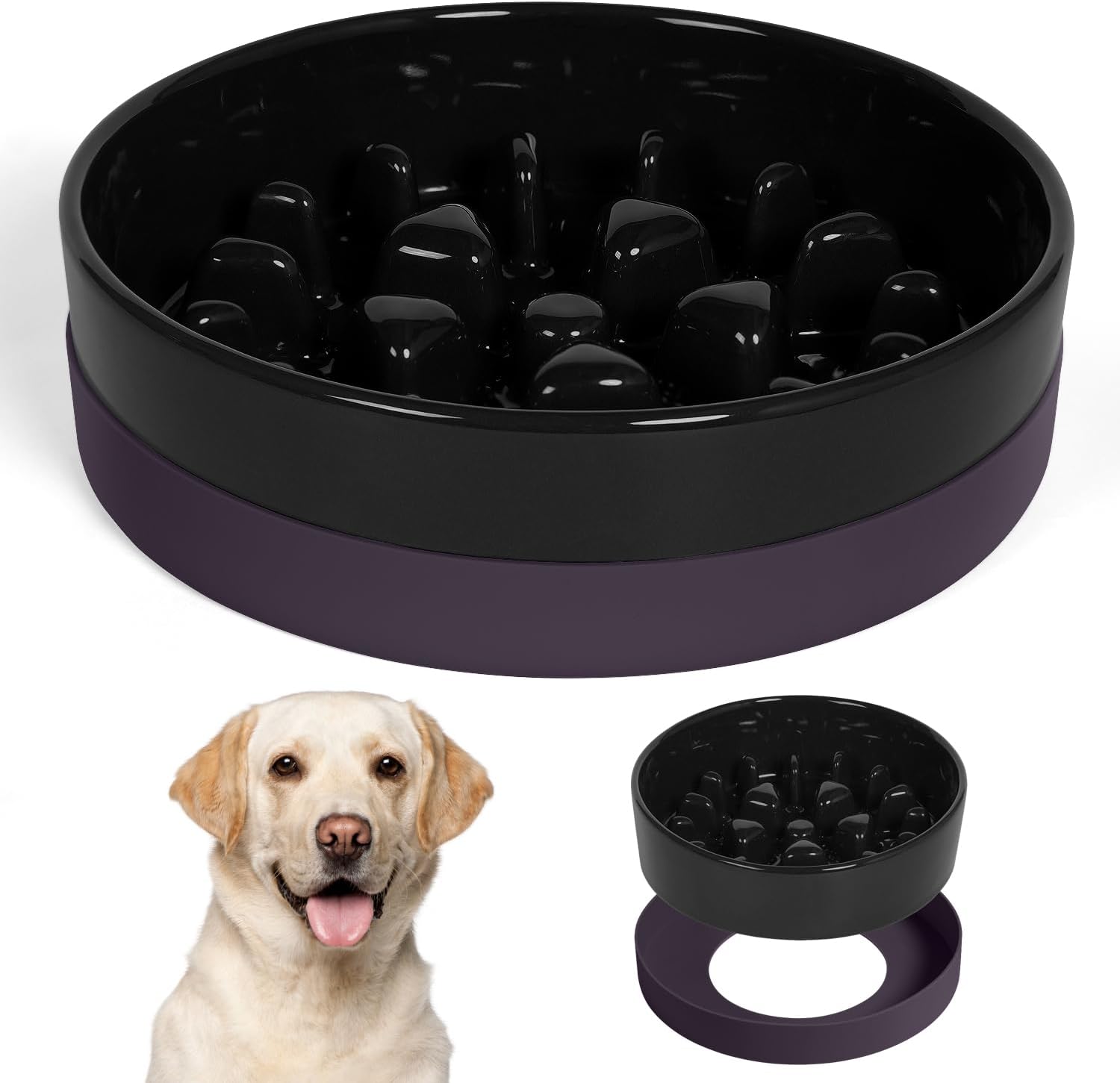
The bowl: Sted Ceramic Slow Feeder Dog Bowls for Medium Large Breed
The bowl
Sted Ceramic Slow Feeder Dog Bowls for Medium Large Breed
This one looks like the odd product in a fall prevention article until you watch a senior dog eat. A dog who gulps a meal in ninety seconds and then walks it off on a tile floor is a dog who is going to slip. A slow feeder stretches the meal out, and a ceramic bowl with weight in the base stays where you set it instead of skating across the kitchen.
Ceramic does not slide the way a light plastic bowl does, and the medium and large breed sizing means a big dog's muzzle is not shoving the bowl around the room to reach the last of the kibble. Keep it on a mat with a non slip backing and you have removed the dinner time scramble entirely.
Check current Amazon price. It is heavy, it is breakable if you drop it on tile, and it usually needs hand washing, which is the trade for a bowl that does not move.
Flaws but not dealbreakers: Slow feeders frustrate some dogs for the first week, and flat faced breeds struggle with deep patterns. For a deep chested large breed, the slower meal is the point.
Anyone feeding a large senior dog on a hard floor should own one.
Now the routine. None of the gear above does anything if the dog is still launching out of the car on Monday morning.
Step one: Map the four places he falls. Walk your normal day with a notebook. The car door. The top and bottom of the stairs. The kitchen floor around the bowls. The edge of the bed or the couch. Those four spots cause most of the falls I hear about, and each one has a different fix. Write down the surface, the height, and the time of day the risk is highest. A senior dog is most likely to go down when he is rushing, tired, or excited about dinner, and all three of those are predictable.
Step two: Get a baseline from your vet before you buy anything. Ask specifically about joint mobility, hip support, weight, pain, and nail length. Long nails change how a paw lands and make a slip more likely, and trimming them is free. Ask whether a harness with a handle or a belly sling belongs in your car kit, and ask what your dog's healthy weight is. Every purchase after this step gets easier because you know what you are working with.
Step three: Fix the floors before you spend money on anything with a hinge. Traction is the cheapest fall prevention there is. Runners on the path from the bed to the door. Mats under the bowls and at the bottom of the stairs. A rug with a non slip backing where he turns. Trim the fur between the paw pads so the pads can grip. If a floor is slick and you cannot cover all of it, put down a strip he can follow and teach him that it is his lane.
Step four: Match the gear to the height. Tall SUV or truck tailgate, go with the long ramp, because ramp angle is the number that decides whether a senior dog walks up or refuses. Lower car, low crossover, couch, or bed, go with the four step set, because each smaller rise is a shorter fall. Do not buy both on day one. Fix the vehicle he rides in most and watch how he moves for a week.
Step five: Train the route before you need it. Park in the driveway, engine off, and put treats on the ramp or the steps until the dog walks them on his own. Two weeks of short sessions beats one stressful morning in a vet parking lot, and a dog who has practiced the boring version will still use it on the day he is sore. Keep the leash on, keep a hand on the harness handle, and never let him launch off the top step even when he feels great. If you want a longer version of this, the same approach shows up in training a senior dog to use a ramp.
Step six: Get the bed height down. A senior dog who jumps down from the bed lands on the same joints every single morning. A low bed with a firm foam density supports the hips without letting the body sink, and a bed that bottoms out under a big dog is a bed that makes him work to stand up. Put steps or a small ramp at the couch and the bed, and stop the furniture launches even if he can still manage them.
Step seven: Change how he eats, and how much. Extra weight on a senior dog is extra load on every joint, so portion control and a slow feeder do more for fall prevention than most people expect. Feed on a mat instead of bare tile, split the meal if your vet recommends it, and keep water where he does not have to cross a slick floor to reach it. A stable bowl and a slower meal mean less gulping, less bloat risk, and less of the post dinner bouncing that ends in a slip.
Step eight: Recheck every month and after every season change. Weigh him, look at the nails and the paw fur, watch him rise from a down, and note anything new: a hesitation at the stairs, a wider stance, a reluctance to get in the car. Add a night light on the path he takes at 2 a.m., and put a mat at the door for wet paws. Keep the routine going in the good weeks, because that is when the habits get built for the bad ones.
The competition and why it lost
When readers ask how to guard a senior dog from falls, the honest answer is that it is a sequence, not a product. The gear that did not make this list is not bad gear. It is gear for a different job.
A harness with a lifting handle is one of the best fall prevention tools there is, and it belongs in a guide about lifting and supporting a senior dog, not in a piece about transitions. Same for a belly sling, which is a two person tool for the stairs and a rear end support for the car.
Toe grips and paw wax come up in every senior dog conversation, and they help some dogs on hard floors, but they are a maintenance item you replace, not a piece of gear you buy once. Stair gates solve the stairs by closing them off, which works until the dog needs water at night. Orthopedic beds answer a different question, which is pressure and rest, not the moment of the fall.
A dog stroller is the honest answer for a dog who can no longer walk the distance, and it is not a fall prevention product. The three items above each stop one specific fall. The ramp stops the jump from the tailgate. The steps stop the drop from a lower car or the couch. The heavy slow feeder bowl stops the scramble on the kitchen floor.
What this all costs
Here is the honest math. Three pieces of gear, all in the range of a single vet visit, and one of them is optional depending on what you drive. Check current Amazon price on each before you buy, because these listings move.
The ramp costs more than the steps, and the steps cost more than the bowl. If you want to start with one purchase, start with the surface your dog touches most. If he rides in a tall SUV every day, that is the ramp. If he slips on the kitchen floor at every meal, that is the bowl. If the couch is the problem, that is the steps.
Compare the cost to the alternative. A fall on a hard floor in an older large breed dog can mean an emergency visit, a radiograph, and weeks of rest, and it can also mean the end of the car rides he loves. The gear is not a guarantee against any of that. It just removes the transitions that cause most of it.
Spend your weekend on the routine, not the shopping cart. Map the four spots, get the vet baseline, cover the slick floors, then buy the single piece of gear that solves the biggest height in your dog's day. Do that, and you have done more to protect a senior dog from falls than any product on this page can do on its own.