A leopard gecko tank fails for boring reasons. Not because the animal is delicate, but because the heat gradient was flat, the UVB bulb was a guess, or the humid hide dried out while nobody was looking. When you set up a leopard gecko tank, you are not decorating a box. You are building three climates inside one footprint and trusting a thermostat to hold them.
Knowing how to set up a leopard gecko tank is mostly a question of sequence: glass, heat, light, hides, then the animal. Do it in that order and the first week is quiet. Do it out of order and you spend a month chasing a gecko that will not eat.
This guide covers the three pieces of gear that need a real decision, then walks the whole build in eight steps, from tank size to the first feeding. The goal is the ideal leopard gecko tank setup: not the most expensive one, the one the animal actually uses.
Why you should trust me
I have kept leopard geckos for years, in everything from a rack of 20-gallon longs to a single 40-gallon breeder for one adult, and the lessons that stuck came from the unglamorous parts: probe placement, substrate depth, and the difference between a thermostat reading the mat and one reading the air. Most of what people get wrong when they set up a leopard gecko tank happens before the animal ever arrives.
The care numbers in this guide, the basking temperature, the humidity range, the thermostat range, are the standard husbandry ranges keepers have converged on because they work. What I add is the order of operations. First tanks that go wrong are usually not missing gear. They are missing a sequence, and the animal pays for it with a bad shed, a stuck eyelid, or a hunger strike that runs three weeks.
I do not sell reptiles, I do not run a shop, and nobody paid me to like the three products below. I picked them because they solve the two real problems a leopard gecko tank has: aiming useful light at a small area, and replacing a bulb before it quietly stops working.
How I picked and how I tested
This is not a guide to which tank to buy. If you need that, the best reptile terrariums for beginners covers the enclosure itself. Here I looked at the lighting side of a leopard gecko tank setup, because that is where beginners tend to overspend in the wrong direction.
I compared the candidates on the specs that decide the outcome: socket and wattage rating, dome depth and reflector shape, UVB percentage, and whether a bulb physically fits the housing without hanging past the rim. I also checked the geometry that matters in a 36 by 18 enclosure, where the lamp sits over one end and the animal needs somewhere to escape the cone. Where a spec was not published, I left it out rather than guessing at it.
The numbers I trust are the boring ones. UVB output is a property of the lamp, not a promise about your tank: a screen top, distance, and reflector shape all change what reaches the gecko's back, which is why the placement steps below matter more than the percentage on the box. A 5.0 compact and a 10.0 compact are the same shape and a very different dose, and one of them is wrong for this species.
I ran the steps below in order on my own tanks, including the empty 48-hour temperature log, because the only honest way to check a build is to see whether it holds its gradient overnight with no animal in it.
The gear that makes a leopard gecko tank setup work
Three decisions, and only three, change the outcome of a leopard gecko tank setup: what holds the bulb, what the bulb emits, and how far it sits from the gecko. Everything else is swappable later.
Budget pick: BNOSDM Reptile Light Fixture,5.5 Inch Shallow Dome Reptiles Heat Lamp Fixture for UVB UVA Bulb,Heat Basking Bulb,Optical Reflection Heat Lamp Fixtures for Reptile Amphibian Tank Terrariums
Budget pick
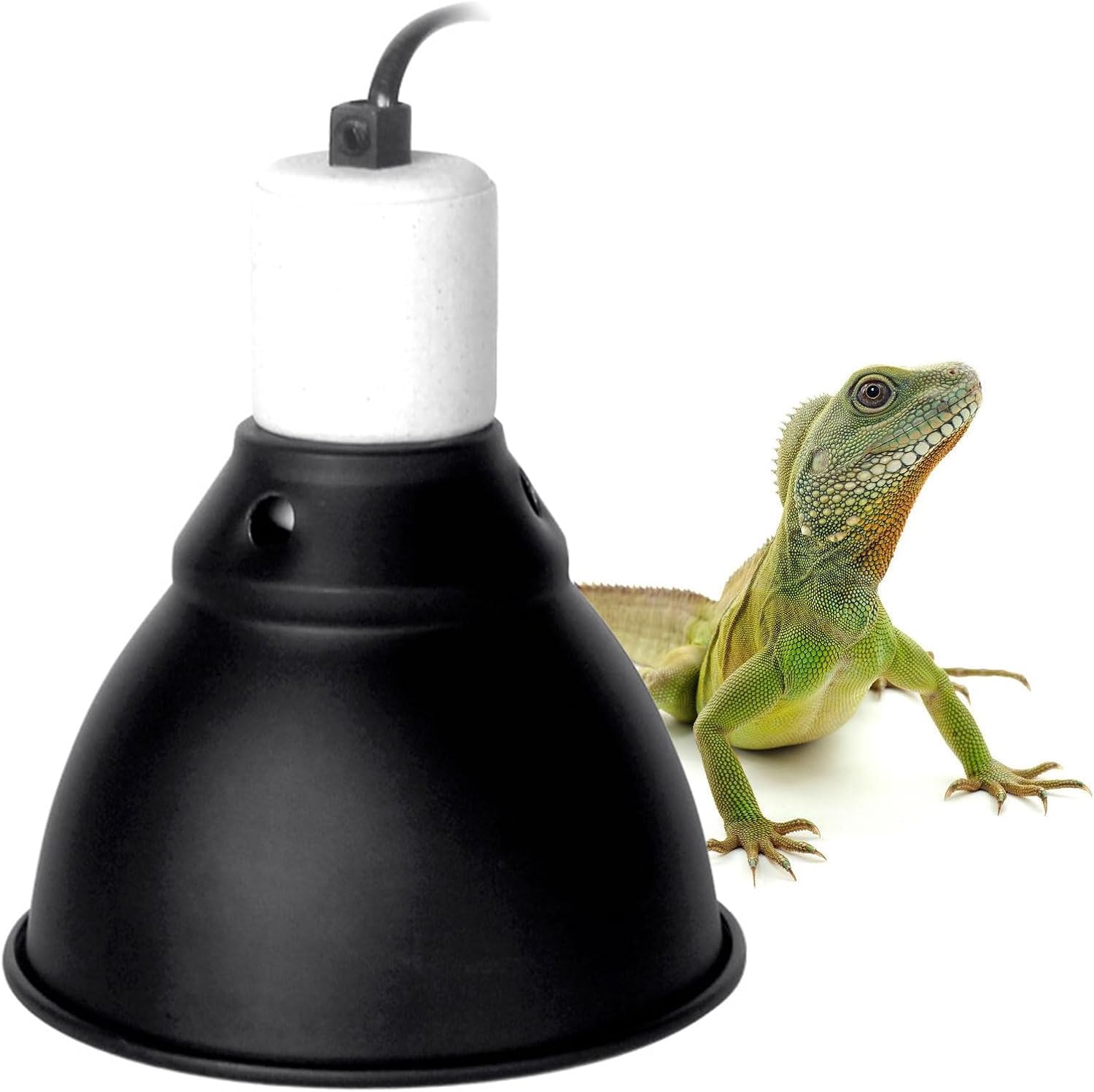
BNOSDM Reptile Light Fixture,5.5 Inch Shallow Dome Reptiles Heat Lamp Fixture for UVB UVA Bulb,Heat Basking Bulb,Optical Reflection Heat Lamp Fixtures for Reptile Amphibian Tank Terrariums
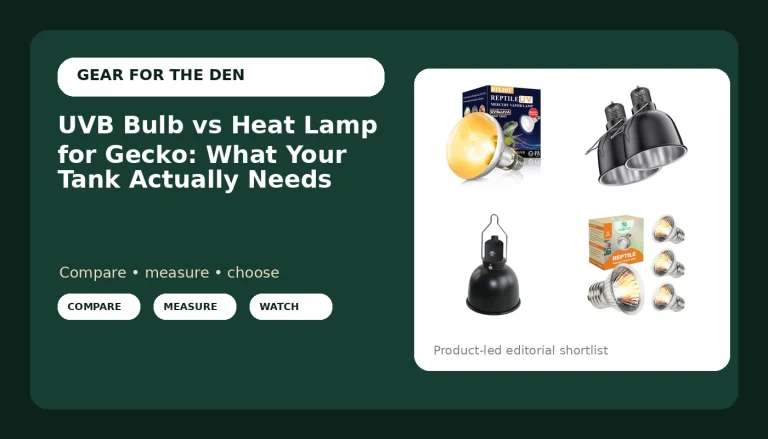
The housing is the piece people forget to budget for, and it decides whether you can aim a bulb at one end of the tank or just flood the whole thing with light. This is a 5.5 inch shallow dome with a reflective interior, which is the shape you want for compact bulbs in a 40-gallon breeder: shallow enough to throw a wide cone, domed enough to aim down instead of sideways. It takes the heat and UVB bulbs this guide uses, and the shallow profile keeps the lamp out of your way when you reach in for a water bowl. Check current Amazon price.
Flaws but not dealbreakers: a shallow dome gives you less reach than a deep dome, so a tall enclosure may need a lamp stand to hit the right distance. The finish is thin and will look scuffed after a season. The ceramic socket, which is the part that actually matters, is the part that holds up.
Anyone setting up a single 20-gallon long or 40-gallon breeder who wants one housing for both a basking bulb and a compact UVB lamp should start here.
Our pick: Jugbuy UVB Reptile Light Bulb 5.0, 23W UV Spiral Compact Florescent Terrarium Lamp Ideal for Tropical Reptiles Bearded Dragon Hermit Crab Turtle Leopard Gecko Tank Chameleons Iguanas Snake – 2 Pack
Our pick
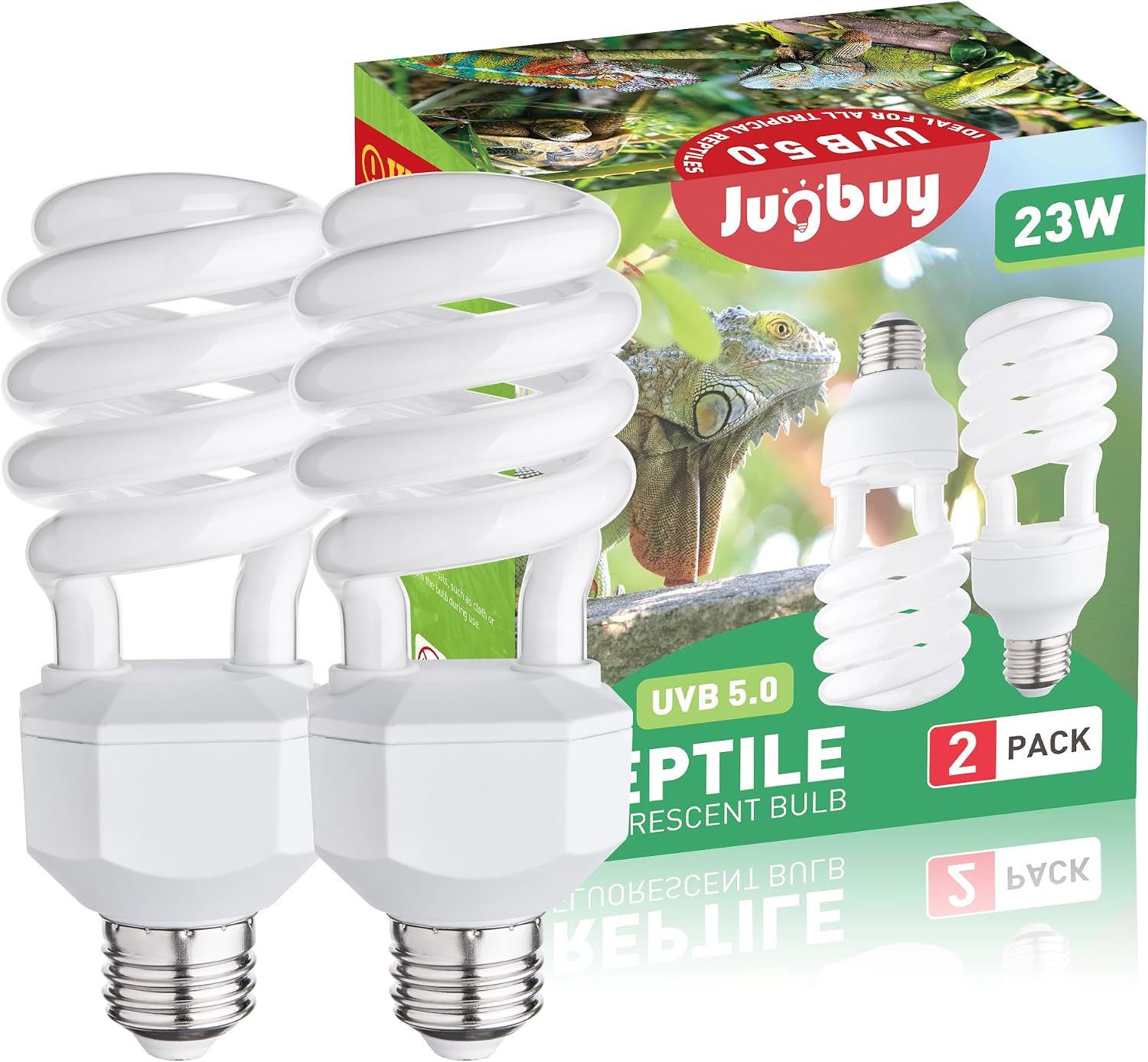
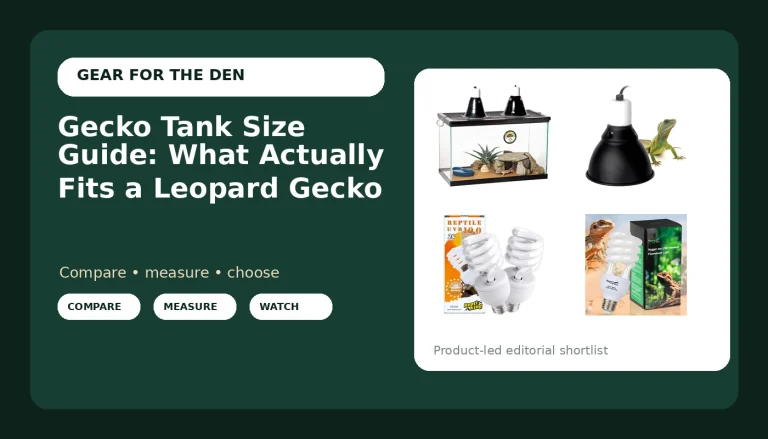
Jugbuy UVB Reptile Light Bulb 5.0, 23W UV Spiral Compact Florescent Terrarium Lamp Ideal for Tropical Reptiles Bearded Dragon Hermit Crab Turtle Leopard Gecko Tank Chameleons Iguanas Snake – 2 Pack
This is the bulb I would put over a leopard gecko, and the reason is behavioral. Leopard geckos are a low-exposure animal in the wild: they spend daylight hours under cover and come out at dusk, so the goal is a gentle gradient they can choose, not a desert blast. A 5.0 compact is the right class of lamp for that job, and a two-pack matters more than it sounds, because UVB output fades long before the lamp stops glowing. Having a spare in the drawer means you swap on schedule instead of guessing. Check current Amazon price.
The 23W spiral drops into the shallow dome above without overhang, which keeps the whole rig compact. The catch with any spiral compact is the shape of the beam: the useful UVB comes out in a narrow cone, so placement distance and a reflector do most of the work. Mount it over one end, keep the far end shaded, and give the gecko a hide it can retreat into. A UVB meter is the only way to know your real numbers, so if you do not own one, follow the manufacturer's distance chart and let the animal choose its exposure.
Flaws but not dealbreakers: spiral compacts do not spread UVB as evenly as a linear tube, so a very wide enclosure will have a hot spot and a dim corner. Replace on schedule rather than waiting for a visible change, because a spent UVB lamp still looks lit.
Anyone who wants low-level UVB over a leopard gecko, or over another crepuscular species in a 20 to 40-gallon tank, should start here.
Upgrade pick: ReptiKing UVB Reptile Light, 2-Pack 10.0 24W UVB Bulbs, UVA UVB Reptile Light Bulb Lamp for Bearded Dragon, Tortoise, UV Bulbs for Desert Reptiles Tank Accessories
Upgrade pick
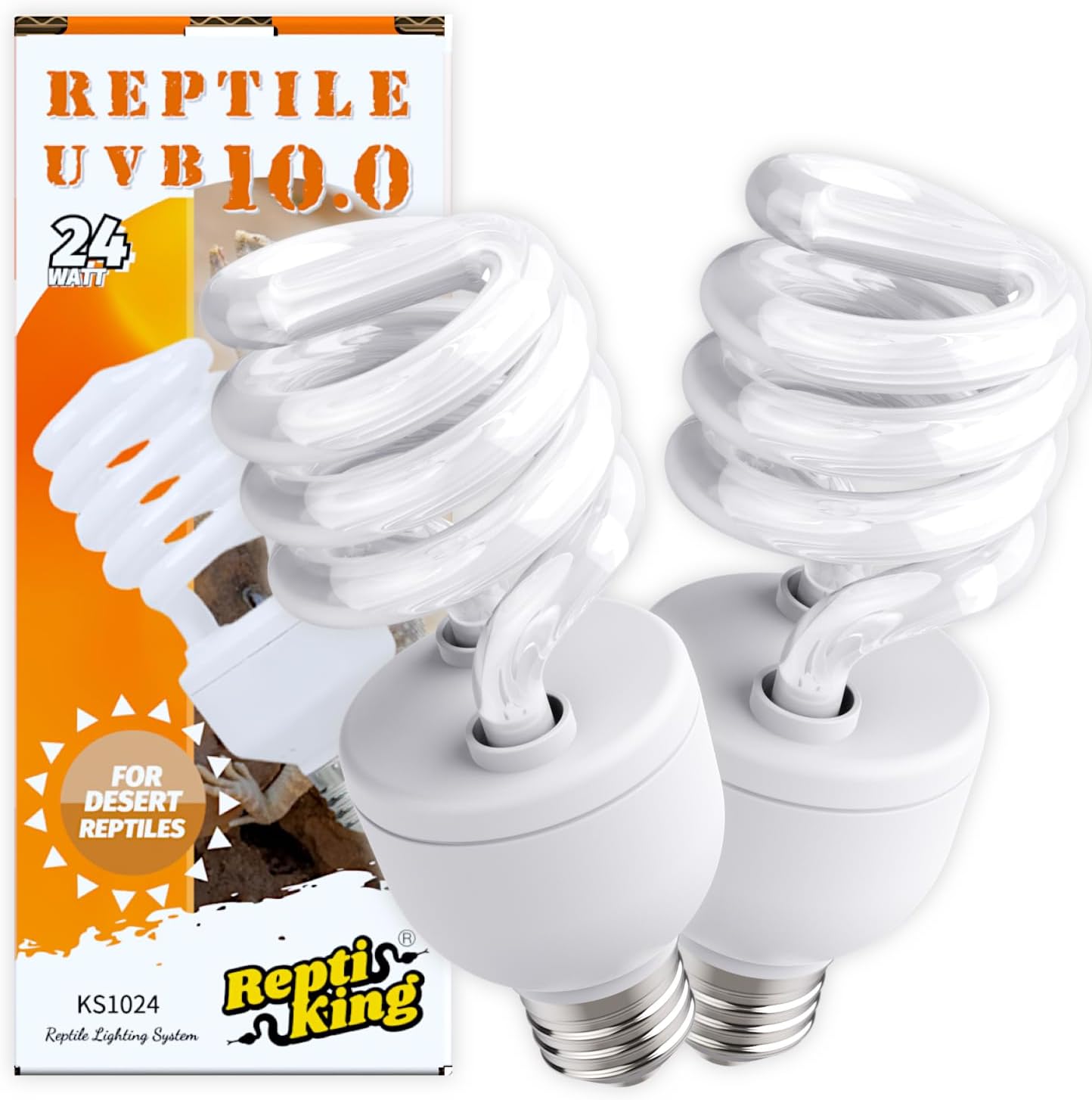
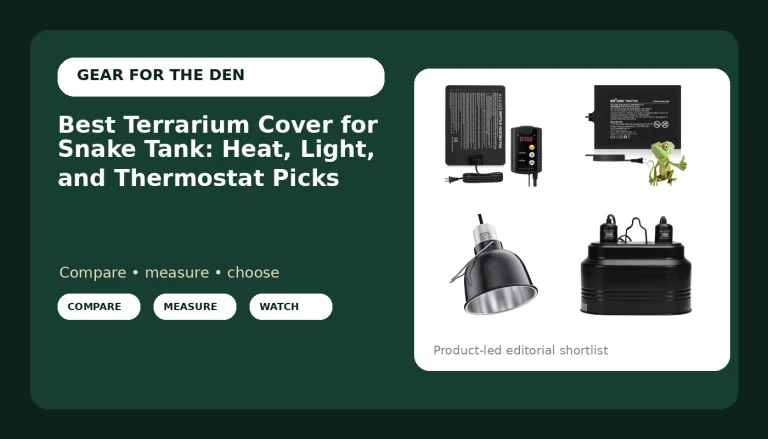
ReptiKing UVB Reptile Light, 2-Pack 10.0 24W UVB Bulbs, UVA UVB Reptile Light Bulb Lamp for Bearded Dragon, Tortoise, UV Bulbs for Desert Reptiles Tank Accessories
Be honest about why you would buy this one. A 10.0 lamp is desert-strength: it is the right bulb over a bearded dragon or a tortoise, and it is too much lamp for a leopard gecko mounted close. The situations where it earns a place in this guide are narrow and specific. If your enclosure is tall enough that a 5.0 would deliver almost nothing by the time it reaches the floor, the stronger lamp with the longer throw is the better tool. If you keep a mixed collection, one spare that serves the desert tank as well as the gecko tank is worth having.
What it does well is headroom. Two bulbs per pack, 24W each, same compact footprint as the 5.0, so it fits the same shallow dome and hangs at the same distance. That means you can dial exposure by moving the fixture rather than buying new hardware, and if you later add a desert species you already own the lamp. Check current Amazon price.
Flaws but not dealbreakers: the strength is the flaw. Put this over a leopard gecko at compact-bulb distance and you are asking a shy, low-exposure animal to sit under something it would avoid in the wild. Use it high, use it over a screen, and watch the animal's behavior for the first week.
Anyone running a desert setup, or a tall leopard gecko enclosure where the lamp has real distance to cover, is the right buyer.
How to set up a leopard gecko tank: the workflow
Here is the order I use, and the order matters as much as the gear. Each step assumes the one before it is finished.
Step one: Tank size and placement. A 20-gallon long is the floor for a juvenile, and a 36 by 18 by 18 front-opening enclosure is the honest target for an adult. Tank size sets everything downstream: how much floor you have to heat, where the hides fit, and how far the lamp has to throw. Put it on a stable surface away from a window, because direct sun through glass turns a controlled setup into an uncontrolled one.
Step two: The heat gradient. A leopard gecko needs a warm end and a cool end, not one temperature. Under-tank heat is the base layer, so size the heat mat wattage to roughly a third of the floor and run it on a thermostat, never straight into the wall. Tape the probe to the mat surface or sandwich it just above, and set the thermostat range so the warm floor sits in the low 90s Fahrenheit while the cool floor stays in the mid 70s. That thermostat is not an accessory. It is the difference between a warm gecko and a cooked one.
Step three: Substrate depth. Start on paper towel for the first few weeks. You need to see droppings and you do not want to guess about impaction while an animal is settling. Once it is eating and passing waste normally, move to a soil and sand mix and build substrate depth of two to four inches at the warm end. Depth is what lets a leopard gecko dig, and digging is how a settled gecko behaves. Skip calcium sand entirely.
Step four: Hides, three of them. Hide size is the mistake people make: a hide should be snug enough that the gecko touches the walls when it turns around. One hide on the warm side, one on the cool side, and one humid hide in the middle packed with damp moss or paper towel. The humid hide is what keeps sheds clean around the toes and eyes, and it is the one thing in the tank you check every couple of days. Keep the tank humidity range in the low 30s to low 40s percent, with the humid hide locally much higher.
Step five: Water and calcium. A shallow water dish the gecko cannot tip or drown in, refreshed daily, plus a bottle cap of calcium without D3 left in the tank. Both go on the cool side. There is nothing to optimize here, which is exactly why people overthink it.
Step six: Light and UVB output. Now the gear from above goes in. Fit the compact bulb into the shallow dome, hang or clamp it over one end so the cone overlaps the warm side, and follow the manufacturer's distance chart for the bulb you bought. Set a photoperiod of about 10 to 12 hours on and 12 to 14 off. UVB output falls off with distance and through screen mesh, so when in doubt, mount the lamp lower and offer more cover rather than buying a stronger bulb.
Step seven: Run the tank empty for 48 hours. Before any animal goes in, plug everything in and log temperatures at the warm floor, the cool floor, and the air in the middle, morning and evening. Adjust the thermostat, not your patience. You are checking that the gradient holds overnight when the room cools down, because a tank that only works at two in the afternoon is not a working tank.
Step eight: The first two weeks. Add the gecko at the start of a quiet evening. No handling for the first week, small prey every other day, and a look at every dropping. If the gecko is eating, basking, and using all three hides by day ten, the build is done. If it is parked in the cool corner and refusing food, the usual culprits are a basking temperature that is too low or a hide that is too big, and both are fixes, not failures.
The competition and why it lost
Deep dome fixtures lost on geometry. They throw a narrower, hotter cone, which is useful in a tall screen-top enclosure and awkward over a 40-gallon breeder where you want a wide basking area rather than a spotlight. The shallow dome above does the job this species needs.
Linear T5 HO fixtures are the better long-term UVB answer for a big enclosure, and they are also a bigger commitment: a reflector, a controller, and a tube that has to be replaced on schedule. For a single leopard gecko in a 20 to 40-gallon tank, the compact route is cheaper and simpler, and the animal does not care which one you chose.
Mercury vapor bulbs lost for a different reason. One bulb doing heat and UVB sounds efficient until you realize you cannot dim it, so you cannot tune the basking temperature without changing the UVB dose at the same time. Two separate controls beat one compromise.
Heat rocks lost because they fail the basic test: they heat from a single point, they have no thermostat, and they are the classic burn injury in this hobby. A heat mat on a thermostat costs less and does the job properly. If you want the fuller picture on mats and controllers, the heat mat and thermostat guide goes deeper than this article needs to.
What this all costs
To set up a leopard gecko tank you are buying three things here, and the housing is the least expensive of the three. The two bulb packs land close enough to each other that price is not the deciding factor; the deciding factor is whether you are lighting a leopard gecko or a desert species, and buying the wrong one costs more than the gap between them.
Then there is the invisible list, the gear nobody puts in a starter kit photo: a thermostat, a heat mat, a digital thermometer and hygrometer pair, and a temp gun if you want to check surfaces without waiting on a probe. Add a spare bulb, because UVB output fades before the lamp dies, and plan on replacing it at least once a year. A two-pack is roughly a year of light, which is why I keep pointing at the packs instead of single bulbs.
The math is not the hard part. The hard part is the sequence: tank size, heat gradient, substrate depth, three hides, water, light, a 48-hour empty run, and then the animal. Do those in order and your first month with a leopard gecko is quiet. Skip the empty run and you will spend that month troubleshooting a problem you created in an afternoon.
That is the job. The gear is simple. The order is what makes it work.