Most dogs eat dinner in ninety seconds, which is exactly the problem you solve when you start a dog on a puzzle feeder. It is also why so many feeders end up on a shelf after a week. The gear is rarely the hard part. The introduction is.
This guide is the sequence I use to introduce a feeder without turning mealtime into a frustration test. You do not need a shelf of new equipment before the first meal. You need one feeder that matches your dog's eating speed and jaw size, a handful of high-value treats, and eight steps you can spread across about two weeks.
If you are wondering how to start a dog on a puzzle feeder when your dog already inhales a bowl in under a minute, the answer is slower than the marketing suggests and simpler than it looks. Puppies, seniors, flat-faced breeds, and dogs on prescription diets can all learn this, but the ramp looks different for each of them.
Why you should trust me
I have fed my own two dogs out of slow feeders and puzzle bowls for years, and I have run the same introduction sequence with the foster dogs that come through my house. I have watched one dog solve a level-four puzzle in four minutes, and I have watched a different dog give up on level one because the pockets were too deep for his muzzle. That second dog is the reason this guide starts where it starts.
I write the dog feeding gear coverage here at Gear for the Den. I do not sell feeders, and when a bowl is wrong for a dog I say so in the same paragraph where I recommend it.
How I picked and how I tested
Picking a puzzle feeder is mostly a math problem about your dog, not a shopping problem about you. I checked three things first: bowl capacity against the size of the actual meal, feeding height against the dog's muzzle and neck, and the depth of the slow feed ridges against how fast the dog normally eats.
Then I ran the same eight step sequence with all three feeders below, first with my own dogs and then with fosters of different sizes and temperaments. I watched how long each dog stayed engaged, whether they pawed or nose-pushed, and whether they walked away. A feeder that made a dog quit lost points, no matter how clever the design was.
For the treat puzzle, I also checked whether a dog could tip it over and dump the food in one motion, because that is the fastest way for a puzzle to stop being a puzzle. For the two bowls, I checked the non slip base on tile and on hardwood, whether the inserts came out without a tool, and whether the whole thing was dishwasher safe, because a feeder that is annoying to clean gets retired faster than one that is annoying to load.
The rules I apply here are the same ones in my guide to slow feeder bowls for large dogs: easy first, short sessions, and more difficulty only when the dog is winning.
The gear you need to start a dog on a puzzle feeder
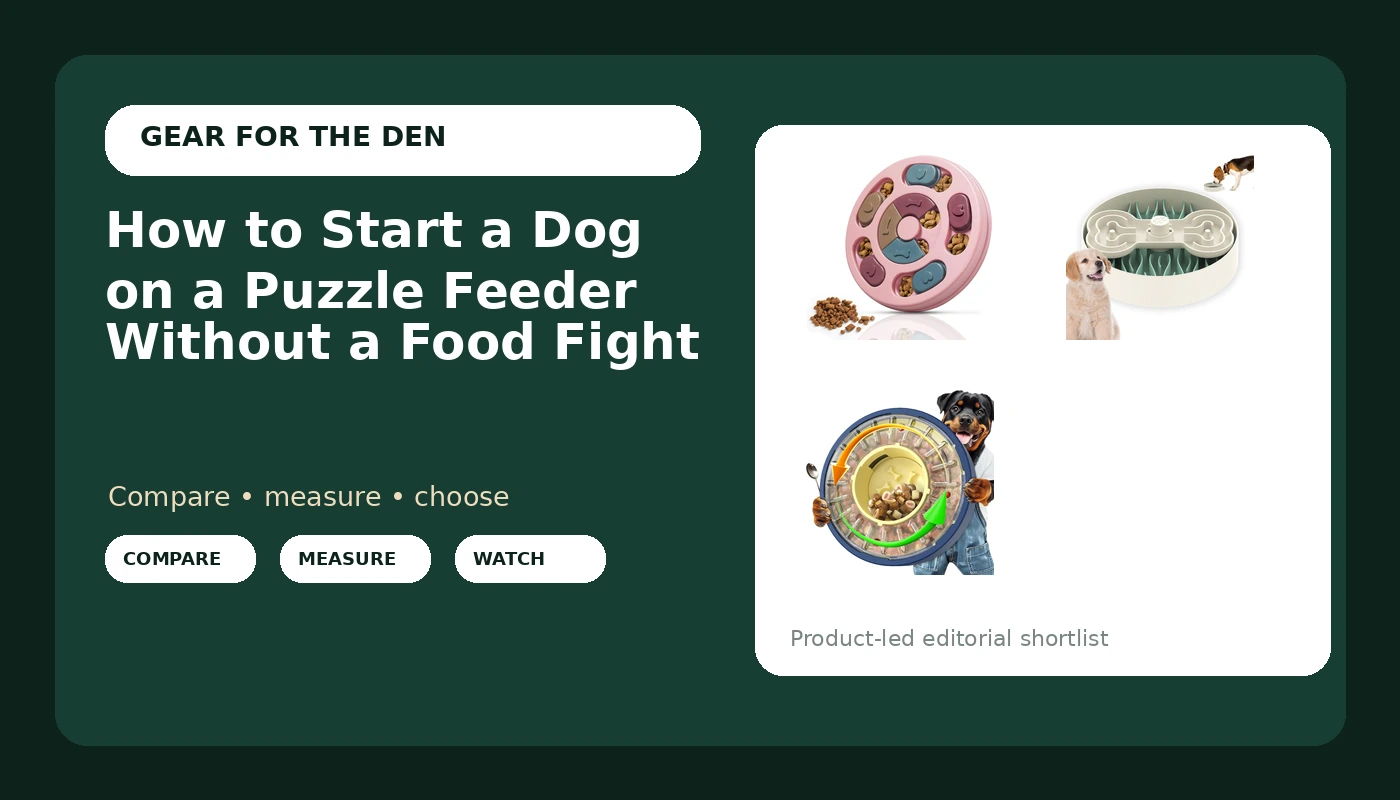
Three feeders cover the whole ramp. One is a treat puzzle for the very first sessions, one is a full meal bowl for a dog that needs to eat slower every single day, and one lets you dial difficulty up and down without buying anything else.
Starter pick: DR CATCH Dog Puzzles,Dogs Food Puzzle Feeder Toys for IQ Training & Mental Enrichment,Dog Treat Puzzle(Pink)
Starter pick
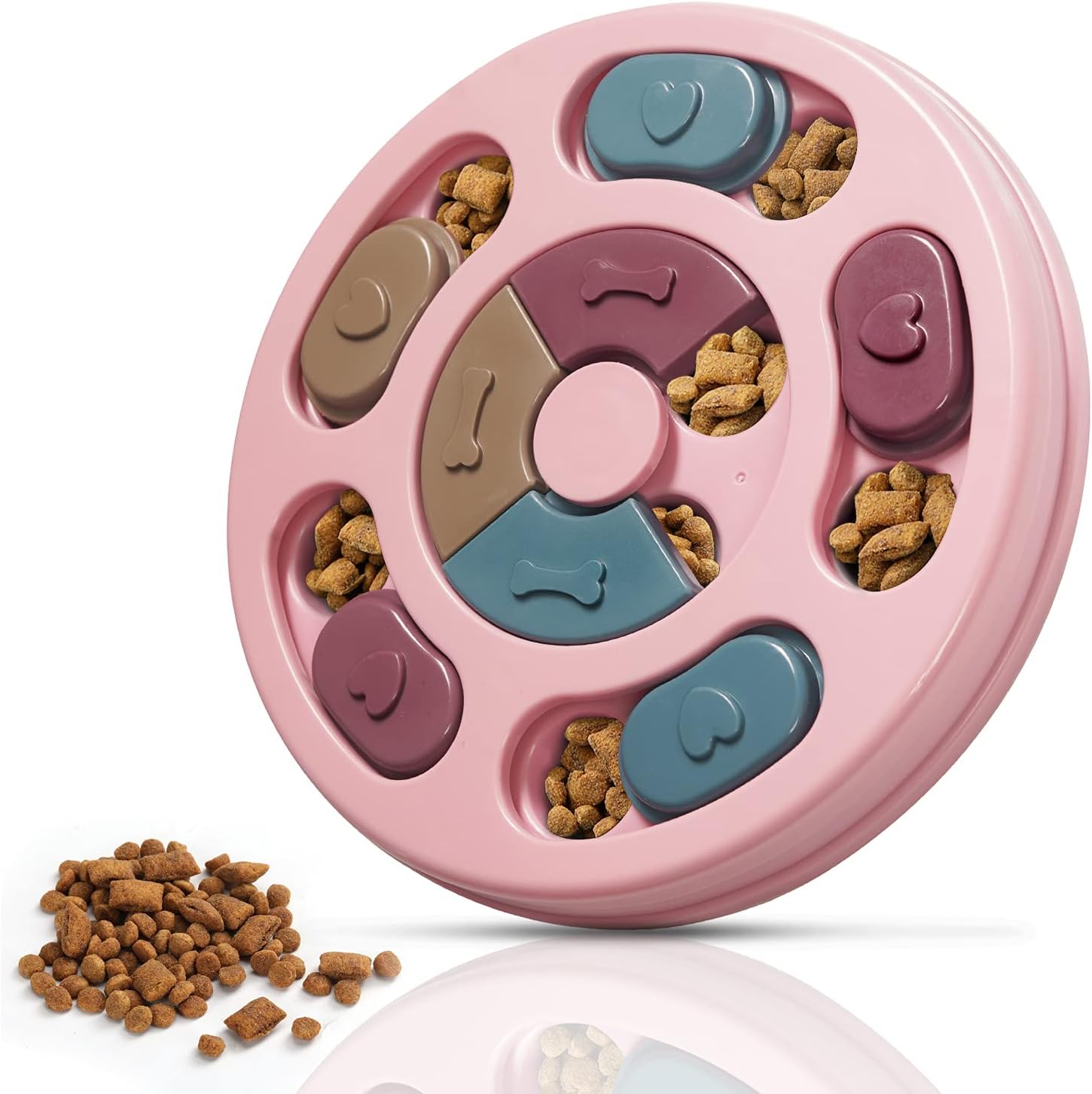
DR CATCH Dog Puzzles,Dogs Food Puzzle Feeder Toys for IQ Training & Mental Enrichment,Dog Treat Puzzle(Pink)
Check current Amazon price.
This is the one I hand to an owner whose dog has never worked for food. It is a treat puzzle, not a meal bowl, and that distinction matters: you load a few high-value treats instead of dinner, so a failed attempt costs nothing and the dog is not skipping a meal while it learns. Because the capacity is small, it suits a first session or a midday brain game rather than a full feeding.
The pink shell is easy to spot on a dark floor, which sounds trivial until you are hunting for it under a couch. It is the least expensive of the three feeders here, which makes it the low-risk entry point if you are not sure your dog will engage at all. Use it for the first three or four sessions, then move to a bowl once the dog understands the game.
Flaws but not dealbreakers: Treat puzzles hold treats, and a large dog can empty one in a couple of minutes once it learns the trick. That is fine for enrichment and useless for slowing a gulper's dinner. If the goal is a slower meal, you need one of the two bowls below.
Anyone with a puppy, a small dog, or a nervous adult that needs convincing that working for food is fun should start here.
Our pick: Puzzle Feeder Slow Feeder Dog Bowl for Large Dogs with Non-Slip Base – Adjustable Speed Design, Removable Puzzle Inserts & Dishwasher Safe, Green
Our pick
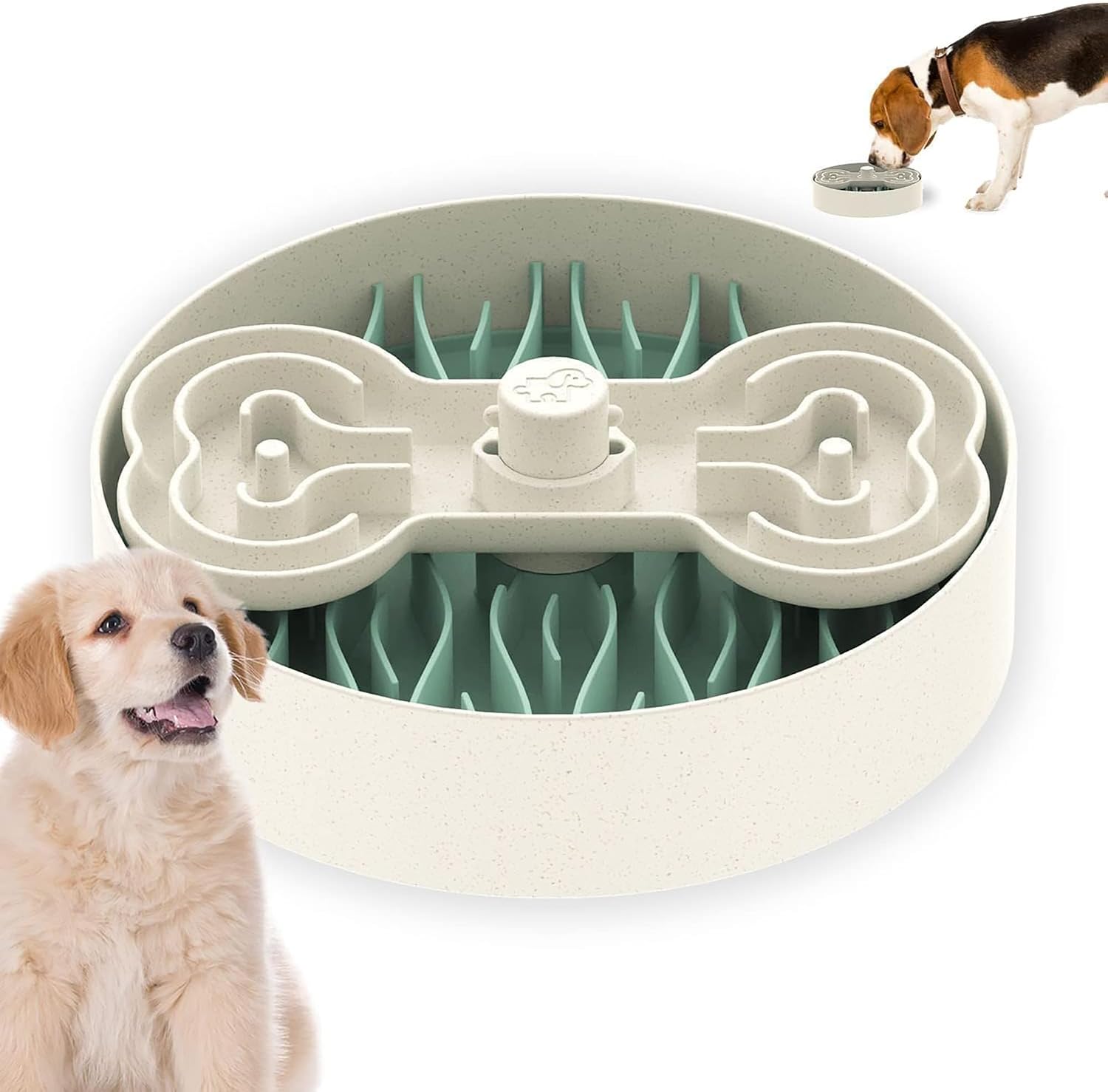
Puzzle Feeder Slow Feeder Dog Bowl for Large Dogs with Non-Slip Base – Adjustable Speed Design, Removable Puzzle Inserts & Dishwasher Safe, Green
Check current Amazon price.
This is the bowl I recommend when a large dog needs to eat a full meal more slowly. The adjustable speed design is the feature that earns its place: you can start with the inserts arranged for an easy meal and rearrange them as the dog gets faster, so you are not buying a new bowl at every difficulty level. The removable puzzle inserts come out so the bowl can be loaded, washed, and reassembled without a tool.
The non slip base is the quiet hero. A big dog pushing a bowl across a tile floor is how feeders get flipped and meals get inhaled off the ground. The dishwasher safe construction matters just as much, because a slow feeder you have to scrub by hand twice a day ends up in the back of a cabinet.
For a large dog, bowl capacity is the number to check before you buy. A bowl that holds less than one meal means you are refilling mid-meal, which defeats the point.
Flaws but not dealbreakers: The green bowl is wide, so it takes up real floor space and it will not fit in a tight feeding corner or a travel bag. The insert pattern is also fixed in shape, so a dog with a very short muzzle may need the easiest arrangement longer than you would like.
Anyone with a large or giant breed that eats a full meal in under two minutes should look here first.
Upgrade pick: KADTC Adjustable 5-60 Min Slow Feeder Dog Bowl & Puzzle Feeder Anti-Gulping
Upgrade pick
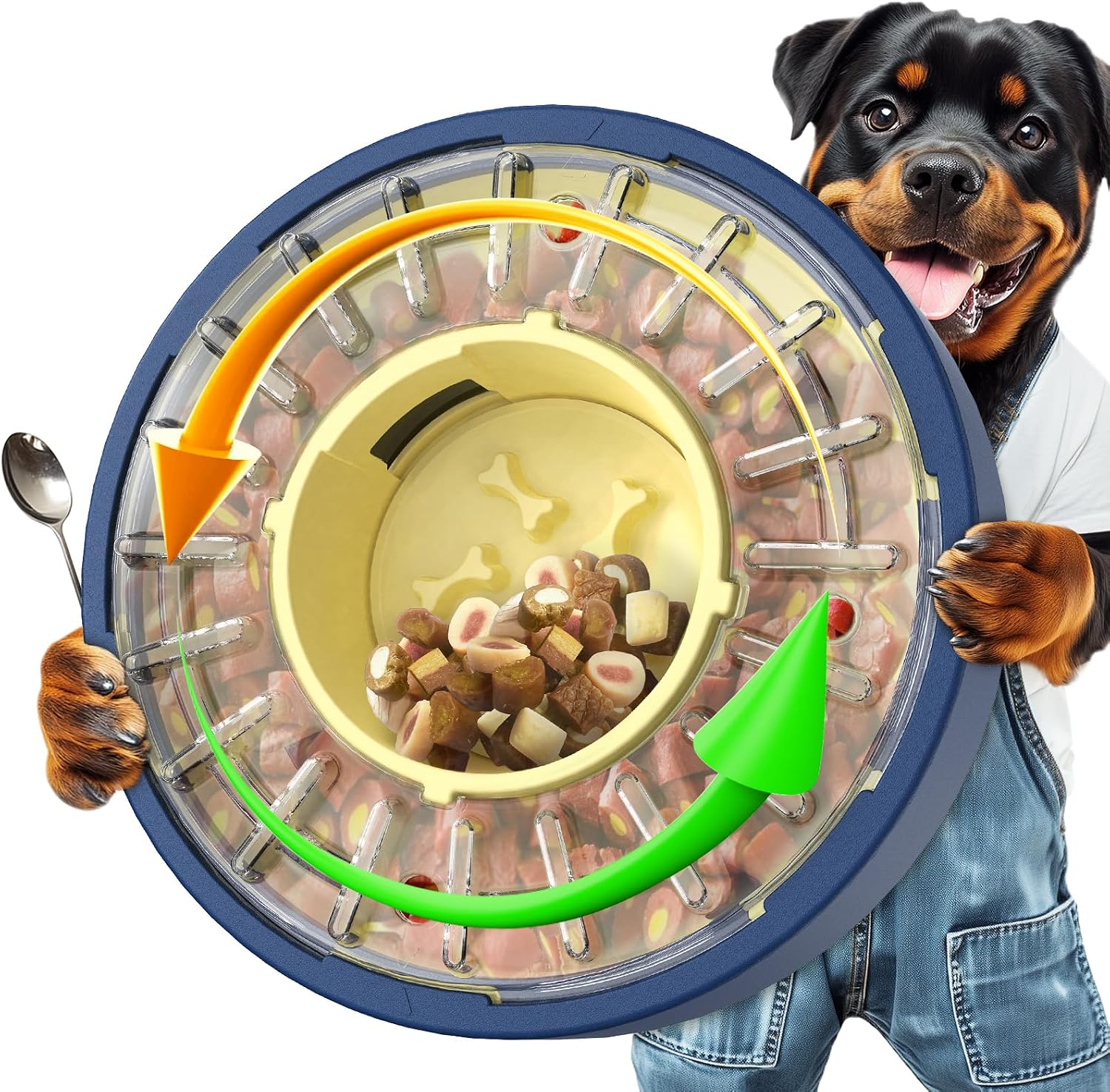
KADTC Adjustable 5-60 Min Slow Feeder Dog Bowl & Puzzle Feeder Anti-Gulping
Check current Amazon price.
The adjustable range on this one is the reason it is the upgrade pick. Instead of choosing between an easy bowl and a hard bowl, you set the feeder to stretch a meal across a window you choose, from a quick five minute session to a long, drawn-out puzzle for a dog that needs real work. For an anti-gulping routine, that control is worth more than any single fixed pattern.
It is also the feeder I reach for when a dog plateaus. If your dog has beaten the same bowl for a month and is back to inhaling, you can make this one harder without buying anything new. The dual identity, slow feeder and puzzle feeder in one, means it can carry a dog from the first week through the point where a plain bowl is boring.
Flaws but not dealbreakers: A feeder with more settings is a feeder with more places for food to hide, so rinse it thoroughly. If your dog is a determined chewer, watch the first few sessions closely, because adjustable parts are only as tough as their weakest clip.
Anyone with a dog that has outgrown an easy slow feeder, or a dog that needs a longer and more deliberate meal, will get the most out of this one.
The actual feeding workflow
This is the sequence. It works with any of the three feeders above, and it works with a dog of any age, though a puppy or a senior will move through it more slowly.
Step one: Match the feeder to the dog, not the trend. A gulper needs a slow feed bowl with real ridges. A bored dog that nibbles needs a puzzle. A dog that has never worked for food needs a treat puzzle first. Get this wrong and every later step feels like a fight.
Step two: Split the meal before you start. Take a portion of the dog's regular meal and set it aside as the reward for the session. Keep those treats in a container with an airtight seal so they stay smelly and high value. Using the whole bowl on day one is how you end up with a frustrated dog and a skipped dinner.
Step three: Load it while the dog watches. Let the dog see you drop the food in. A feeder that appears out of nowhere full of food is confusing; a feeder the dog watched you fill is a game. Then put it down and step back.
Step four: Keep the location and the feeding height the same. Feed in the usual spot, on the usual floor, at the usual feeding height, with the non slip base doing its job on a hard surface. New gear plus a new location is two changes at once, and most dogs only tolerate one.
Step five: Keep the first sessions short. The ideal start a dog on a puzzle feeder session is shorter than owners expect: two to five minutes, once a day, in the first week, ending while the dog is still winning. Ten minutes of failure teaches a dog that the bowl is a trap.
Step six: Add difficulty one notch at a time. Move the inserts, or change the setting on the adjustable feeder, only after the dog has cleared the current level three meals in a row. A dog that is winning most of the time stays interested; a dog that is failing half the time quits.
Step seven: Read the dog, not the clock. Gentle pawing is problem solving. Hard pawing, barking, walking away, or shoving the bowl with a flat nose is frustration. If you see the second set, go back one level for two meals and try again.
Step eight: Build to a full meal, then rotate. Once the dog finishes a whole meal in the feeder without quitting, you have arrived. Rotate between feeders every few weeks, because a puzzle the dog has memorized stops slowing anything down. The correct start a dog on a puzzle feeder sequence never skips the easy setting on the way back up, even for a dog that has done this before.
The competition and why it lost
Several feeding tools do part of this job, and they are all worth knowing about, but none of them belongs in a first-two-weeks plan.
Snuffle mats are excellent enrichment for a dog that needs to use its nose, and they are gentle on anxious dogs, but they do not hold a full meal and they are miserable to clean if you put wet food in them. A mat is a snack, not a feeding system.
Lick mats are the opposite problem. They are easy to clean and great for frozen treats, but a determined gulper can empty one in a minute, and they do not slow a meal at all.
Treat dispensing balls are the classic boredom buster. They roll under furniture, they are loud on hardwood, and their capacity is small, so they work as a midday game rather than a replacement for dinner.
Fixed maze bowls are the most common mistake. They have one difficulty level, so the dog either solves it in a week or never solves it at all. Without an adjustable setting, you are guessing at the right difficulty and living with the result.
Gravity feeders and elevated stands solve different problems. A gravity feeder makes food continuously available, which is the opposite of what a gulper needs, and an elevated stand is about feeding height and joint comfort, which is a separate conversation. Both are covered elsewhere on this site.
Finally, anything with small removable pegs that a chewer can swallow is off the list, no matter how clever the design. Safety first, puzzle second.
What this all costs
The three feeders here sit in three different price brackets, and the ranking matters more than the numbers: the treat puzzle is the cheapest, the large-dog slow feeder sits in the middle, and the adjustable unit is the most expensive of the three. The gaps between them are smaller than most owners expect, so it is worth checking the current listing before you commit.
The hidden cost is not the gear. It is the treats, the extra rinsing, and the second feeder you buy when you realize rotation is what keeps the game interesting. A treat puzzle plus one bowl is the practical minimum for a dog that eats too fast. Add the adjustable feeder later if your dog plateaus.
The cost of skipping all of this is harder to itemize. A dog that inhales a bowl of kibble in ninety seconds is a dog at higher risk of vomiting, bloat, and the kind of boredom that chews baseboards. Feeding slower is not a luxury upgrade. It is basic meal management, and a puzzle feeder is the cheapest way to do it at home.
Start with the easiest setting, keep the sessions short, and let the dog win. That is the whole trick, and it is the same whether you are working out how to start a dog on a puzzle feeder for the first time or resetting a dog that has gotten too good at the bowl it already owns.