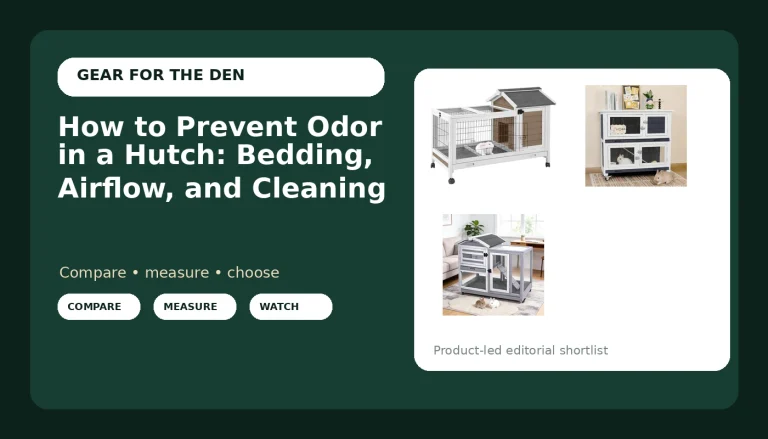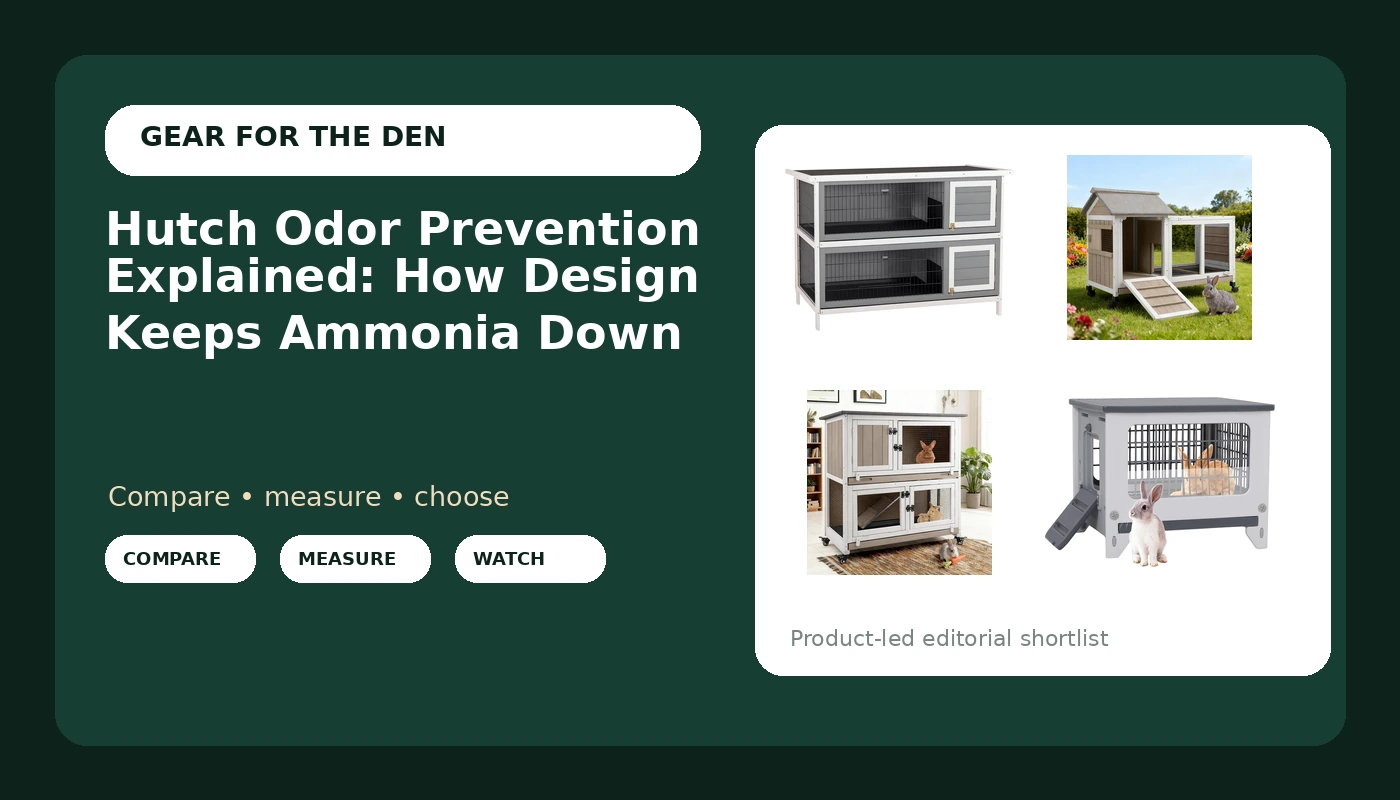
Rabbit urine is the source of most hutch smell, and it is a chemistry problem before it is a cleaning problem. Urine contains ammonia, and ammonia builds fastest when liquid sits on a hard surface instead of draining away or soaking into absorbent bedding. That is why hutch odor prevention comes down to three variables: how quickly waste leaves the living area, how much air moves through the enclosure, and how often the absorbent layer is replaced. Handle those three well and most hutches stay manageable between deep cleans. Handle them poorly and no amount of scrubbing keeps the smell away for long. This guide explains the mechanics first, then compares four hutches whose designs change how much daily work that routine demands.
Quick answer
Hutch odor prevention explained in one sentence: keep the waste dry. A hutch with a pull-out tray, a floor that does not soak up liquid, and enough airflow dries faster than a solid-floor box packed with deep bedding, and dry surfaces release far less ammonia. Each hutch below handles that differently, and none of them removes the need for a cleaning routine.
Four hutches that make hutch odor prevention easier
| Model | Best fit | What stands out |
|---|---|---|
| PawHut 54" 2-Story Large Rabbit Hutch Bunny Cage Wooden Pet House Small Animal Habitat with Lockable Doors, No Leak Tray and Waterproof Roof for Outdoor/Indoor Dark Grey | Large outdoor or indoor setups with room for a two-story footprint | A 54 inch two-story frame with a no leak tray, lockable doors, and a waterproof roof |
| 38" L Expandable Rabbit Hutch with Run, 2-Story Bunny Cage on Wheels | Small patios, balconies, and homes where the hutch gets moved | An expandable run on a wheeled two-story frame |
| 2 Story Rabbit Hutch Indoor & Outdoor, Wooden Rabbit Cage with 2 Leak-Proof Pull-Out Trays, 4 Wheels, Ramp, Chew-Anti Metal Strip for Rabbit, Guinea Pig, Hamster (36" L x 17.8" W x 36.7" H) | Indoor rooms where each level needs its own slide-out tray | Two leak-proof pull-out trays, four wheels, a ramp, and chew-anti metal strip edging |
| Plastic Rabbit Hutch for Indoor & Outdoor | Households that would rather wipe a surface than seal wood | Plastic panels that do not absorb liquid the way bare wood can |
Large outdoor option: PawHut 54" 2-Story Large Rabbit Hutch Bunny Cage Wooden Pet House Small Animal Habitat with Lockable Doors, No Leak Tray and Waterproof Roof for Outdoor/Indoor Dark Grey
The waterproof roof matters more for odor than it first appears. Wet bedding is the biggest single driver of ammonia smell, and rain blowing into an open hutch resets the drying clock every time it happens. A covered top keeps the absorbent layer working longer, which stretches the interval between full changes. The no leak tray adds a second layer of defense, because liquid that drains through the bedding lands on a removable surface instead of soaking into the wood floor. The trade-off is footprint. A 54 inch two-story hutch takes up real space, and the upper level still needs its own routine since rabbits often pick one corner as a latrine and use it consistently. Wood also holds odor once urine reaches an unsealed edge, so wiping the frame during tray changes is part of the job.
Expandable wheeled option: 38" L Expandable Rabbit Hutch with Run, 2-Story Bunny Cage on Wheels
Rabbits naturally choose a toilet corner away from where they eat and sleep, and a run gives them room to keep that habit. When the latrine area and the sleeping area are separated, the bedding in the enclosed section stays dry much longer, and that alone cuts how often the whole hutch needs a full change. The wheels matter for a different reason: a hutch that can be rolled onto a patio or driveway is easier to hose out, and easier to move into shade during a hot stretch, since warmth speeds the bacterial breakdown that produces ammonia. The trade-off is exposure. An open run offers less shelter from wind and rain than a fully enclosed hutch, so outdoor placement in a wet climate means checking the run floor after every storm.
Indoor double-tray option: 2 Story Rabbit Hutch Indoor & Outdoor, Wooden Rabbit Cage with 2 Leak-Proof Pull-Out Trays, 4 Wheels, Ramp, Chew-Anti Metal Strip for Rabbit, Guinea Pig, Hamster (36" L x 17.8" W x 36.7" H)
Two trays are the practical part. In a single-tray two-story hutch, the upper level drips onto the lower one and the mess compounds; a tray on each floor means urine gets captured where it lands and slides out for rinsing without dismantling anything. That shortens the daily routine to a scoop and a wipe, with a full tray wash a couple of times a week. The 36 by 17.8 inch footprint is the limitation to weigh. It fits an indoor corner, but floor area is what dilutes waste concentration, so a large rabbit in a small footprint will soil the available surface faster no matter how good the tray is. The chew-anti metal strip addresses a separate problem, since rabbits that chew wooden edges expose raw wood that absorbs urine and holds odor.
Plastic option: Plastic Rabbit Hutch for Indoor & Outdoor
Plastic changes the odor equation because it does not soak up urine. Wood is porous, and once urine reaches the grain, that section keeps releasing ammonia even after the bedding is replaced, which is why older wooden hutches sometimes smell faintly no matter how often they are cleaned. A plastic shell wipes clean and dries quickly, so the surface is back in service sooner after a wash. The trade-off is that this listing gives fewer structural details than the wooden options, so it is worth confirming the tray arrangement, door latches, and ventilation openings before buying. Plastic also tends to be lighter, which helps if the hutch has to come indoors for winter, though a lighter shell is easier for a determined rabbit to shift.
Prices and availability may change. Product images, names, and retailer links are matched to verified listings. No current price, rating, stock status, or measured result is stated here without current evidence.
What actually causes hutch odor
Fresh rabbit urine is not especially pungent. The smell comes from what happens next. Bacteria that live on damp surfaces produce an enzyme that converts urea in the urine into ammonia, and ammonia is the sharp smell people associate with a dirty hutch. Three conditions speed that reaction up: moisture, warmth, and a surface that holds both. That is why a hutch with wet bedding smells far worse than one holding the same amount of waste on a dry tray.
Ventilation is the other half of the equation. Ammonia is heavier than air and pools in low, enclosed spaces, so a hutch with tight panels and a closed roof traps it around the animals. Bar spacing and open wire panels give that gas somewhere to go, though they also change how much weather reaches the bedding.
Bedding dust plays a smaller but real role. Very dusty bedding irritates a rabbit's respiratory tract, and fine particles pack down and hold moisture longer than coarse shavings or paper pellets. Floor area and hideout size matter for the same reason: waste concentration depends on how much surface the animal has to spread it across, and a hideout that is never moved and never dries becomes a permanent source. Cage size, in other words, is an odor variable, not just a comfort variable.
Which design features change the smell math
There is no universal ideal hutch odor prevention formula, but a few design features move the needle more than others.
Pull-out trays. A tray that slides out for rinsing removes urine before bacteria can work on it. Two trays beat one on a two-story cage, because liquid on the upper floor otherwise lands on the lower one.
A waterproof or non-porous floor. Liquid that cannot soak into wood can be wiped away. This is the difference between a hutch that smells clean after a wash and one that smells faintly of ammonia no matter what.
Airflow. Bar spacing and open panels let ammonia disperse. A hutch sealed against weather on every side also seals in gas.
Bottle capacity and hay rack placement. A water bottle that drips soaks the bedding beneath it, and a hay rack hung over the sleeping corner drops debris exactly where the rabbit rests. Moving both away from the dry corner keeps the absorbent layer working.
Enrichment dimensions. Hideout size and tunnel diameter determine how much of the floor is covered by objects that trap damp bedding underneath. A hideout that lifts out for cleaning is easier to keep dry than one that stays put.
- Scoop solid waste and soaked bedding once a day, ideally at the same time so it becomes automatic.
- Pull the tray, rinse it, and let it dry completely before sliding it back into the frame.
- Replace damp bedding rather than topping it up, since fresh bedding over a wet layer only hides the moisture.
- Wipe wooden edges and corners during every tray change so urine never reaches bare grain.
- Do a full clean with a rabbit-safe cleaner on a fixed schedule, and let every surface dry before the animal goes back in.
Practical habits that keep a hutch dry
- Keep one corner as the latrine and set an absorbent pad or shallow tray there, because rabbits toilet in a consistent spot.
- Check the water bottle daily. A slow drip is one of the most common hidden sources of soaked bedding.
- Hang the hay rack away from the sleeping area, and clear dropped hay before it mats down against the floor.
- In humid weather, change bedding more often instead of adding more of it, because extra depth traps moisture in the middle of the layer.
- Move the hutch into shade during hot spells, since warmth speeds the bacterial conversion of urea into ammonia.
- A weekly hutch cleaning routine covers the parts that daily scooping misses.
Which option should you choose?
Choose the PawHut 54" 2-Story Large Rabbit Hutch when you have outdoor space, a large rabbit, and want the waterproof roof and no leak tray working together to keep bedding dry. Choose the 38" L Expandable Rabbit Hutch with Run when the hutch needs to move, or when you want a run that separates the toilet corner from the sleeping area. Choose the 2 Story Rabbit Hutch with 2 Leak-Proof Pull-Out Trays when the hutch lives indoors and you want both levels to have their own slide-out tray. Choose the Plastic Rabbit Hutch for Indoor & Outdoor when you would rather wipe a non-porous shell than seal and monitor wood.
None of these hutches is a self-cleaning system, and no listing detail substitutes for watching your own animal's habits. A rabbit that drinks heavily, a guinea pig in a small footprint, or a humid room will all push the cleaning interval shorter than a product description suggests. Treat tray design and airflow as the parts you can plan around, then adjust your hutch odor prevention routine based on what you see and smell.
The bottom line
Correct hutch odor prevention is mostly about moisture, not about how much cleaner you use. Urine only turns into that sharp ammonia smell when bacteria have a damp surface to work on, so the hutches that stay pleasant longest are the ones that get liquid off the floor fast: a pull-out tray, a floor that does not absorb, and airflow that carries gas away. The PawHut covers the outdoor, large-rabbit case with a waterproof roof and a no leak tray. The expandable wheeled hutch solves the moving-and-run problem. The double-tray indoor cage puts a tray under each level. The plastic hutch offers the simplest surface to wipe. Pick the one whose layout matches where the hutch will live, then keep the bedding dry and the trays empty, because that routine does more for odor than any single design feature.