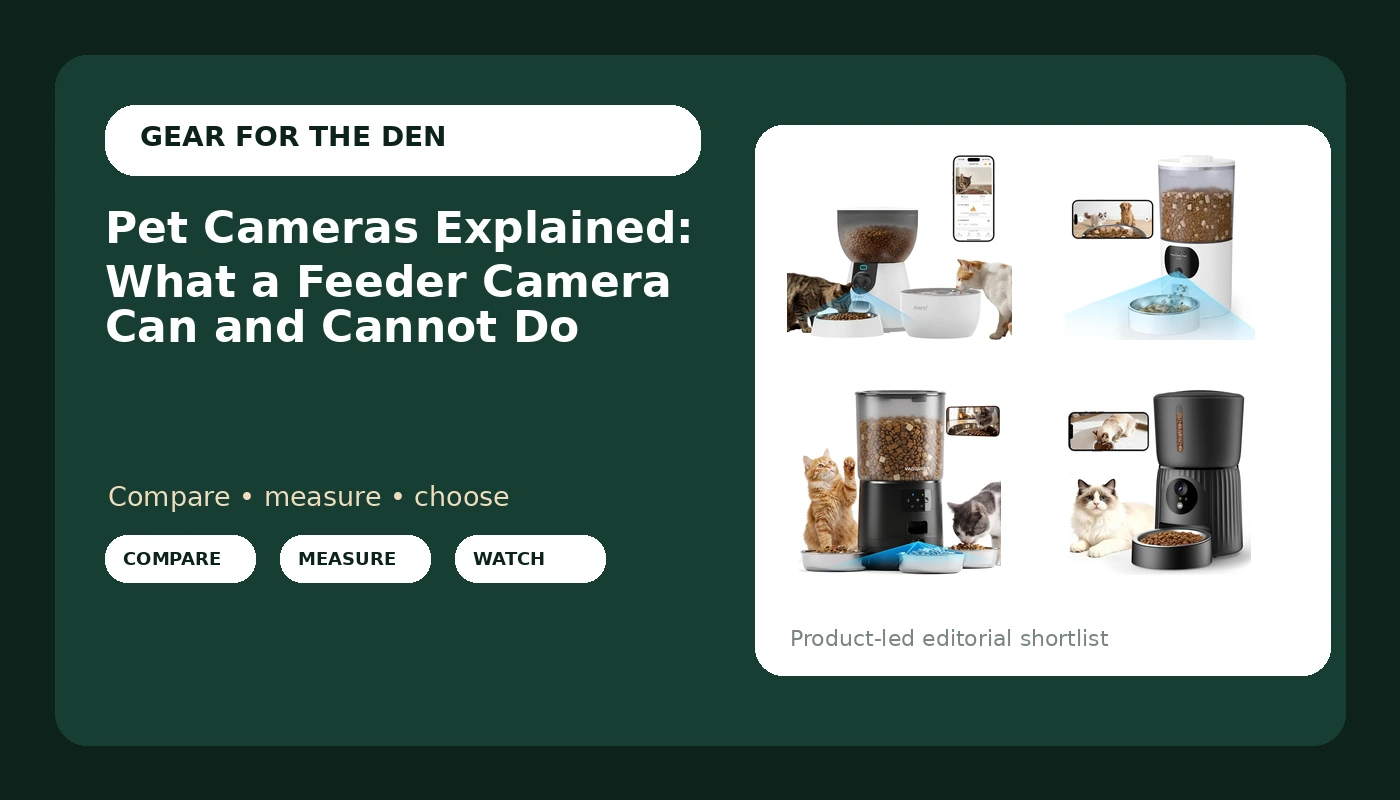
A camera feeder is a simple idea: a timed hopper with a lens aimed at the bowl, so you can see whether your cat actually ate instead of guessing from a half-empty dish. That is pet cameras explained in one sentence, and it is also where the buying questions start. Pet cameras in this category are feeders first and cameras second, which is why the details that shape your day to day are rarely the ones the product listings lead with.
The appeal is easy to see for anyone who works long shifts, travels for a night, or runs a home with more than one cat. A camera shows the bowl, the eating pace, and whether a scheduled portion actually dropped, and it lets you check in without a separate security setup. The trade-offs are just as practical. Video streaming competes with the feeder's own timers, night vision quality varies between models, and a camera that stops working when your home internet drops is not the same thing as a feeder that keeps feeding on schedule.
This guide covers four camera feeders sold for cats and small dogs. None of them is a general purpose pet camera you mount on a shelf; each is a feeder with a lens, which means food handling, portion accuracy, and power backup matter as much as the picture.
Quick answer
If you want to see the bowl and schedule meals from a phone, all four units here do that job. The choice comes down to how many cats you feed, how much dry food you want to store, whether you also need a water source, and how wide a view you need of the feeding area. A camera feeder is not a home security camera, and it will not tell you anything about your cat's health; it shows the bowl, the room around it, and the timing of meals. Match capacity to your feeding routine, confirm the app supports the Wi-Fi band your router broadcasts, and decide before you buy whether two-way audio, night vision, or a blockage alert is something you will actually use. No single unit here suits every household, because the right pick depends on your routine rather than on a spec sheet.
Four useful options
The table below sorts the four units by the household each one suits.
| Model | Best fit | What stands out |
|---|---|---|
| ARENTI 4L/17 Cups Automatic Cat Feeder and Water Fountain with Camera | Households that want food and water on one app | A 4-liter, 17-cup hopper combined with a water fountain and a camera |
| Automatic Cat Feeder with 2K Camera, 6.5L Smart App Control 5G/2.4WiFi | Larger appetites and sharper video | The biggest hopper in this group at 6.5 liters, plus a 2K camera and dual-band Wi-Fi |
| Automatic Cat Feeder with Camera for 3 Cats, 310° Monitoring, 2G/5G WiFi | Multi-cat homes that need a wider view | Monitoring across a 310-degree arc, built for a three-cat household |
| Faroro Automatic Cat Feeder with Camera, 1080P HD Video with Night Vision, 5G WiFi Automatic Dog Feeder with APP Control, 2-Way Audio, Blockage Sensor for Cats or Small Dogs, 4L (Black) | Buyers who want audio and a blockage alert | 1080P video with night vision, two-way audio, and a blockage sensor |
Feeder and fountain combo: ARENTI 4L/17 Cups Automatic Cat Feeder and Water Fountain with Camera
The trade-off with a combined feeder and fountain is maintenance. A fountain needs regular water changes and pump cleaning, and the camera has to cover two stations rather than one, which usually means a slightly wider view and a larger footprint on the floor. What you gain is one app for both, and a way to notice when a cat stops drinking or stops finishing meals. If your cat already has a fountain you like, a feeder-only unit leaves you less to clean; if you are starting from nothing, one unit with one camera is simpler to place and simpler to explain to a pet sitter.
Highest-resolution view: Automatic Cat Feeder with 2K Camera, 6.5L Smart App Control 5G/2.4WiFi
Resolution is the headline here, but it is worth thinking about what you are buying. A 2K stream shows more detail at the bowl, which helps when you are confirming that a portion dropped or that a cat is eating rather than sniffing. It also uses more bandwidth, so a stable router matters and the app has to keep up with the stream. The 6.5-liter hopper is the practical half of the story: fewer refills on a trip or a long week, and enough capacity for a household feeding more than one cat from a single station. Portion accuracy is set in the app, so check that the smallest portion it allows is small enough for your cat's normal meal.
Multi-cat monitoring: Automatic Cat Feeder with Camera for 3 Cats, 310° Monitoring, 2G/5G WiFi
A 310-degree monitoring arc and support for three cats point at a specific problem: in a multi-cat home, one cat can guard the bowl while another waits. A wider view helps you see who is eating and when, and it makes it easier to place the feeder where a shy cat has a clear approach. The catch is that no camera fixes resource guarding. If two cats will not share a station, the durable answer is usually a second feeder in a different room, and the camera then tells you whether both stations are in use. Feeders designed for multi-cat homes also tend to have larger hoppers, which is worth checking against your weekly food use.
Two-way audio and blockage alerts: Faroro Automatic Cat Feeder with Camera, 1080P HD Video with Night Vision, 5G WiFi Automatic Dog Feeder with APP Control, 2-Way Audio, Blockage Sensor for Cats or Small Dogs, 4L (Black)
Two-way audio is the feature people either love or never open. It lets you speak through the feeder, which some cats ignore completely and some small dogs respond to. The blockage sensor is the quieter, more useful inclusion: if food stops dispensing, an alert reaches you instead of a cat sitting in front of an empty bowl. The 1080P camera with night vision covers meals after dark, and the 4-liter hopper sits between a small countertop unit and the larger tanks in this group. Because it is listed for cats or small dogs, it is the one to consider if a dog shares the house, though a large dog will work through a 4-liter hopper quickly.
Prices and availability may change. Product images, names, and retailer links are matched to verified listings. No current price, rating, stock status, or measured result is stated here without current evidence.
How pet cameras work
Every unit in this group does the same three things: it stores dry food, it drops a measured portion on a schedule or on command, and it streams video of the area in front of it. The parts that vary are the ones worth comparing.
Camera resolution is measured in pixels, and the listings here range from 1080P to 2K. Higher resolution gives a clearer view of the bowl and the food level, at the cost of more bandwidth and more storage if clips are saved. Night vision uses infrared light, which produces a black and white image in a dark room, and it matters if your cat eats before dawn or after you go to bed.
Signal range and band support decide whether the stream stays connected. Some smart feeders work on 2.4 GHz Wi-Fi only, while others also accept 5 GHz. A 5 GHz network is faster but covers less distance and passes through fewer walls, so a feeder in a back room may still be better off on 2.4 GHz even when the hardware supports both. App pairing is where most setup problems appear, usually because the phone is on the wrong band during setup.
Some brands put recorded clips, extra users, or advanced alerts behind a subscription, so check what the free tier includes before you rely on cloud history. Power is the other variable: battery life matters for cordless placement, but a feeder that runs on an adapter with battery backup keeps its schedule through a short outage. Water resistance is mostly a fountain concern, since pumps and water trays need cleaning, and any camera near a water source should be kept clear of splashes. Portion accuracy is set in the app, in cups or grams per meal, and it is the specification that most directly affects how the feeder fits your cat's diet.
Matching a camera feeder to your household
Before comparing features, work out what your household actually needs. The five steps below take about ten minutes and narrow the list faster than any spec table.
- Count the cats and note how they eat, separately or from one bowl, because a shared station changes the feeder you need.
- Estimate your weekly dry food use and compare it with the hopper size you are considering, from 4 liters up to 6.5 liters.
- Check which Wi-Fi bands your router broadcasts and where the feeder will sit, then confirm the app supports that band.
- Decide whether water belongs in the same unit as the food, since a fountain adds cleaning to your routine.
- List the alerts you will act on, such as a blockage, an offline camera, or a low food level, and treat everything else as optional.
Practical guidance for setup and daily use
- Place the feeder on a level, stable surface away from direct sun and away from a wall the cat has to squeeze past, then watch the first few meals to confirm the cat approaches it.
- Complete app pairing while standing near the router if setup fails, and switch the phone to the 2.4 GHz band if your router splits its bands into separate network names.
- Run a test portion into a small bowl before you trust the schedule, and adjust the portion size in the app rather than guessing at it.
- Wipe the lens with a dry microfiber cloth as part of your weekly routine, because dust and food spray blur the view faster than most owners expect.
- Keep the power adapter on a surge protector, load backup batteries if your model accepts them, and restart the feeder once to confirm the schedule survives an outage.
Which option should you choose?
Choose the ARENTI 4L/17 Cups Automatic Cat Feeder and Water Fountain with Camera when you want one camera and one app covering both food and water and you do not mind the extra cleaning a fountain brings. Choose the Automatic Cat Feeder with 2K Camera, 6.5L Smart App Control 5G/2.4WiFi when you feed a bigger appetite from one station and want the largest hopper and the sharpest video in this group. Choose the Automatic Cat Feeder with Camera for 3 Cats, 310° Monitoring, 2G/5G WiFi when a wider view matters because several cats use the same area or a shy cat needs a clear approach. Choose the Faroro Automatic Cat Feeder with Camera, 1080P HD Video with Night Vision, 5G WiFi Automatic Dog Feeder with APP Control, 2-Way Audio, Blockage Sensor for Cats or Small Dogs, 4L (Black) when two-way audio and a blockage sensor are features you will actually use and a small dog shares the house.
There is no universal answer here, and that is the honest version of the question. The ideal pet cameras for a single-cat apartment are more hardware than that household needs, while a busy multi-cat home will notice every missing alert. The correct pet cameras for your home are the ones whose capacity, app, and notifications match your routine. Before you commit, confirm the return window and check that the app is available for your phone, because those two details decide how easy a mistake is to undo.
The bottom line
Camera feeders solve a narrow, real problem: they let you confirm that meals are landing and see the bowl without standing in the kitchen. The four units here differ mainly in capacity, video quality, and how many cats they are designed to serve, and every one of them depends on your home Wi-Fi for the camera half of the job. Pick the hopper size that matches your weekly food use, choose the Wi-Fi band that reaches the feeding spot, and treat audio and alerts as features worth paying for only if you will act on them. Keep the setup simple enough that a pet sitter can run it without a walkthrough.