The phrase bird cage sizes explained points to a simple truth: a cage is not a box you park a bird in, it is the bird's whole indoor territory. If you have ever stood in a store aisle comparing wire panels and wondering whether a taller cage beats a wider one, you are not alone. The right dimensions depend on wingspan, tail length, climbing style, and how much time your bird spends outside the cage. Get the footprint, cage height, and bar spacing wrong and even a well-made cage can feel cramped or unsafe. This guide walks through the measurements that matter, the accessories that make a cage workable, and the points where a smaller cage can still be a reasonable choice.
Quick answer
Match the cage to the bird, not to the corner of the room where you want it to fit. A cage should be at least wide enough for your bird to stretch both wings without touching the sides, tall enough to allow full tail clearance below the highest perch, and built with bar spacing small enough that your bird cannot push its head through. For most small parrots, horizontal bars, a secure tray liner, and room for several perch diameters will serve better than a tall, narrow cage with a single dowel. Write down your bird's wingspan, tail length, and approximate head width before you shop, because those three numbers rule out most unsuitable cages quickly. The accessories below are cage fittings and enrichment items, not cages themselves, and they help you use the space you already have.
4 useful options
| Model | Best fit | What stands out |
|---|---|---|
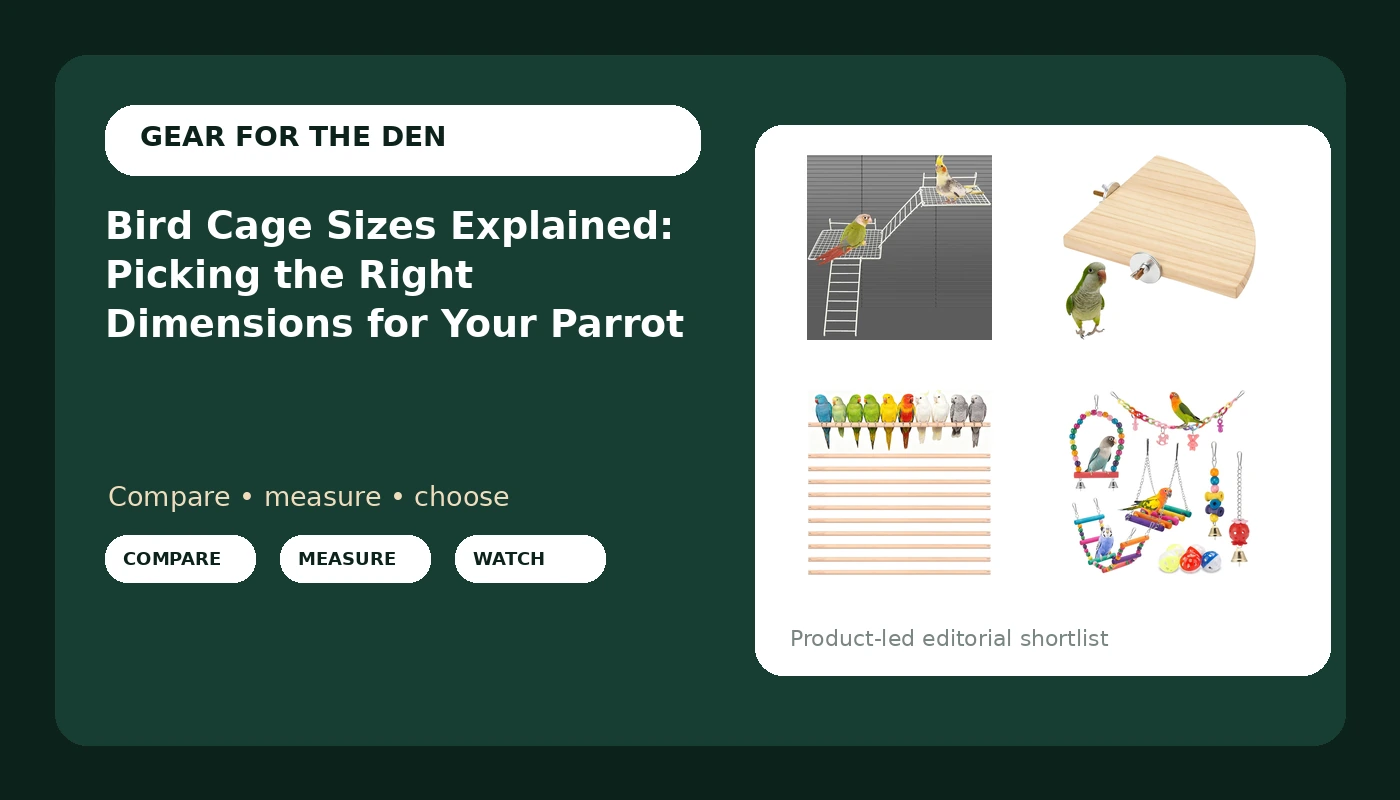
| BNOSDM 4 PCS Bird Perches Platform, Stainless Steel Grid Platform for Parakeet Parrot Stand with Climbing Ladder Bird Cage Accessories for Small to Large Birds (White) | Birds that need a flat platform and a way to climb between levels | Stainless steel grid platform with an included climbing ladder |
| 6.7 Inch Fan-Shaped Bird Perch Platform, Natural Wood Flat Bird Perches for Cage, Parrot Perch Corner Stand, Small Parrot Stand Animal Cage Accessories for Hamsters Gerbils | Small parrots that need a corner perch without losing flight space | Fan shaped natural wood platform sized for cage corners |
| Wopgrty 10 Pcs 24 x 0.6 Inches Wooden Bird Perches for Cage Accessories Natural Parrot Rods with Double Head Slots Grinding Stick for Budgies Parakeet Cockatiel Conures Macaw Cockatoo | Budgies, cockatiels, conures, and similar birds needing multiple perches | Ten wooden rods with double head slots and a grinding surface |
| Bird Parakeet Toys – Swing Hanging Standing Chewing Hammock Climbing Ladder Bird Cage Colorful Toys Suitable for , Parakeet, Conure, Cockatiel, Mynah, Love Birds, Finches | Parakeets and similar small birds that need swinging and chewing enrichment | Colorful swing, hammock, and climbing ladder in one set |
Platform and ladder: BNOSDM 4 PCS Bird Perches Platform, Stainless Steel Grid Platform for Parakeet Parrot Stand with Climbing Ladder Bird Cage Accessories for Small to Large Birds (White)
A grid platform is useful when you want to break up a tall cage into usable levels. Birds that are nervous about stepping onto a swinging perch often accept a stable platform faster, and the grid lets droppings fall through instead of soaking into wood. The trade off is cleaning: grid surfaces need scrubbing more often than a smooth perch, and food can get caught in the openings. Place it where your bird already likes to sit rather than in the middle of open flight space.
Corner platform: 6.7 Inch Fan-Shaped Bird Perch Platform, Natural Wood Flat Bird Perches for Cage, Parrot Perch Corner Stand, Small Parrot Stand Animal Cage Accessories for Hamsters Gerbils
Corner platforms are one of the simplest ways to make a small cage work harder. Because the platform hugs the corner, it does not eat into the space your bird uses to hop between perches. Natural wood can be chewed, which is normal for parrots, so inspect it regularly and replace it if it becomes rough or unstable. The flat surface also gives you a place to set a food cup or a small foraging item without adding another hanging accessory.
Wooden perch rods: Wopgrty 10 Pcs 24 x 0.6 Inches Wooden Bird Perches for Cage Accessories Natural Parrot Rods with Double Head Slots Grinding Stick for Budgies Parakeet Cockatiel Conures Macaw Cockatoo
Perch diameter is one of the most overlooked parts of cage setup. A 0.6 inch rod is a middle ground: it gives small and medium birds something to grip without forcing their feet into an unnatural spread, though very small finches may prefer a thinner perch and very large macaws may need a thicker one. The double head slots are meant to wedge into cage bars, so measure your wire spacing before you order. Because the set is uniform, it does not provide the variety of diameters that supports the widest range of foot exercise, but it is a practical way to fill a new cage or replace chewed rods.
Swing and climbing set: Bird Parakeet Toys – Swing Hanging Standing Chewing Hammock Climbing Ladder Bird Cage Colorful Toys Suitable for , Parakeet, Conure, Cockatiel, Mynah, Love Birds, Finches
Enrichment items do not replace space, but they change how a bird uses the space it has. A swing mount gives a bird a moving perch that builds balance, while a hammock offers a soft resting option and a ladder adds a climbing route. The main trade off is clutter: too many hanging toys can crowd a cage and make cleaning harder, so rotate pieces rather than hanging everything at once. Check the swing mount and any clips regularly for wear, especially if your bird is a dedicated chewer.
Prices and availability may change. Product images, names, and retailer links are matched to verified listings. No current price, rating, stock status, or measured result is stated here without current evidence.
How bird cage sizes affect your bird's daily life
There is no single ideal bird cage sizes chart that fits every species, because a cage that feels generous to a finch can be cramped for a conure. The measurements that matter most are width, depth, height, and bar spacing. Width and depth determine how far your bird can fly or hop from perch to perch, while cage height matters for birds with long tails that need clearance below the highest perch. A tall cage with a small footprint is not automatically better than a shorter, wider cage, especially for birds that prefer horizontal movement. Bar spacing is a safety measurement first and a species guide second: if the gap is wide enough for a bird to push its head through, the cage is not the correct bird cage sizes for that bird, no matter how large the cage looks in the room.
Flight is not the only way birds use a cage. Many parrots climb the bars, hang upside down from the roof, and shuttle along perches, so the interior layout matters as much as the raw dimensions. A cage with a few well-placed perches at different heights encourages more movement than a single long dowel, and a flat platform can serve as a feeding station or a resting spot for older birds. If you keep more than one bird, add separate feeding and resting zones so a more dominant bird cannot guard every resource. The goal is a cage that supports normal behavior, not just one that passes a size check.
Matching bar spacing and perch diameter to your bird
Getting correct bird cage sizes right is less about a number on a box and more about a set of fit checks. Start with your bird's body length and wingspan, then compare those numbers to the cage's interior dimensions rather than its exterior footprint. Bar spacing should be narrow enough that the bird cannot fit its head between the bars, but wide enough that toes and beak tips do not get caught. Perch diameter should let the bird's toes wrap most of the way around the perch without the ends meeting underneath. Food cup size matters too: a cup that is too deep can make it hard for a small bird to reach the bottom, and a cup that is too shallow invites spills. Finally, think about carrier size if you travel with your bird, because a cage that is right for the living room may be far too large for a vet visit.
Bar spacing and perch diameter work together. A cage with safe bar spacing but perches that are too thin can still leave a bird gripping with its toes curled underneath, while perches that are too thick can cause the bird to slide or sit with its feet flat. Variety helps: include at least two perch diameters in the cage so the feet and legs change position through the day. If your bird spends most of its time on one perch, that is the one to adjust first.
- Measure your bird's wingspan and tail length before comparing cages.
- Check the bar spacing against your bird's head width, not just its body size.
- Choose perch diameters that let the toes wrap most of the way around.
- Place perches so the highest one leaves tail clearance below it.
- Leave open flight space in the middle of the cage rather than filling every corner.
Setting up the cage and checking fit
- Use a tray liner that slides out easily, because cleaning frequency affects cage air quality.
- Set food cup size and placement so your bird can reach food without perching on the cup rim.
- Add foraging difficulty gradually, starting with easy treats and moving to puzzles once your bird understands the game.
- Check the swing mount and any hanging clips weekly for wear, especially with birds that chew.
- Keep a carrier size that fits your bird comfortably for short trips, and store it near the cage so it is not a scramble during an emergency.
For a deeper clean, see our small pet cage cleaning routine.
Which option should you choose?
Choose the BNOSDM 4 PCS Bird Perches Platform, Stainless Steel Grid Platform for Parakeet Parrot Stand with Climbing Ladder Bird Cage Accessories for Small to Large Birds (White) when you want a stable platform and a climbing route for a small to large bird. Choose the 6.7 Inch Fan-Shaped Bird Perch Platform, Natural Wood Flat Bird Perches for Cage, Parrot Perch Corner Stand, Small Parrot Stand Animal Cage Accessories for Hamsters Gerbils when you need a corner perch that adds standing space without blocking the middle of the cage. Choose the Wopgrty 10 Pcs 24 x 0.6 Inches Wooden Bird Perches for Cage Accessories Natural Parrot Rods with Double Head Slots Grinding Stick for Budgies Parakeet Cockatiel Conures Macaw Cockatoo when you are setting up multiple perches or replacing worn wood. Choose the Bird Parakeet Toys – Swing Hanging Standing Chewing Hammock Climbing Ladder Bird Cage Colorful Toys Suitable for , Parakeet, Conure, Cockatiel, Mynah, Love Birds, Finches when your small parrot needs swinging, climbing, and chewing enrichment.
No single accessory fixes a cage that is too small, and none of these items is a substitute for adequate space and daily out-of-cage time. Use them to improve a cage that already meets your bird's basic size needs, and adjust the layout as your bird grows, molts, or changes habits.
The bottom line
Bird cage sizes explained comes down to fit, safety, and daily use. Measure your bird, check bar spacing and cage height, then choose perch diameters that support natural foot posture. The right cage is the one your bird can move in comfortably, and the right accessories are the ones that make that space easier to clean, climb, and explore. Start with the largest cage your room and budget allow, add a mix of platform and rod perches, and rotate enrichment so the cage stays interesting. If you are unsure between two cages, favor the one with more horizontal room and safer bar spacing rather than the one with the taller silhouette.