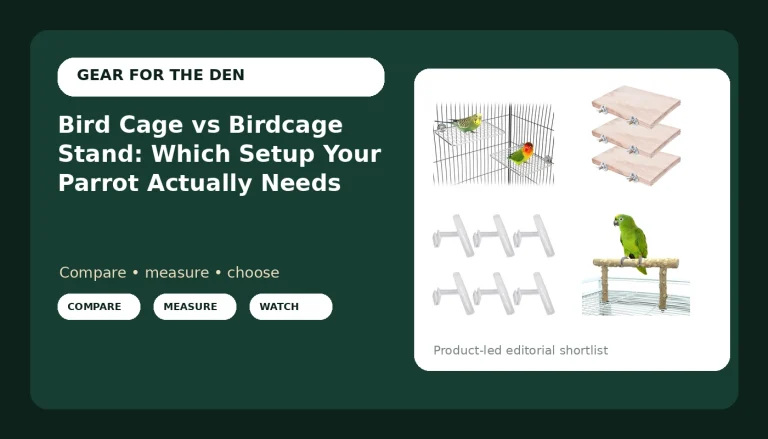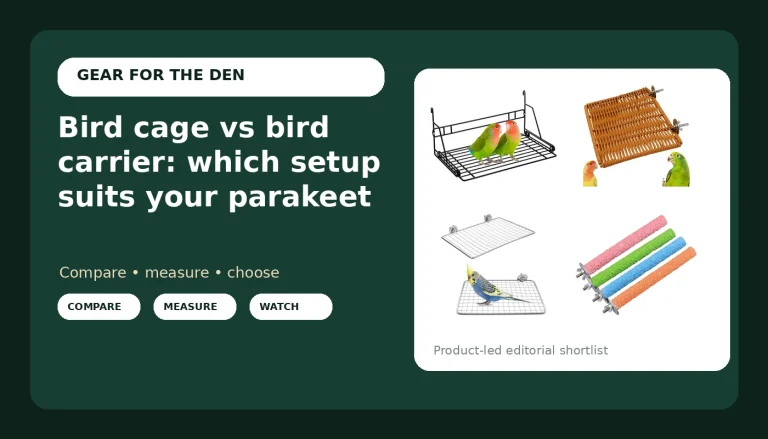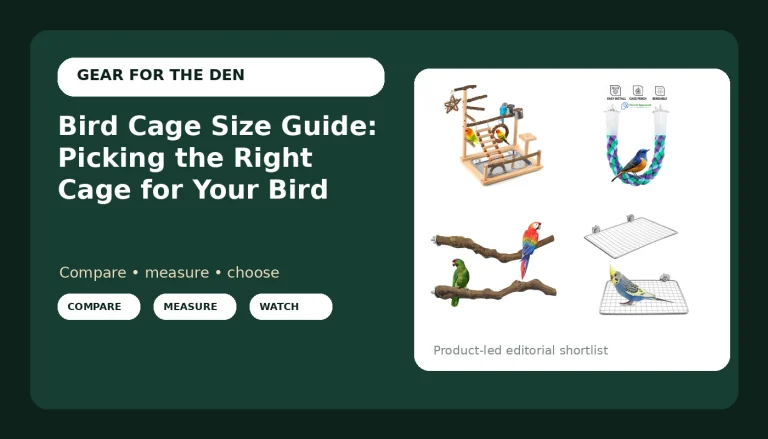
Most new bird owners frame the choice wrong. They treat bird cage vs bird foraging toy as a purchase decision, when it is really a sequencing decision. The enclosure sets the limits, and everything you hang inside it either works with those limits or fights them. A cage with sensible bar spacing and enough cage height gives a bird somewhere to climb. A perch, a ladder, or a play stand gives it a reason to.
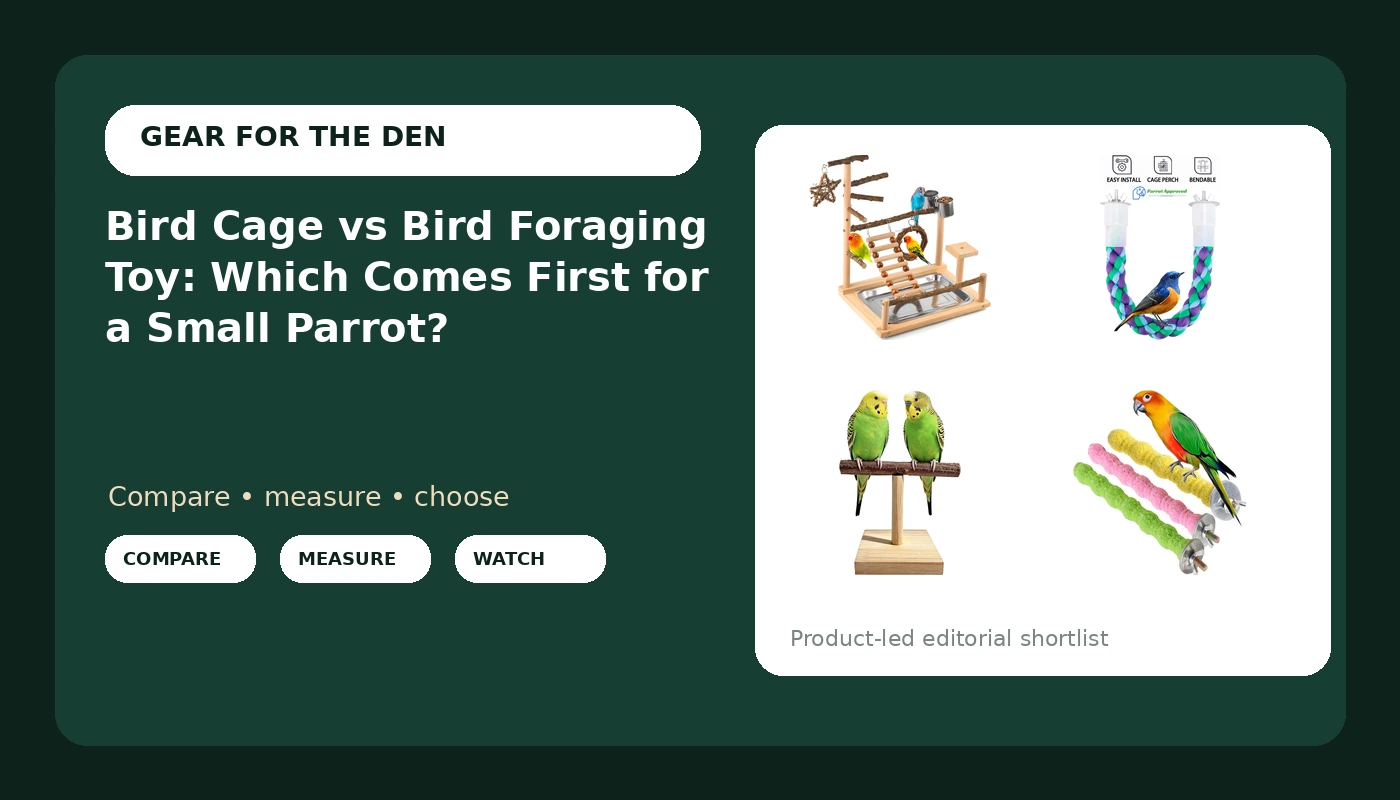
The short answer for most households: sort the cage first, then spend the rest of the budget on perches and out-of-cage stations, because enrichment only earns its keep when the bird has somewhere to use it. The four products below all sit on the enrichment side of that line, and they are not interchangeable. One is a full playground with a tray liner and stainless cups, one is a pair of bendable rope perches, one is a portable training stand, and one is a set of natural wood sticks. The table gives you the shape of it; the sections explain why the gap between a perch and a playground matters more than the gap in price.
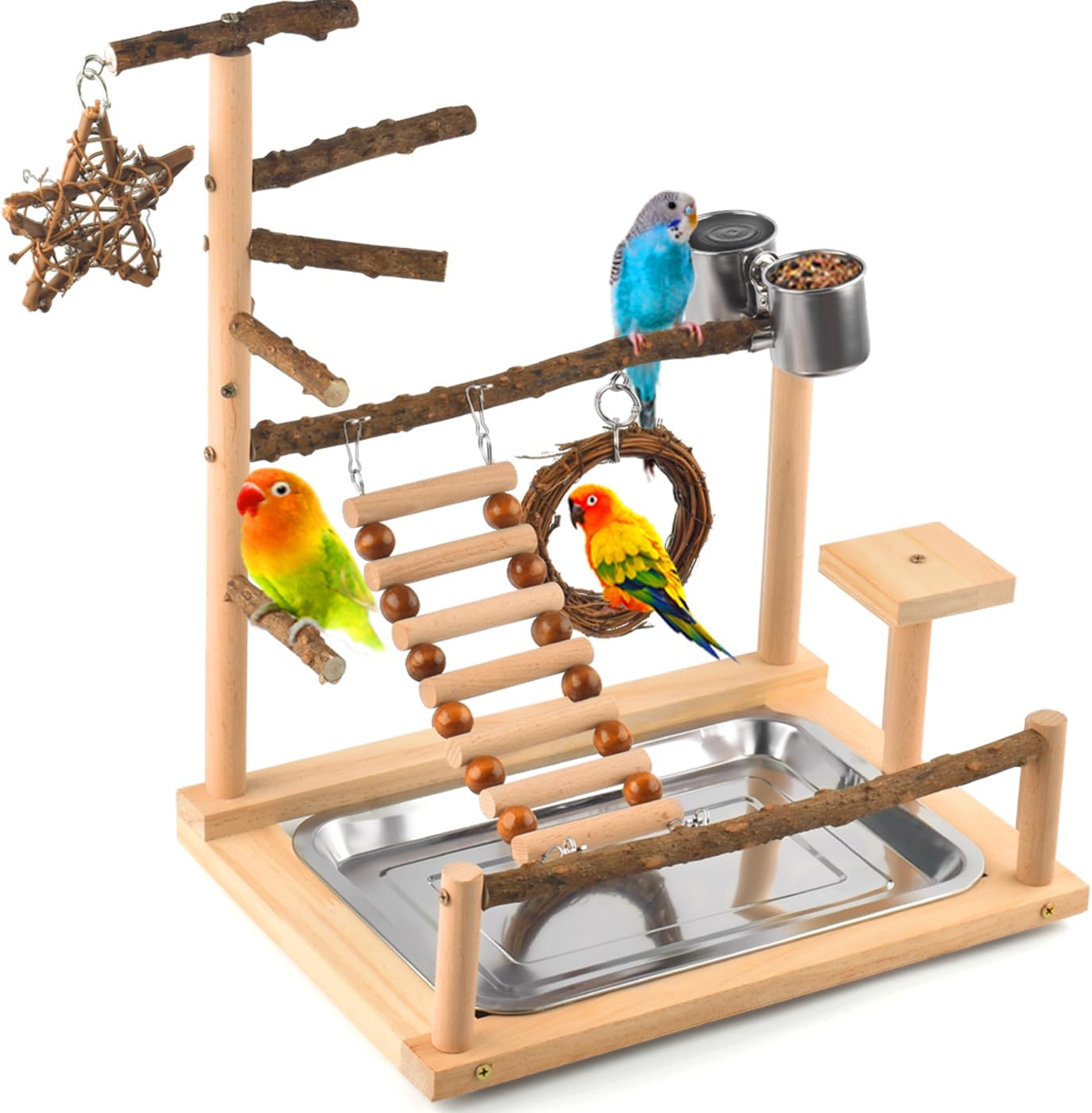
KATUMO Bird Playground
A complete out-of-cage station: ladder, swing, removable tray and two stainless steel cups in one purchase
Needs a flat table or floor spot and the longest cleaning routine of the four
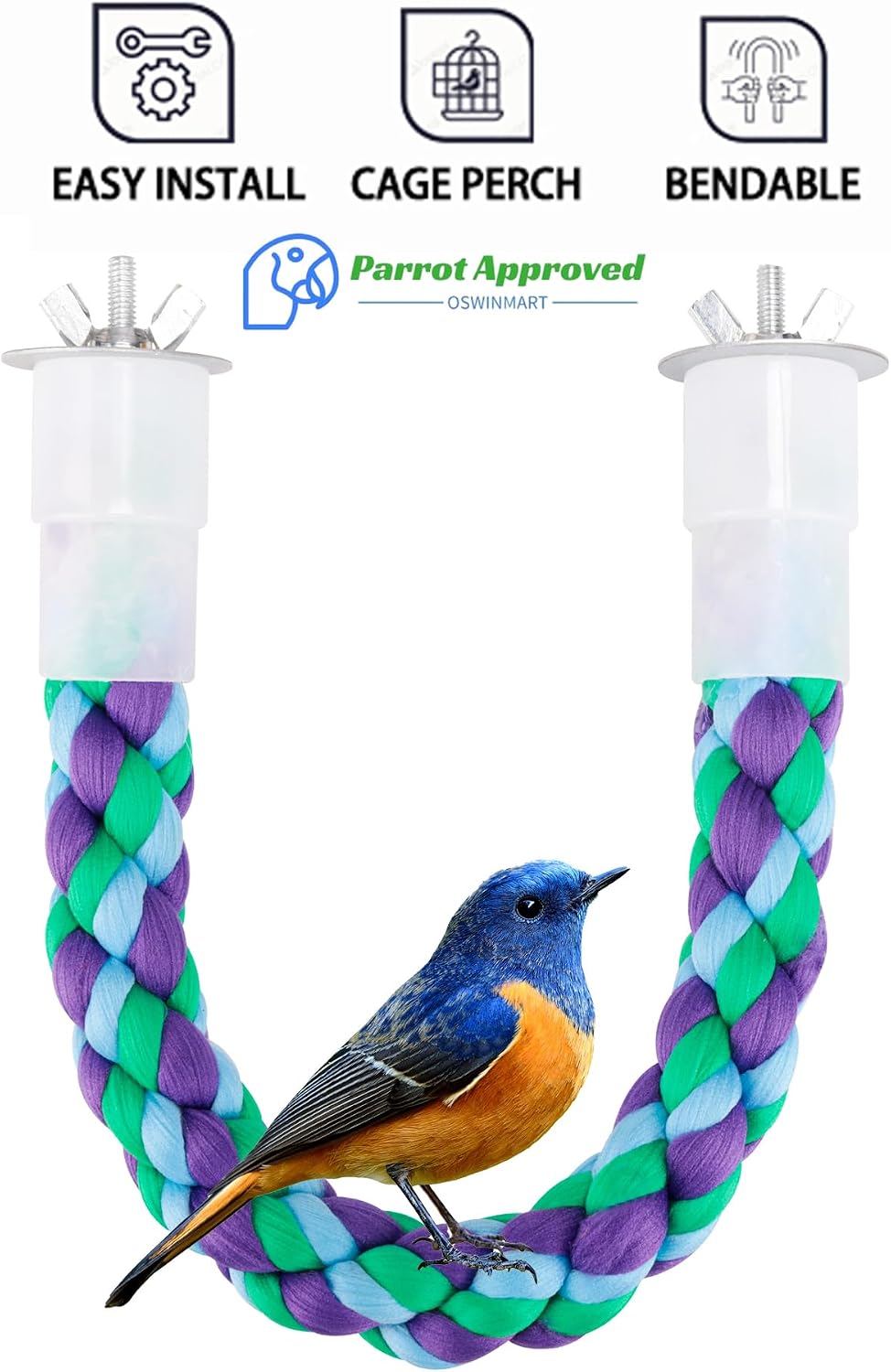
2Pcs 11.8'' Bird Rope Perches
Bendable, so it fits corners and odd angles a straight dowel never will, and it adds climbing variety cheaply
Rope frays over time and it is not a foraging station on its own
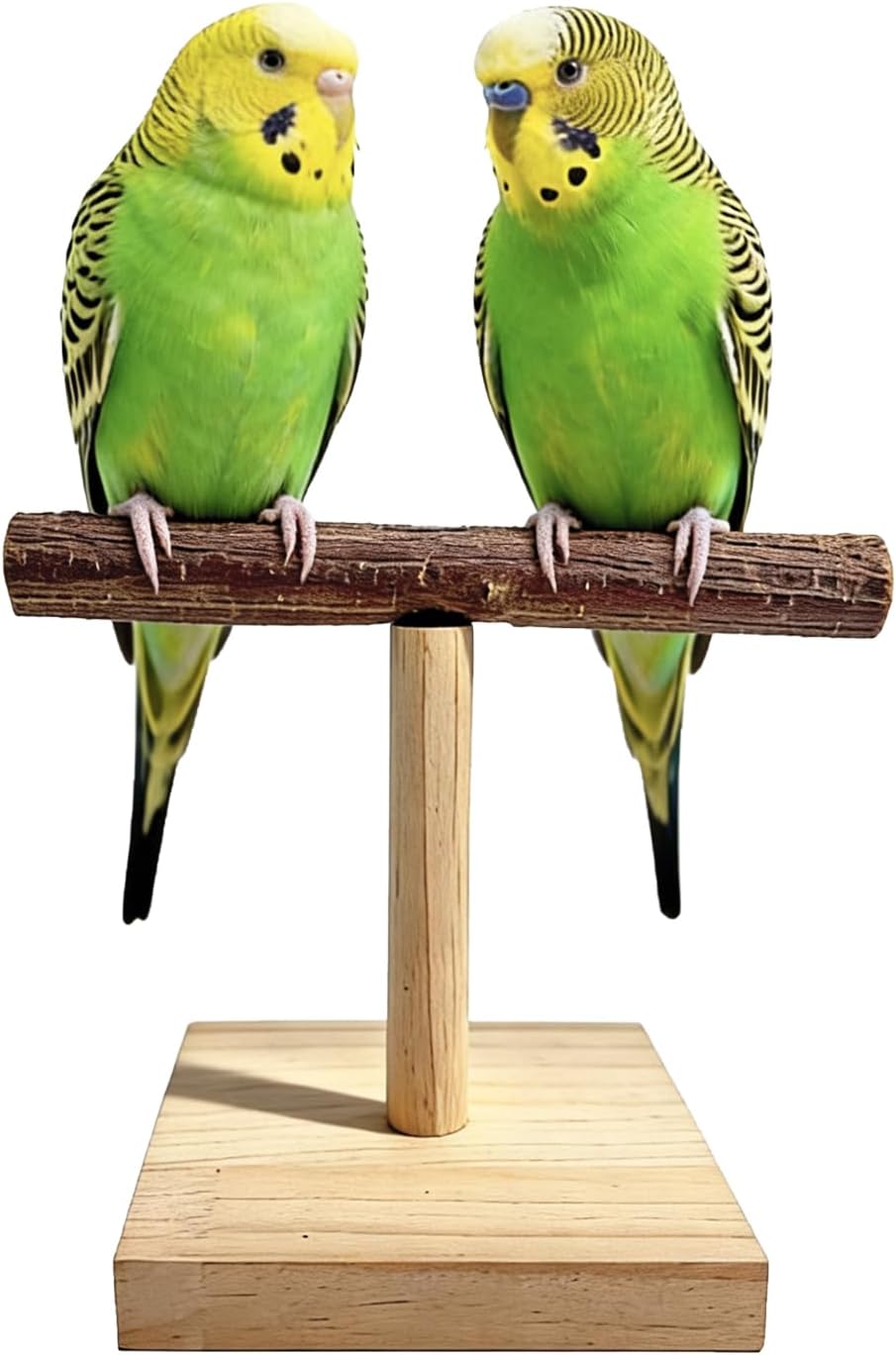
Bird Perch Stand Portable Training Playstand
Light enough to move room to room, which makes it genuinely useful for training sessions
Small footprint means limited enrichment, and there is no tray or cup
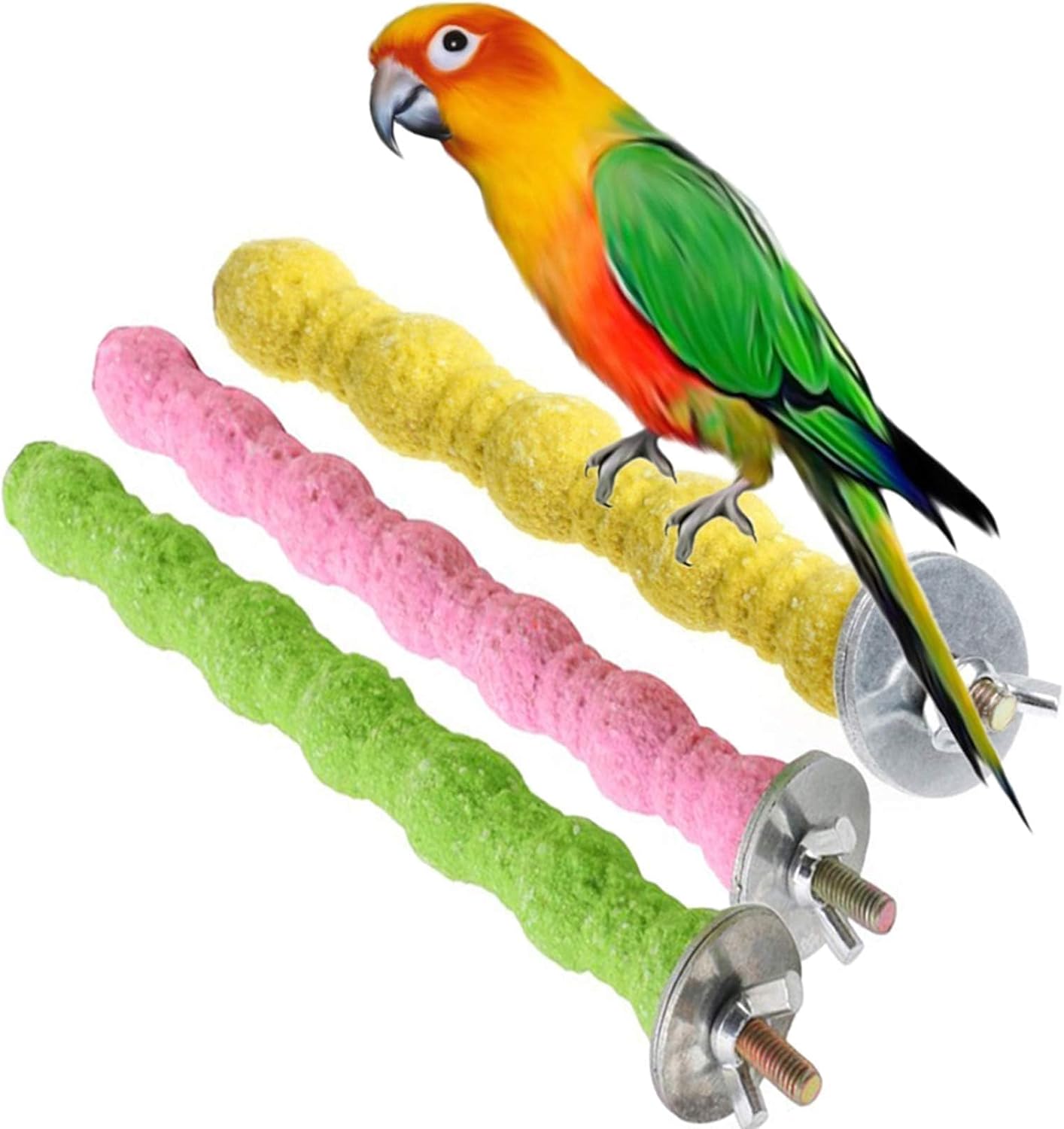
kathson 3PCS Bird Perch
Three rough-surfaced natural wood sticks give grip plus beak and nail wear for very little money
Fixed 7.87 inch length and random color, so it is a supporting act rather than a centerpiece
Prices and availability may change.
Bird cage vs bird foraging toy: what each one is actually for
A cage is containment, sleep, safety, and a home base. Its job is to be the right size, the right bar spacing, and the right height for the bird you actually have rather than the bird in the video you watched. It also needs to be boring in the right way: a place where the bird can rest without being asked to perform.
A foraging toy or a play station has the opposite job. It exists to be solved. The difference between bird cage and bird foraging toy is mostly a difference in responsibility. The cage answers where the bird lives, and the enrichment answers what the bird does between meals. A bird that only has the first one will spend its waking hours looking for something to take apart, and the cage bars are usually what it finds.
Foraging difficulty is the dial you turn once the bird has a safe place to work: easy puzzles for a nervous bird, harder ones for a bird that empties a bowl in ten minutes. That dial only exists if the bird has a station to work at.
That is why this is not a contest. Nobody should read it as a straight choice of bird cage or bird foraging toy, in the sense of buying one and skipping the other. The useful question is which piece to upgrade next, and how much of the budget the enrichment deserves once the enclosure is adequate.
Owners who ask about this usually already suspect the answer. They have a cage that is fine but not great, and a bird that is bored but not distressed, and they want to know where the next round of spending should go. The honest answer depends on one thing: whether the cage is genuinely adequate for the species. If it is, the enrichment side wins every time, because a perch costs a fraction of a cage and changes the bird's day far more.
How I judge perches, stands, and enrichment gear
Four things decide whether a perch or a stand earns the space it takes up.
Perch diameter and surface. A bird's foot should wrap most of the way around the perch rather than sitting flat on top of it. Natural wood with a rough surface gives grip and wears down nails and beak edges in the ordinary course of climbing. Smooth dowels look tidy and do almost nothing for the bird standing on them.
Mounting and stability. A swing mount that rattles, or a stand that tips when a bird lands hard, is worse than no stand at all. Anything that shifts under the bird's weight teaches it not to trust the furniture, and a bird that does not trust its perches ends up sitting on the floor of the cage instead.
Cleanability. Tray liner, food cup size, and how easily the whole thing wipes down decide whether you keep using it past the first month. A playground with a removable tray and two stainless steel cups is a different ownership experience from a bare wooden frame hanging over your carpet.
Fit for the bird. Bar spacing and carrier size are cage specs, but they matter here too, because a perch sized for a macaw is a hazard for a finch. Match the gear to the bird in front of you, not to the bird in the product photo.
None of that is exotic. It is the same checklist you would apply to a dog crate or an aquarium filter: does it fit, does it stay put, can you clean it, and will it still be usable in a year.
The full playground: KATUMO Bird Playground
The KATUMO Bird Playground is the only product here that covers both halves of the enrichment job at once. It is built around natural wooden perches with a parakeet ladder and a conure swing, and it adds two things that turn a perch into a station: a removable tray and two stainless steel cups.
That combination matters more than it sounds. A bare wooden stand over a carpet is a mess waiting to happen, and a bird that has nowhere to drink while it is out of the cage goes back to the cage. The tray liner catches the droppings and the dropped food, and the stainless cups handle water and a small snack. For a conure or a parakeet owner who wants the bird nearby while they work, this is the piece that makes the arrangement sustainable rather than a novelty.
The trade-offs are space and surface. This is a tabletop or floor-standing item, so it needs a flat spot that is not in the way of foot traffic, and it needs to be somewhere the bird can be supervised. It is also the largest and most involved of the four products, which means it is the one that takes the longest to clean properly.
If your cage is already adequate and you want one purchase that changes how much of the day your bird spends doing something, this is the pick. It answers the enrichment half of the bird cage vs bird foraging toy question in a single box.
The bendable rope perches: 2Pcs 11.8'' Bird Rope Perches
Rope perches are the cheapest way to change a cage layout, and these two are the flexible end of that idea. They bend, which means they can be shaped into a gentle U, wrapped around an existing perch, or run across a corner where a straight dowel would never fit. For small to regular size birds, that flexibility is the whole point.
The climbing value is real. A bird that has one straight perch at one height has one place to stand. A bird that has a rope perch curving from the food cups to the far side of the cage has a path, and paths are what keep birds moving instead of perching in one spot all day. Shaping the rope also lets you create a natural swing mount point without buying a separate swing.
The downside is maintenance. Rope frays, and frayed rope needs to be inspected and trimmed rather than left alone, especially with a bird that chews. These are not a foraging station and they are not a substitute for one. Treat them as structure and grip variety, and expect to replace them eventually.
For the money, though, nothing else on this list changes a cage layout as much. If you are at the beginning of the bird cage vs bird foraging toy decision and you are not ready to commit to a full stand, start here.
The portable training playstand
The Bird Perch Stand is the smallest and lightest option here, and it is built around a different job: being moved. It is a training stand rather than a station, sized for cockatiels, parakeets, macaws, finches, and small to medium parrots, and its value is that you can carry it from the living room to the kitchen to the office without rearranging anything.
That portability is genuinely useful in a way that a fixed playground is not. Training sessions go better when the bird has a consistent perch that appears only for training, and a stand that lives on a shelf and comes out on cue does that job. It is also a reasonable answer for an apartment bird that spends most of its day in one room.
What it is not is a full enrichment setup. There is no tray, no cup, and no ladder, so it does not catch anything and it does not occupy a bird for long stretches on its own. It is a perch with a base, and it should be judged as one.
Buy it if you want a training perch or a second station you can move. Do not buy it expecting it to replace a playground.
The natural wood perch set: kathson 3PCS Bird Perch
This is the plainest product of the four and the one most people should probably buy first. It is a set of three natural wooden sticks with a rough surface, sized at 7.87 inches, intended for cockatiels, cockatoos, lorikeets, conures, and parakeets. The rough surface is the point: it gives feet something to grip and wears nails and beak edges down as the bird climbs.
Three sticks means three chances to fix a cage that has one smooth dowel running the length of it. Put one low near the food cups, one high for sleeping, and one at an angle to force a little movement between them. That single change does more for a bored bird than most toys, and it costs less than a bag of treats.
The compromises are the length and the color. At 7.87 inches these fit smaller cages and specific spots rather than wide flight cages, so measure before you order. Color is random, which means you take what arrives. Neither of those is a dealbreaker at this price, but it does mean this set is a supporting act rather than the centerpiece.
Pair it with the rope perches and you have a cage that is textured, climbable, and cheap to refresh.
Where the bird cage vs bird foraging toy line falls in practice
All four products here are on the enrichment side, and none of them is a cage. That is worth saying plainly, because the bird foraging toy vs bird cage debate online tends to get framed as a choice between two purchases when it is really a question about sequence and budget.
Here is how the four stack up against each other. If you want a station, the KATUMO playground is the only one that qualifies, because it is the only one with a tray and cups. If you want to change a cage layout cheaply, the rope perches do that. If you want something to move from room to room, the portable playstand does that. If you want to fix a boring cage full of smooth dowels, the kathson set does that.
Notice that none of those four jobs is replacing the cage. A bird in a cage with the wrong bar spacing, the wrong height, or too little room will not be fixed by any perch on this list. The reverse is also true: a bird in a good cage with one smooth dowel and no out-of-cage time is still under-stimulated, and the cheapest fix is a modest perch, not a new cage.
So the practical answer to bird cage vs bird foraging toy is usually cage first, then enrichment, and then keep buying enrichment for as long as you own the bird. Enrichment is not a one-time purchase. It is a rotation, and the rotation is what keeps a clever bird from turning its attention to the curtains.
Should you buy enrichment before a bigger cage?
Usually, no, with one exception worth naming.
If the current cage is adequate for the species, buy the enrichment. If it is not, the enrichment money is better spent on the cage, because everything else on this list assumes the bird already has a safe, appropriately sized home base. A playground next to an undersized cage is just a nicer version of the same problem.
The exception is travel and out-of-cage time. A bird still needs somewhere to be when the cage is being cleaned, when you are moving furniture, or when you are carrying it to the vet, and a carrier size that fits the bird properly is part of that picture. A portable stand and a set of rope perches make those situations easier without touching the cage decision at all.
One more thing worth checking before you buy anything: measure the space you actually have. A playground that does not fit on any surface you own is not a bargain, and a perch that is the wrong diameter for your bird is not a saving either.
What I am watching next
Two things are on the list for the next round of updates.
The first is tray design. A removable tray with a liner is the difference between a play stand you use daily and one you quietly stop using, and I want to see more of the smaller stands adopt them instead of leaving the bird over a bare table. The second is perch sizing across the budget range, because the cheap end of the market still sells a lot of uniform dowels that do nothing for a bird's feet.
If you are deciding right now, start with the cage, then buy one perch and one station, and see how your bird uses them before you buy more. The bird will tell you what it needed faster than any list will.