Mats are not the same thing as tangles, and that difference shapes every buying decision in this category. A mat is felted hair: loose undercoat, skin oil, and shed fur packed together against the skin until the clump tightens and pulls. The phrase cat brush for matted fur mixes two separate jobs. The first is prevention, lifting dead undercoat out of a coat that still runs smoothly under your hand. The second is working a mat out of fur that has already felted. Nearly every tool sold as a cat deshedding brush is built for the first job. This cat brush for matted fur explained guide covers the four tools in this category, what each one is designed to do, and how coat length, undercoat density, and comb spacing change which one fits your cat.
Quick answer
A cat brush for matted fur is usually the wrong tool for a mat that already exists and the right tool for stopping one from forming. Deshedding tools with a fine deshedding edge lift loose undercoat before it binds, which is what keeps most coats free of mats in the first place. If the fur is already felted tight against the skin, stop brushing that spot, never reach for scissors, and treat it as a grooming or veterinary problem rather than a tool problem, because a tight mat can hide irritated or broken skin. For prevention, match the tool to the coat: short, dense coats suit a compact head with short teeth, medium and long coats need an edge that reaches the undercoat without dragging the topcoat, and a cat that will not tolerate a brush often accepts a grooming glove. None of these tools should be called the best or the safest in the abstract, because the fit depends on coat length, undercoat density, and how much handling your cat allows.
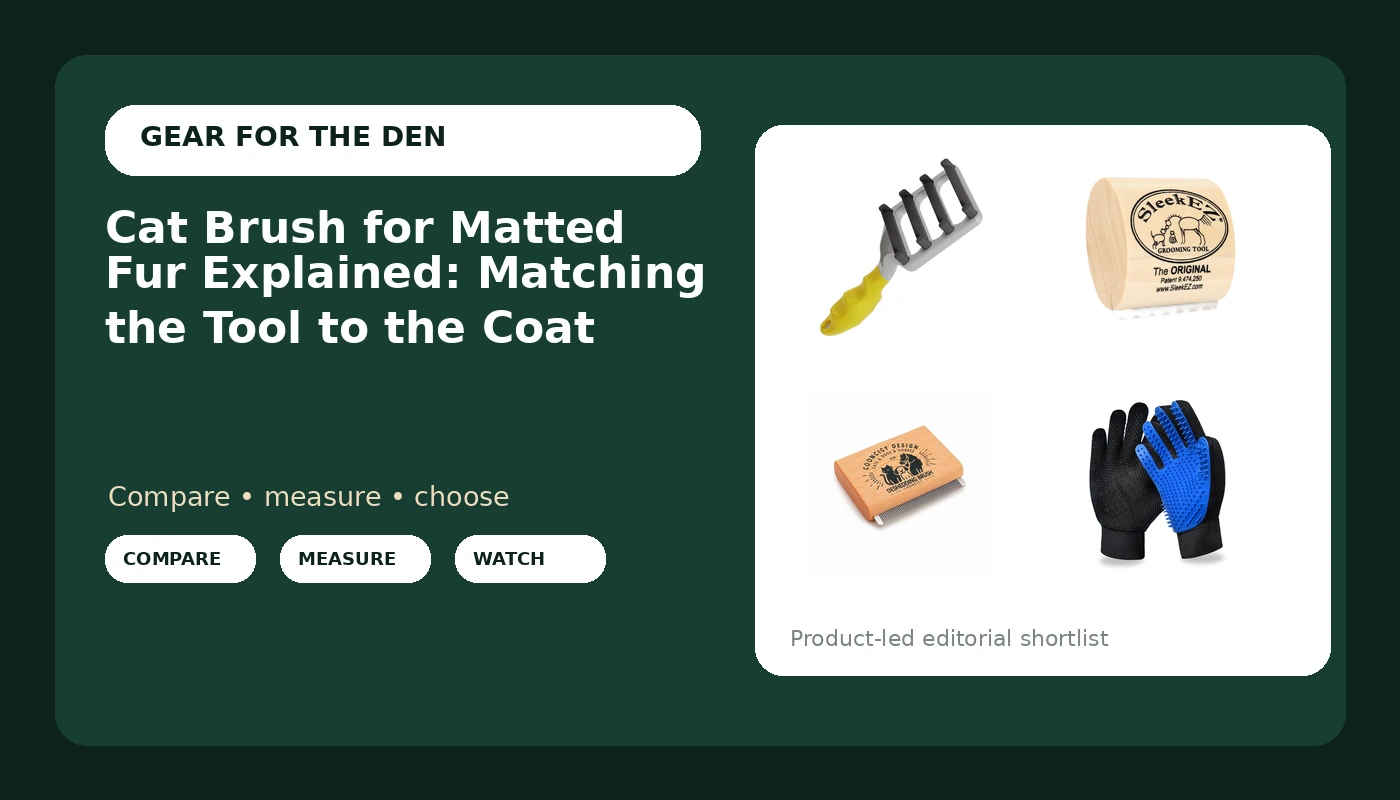
4 useful options
| Model | Best fit | What stands out |
|---|---|---|
| FUR4 deShedding Cat Brush for Short Hair Cats | Short, dense coats | Four carbon fiber deshedding edges on a compact head |
| SleekEZ Cat Brush for Shedding | Short, medium, and long coats | Patented design, made in the USA |
| Cooncicy Deshedding Brush for Cat & Small Pets | Cats and small pets sharing one tool | Single-purpose deshedding head sized for smaller animals |
| GJEASE Cat Grooming Glove Brush 2-Pack | Cats that will not sit for a brush | Two gloves that groom by hand and pick up loose hair |
For short, dense coats: FUR4 deShedding Cat Brush for Short Hair Cats
Carbon fiber is one of several bristle types you will see in cat tools, and it changes the feel of a stroke more than it changes the job. Because the head is compact and the teeth are short, this design is a poor match for a long coat: the edge never reaches the undercoat, and the topcoat takes all the friction. The trade-off for a short-coated cat is coverage. You will make more strokes on a large cat than you would with a wider head, and a cat with a dense double coat still needs those strokes done on a schedule rather than once a season.
For mixed coat lengths: SleekEZ Cat Brush for Shedding
The case for a tool that covers several coat lengths is practical: in a multi-cat home you are not buying three brushes. The case against it is that a single edge still has to be angled correctly, and a long coat rewards patience more than hardware. Part the coat, draw the edge along the direction of growth in short strokes, and stop when the tool starts to tug, because tugging on a coat that is already felting is how cats learn to hate grooming. If you want a second read on tool styles before you commit, our guide to choosing between a grooming glove and a brush covers the same trade-offs from the handling side.
For cats and small pets: Cooncicy Deshedding Brush for Cat & Small Pets
Small pets bring their own coat rules. A rabbit or guinea pig coat is dense and fine, and a head sized for a cat is not automatically the right size for a smaller animal, so start with light strokes and watch for any sign that the tool is pulling rather than collecting. If the same head is used on more than one animal, clean it between sessions so you are not moving loose hair from one coat to the next. The appeal here is simplicity: one head, one motion, and no settings to learn.
For cats that resist brushing: GJEASE Cat Grooming Glove Brush 2-Pack
A glove is not a substitute for a deshedding edge on a double coat. It gathers what is already loose, and it does that while the cat is being petted, which for a nervous cat is often the only grooming that happens at all. Treat it as an entry point. If the cat starts tolerating longer sessions, a deshedding tool added later will do more of the undercoat work than the glove can.
Prices and availability may change. Product images, names, and retailer links are matched to verified listings. No current price, rating, stock status, or measured result is stated here without current evidence.
What a cat brush for matted fur can and cannot do
A deshedding tool does one thing well: it pulls dead undercoat and loose fur out of a coat before that hair packs down. That is the mechanism behind most mat prevention. Brushing on a coat that is still smooth removes the shed hair that would otherwise mix with oil and felt against the skin, and it does so in a few minutes a week.
What these tools do not do is split an existing mat. A mat is a solid clump, and a deshedding edge dragged across it pulls the skin with it. That is how cats end up with brush burns, nicked skin, or a lasting fear of being handled. Tight mats, especially on the belly, armpits, and behind the ears, are a job for a wide-tooth comb worked from the outer edge inward, a groomer, or a vet if the skin underneath looks red, crusty, or broken.
There is also a health layer that tool shopping tends to bury. Cats stop grooming when something hurts or when they cannot reach, so arthritis, dental pain, obesity, and age often show up as a dull, clumpy coat first. If a cat that has always been sleek suddenly mats, the coat is the symptom rather than the problem.
Finally, mats are not the only source of loose hair in a house. If your search history includes cat brush for desk matted fur or cat brush for floor matted fur, the fur you are fighting is probably shed hair landing on surfaces rather than felted hair on the animal. Those are two different problems, and only one of them is solved by brushing the cat.
How coat length and undercoat change the tool
Coat length, undercoat density, and the spacing between the teeth of the tool are the three variables that matter most. A short, dense coat holds its undercoat close to the skin, so the loose hair sits near the surface and a compact head with short teeth does the work in a few strokes. A medium or long coat has a topcoat the tool has to pass through before it touches undercoat, which is why a head designed only for short hair tends to skate across the surface instead of collecting anything.
Bristle type and edge style matter for the same reason. A metal or carbon fiber deshedding edge grabs and holds loose hair. A rubber or silicone surface, like the nubs on a grooming glove, mostly lifts surface hair and picks up what is already loose. Neither is better in the abstract, because they solve different halves of the same problem.
Comb spacing is the variable people skip. Teeth packed too tightly on a long coat pull and tug. Teeth spaced too widely on a short, dense coat pass through without catching the undercoat at all. If you buy only one tool, look for one stated to work across the coat length you actually have, and expect to spend more time on a double coat in spring and fall.
- Identify your cat's coat length and whether there is a real undercoat, because that decides everything else.
- Run your fingers over the skin, not just the fur, and note any spot that is warm, tender, or already clumped.
- Match the edge to the job: a deshedding edge for loose undercoat, a wide-tooth comb for mats, a glove for surface hair on a cat that resists handling.
- Test on a small area with short strokes in the direction of growth, and look for a rounded edge or a nail guard if you plan to work near the belly and armpits.
- Set a schedule, brush for a few minutes at a time, and stop the session the moment the cat starts pulling away.
Working around mats without hurting your cat
- Never cut a mat with scissors. Cat skin is thin and loose, and it is easy to catch skin that you cannot see under the felted hair.
- Do not drag a deshedding tool across a mat. Work the outer edge of the clump with your fingers or a wide-tooth comb, a little at a time, over several short sessions.
- Keep the tool angle shallow and the strokes short, and give the cat a break before it decides grooming is a fight.
- Pick up the shed hair around the house with a roller adhesive or a damp rubber glove, the same way you would clear a desk mat, a couch cushion, or a cat bed.
- Treat sudden matting on a previously well-groomed cat as a reason to check in with your vet rather than a reason to buy a stronger brush.
Which option should you choose?
Choose the FUR4 deShedding Cat Brush for Short Hair Cats when your cat has a short, dense coat that sheds steadily and you want a compact head you can work in short strokes. Choose the SleekEZ Cat Brush for Shedding when more than one coat length lives in your house, or when your cat's coat is medium or long. Choose the Cooncicy Deshedding Brush for Cat & Small Pets when the same tool has to serve a cat and another small pet, or when you want a plain deshedding head with nothing extra to learn. Choose the GJEASE Cat Grooming Glove Brush 2-Pack when your cat will not sit still for a brush and you need something that works during petting.
One caveat applies to all four. These are prevention and maintenance tools, not mat removers, and no listing detail changes that. If your cat already has tight mats, the tool question comes second to the welfare question: loose mats can often be combed out slowly, while tight mats against the skin belong with a groomer or a vet. Prices, availability, and listing details change over time, so check the current listing before you buy rather than relying on a description.
The bottom line
A cat brush for matted fur works best as a prevention habit rather than a rescue tool. Pick the head that matches your cat's coat length, use it on a schedule before the undercoat packs down, and treat an existing mat as a handling problem instead of a brushing problem. For a short, dense coat, a compact multi-edge head like the FUR4 is the direct fit. If one tool has to cover several coat lengths, the SleekEZ is the flexible choice. If small pets share the household, the Cooncicy is the one listed for them. And if the cat will not tolerate a brush at all, the GJEASE gloves keep grooming happening in the only way that cat will allow.