Most cat carriers explained articles start with a size chart and stop there, which is backwards. A carrier is a small closed box your cat has to sit inside while the world moves, so the details that decide whether a trip goes smoothly are the ones you can check before you buy: interior length and height against your cat's nose-to-tail length, a weight limit that covers a full-grown cat plus the carrier itself, where the doors open, and how much airflow the panels actually provide. Get those wrong and every vet visit starts with a chase around the living room. Get them right and a cat will often walk in on its own. This guide covers how cat carriers are sized and built, how to read the specifications that matter, and which home gear keeps scratching and climbing needs met so the furniture survives the relationship.
Quick answer
Pick a carrier whose interior length is at least your cat's nose-to-tail length plus about two inches, and whose stated weight limit sits comfortably above your cat's weight. Prefer a model with a top opening as well as a front door, locking zipper pulls or secure latches, and mesh on more than one side. Hard-sided carriers hold their shape and stack neatly; soft-sided carriers store flat and are often easier to load through a top flap. Whichever you choose, leave it out at home with a familiar blanket inside so it stops being a strange object. On the home side of the same problem, adhesive furniture guards and a raised perch cover the two behaviors that cause the most damage: scratching and climbing.
Four useful options
| Model | Best fit | What stands out |
|---|---|---|
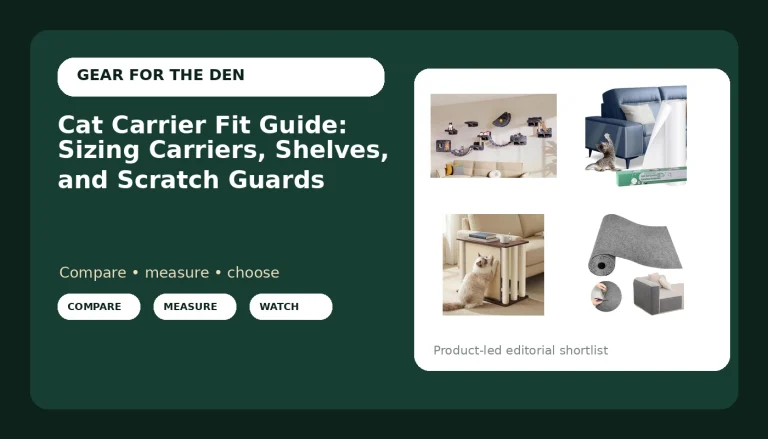
| Cat Anti Scratch Furniture Protector – Couch Scratch Protector from Cats – Furniture Protection from Cat Scratching (8) | Homes with damage spread across several furniture edges | Sold as a multi-piece set rather than one continuous roll |
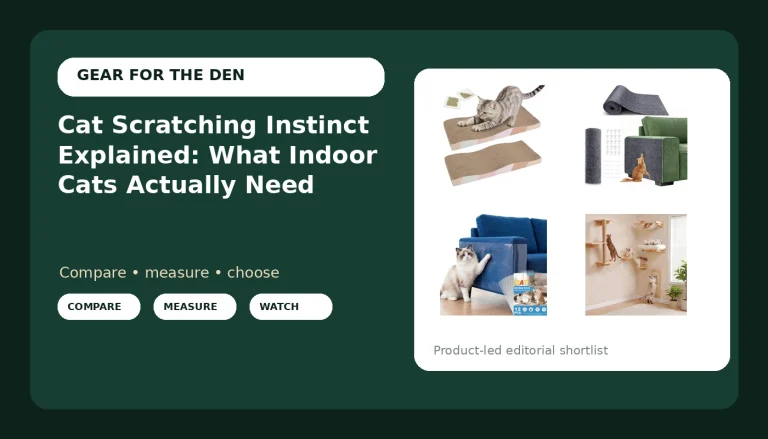
| Cat Scratch Furniture Protector – Design for Leather Couch, 157.5"x11.8" Clear Couch Protector from Cat Claws, Thickened Anti-Scratch Adhesive Roll, Cuttable & Residue-Free, No Pins | Leather sofas and long couch fronts | A wide, long roll described as thickened, cuttable, and residue-free |
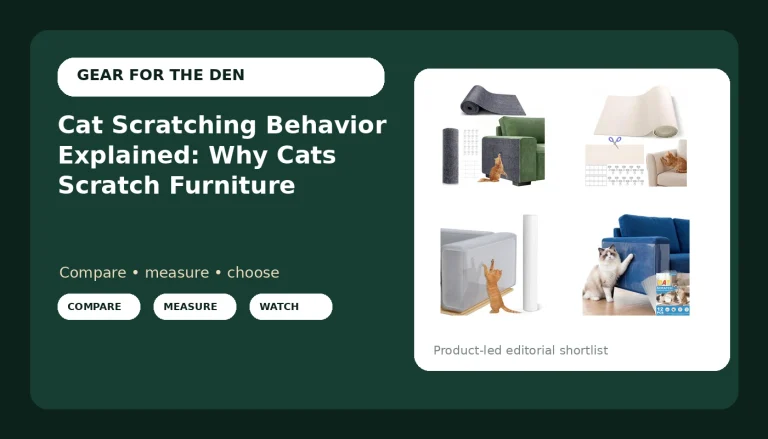
| Houlishu Cat Scratch Furniture Protector, Clear Flexible Plastic Adhesive Cover, Single Side Sticky Sofa Couch Guard, 7.87 x 196.8 Inches | Narrow trim, corners, and small panels | Nearly 197 inches of narrow, single-side sticky film |
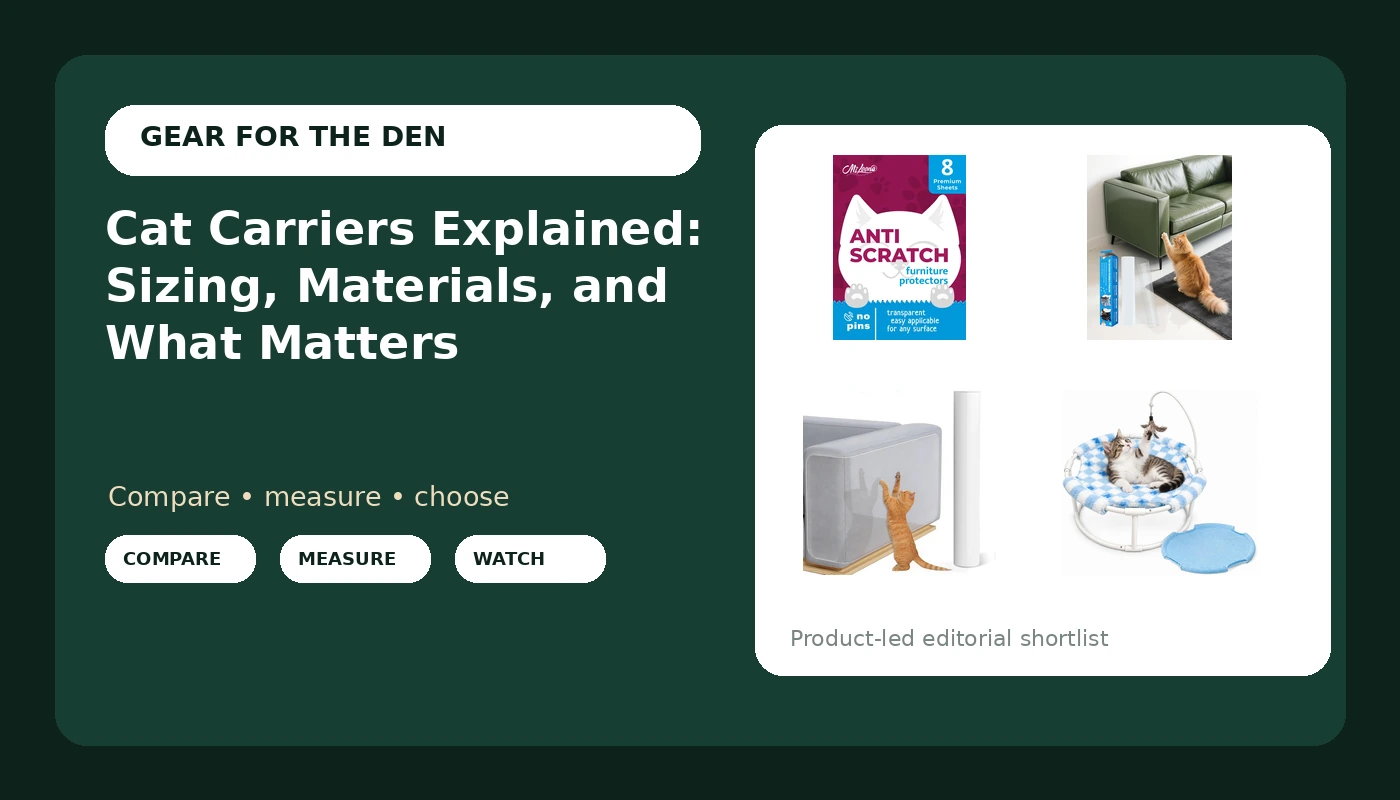
| Cat Hammock Bed with 2 Reversible Mats, 19-Inch Elevated Cat Bed, Interactive Feather Teaser Toy, Stable Round Frame for Indoor Cats and Kittens | Cats that want height instead of a floor-level bed | A 19-inch elevated round frame with two reversible mats |
The multi-piece set: Cat Anti Scratch Furniture Protector – Couch Scratch Protector from Cats – Furniture Protection from Cat Scratching (8)
Scratching usually increases around change, and a vet trip is change. A cat that has been boxed, driven, and handled often comes home and takes it out on the sofa arm. Covering the two or three spots your cat already uses removes the payoff while you work on the carrier itself. The trade-off with any adhesive film is appearance: it is visible on most upholstery, and it holds best on a clean, dry, dust-free surface. Check the maker's instructions before applying anything to leather, velvet, or a loose-weave fabric, and lift a corner slowly when you remove it.
The leather-couch roll: Cat Scratch Furniture Protector – Design for Leather Couch, 157.5"x11.8" Clear Couch Protector from Cat Claws, Thickened Anti-Scratch Adhesive Roll, Cuttable & Residue-Free, No Pins
Leather is the surface where patience pays. A wide roll like this is meant to run along a seat front or cushion edge, and because it is cuttable you can size pieces to arms and corners instead of forcing one long strip around a curve. Test a hidden patch first, since finishes vary between leather and bonded leather, and press the film down firmly so a claw cannot catch a lifted edge. The anchor type matters more than the length here: an adhesive that grips cleanly is what keeps the guard in place when a cat pulls on it.
The narrow trim roll: Houlishu Cat Scratch Furniture Protector, Clear Flexible Plastic Adhesive Cover, Single Side Sticky Sofa Couch Guard, 7.87 x 196.8 Inches
A narrow roll solves a different problem than a wide one. Cats often work on vertical surfaces: the outside corner of a sofa, a door frame, the side of a cabinet. A strip that is under eight inches wide wraps those edges without a lot of trimming, and a long roll means fewer seams to peel. Pair it with a wider product if your cat also rakes the seat cushions, since one narrow band across a big panel leaves most of the surface exposed.
The elevated perch: Cat Hammock Bed with 2 Reversible Mats, 19-Inch Elevated Cat Bed, Interactive Feather Teaser Toy, Stable Round Frame for Indoor Cats and Kittens
Scratching and climbing are not misbehavior, they are maintenance, and a cat with no legal outlet will find one on your shelves. A perch gives that energy a target. When you place one, think about platform height first: a raised bed works when the cat can see the room from it, not when it is tucked into a corner at knee level. Perch width and hammock fabric decide who uses it, since a cat that cannot stretch out will abandon a bed that looked generous in the photo. If you already own a cat tree with a thin post diameter or a shallow shelf depth, that is often why it sits empty.
Prices and availability may change. Product images, names, and retailer links are matched to verified listings. No current price, rating, stock status, or measured result is stated here without current evidence.
What actually decides whether cat carriers work
The carrier question is really a measurement question. Start with interior dimensions, not exterior ones, because a molded shell with thick walls can be far smaller inside than the box suggests. A cat should be able to stand without crouching and turn around without wedging its shoulders. What counts as ideal cat carriers for a six-pound kitten and for a fourteen-pound adult are two different products, and a kitten will outgrow the first one within a year.
Construction comes next. Hard-sided carriers hold their shape, which matters if the carrier is ever pressed against a seat or another bag. Soft-sided carriers flex, store flat, and often open from the top, which is the single most useful feature for a reluctant cat: lowering a cat in from above is far easier than pushing it through a front door. Look at the zippers or latches, the mesh count on the sides, and whether the base is rigid enough that the floor does not sag under weight.
Matching the box to the cat is what separates correct cat carriers from ones that sit unused in a closet. Weight limit is the number people skip, and it usually refers to the cat plus whatever the carrier can safely hold, not just the cat. Leave margin above your cat's current weight, especially with a growing kitten. Then practice: leave the carrier open at home, feed near it, and take a few short drives that do not end at the vet. Cats that only ride to bad places learn to hide at the sight of the box.
Numbers worth measuring around the house
Carrier size is one set of figures; the home setup has its own. Platform height determines whether a raised bed feels safe or exposed. Perch width decides whether a cat can lie flat or has to curl. Hammock fabric affects warmth and how much the surface gives under weight, which some cats like and others avoid. If you are comparing a perch to a cat tree, the post diameter and shelf depth tell you whether a full-grown cat fits, and the anchor type tells you whether the whole thing stays upright when a cat launches onto it.
For furniture protection, the equivalent numbers are coverage and adhesive behavior. Measure the couch front, arm, and corner you intend to cover, then compare that to what a roll or set actually provides. A 157.5-inch roll and a 196.8-inch roll cover very different amounts of a sectional. Decide whether you want one wide panel or several narrow strips, since corners wrap better with narrow film and flat cushion fronts look cleaner with wide film. Whichever you use, clean the surface, press down firmly, and check a hidden spot first on leather or a delicate weave.
- Measure your cat from the base of the tail to the tip of the nose while it stands, then add roughly two inches for interior length.
- Weigh your cat and compare that figure to the carrier's stated weight limit, leaving room for growth or winter weight.
- Decide whether you need a top opening, because a cat that panics at a front door loads far more easily from above.
- Count the mesh panels, since airflow on one side only is much less than airflow on three.
- Set the carrier out open for a week before the first trip, with a worn shirt or familiar blanket inside.
Practical guidance for carrier day and the days around it
- Leave the carrier out between trips with the door tied open so it reads as furniture rather than a warning sign.
- Secure the carrier with a seat belt or wedge it behind a seat, since a loose carrier becomes a projectile in a sudden stop.
- Skip the meal right before a drive if your cat gets carsick, and pack a towel for the trip home.
- Put a perch near a window so climbing energy has an outlet that is not the top of a door or a bookshelf.
- Apply adhesive guards to clean, dry surfaces, press them down firmly, and test a hidden patch before covering leather.
Which option should you choose?
Choose the Cat Anti Scratch Furniture Protector – Couch Scratch Protector from Cats – Furniture Protection from Cat Scratching (8) when scratching is spread across several pieces of furniture and you want a set of pieces rather than one long roll. Choose the Cat Scratch Furniture Protector – Design for Leather Couch, 157.5"x11.8" Clear Couch Protector from Cat Claws, Thickened Anti-Scratch Adhesive Roll, Cuttable & Residue-Free, No Pins when the main target is a leather sofa front and you want a wide roll you can cut to fit. Choose the Houlishu Cat Scratch Furniture Protector, Clear Flexible Plastic Adhesive Cover, Single Side Sticky Sofa Couch Guard, 7.87 x 196.8 Inches when the damage is on corners, trim, and narrow vertical faces. Choose the Cat Hammock Bed with 2 Reversible Mats, 19-Inch Elevated Cat Bed, Interactive Feather Teaser Toy, Stable Round Frame for Indoor Cats and Kittens when your cat needs somewhere to climb that is not your shelves.
None of these four replaces a carrier, and none of them is a fix for a cat that is scratching because of stress, fleas, or pain. If scratching started suddenly or comes with overgrooming, talk to your vet before buying anything. Product listings change, so confirm dimensions and materials on the current page before you order.
The bottom line
Cat carriers are a measurement purchase, not a style purchase. Size the interior to your cat's full adult length, keep a margin on the weight limit, and favor a carrier that opens from the top as well as the front. Around the house, the same logic applies to the gear that absorbs scratching and climbing: cover the surfaces your cat already uses, give it a perch with enough width and height to be worth using, and measure before you buy either. For a wider look at keeping a multi-cat household calm, see our guide to setting up a home for more than one cat.