Cat feeding mat waterproofing is a small detail that becomes a large one the third time you mop under the bowls. The mat is a barrier: it catches drips from a water bowl, splash from a fountain, and kibble dust from a dispenser before any of it reaches the floor or the seams of a laminate plank. Waterproofing is a property of the material and the edge, not of thickness, color, or pattern. So here is cat feeding mat waterproofing explained in practical terms: where the water comes from, what actually stops it, and which feeding gear sitting on top makes the mess worse. The products below are the feeding tools that generate the spills in the first place, because a mat is only as useful as the station above it.
Quick answer
A mat is waterproof when its top surface does not absorb liquid and its backing does not wick that liquid through to the floor. In practice that means a solid silicone or rubber sheet, a coated fabric with a sealed underside, or a molded tray with a raised lip around the perimeter. Thickness, color, and print say nothing about waterproofing, and no mat makes a feeder or a fountain waterproof; the mat protects the flooring while the appliance's own design decides whether anything leaks. For the gear itself, portion size, bowl width, and water capacity tell you how much mess a station can produce.
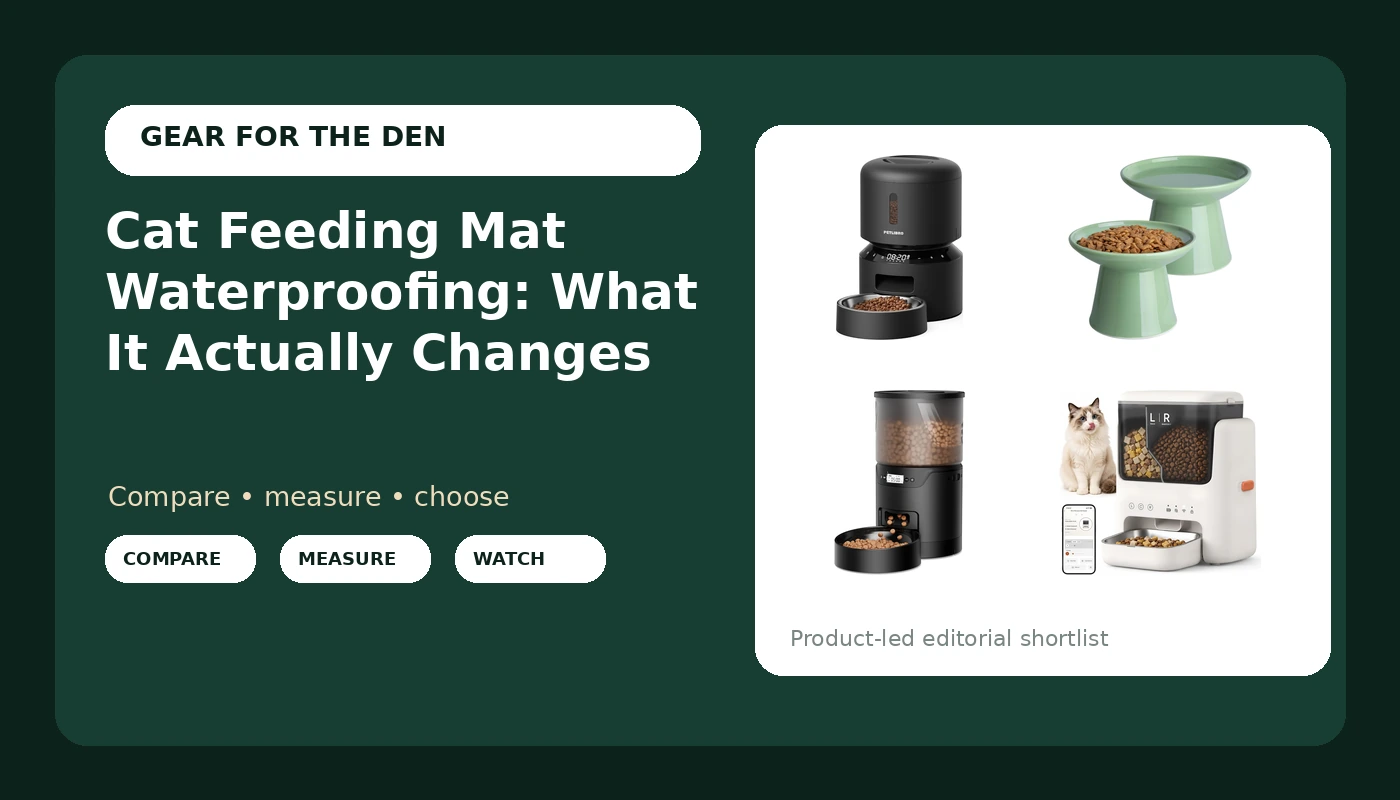
Four useful options
These are feeding tools rather than mats, and each one changes how much food or water ends up on the surface underneath.
| Model | Best fit | What stands out |
|---|---|---|
| PETLIBRO Automatic Cat Feeder, Timed Dry Food Dispenser for Cat & Small Dog | Scheduled dry-food meals for a cat or a small dog | Timer-based dispensing of dry food |
| KITCHENLESTAR Ceramic Elevated Cat Food Bowls, 6.2" Wide, 2-Pack, Green | Cats that do better with a raised, wide bowl | Ceramic bowls with a 6.2 inch opening, two per pack |
| IMIPAW PET Automatic Cat Feeder, 3L Timed Dispenser with 6 Meal Programming | Portion control without app dependency | Six programmable meals and 1 to 20 portion control |
| Automatic Cat Feeder, Dual Hopper for Meals & Treats, App Control | Households that want meals and treats from one unit | Two hoppers plus app control |
Scheduled dry food: PETLIBRO Automatic Cat Feeder, Timed Dry Food Dispenser for Cat & Small Dog
A timed dry-food dispenser produces crumbs rather than puddles, which changes what the mat has to do. Kibble that misses the bowl bounces and rolls, and fine dust settles into the texture of a mat, so a smooth silicone surface is easier to shake clean than a fabric one with a deep pile. Portion size matters here too: a portion that is too large for the bowl in front of it is the usual reason kibble ends up on the mat instead of in the cat. Because this feeder handles dry food only, the waterproofing question around it is mostly about the water bowl placed beside it. If that bowl is a fountain, water capacity, pump noise, and filter type become the variables that decide how wet the mat gets.
Elevated bowl pair: KITCHENLESTAR Ceramic Elevated Cat Food Bowls, 6.2" Wide, 2-Pack, Green
Ceramic bowls sit heavier on a surface than thin plastic, so they slide less, and a bowl that stays put spills less. The wide opening gives more whisker clearance than a narrow dish, and the raised stand changes the elevation angle at which the cat reaches the food. Both are comfort variables rather than waterproofing variables, but they affect the mat indirectly, because a cat that eats comfortably is less likely to drag food out of the bowl and across the surface. Two bowls in one pack also means one can be in the wash while the other is in use, which keeps the station tidier and the mat cleaner. Ceramic is not unbreakable, so a mat with a little give under the bowls is worth considering.
Portion control on a budget: IMIPAW PET Automatic Cat Feeder, 3L Auto Food Dispenser
This is the budget-minded version of the timed dispenser idea: a 3L hopper, six meal slots, and portion control from 1 to 20 units per meal. The desiccant bag is there to keep dry food fresh in the hopper, and the product is described as easy to clean and set up. How easily a hopper empties and wipes matters more than most buyers expect, because stale crumbs at the base of a hopper are one of the ways food ends up scattered around the mat instead of eaten. None of that makes the unit itself waterproof. As with any powered dispenser, cleaning means wiping rather than rinsing, so keep the base on a dry stretch of mat and lift the whole unit off the mat when you clean underneath it.
Meals and treats in one unit: Automatic Cat Feeder, Dual Hopper for Meals & Treats, App Control
Two hoppers change the feeding station more than they change the mat. Meals and treats come from separate compartments, and scheduling runs through an app, which suits owners who want to adjust feeding times without crouching over the unit. The trade-off is more to configure and more surfaces to keep clean, and a treat-heavy routine tends to leave more crumbs on the mat than a plain dry-food schedule. If the station also includes a fountain, keep the fountain at the far end of a long mat or on its own mat, so that splashing and pump noise do not sit directly beside the feeder base. That single placement decision does more for floor protection than the mat's thickness ever will.
Prices and availability may change. Product images, names, and retailer links are matched to verified listings. No current price, rating, stock status, or measured result is stated here without current evidence.
What cat feeding mat waterproofing actually means
The phrase cat feeding mat waterproofing describes two separate things, and mixing them up is why some mats disappoint. The first is the top surface: does it absorb a spill or shed it? Microfiber, chenille, and felt tops soak up liquid and hold it against the floor until you wash the mat, which is fine for crumbs and useless for a tipped water bowl. Silicone, TPR, PVC, and coated polyester shed liquid, so a spill can be wiped or poured off. The second is the backing: a mat with a coated or non-porous top and an unsealed fabric underside can still pass moisture through by wicking. A cat feeding floor mat waterproofing claim usually rests on both layers being non-porous, or on a molded tray that simply holds water like a shallow pan.
A raised lip is the most reliable feature, because it gives spilled water somewhere to sit instead of somewhere to run. Flat mats rely on the material alone, and water that reaches an unfinished edge can travel around it. Backing matters as much as the top: a rubberized or textured underside keeps the mat from sliding, and a mat that folds or bunches can channel water toward the floor rather than away from it. Thickness is not a waterproofing spec. A thick fabric mat is often more absorbent, not less.
Anyone searching for cat feeding desk mat waterproofing is usually feeding on a table, a counter, or a windowsill, where the same rules apply on a smaller footprint. A silicone desk mat with a molded lip does on a tabletop what a floor mat does on tile. Cat-specific details matter too. A microchip-activated feeder only opens within its microchip range, so the cat stands close and low to the unit, and that is exactly where drool and drips land. Wet food bowls leave a residue that holds moisture against the mat, which is why wipe-clean beats plush in most cat households.
Materials, edges, and where the water comes from
Water reaches the floor from a handful of predictable places: a cat pawing at a water bowl, splash from a fountain, water carried out of the bowl in the mouth, condensation on a chilled bowl, and the wet ring left under a bowl that is refilled in place. Dry feeders add crumbs and dust instead. Knowing which of those you actually have decides what the mat needs to do.
- Measure the station footprint, including the bowls, the feeder base, and any fountain, then add clearance on every side.
- Decide what the mat must handle: crumbs only, or standing water from a bowl or fountain.
- Choose the material to match, silicone or a molded tray for water, coated fabric with a sealed backing if the look matters.
- Check the edge and the underside, looking for a raised lip and a grip backing rather than a stitched seam that pierces the top layer.
- Plan the cleaning routine before buying, since a mat that is hard to wash gets used dirty and stops doing its job.
Keeping the feeding station dry day to day
- Put the water bowl on the section with the lip, and keep the feeder on the flatter part of the mat.
- Leave a gap between the feeder and the fountain so splash does not reach the dispenser base.
- Shake crumbs off before wiping, because wiping first pushes dust deeper into the surface texture.
- Lift the bowls and the feeder regularly and wipe the mat underneath, since trapped residue holds moisture.
- Check the floor under the mat every month or so, because slow trapped moisture, not the visible spill, is what damages wood and laminate.
- Re-measure the mat after changing gear, such as adding a wider bowl or a taller fountain.
Which option should you choose?
Choose the PETLIBRO Automatic Cat Feeder, Timed Dry Food Dispenser for Cat & Small Dog when you want a straightforward timed dry-food schedule and no app. Choose the KITCHENLESTAR Ceramic Elevated Cat Food Bowls, 6.2" Wide, 2-Pack, Green when the priority is a wide ceramic bowl at a raised height for a cat currently eating from a floor-level dish. Choose the IMIPAW PET Automatic Cat Feeder, 3L Auto Food Dispenser when you want programmable meals and portion control on a tighter budget. Choose the Automatic Cat Feeder, Dual Hopper for Meals & Treats, App Control when meals and treats need to come from one unit and app scheduling suits your routine.
None of these four products is a mat, and none is sold as waterproof, so the waterproofing discussion applies to the surface you place under them. Sizes, materials, and availability change, and no measured absorbency or leak result is claimed here.
The bottom line
Cat feeding mat waterproofing comes down to two questions: does the top shed liquid, and does the underside keep it from reaching the floor? A molded tray with a raised lip answers both for a fountain or a messy water bowl, while a wipe-clean silicone sheet is enough for a dry feeder that only drops crumbs. The feeding gear matters because it decides how much mess exists in the first place. A wide ceramic bowl on a raised stand slides less, a programmable dispenser with sensible portion size drops less food outside the bowl, and a fountain placed away from the feeder keeps splash off the base. Match the mat to the station, keep the station tidy, and check the floor underneath now and then.