Walk into any pet store and you will find two shelves: one full of bins and scoops, and one full of machines that drop kibble on a timer. The cat food storage container vs canister question belongs to the first shelf, but it quietly decides what you buy from the second, because every automatic feeder is a sealed hopper with a motor bolted underneath. Get the hopper wrong and the feeder is wrong, no matter how long the feature list is. Get it right and the machine disappears into your routine, which is the entire point of buying one.
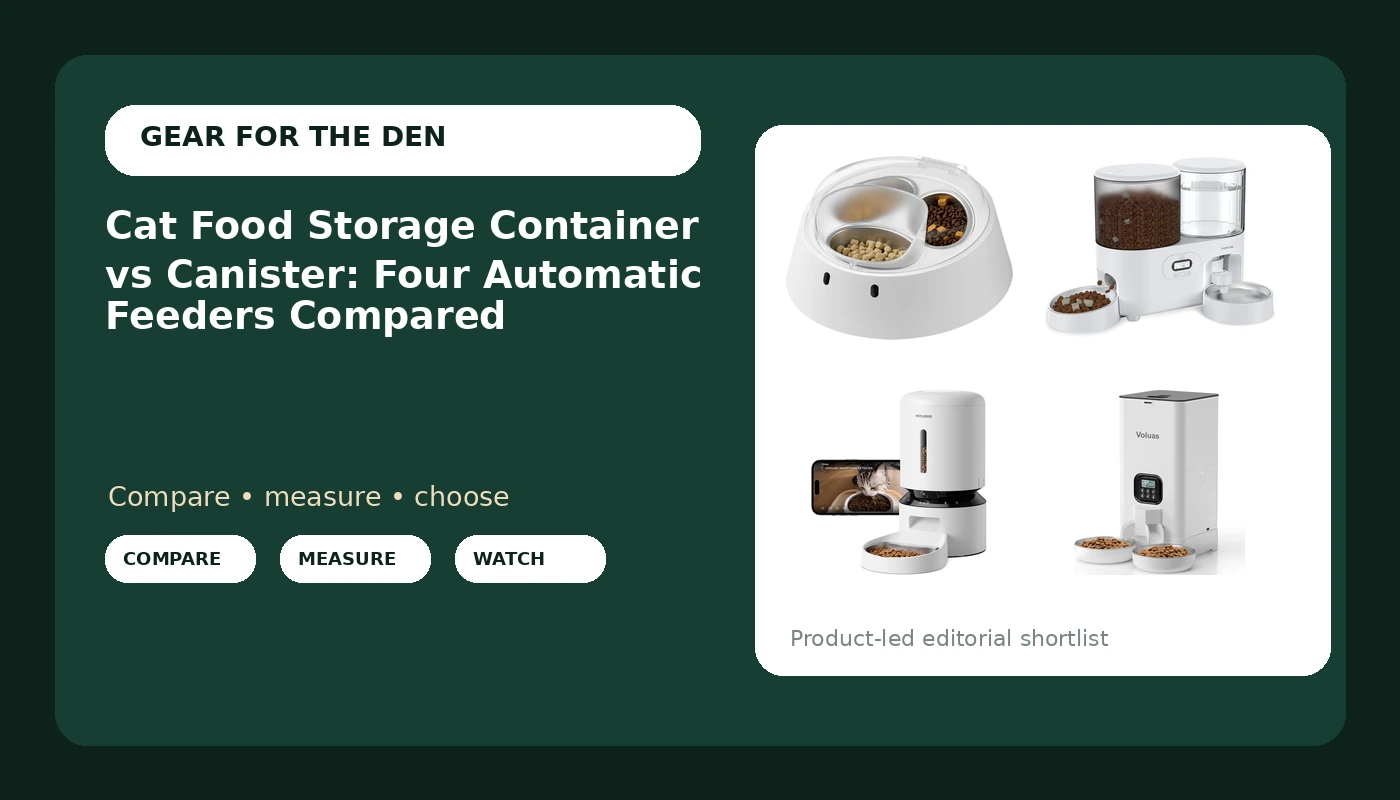
I compared four feeders from that second shelf using what their listings promise: an RFID access-control unit, a 10L feeder and water combo, a camera feeder, and a 6L dual-bowl feeder. I have not run all four side by side on a bench, so treat this as a spec-level comparison rather than a lab report. What I can do is tell you which design decisions matter, which ones are marketing, and where each of these four machines fits in a real kitchen with real cats.
Short answer: the VOLUAS 6L dual-bowl feeder is the pick for most two-cat homes, the Adolug RFID unit is the only one here that stops food theft, the Yuposl 10L combo wins for long absences, and the PETLIBRO camera feeder earns its place only if you genuinely want to watch your cat eat at 2 a.m.
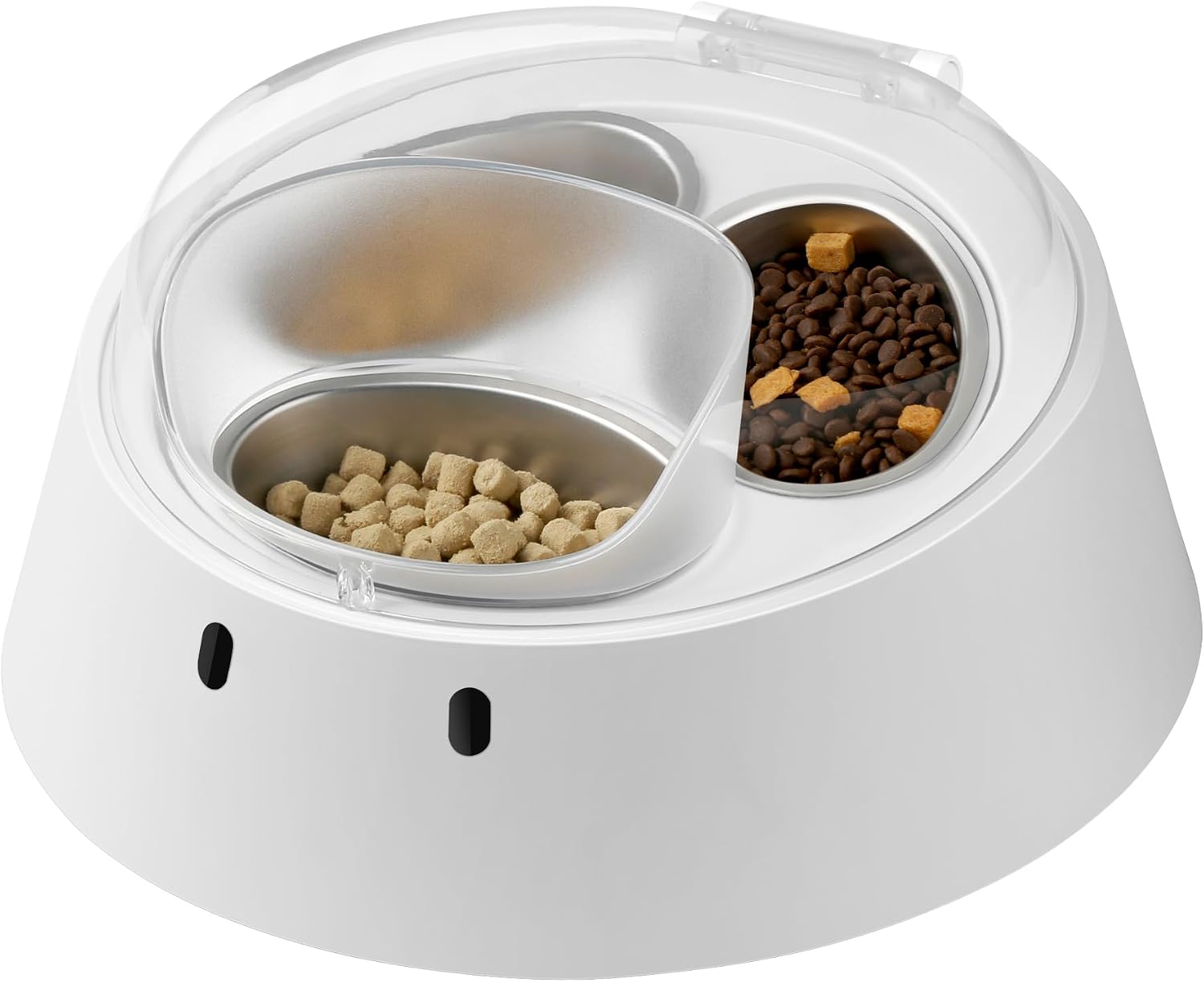
Adolug RFID Microchip Cat Feeder, 1 Tag Opens 2 Hidden Bowls, Anti-Theft
The only feeder here that gates food behind a tag: one RFID tag opens two hidden bowls, which is real anti-theft control in a multi-cat house
It manages access, not volume, so it does not solve bulk storage or watering at all
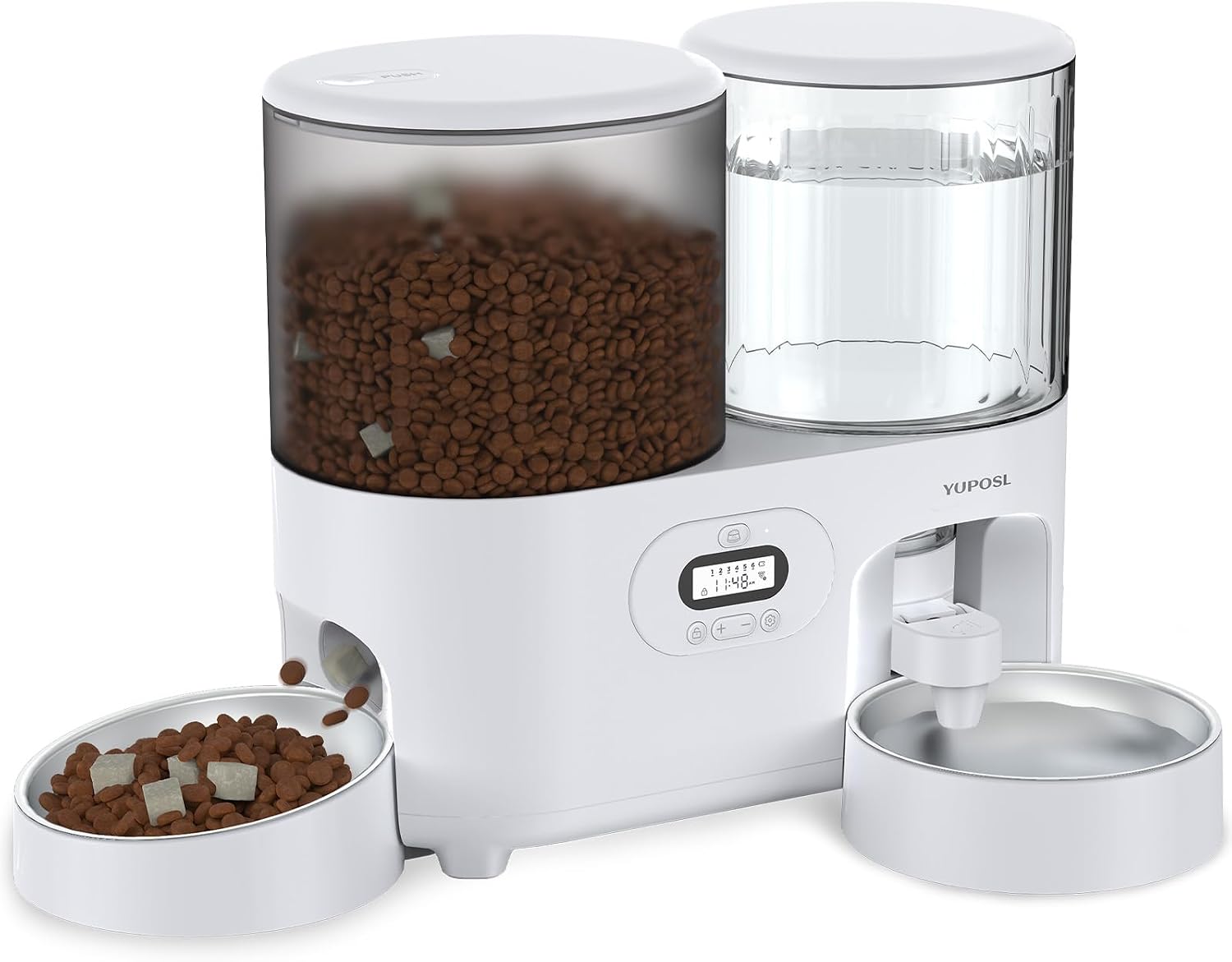
Yuposl Automatic Cat Feeder and Cat Water Dispenser, 10L Large Capacity
Feeder and water dispenser in one 10L unit, so long trips need fewer refills and one outlet instead of two
Shared footprint and shared failure point, and no access control for households with a food thief
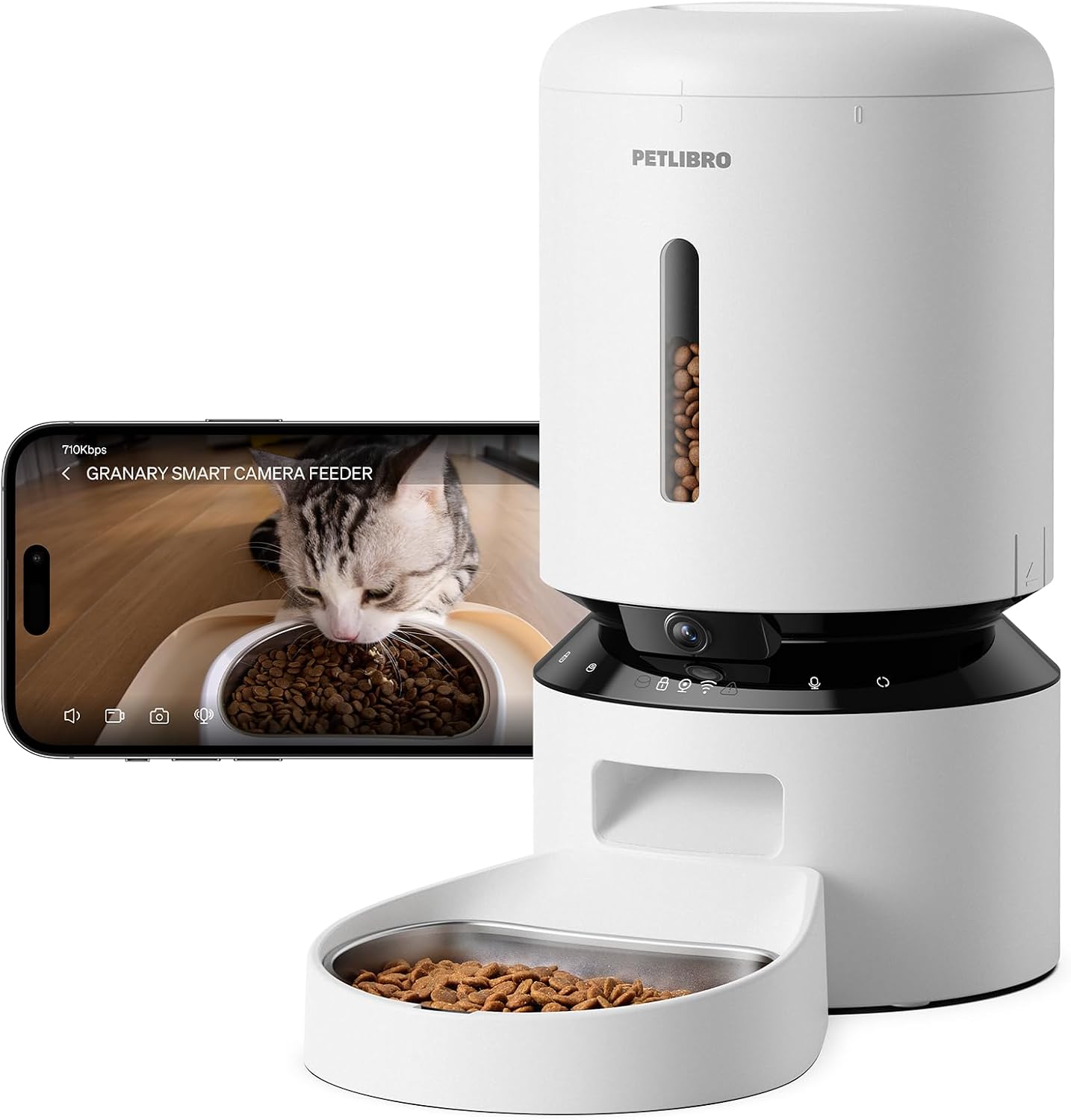
PETLIBRO Automatic Cat Feeder with Camera, 1080P HD Video & Night Vision
1080P HD video with night vision turns feeding into something you can actually verify from another room
The camera does nothing for storage or capacity, and video is the most expensive feature you can pay for here
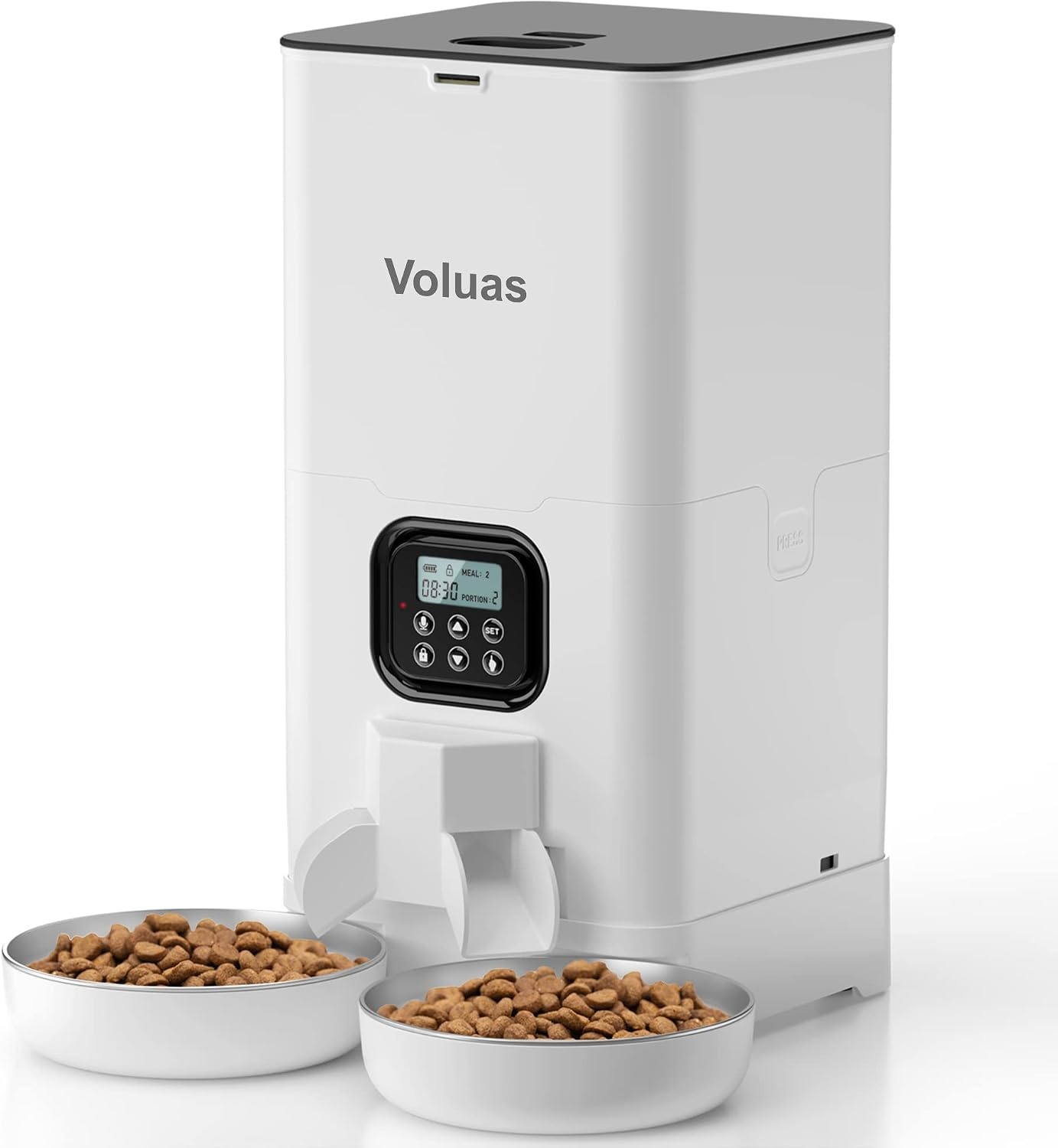
VOLUAS Automatic Cat Feeder for Two Cats with Dual Stainless Bowls, 6L
A 6L hopper feeding dual stainless bowls built for two cats, which is the simplest useful shape a feeder can take
Two open bowls invite competition, so a fast eater can still finish both portions
Prices and availability may change.
How I compare automatic feeders
Four things decide whether a feeder earns permanent counter space, and none of them is the length of the feature list.
Storage. Every feeder holds kibble in a hopper, which is a canister wearing a different hat. Volume matters less than seal and light exposure. A large hopper that lets air and light in will stale food faster than a smaller one with a proper gasket, because kibble loses aroma as it oxidizes, and a cat that refuses food is usually refusing stale food.
Delivery. Portion size, how the food lands in the bowl, and how wide that bowl is. A bowl that is too narrow makes a cat eat with its whiskers pressed against the rim, and that whisker clearance problem is a real reason cats walk away from a full dish.
Access. An open bowl feeds every animal in the house. A gated bowl feeds one. That single distinction matters more than capacity in a two-cat home.
Water and monitoring. Water capacity, pump noise, and filter type matter if the unit includes a fountain, because a loud pump gets unplugged. A camera matters if you want to see intake rather than count portions.
The cat food storage container vs canister debate in a feeder
The difference between cat food storage container and canister is mostly shape, seal, and how the food comes out. A container is wide-mouthed and scooped. A canister is tall, narrow, and poured. The canister vs cat food storage container argument usually turns into a fight about seals and light, and the canister wins both: a narrow neck takes a tighter lid, and an opaque body blocks the light that degrades fat in kibble.
So if you are choosing a cat food storage container or canister for the bag in your pantry, the canister is the safer default for anything you will not finish in a few weeks. The container is better if you scoop daily and want to see how much is left without lifting a lid.
Now apply that to feeders. The hopper in the Yuposl 10L combo, the PETLIBRO camera feeder, and the VOLUAS 6L is a canister: you pour kibble in and the machine dispenses it in measured drops. The Adolug does not really use a storage canister at all. It stores food in two hidden bowls that open only for the cat wearing the tag, which is a completely different answer to the same problem.
Framed as cat food storage container vs canister, the honest conclusion for feeders is that you get both in one body, and the storage half is the half nobody advertises. Also worth noting: raising any of these bowls on a stand changes the elevation angle, and a cat with arthritis often eats better from a raised dish than a floor-level one.
Access control: the Adolug RFID feeder
The Adolug RFID Microchip Cat Feeder is the odd one out in this group, and for some households it is the only one that matters. One RFID tag opens two hidden bowls, and the anti-theft design means the food is not sitting open for whoever walks past. In a house where one cat inhales everything and the other grazes, that is not a convenience feature, it is the difference between a diet working and a diet failing.
What you need to understand before buying is microchip range. Tag-based access depends on the tag being close enough to the reader at the moment the cat arrives, and a cat that approaches from an awkward angle can wait a beat longer than you expect. Hanging the tag on a collar solves most of it, but check how the unit is meant to be mounted and whether the tag is the collar type or something else.
The trade-off is straightforward: no large hopper, no water, no camera. It is a portion-controlled gate, not a storage system. If your problem is bulk storage for a 16-pound bag of kibble, this is the wrong tool. If your problem is a cat stealing another cat's dinner, it is the only tool on this list.
Capacity and water: the Yuposl 10L combo
The Yuposl Automatic Cat Feeder and Cat Water Dispenser is the one to look at if you travel, work long shifts, or simply hate refilling things. The listing advertises a 10L large capacity across a feeder and a water dispenser in a single unit, which is the biggest number in this comparison and the main reason it exists.
Two systems in one body has an obvious upside and an obvious cost. The upside is fewer outlets, fewer cords, and one place to check before you leave the house. The cost is that both halves share a footprint and a failure point, and if the pump develops a rattle you cannot just ignore the water side while keeping the food side.
On the water half, listen for pump noise before you commit, and check the filter type, because replacement filters are the hidden subscription in every fountain. On the food half, watch the portion size settings against your cat's actual calorie needs. A 10L hopper is a lot of kibble, and a big hopper makes it easy to overfill and then overfeed.
What it does not do is gate food. Any cat in the house can eat from it, so pair it with a separate solution if you have a thief.
Remote monitoring: the PETLIBRO camera feeder
The PETLIBRO Automatic Cat Feeder with Camera is the premium pick here, and it is the only one that lets you look instead of guess. The listing promises 1080P HD video and night vision, which means you can check on a cat after dark without turning on a kitchen light.
That matters in three situations: a cat on a prescription diet you need to confirm is being eaten, a senior cat you are watching for weight loss, and a multi-cat home where you want to know which cat actually shows up at the bowl. A camera does not fix anything, but it turns a vague worry into something you can observe, and that is worth real money to some owners.
It is also the feature most people pay for and then never open. If you are not the type to check an app, the camera is dead weight and you are better off spending that budget on capacity or access control instead. A camera feeder also needs a network to be useful, so think about where the unit sits relative to your router before you buy.
Dual bowls and stainless steel: the VOLUAS 6L
The VOLUAS Automatic Cat Feeder for Two Cats with Dual Stainless Bowls is the most conventional design in the group, and conventional is a compliment here. A 6L hopper, two stainless bowls, and a shape built for two cats eating at the same time. Nothing in that description needs explaining, which is exactly why it works for most homes.
Stainless steel is the right material for a cat bowl. It does not hold onto oils and odors the way plastic does, it cleans up fast, and it does not develop the scratches that trap bacteria. Dual bowls also mean two cats can eat simultaneously instead of one waiting while the other finishes, which reduces the guarding behavior that shows up around a single dish.
The weakness is the same as its strength. Two open bowls mean no access control, so a fast cat can finish its own portion and then push the slower cat off the second bowl. Bowl width and portion size are the two specs to check against your cats, and if one of them is a gulper, this is not the machine that fixes it.
Trade-offs the table cannot show
A comparison table can only carry what the listings state, and several things that decide daily life are not in there. Noise is the big one. Motors, augers, and pumps all make sound, and a feeder that wakes you at 5 a.m. is a feeder you will resent.
Cleaning cadence is another. Hoppers need emptying and wiping between bags, bowls need daily rinsing with stainless and more often with plastic, and fountains need the pump pulled apart periodically. None of these listings tells you how many parts you will be scrubbing.
Then there is power behavior. What happens during an outage is not something I can confirm from a product name, and it matters if you are away. Same for whether a hopper is genuinely airtight, whether parts are dishwasher safe, and how the unit handles a jam. Verify those in the listing or the manual before you spend.
Finally, none of these four replaces a storage container for your bulk bag. You still need somewhere to keep the rest of the kibble.
Which feeder fits which household
Match the machine to the problem rather than to the feature list.
If you have two cats who eat peacefully and you want the simplest reliable setup, take the VOLUAS 6L dual-bowl feeder. Stainless bowls, a 6L hopper, and no gimmicks.
If one cat steals from the other, take the Adolug RFID unit. Access control is the only feature that solves that problem, and nothing else on this list does it.
If you are away for long stretches and want food and water handled in one place, take the Yuposl 10L combo, and budget for filters.
If you are managing a health issue and want eyes on the bowl, take the PETLIBRO camera feeder, and be honest with yourself about whether you will actually open the feed.
What I am watching next
The category is converging fast. Feeders are absorbing fountains, cameras are dropping into mid-tier units, and tag-based access control keeps getting cheaper, which means the gaps between these four will narrow within a year or two.
The thing I would like to see more of is honesty about storage. A hopper is a canister, and the brands that say so on the box, with a real gasket and an opaque body, are the ones worth trusting with a month of kibble. Until then, read the seal before you read the feature list.