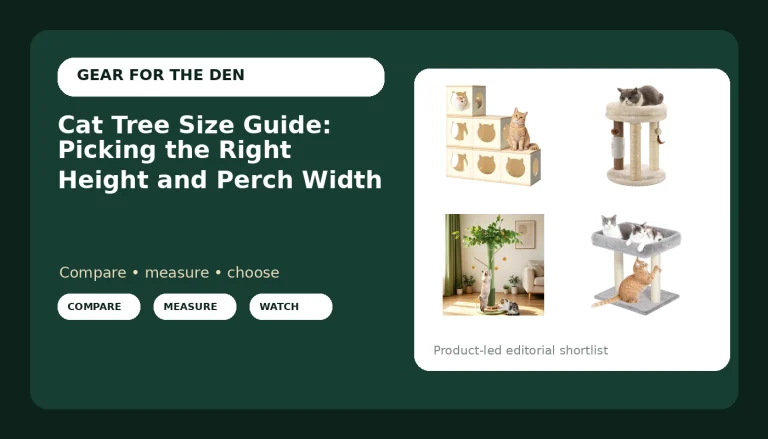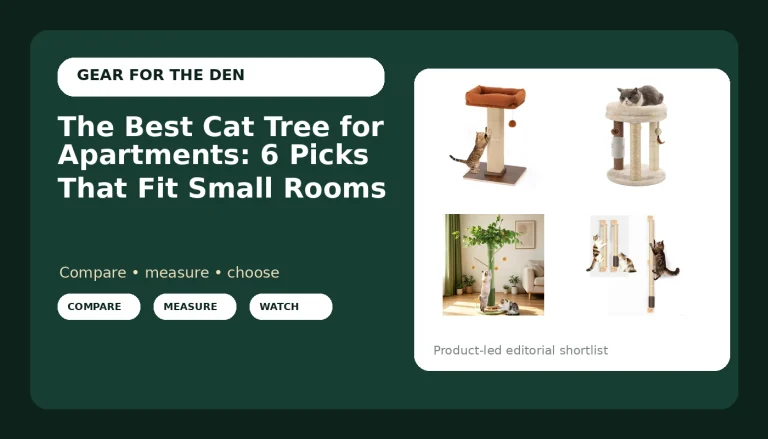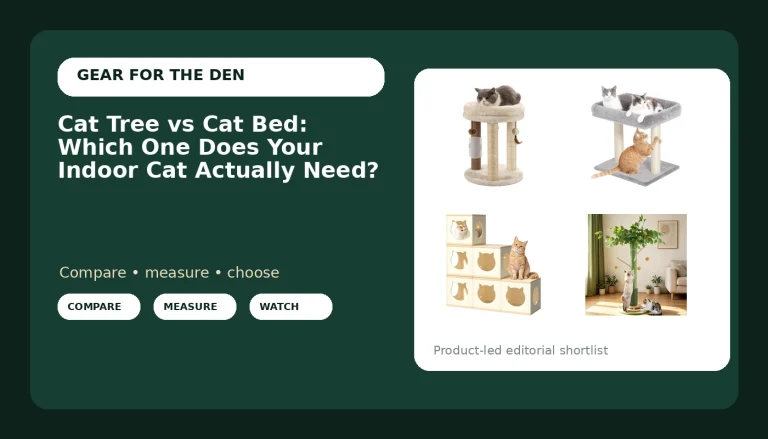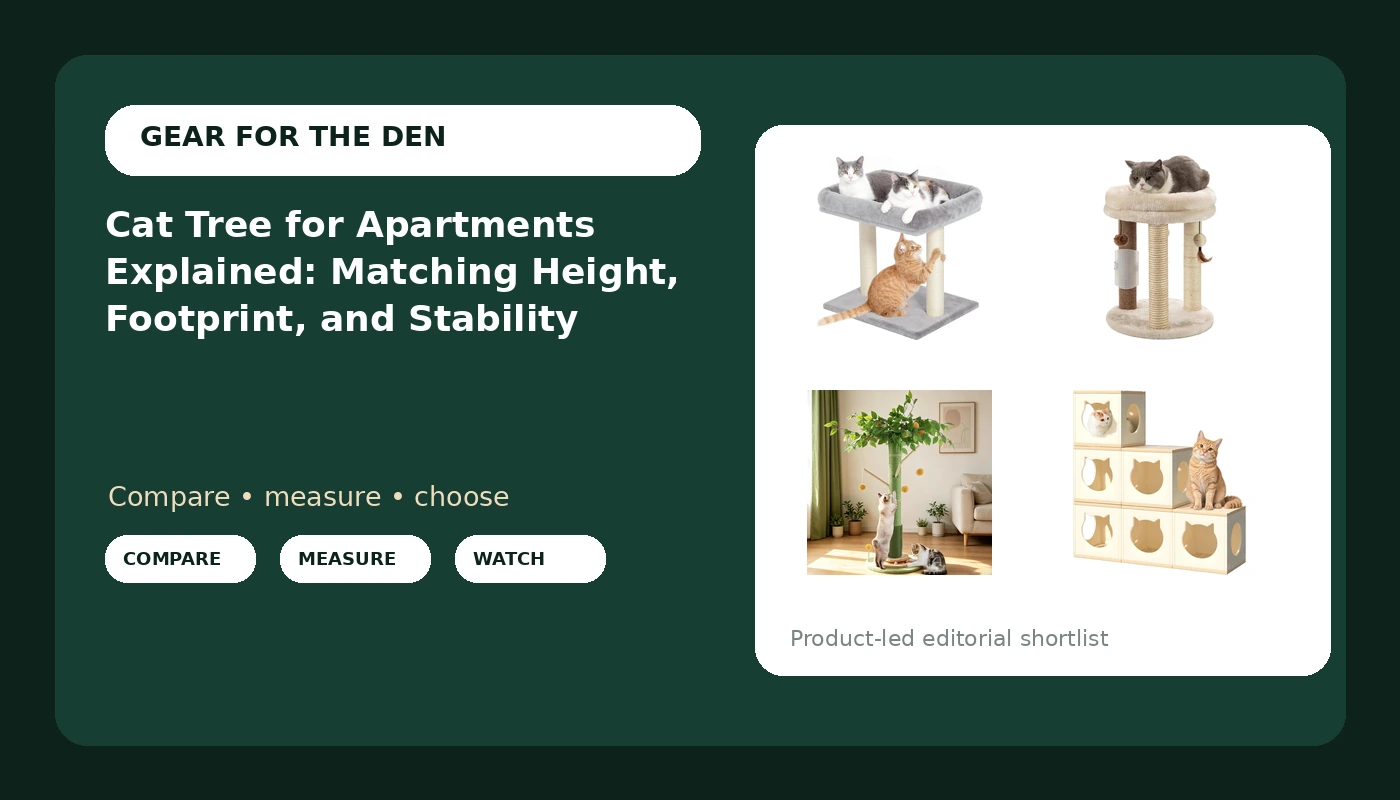
A studio or one-bedroom floor plan punishes gear that assumes space you do not have. A cat tree for apartments has to do three jobs at once: give a cat vertical territory, absorb daily scratching, and stay out of the walking path between the kitchen and the door. Most listings sell height and skip the details that decide whether the thing actually works in a small room, such as how much floor the base eats, how wide the top perch is, and whether the whole unit rocks when a cat launches off it.
This is a cat tree for apartments explained piece rather than a ranking, because the four listings below cover the shapes a small apartment can realistically accept, from a 19 inch perch tree to a stackable cube tower. The useful question is not which one is biggest. It is which shape matches your room, your cat, and your tolerance for wobble.
Quick answer
The short version of cat tree for apartments explained is this: the correct cat tree for apartments is the one that fits the floor space you actually have free, not the one with the highest top platform. Prioritize three things in order: a base that sits flat without rocking, a post diameter thick enough that an adult cat cannot wrap a paw around it, and a perch wide enough for the cat to lie down rather than balance. Then check the tallest platform against your cat's normal jumping range, and read the stated weight limit against your cat's current size rather than the size it was as a kitten.
Four useful options
| Model | Best fit | What stands out |
|---|---|---|
| KinoTail 19" Small Cat Tree with Scratching Post for Indoor Cats with Perch | Tight corners and single-cat rooms | Short footprint with a dedicated perch and a scratch post |
| MECOOL 4in1 Small Cat Tree,Scratching Post with Tower Soft Bed, Sisal Carpet Jute Posts with Three Hanging Ball Toys and Massage Brush for Indoor Cats | First-time buyers who want the extras included | Bed, hanging toys, and a massage brush in one unit |
| 46" Tall Cat Scratching Post, Natural Sisal Cat Tree for Indoor Adult Cats | Cats that need a tall vertical scratch target | A 46 inch post aimed at adult cats |
| 6-Cube Stackable Cat Tree Tower, Plastic Cat Tunnel for Indoor Cats | Rooms that need the tree to change shape | Six stackable cubes plus a plastic tunnel |
Smallest footprint: KinoTail 19" Small Cat Tree with Scratching Post for Indoor Cats with Perch
A 19 inch tree is a compromise, and it is worth being honest about what you give up. The top perch sits low, so a cat that already climbs bookcases will treat it as a step rather than a destination. What you gain is floor space and a scratch surface that is always within reach. If your cat currently shreds the arm of the couch, a low post placed directly in front of that couch changes the target without adding a piece of furniture that dominates the room. Shelf depth matters here: measure the gap you have and confirm the base clears it with room for the cat to land.
Feature-dense starter: MECOOL 4in1 Small Cat Tree,Scratching Post with Tower Soft Bed, Sisal Carpet Jute Posts with Three Hanging Ball Toys and Massage Brush for Indoor Cats
The trade-off with a feature-dense unit is that a busier frame gives a nervous cat more to inspect before it commits. The soft bed tends to get used first by cats that already sleep on your furniture, and the hanging toys do most of their work in the first weeks, when the tree is still new. Check the strings on hanging toys as part of your monthly once-over, since that is the part most likely to loosen. If you have a large adult cat, weigh the stated weight limit against the cat and treat the top perch as a perch rather than a launch pad.
Tallest vertical option: 46" Tall Cat Scratching Post, Natural Sisal Cat Tree for Indoor Adult Cats
Height without a wide base is the classic wobble setup, so this is the one to think about before you place it. A tall post carries more leverage at the top than a short tree does, and carpet, rug, and hard flooring each behave differently under the same base. Check the ceiling clearance in the spot you have in mind, and decide the anchor type before you buy rather than after the first wobble. This is also the pick for the cat that ignores a low post but attacks the corner of your mattress, because the height matches the stretch it is already doing.
Most flexible footprint: 6-Cube Stackable Cat Tree Tower, Plastic Cat Tunnel for Indoor Cats
Stackable systems ask you to think per cube rather than per tower. Each cube has its own weight limit, and a stack that is stable at three cubes may behave differently at six, so build it low first and add sections once you see how your cat uses it. The tunnel is the part cats either love or ignore, and it is worth watching whether yours walks through it or sleeps on top of it. This is the only option here that gives two cats separate enclosed spaces, which matters more than height in a multi-cat apartment.
Prices and availability may change. Product images, names, and retailer links are matched to verified listings. No current price, rating, stock status, or measured result is stated here without current evidence.
How platform height and post diameter decide what fits
Platform height gets marketed hardest and matters least on its own. What matters is the gap between platforms. A cat that can hop from a dining chair to a tree platform will use a tall tree; a cat that has to launch from the floor will use it once and then ignore it. Before you buy, look at what your cat already climbs. If the top of the refrigerator is a favorite spot, a tall unit fits the existing routine. If the cat only ever sits on the windowsill, a low tree with a wide perch gets more use than a tower.
Post diameter is the measurement that separates a post a cat can scratch from one it cannot. A cat scratches by gripping the post and pulling against it. If the post is thin enough that the paws meet, the cat cannot get the leverage it wants, and it goes back to the couch. Look for the wrap material and the post thickness in the description rather than comparing total heights. When you check a listing, look for the post thickness in the description, not just the total height.
The weight limit is the other number to read carefully. Every platform has one, and it is usually expressed per platform rather than for the whole unit. A large cat near the top of a stated range puts more stress on the joints, so leave margin. If two cats both want the top spot, look for a unit with more than one usable high platform instead of a single tall perch.
Ceiling clearance and anchor type belong in the same check. A post that reaches nearly to the ceiling can be braced or strapped, but a shorter post relies on its base alone. In a rental, a wall strap with one screw hole is usually the least invasive anchor, and a wide flat base on carpet is the alternative. There is no single ideal cat tree for apartments, because the limiting factor is your floor plan rather than the product itself. Whichever unit you choose, it should not move more than a finger's width when you push the top of it.
Measuring before you buy: shelf depth, perch width, and anchor type
Start with a tape measure and the actual free floor space, not the room's total area. A tree needs its base fully on the floor with a clear landing zone in front of it. Shelf depth, meaning how far the base and the platforms extend from the wall, decides whether the tree blocks a doorway or a radiator. Anything deeper than a side table will feel like it is in the way in a small room.
Perch width is the next measurement. A perch should be wide enough for the cat to lie flat with its paws tucked, not just sit upright. A narrow perch high on a tree becomes a balance beam, and cats abandon balance beams as they get older. If you have a senior cat or a large breed, favor wide, low platforms over narrow, high ones.
Anchor type is where apartment living changes the calculation. Freestanding bases are the simplest option and the only one available if your lease forbids holes. Wall straps and tension braces add stability with minimal hardware, but they need a solid wall rather than drywall over a gap. If you plan to move within a year, think about how the unit comes apart and whether you can carry the pieces, and check your cat's carrier size against the corner where the crate will live, because a carrier jammed behind a tree base is a carrier your cat will avoid.
Hammock fabric is worth a look on models that include a hammock or a bed. Woven fabrics breathe and hold up to claws better than slick synthetics, and a removable, washable cover is worth more in a small apartment than a fancier shape, because everything in a small space gets dirty faster.
- Measure the free floor footprint, including the landing zone in front of the tree.
- Watch your cat for a week and note the highest surface it chooses on its own.
- Check post diameter and wrap material in the listing before comparing heights.
- Test the base on your actual floor, since carpet, rug, and hard flooring behave differently.
- Decide the anchor type before you buy, not after the tree wobbles.
Practical guidance for a cat tree for apartments
- Place the tree where the cat already scratches, not in the corner you want to reclaim.
- Keep the base fully on one surface, because a base straddling a rug edge will rock.
- Leave a clear landing zone in front of the tallest platform, roughly a cat's body length of open floor.
- Move the tree once after a month if the cat ignores it; a different wall often changes the verdict.
- Vacuum sisal with a brush attachment and spot clean fabric covers, and check hanging toys and strings monthly.
Which option should you choose?
Choose the KinoTail 19" Small Cat Tree with Scratching Post for Indoor Cats with Perch when you have a corner, a single cat, and no room for a full tower. Choose the MECOOL 4in1 Small Cat Tree,Scratching Post with Tower Soft Bed, Sisal Carpet Jute Posts with Three Hanging Ball Toys and Massage Brush for Indoor Cats when you want the bed, the toys, and the scratch post in one purchase and your cat is small to average. Choose the 46" Tall Cat Scratching Post, Natural Sisal Cat Tree for Indoor Adult Cats when scratching rather than lounging is the problem and your cat needs a tall vertical target. Choose the 6-Cube Stackable Cat Tree Tower, Plastic Cat Tunnel for Indoor Cats when you want a footprint you can rearrange and you have more than one cat.
None of these listings states a measured stability result, and none of them comes with a guarantee that matches your floor, your cat's weight, or your wall. Treat the dimensions in each listing as a starting point and verify the current numbers on the listing page before you order, since sellers revise specifications between batches.
The bottom line
The right cat tree for apartments is the one that survives its first month in place: base flat, perch used, post scratched instead of the sofa. Start with the floor space you can spare and the height your cat already uses, then pick the shape that matches. A short tree that gets used beats a tall tower that wobbles, and in a small apartment the difference between the two is usually a tape measure and ten minutes of watching your cat.