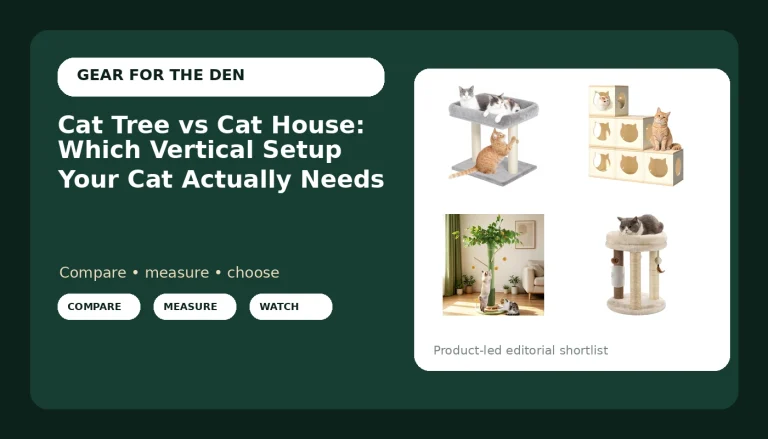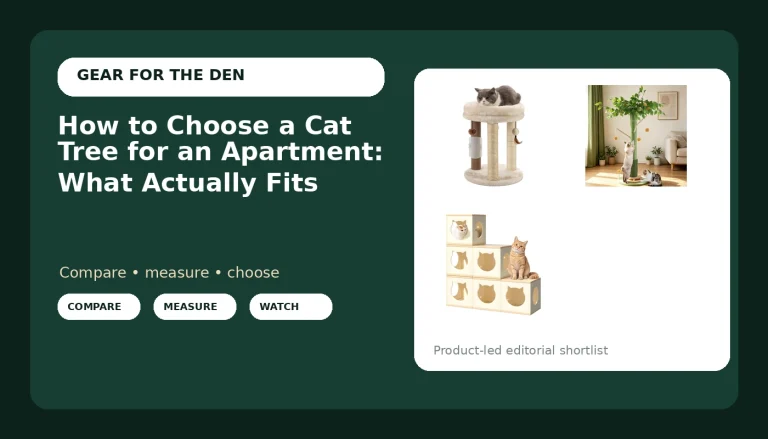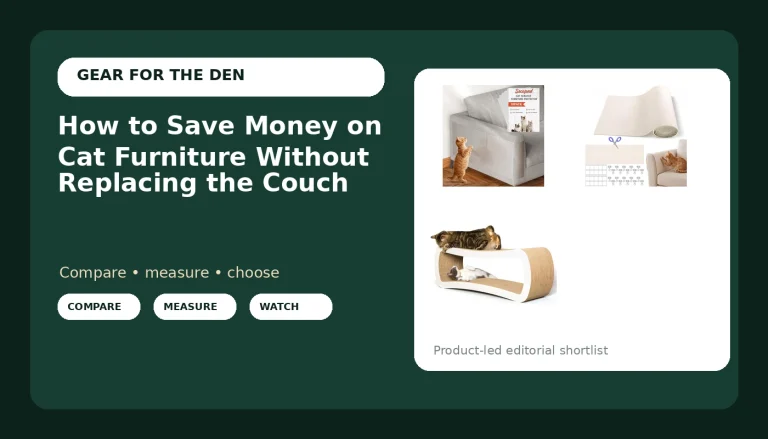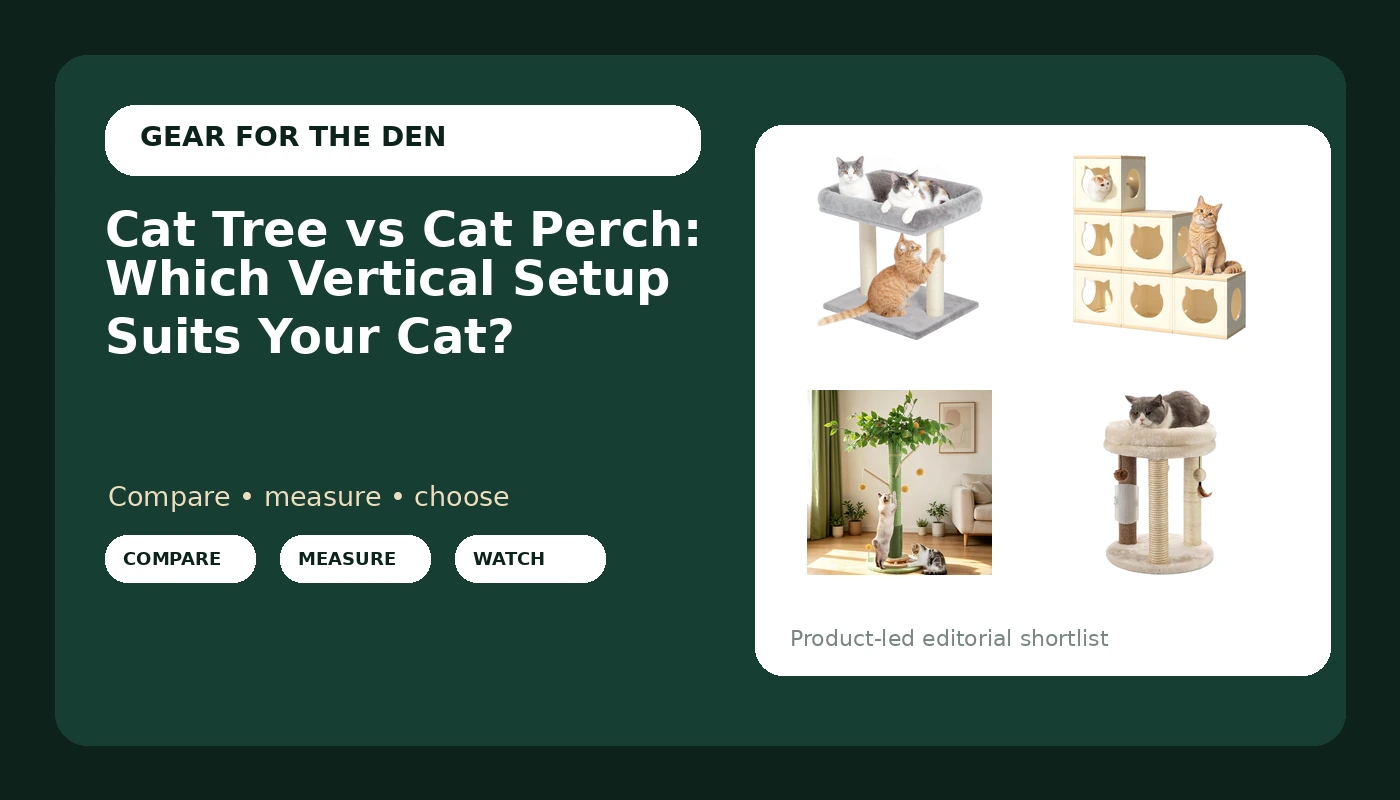
A cat tree vs cat perch is really a question about how much vertical furniture your room can absorb and how many cats need to claim a piece of it. Both formats do the same core job: they give a cat a raised surface, a scratching texture, and a reason to stop using the sofa arm as a gym. The difference shows up in what else you get, how much floor space you spend, and how much anchoring and assembly the thing demands. This comparison walks through four very different versions of that idea, from a 19 inch tree with a perch to a 46 inch tall sisal post to a stackable six-cube tower, so you can match the format to the room instead of rebuilding the room around the format.
For a single cat in a normal apartment, the 46 inch tall sisal post is the safest first buy, because it delivers a full-stretch scratch without eating floor space. If you want a lounging surface as well as a scratch post, the 19 inch tree with a perch does both jobs in one footprint. The stackable cube tower only makes sense when you have several cats, a large room, or a layout you want to rearrange.
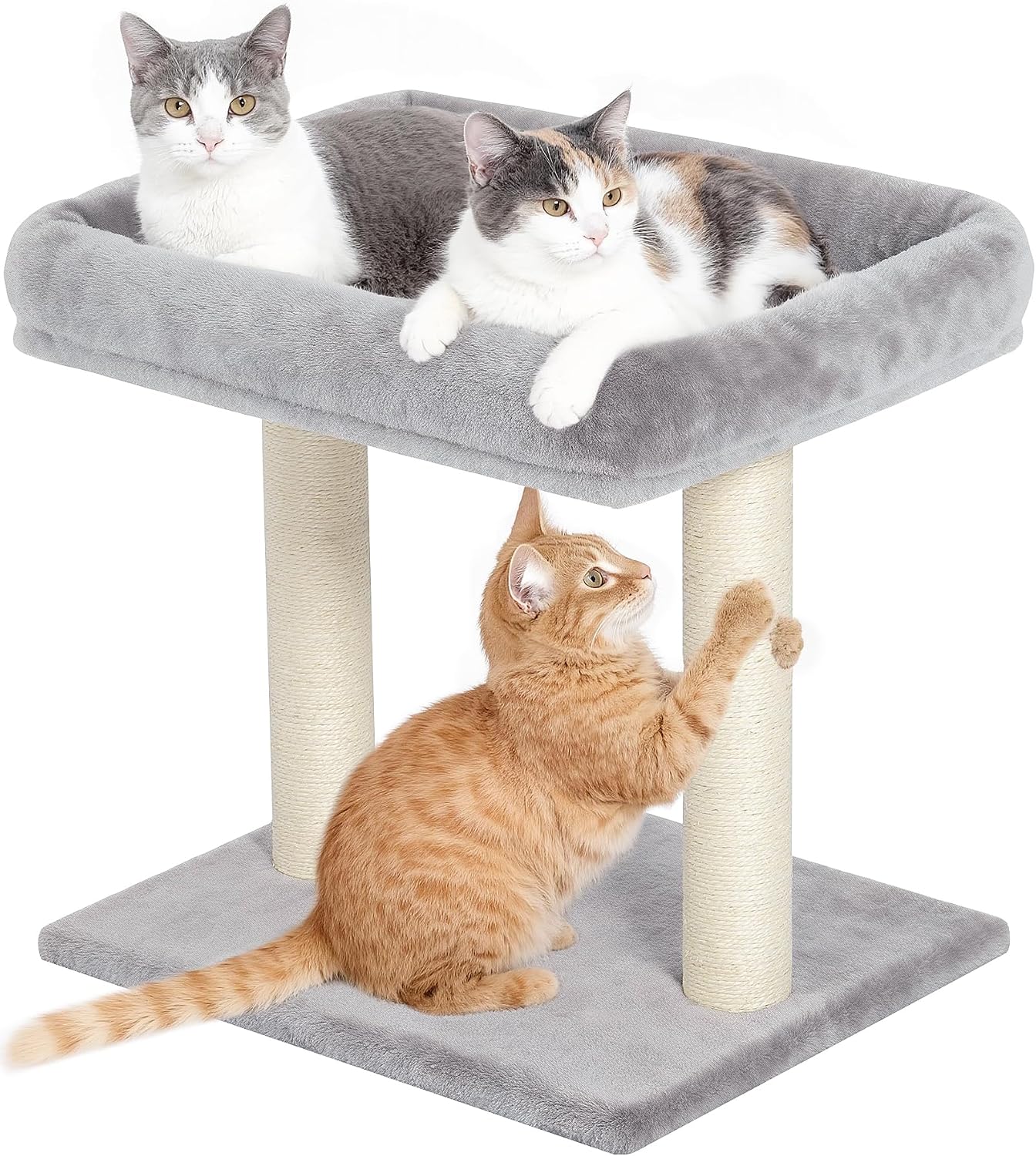
KinoTail 19" Small Cat Tree with Scratching Post for Indoor Cats with Perch
A perch and a scratch post in one small footprint, which is the entire point of the format
The 19 inch height keeps the perch low for a tall cat, and the platform is sized for one cat
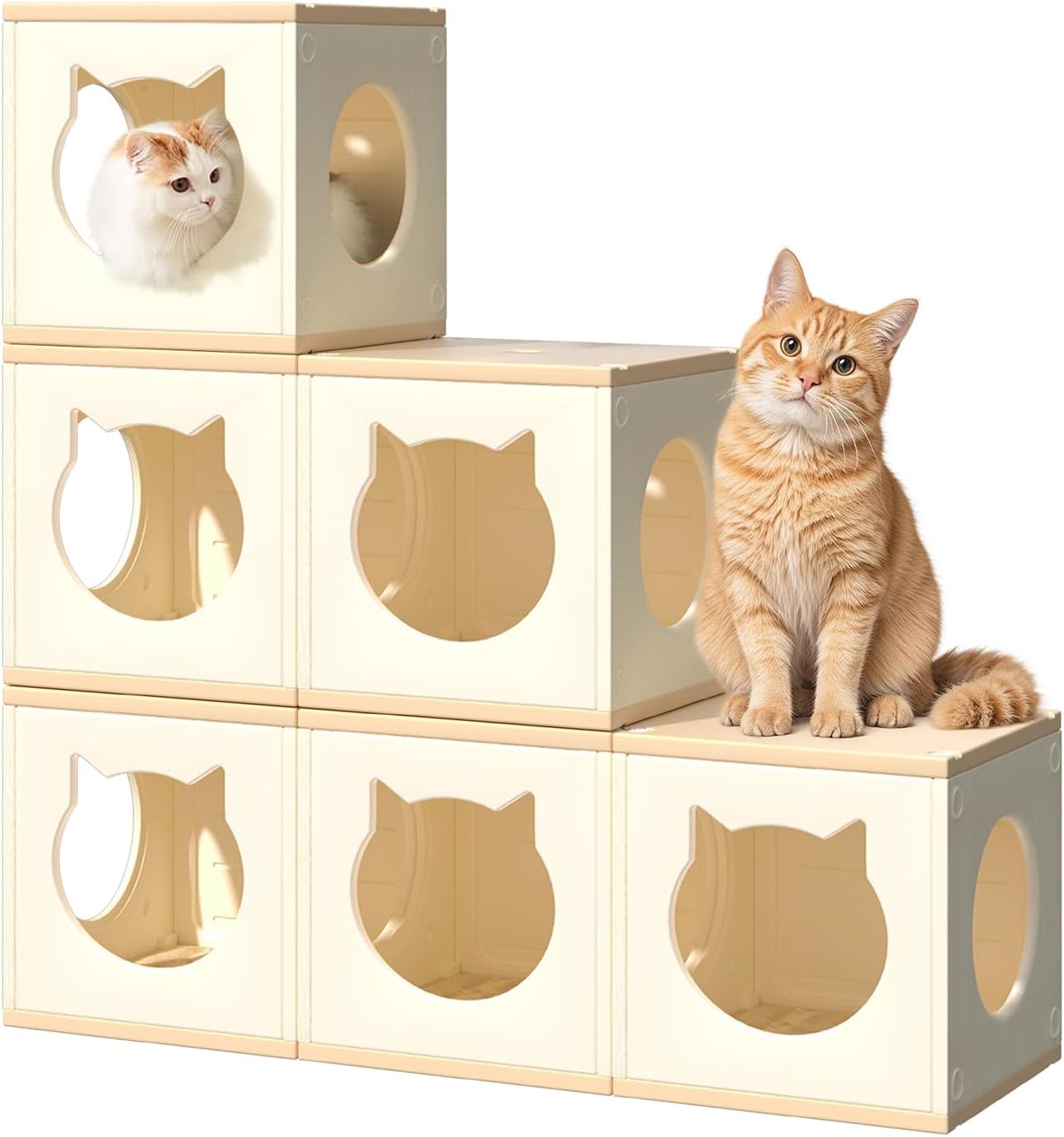
6-Cube Stackable Cat Tree Tower, Plastic Cat Tunnel for Indoor Cats
Modular cubes you can restack as the room changes, plus a tunnel that gives cats a chase route
The largest footprint and the most assembly of the four, and a plastic tunnel is not a scratch surface
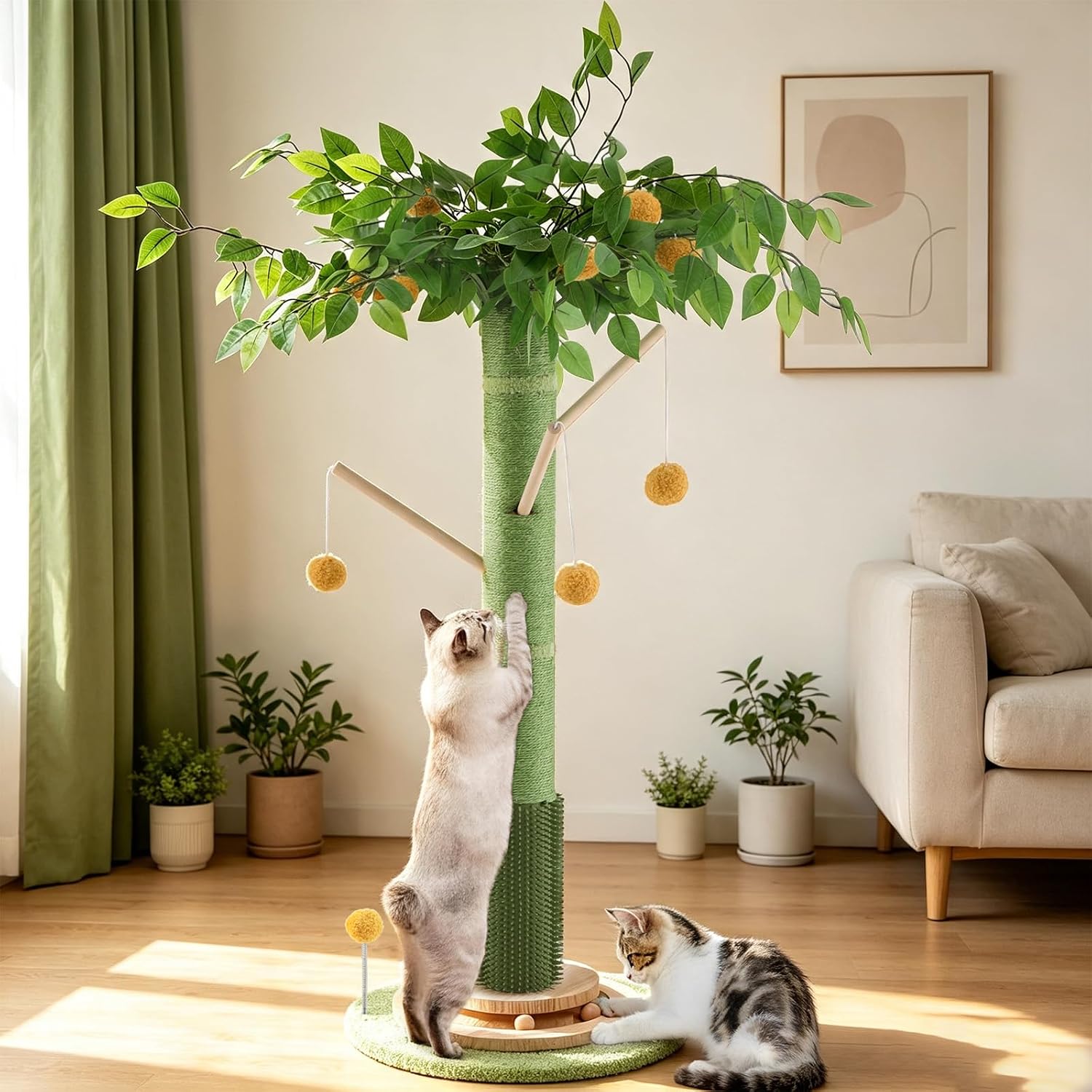
46" Tall Cat Scratching Post, Natural Sisal Cat Tree for Indoor Adult Cats
Full-stretch scratching height in a footprint barely wider than a dinner plate
No lounging surface at all, and a tall narrow post wants anchoring or a corner
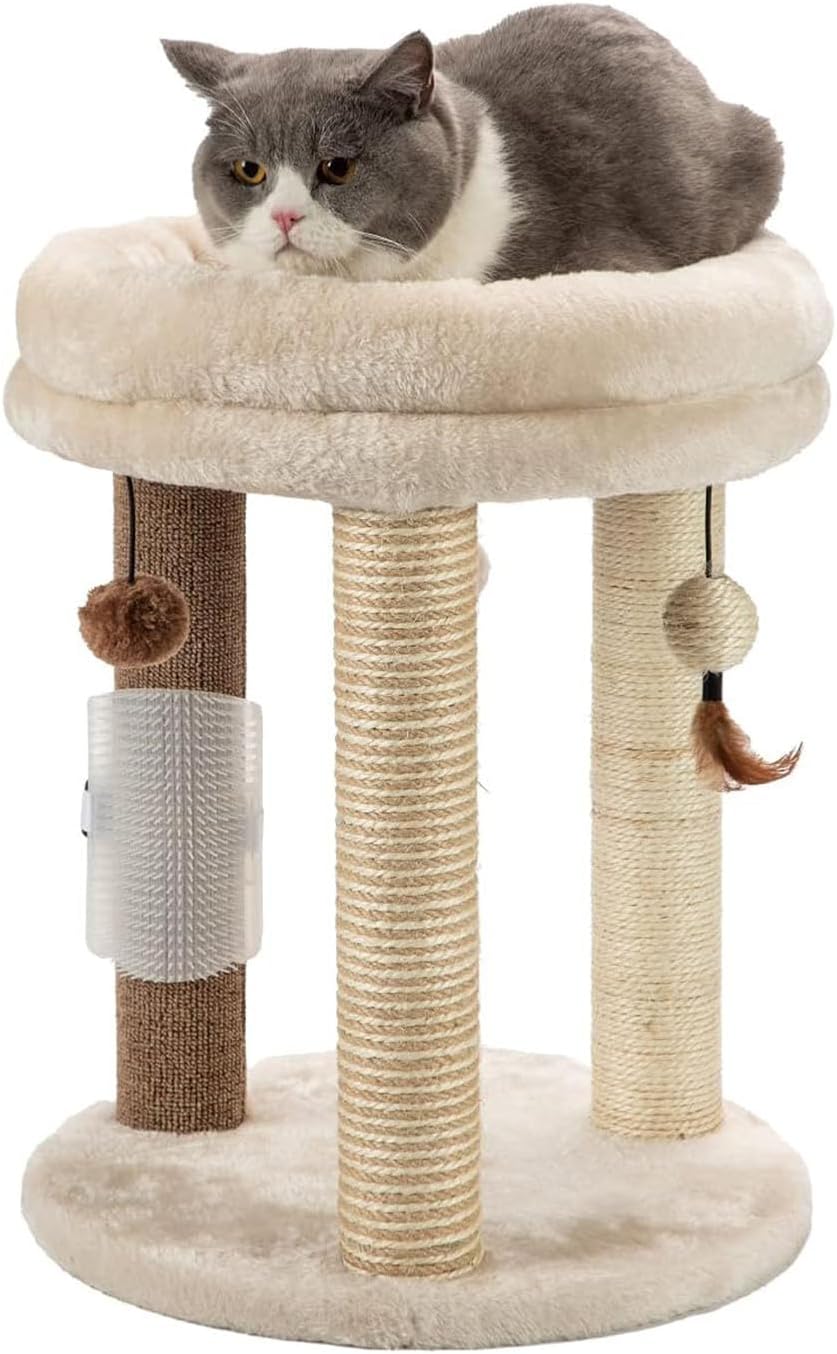
MECOOL 4in1 Small Cat Tree,Scratching Post with Tower Soft Bed, Sisal Carpet Jute Posts with Three Hanging Ball Toys and Massage Brush for Indoor Cats
Bed, posts, hanging toys and a grooming brush in one compact unit that suits a single adult cat or a kitten
Four jobs in a small frame means every surface is small, and the toy attachments are parts to keep track of
Prices and availability may change.
How the cat tree vs cat perch choice changes your room
When people ask about the difference between cat tree and cat perch, they are usually asking whether they need the whole structure or just the high seat. A perch is a single elevated platform, either mounted to a wall or sitting on top of a post. A tree is a frame that carries one or more platforms, at least one scratch surface, and often a bed, a hammock, or a tunnel. A tree is therefore not a bigger perch so much as a bundle: it answers the scratching question and the height question at the same time, and it charges you floor space and assembly time for the convenience.
The practical consequence is order of operations. If your cat already has a scratching post it genuinely uses, adding a perch is the cheaper upgrade, because the scratch need is met and you are only buying height. If your cat has neither, a small tree gives you both in one footprint, which is why the 19 inch KinoTail and the MECOOL 4in1 exist as products at all. A cat tree or cat perch decision made in the other order, buying height first and hoping the scratching follows, tends to end with a shredded sofa and an unused platform.
The cat perch vs cat tree framing is also a question about resources, not just furniture. Scratching, climbing, and resting are three separate needs, and a cat will happily satisfy them in three different places. The trick is noticing which need is currently being met by something you own and dislike. If the answer is scratching, you need sisal more than you need height. If the answer is resting on top of the refrigerator, you need a legal high seat before you need another post.
Platform height and perch width decide who actually uses it
Platform height is the spec that determines whether a cat uses the thing at all. A platform that sits below the household traffic line rarely becomes a favourite, because it does not give the cat the vantage point it was looking for. Cats want to watch the room from above the doorway, not from ankle height. That is why the 46 inch post in this group reads as a serious piece of furniture despite having no platform on it: it puts the top of the post at a height an adult cat can reach with a full upward stretch, which is the movement that actually maintains the scratch habit.
Perch width matters more than most shoppers expect, and it matters most for large cats. A narrow perch means paws hanging off the edge, which is fine for a five minute survey of the living room and miserable for a two hour nap. Perch width and shelf depth are the two numbers that separate a perch a cat sleeps on from a perch a cat merely visits. If your cat is a Maine Coon or a chunky domestic shorthair, read those numbers before you read anything else on the listing.
Age changes the calculation too. A kitten or a young, agile adult will use a 46 inch post and a high cube without hesitation. An older cat with stiff joints wants the opposite: a low, wide landing area with a short hop, which is where a 19 inch tree with a perch beats a tall post outright. If you are buying for a senior cat, platform height is a comfort spec, not a status symbol.
Post diameter, shelf depth, and the hardware nobody checks
Post diameter is the difference between a scratch post and a scratch toy. A thick post lets a cat wrap its forelegs around the surface and rake downward with real resistance, which is the motion that files the claws and stretches the spine. A thin post forces the cat into a hug, and most cats abandon it within a week. This is also why material matters: the 46 inch post uses natural sisal, and the MECOOL unit uses sisal carpet jute posts. Both give claws something to bite into, which smooth plastic never does.
Shelf depth is a trade-off between stability and space. A deep shelf or platform resists wobble when a cat launches off it and lands back on it, but it also sticks further into the room and catches shins. A shallow shelf saves floor space and gives up rigidity. If a listing does not state shelf depth, look at the product photos and judge how much of a cat's body fits on the platform relative to the base width underneath it.
Then there is the hardware that nobody photographs: the joint where the post meets the base, and the base itself. A tall post with a small base is a lever waiting for a cat to test it. That is not a reason to avoid tall posts, it is a reason to plan where the post goes and whether you will bolt it to a wall.
Anchor type and weight limit: the safety side of the comparison
Anchor type is the least glamorous spec in this comparison and the one most likely to decide whether you keep the furniture. Freestanding units are the norm, and they are fine when the base is wide relative to the height and the unit sits in a corner or against a wall. Wall anchored or wall braced units are the safer answer for anything tall and narrow, including the 46 inch post and the stacked cube tower. If you rent and cannot drill, a corner placement plus a non-slip pad under the base is the compromise most people make.
Weight limit is the other number to hunt for. A listing that states a weight limit is telling you the platform was engineered for a specific load, and a listing that stays silent is usually sized around an average adult cat. That is fine for most households, but it is worth knowing before a large cat treats the top cube as a launch pad. If you cannot find a stated weight limit, treat the topmost platform as the least load-bearing surface in the unit and let the cat earn it gradually.
One more structural note: how the platforms attach. Fixed platforms are sturdier and less interesting. Adjustable platforms are more flexible and more likely to work loose, which means a periodic check with a screwdriver every few months. Neither design is wrong, but adjustable furniture asks for maintenance that fixed furniture does not.
Multi-cat households: hammock fabric, tunnels, and carrier size
In a two cat home, the cat tree vs cat perch question stops being about one cat and starts being about queues. Two cats will not share a single perch happily for long; one cat leaves, and the leaving cat learns the perch belongs to somebody else. The fix is duplication at the same height band: two platforms at similar heights, separated enough that neither cat has to pass the other to reach safety. That is where a stackable cube tower starts to justify its footprint, because you can spread the cubes and create multiple routes and resting spots in the same vertical zone.
Hammock fabric is a cleaning question more than a comfort question. Fleece style hammocks collect hair and hold it, and they usually machine wash. Canvas or woven fabric sheds hair more easily and takes longer to dry. Either way, check whether the cover comes off, because a hammock you cannot wash becomes a hammock you throw away.
Tunnels change traffic patterns. The plastic tunnel in the six-cube tower gives cats a chase route that passes underneath the resting spots, which is useful in a household where one cat likes to ambush and the other likes to hide. And if you travel or move between apartments, carrier size and door width deserve a thought before you buy: a cube tower that fits the room may not fit the hallway, and a tall post is far easier to shift than a modular stack.
The trade-offs each format asks you to accept
Every one of these four units is a set of compromises, and the honest version of this comparison is that none of them is best at everything.
The 46 inch tall sisal post wins on scratching and loses on everything else. It gives an adult cat the full stretch it needs, it takes up almost no floor, and it offers nothing to sleep on. Buy it if your cat already has a bed it likes and you are solving a claw problem.
The 19 inch KinoTail tree is the middle path. You get a perch and a post in one small footprint, which is the most efficient use of space in this group. The cost is scale: the perch is low, and the platform suits one cat, so it is a single cat solution rather than a household solution.
The MECOOL 4in1 is the busiest of the four. A soft bed, sisal carpet jute posts, three hanging ball toys and a massage brush in one unit means a kitten or a single adult cat has scratching, sleeping and play in one spot. The trade-off is that four functions in a small frame makes every individual surface small, and small attachments have a way of disappearing under the sofa.
The six-cube stackable tower is the largest commitment. It offers modular configuration, a tunnel, and enough vertical real estate for a multi-cat household. In exchange you give up floor space, assembly time, and any expectation that it will scratch like a sisal post.
How to choose without measuring your cat
Start with the need that is currently being met badly. If your sofa is the scratch post, buy sisal. If your cat sleeps on top of the fridge, buy height. If both are true and the room is small, buy the compact tree and accept that the perch is a single cat seat.
Then check the listing for the four specs that actually predict satisfaction: platform height, perch width, shelf depth, and post diameter. Add anchor type and weight limit if you have a large cat or a tall unit. Skip the marketing photos of cats looking majestic, because every listing has them and none of them tell you how wide the platform is.
Finally, decide where the unit will physically stand before you order it. A 46 inch post in a corner next to the window will get used every morning. The same post in the middle of a hallway will get bumped, wobble, and eventually get moved to a storage closet. The furniture does not train the cat, the placement does, and that part of the cat tree vs cat perch decision is entirely yours to make.