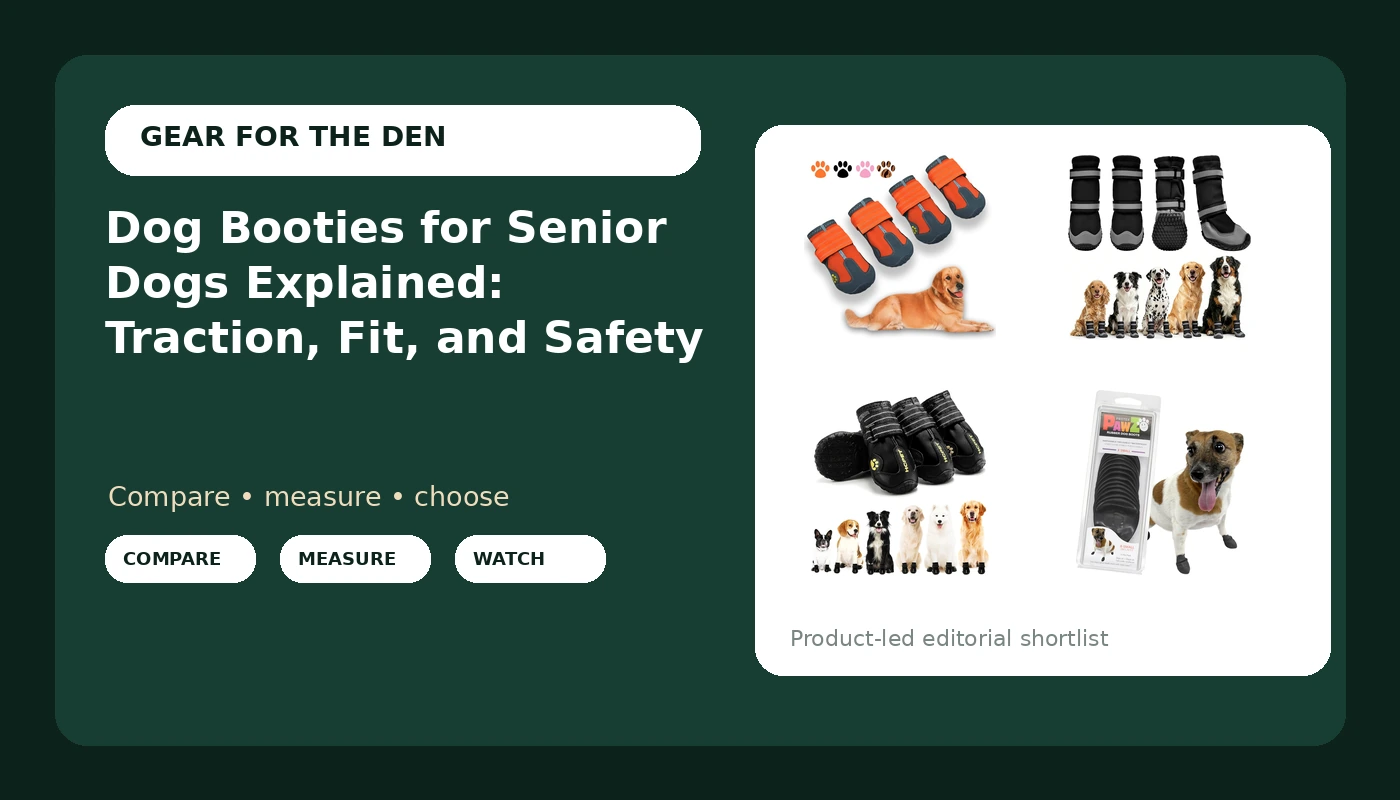
If you have searched for dog booties for senior dogs explained in plain language, the short version is this: senior dogs often need paw protection for the same reasons younger dogs do, but they have less margin for a boot that slips, rubs, or changes their balance. A senior dog may have weaker nails, thinner paw pads, arthritis, or reduced traction on smooth floors. Hot pavement, salted sidewalks, ice, and rough gravel can all turn a short walk into a struggle. The right pair of dog booties for senior dogs is not about fashion. It is about a secure fit, a sole that grips, and a design your dog will tolerate long enough to finish the walk. Some senior dogs wear booties for every walk, while others only need them on extreme surfaces. This guide explains what to look for, how boot sizing works, and which of four available options fits different senior-dog walking routines.
Quick answer
Dog booties for senior dogs explained comes down to fit and traction. Look for a bootie that stays on without pinching, has a flexible traction sole, and matches the surface your dog walks on most. Senior dogs often do better with a lighter boot and a short break-in period. No single pair is right for every paw, so measure first, then choose a style that matches your routine. A good test is whether your dog can take five steps without lifting a paw or stopping. For hot pavement, a simple pavement-focused bootie can be enough. For winter, a waterproof boot with reflective details is more useful. For a dog that needs a more adjustable fit, a strapped boot is worth trying. For backup pairs and quick trips, a multi-pack of rubber boots can work.
Four useful options
| Model | Best fit | What stands out |
|---|---|---|
| XSY&G Dog Shoes for Hot Pavement, Dog Snow Booties for Medium to Large Dogs | Medium to large dogs on hot or cold pavement | Listed for hot pavement and snow use |
| Dimicoo Dog Shoes,Waterproof Dog Boots for Winter,Anti-Slip Dog Snow Booties for Large Small Medium Dogs,Reflective Paw Protectors for Outdoor Walking Hiking | Winter and wet-weather walks | Waterproof winter design with reflective paw protectors |
| Hcpet Dog Boots, Dog Shoes for Large Dogs, Medium Dog Boots & Paw Protectors, Anti-Slip Dog Booties for Hot Pavement Winter Snow Hiking with Reflective Straps Black Size 1 | Dogs that need a more adjustable strap fit | Reflective straps and an anti-slip sole description |
| PawZ Rubber Dog Boots – Waterproof Non-Slip Dog Shoes & Booties, 12 Pack | Backup pairs and short protective walks | Waterproof non-slip rubber boots in a 12 pack |
Everyday hot-pavement option: XSY&G Dog Shoes for Hot Pavement, Dog Snow Booties for Medium to Large Dogs
The trade-off with a pavement-focused bootie is that the same design may not handle deep snow or long wet walks as well as a winter-specific boot. If your senior dog mostly walks on hot sidewalks and you want a simple option, this is a reasonable starting point. Check boot sizing carefully, because a loose boot can twist on a weak paw, and a tight boot can rub a thin pad. If your dog has dewclaws or a narrow paw, check the opening for pressure points. A chest strap or front clip on the harness can also keep the leash from pulling your dog off balance while you adjust the boots.
Winter and wet-weather option: Dimicoo Dog Shoes,Waterproof Dog Boots for Winter,Anti-Slip Dog Snow Booties for Large Small Medium Dogs,Reflective Paw Protectors for Outdoor Walking Hiking
More coverage can mean more material around the paw, so a senior dog with arthritis or a sensitive gait may need a slow introduction. Start with one boot indoors, then add the others as your dog adjusts. A waterproof boot can trap moisture if the paw gets wet, so dry the paws after the walk. Keep the leash length short on slippery ground, and use a front clip harness if your dog pulls or stumbles. A cooling fabric harness or mat can help after a warm-weather walk, but it does not replace paw protection on hot days.
Adjustable secure-fit option: Hcpet Dog Boots, Dog Shoes for Large Dogs, Medium Dog Boots & Paw Protectors, Anti-Slip Dog Booties for Hot Pavement Winter Snow Hiking with Reflective Straps Black Size 1
A strapped boot is not automatically better for every senior dog. Some dogs tolerate straps well, while others do better with a slip-on rubber boot. The listed size 1 is specific, so measure paw width and length before ordering. Reflective straps are most useful when they sit on the outside of the paw and do not twist. If your dog wears a harness, check the chest strap and front clip for rubbing, and keep the leash length long enough that your dog can choose a comfortable pace.
Lightweight backup pack: PawZ Rubber Dog Boots – Waterproof Non-Slip Dog Shoes & Booties, 12 Pack
Rubber boots fit differently from strapped boots. They rely on a snug, flexible fit, so boot sizing is still the deciding factor. A senior dog with very thin or very wide paws may need a different style. Because rubber can be slick on wet tile, test them on carpet or grass first. If you use a GPS tracker on walks, check the gps range and battery life before you rely on it, especially if your dog moves slowly and the walk takes longer than expected.
Prices and availability may change. Product images, names, and retailer links are matched to verified listings. No current price, rating, stock status, or measured result is stated here without current evidence.
What changes for senior dogs on walks
Senior dogs may have less paw pad cushioning, weaker nails, or joint stiffness that changes how they place their feet. They may also have less tolerance for a boot that feels heavy or awkward. That does not mean every senior dog needs booties. It means the decision should start with the surface and the dog's comfort. Hot pavement can burn pads, salt and ice can irritate skin, and rough gravel can be painful on thin pads. On the other hand, a dog with good traction on grass may not need booties at all. Watch how your dog walks, check the paws after walks, and talk with your veterinarian if you see limping, licking, or redness. Senior dogs can also lose confidence on slippery floors, so a boot with a grippy sole may help indoors as well as outside.
A senior dog may also need a different walking setup. A chest strap harness can spread pressure better than a neck collar. A front clip can reduce pulling if your dog surges forward. Leash length matters too, because a long leash can tangle around weak legs. If you use a GPS tracker, check the gps range and battery life before a trip. These details do not replace booties, but they make the walk safer for a dog with limited mobility. Keep walks shorter and more frequent if your dog tires easily, and bring water on warm days.
How to choose dog booties for senior dogs
Finding ideal dog booties for senior dogs means matching the boot to the paw, not to a marketing label. The correct dog booties for senior dogs are the ones that stay on during a short walk and do not rub. Start with boot sizing. Measure the paw at the widest point while your dog is standing, then compare that number with the listing size chart. A boot that is too large can twist or fall off. A boot that is too small can pinch toes or restrict circulation. If the measurement falls between two sizes, size up only if the closure can tighten enough to hold the boot in place.
Next, look at the sole. A traction sole with some flexibility can help on smooth floors, hot pavement, and light snow. A very stiff sole may protect more but can feel heavy for a senior dog. Then consider the closure. Straps, hook-and-loop tabs, and elastic openings all fit differently. Some dogs do better with a simple slip-on rubber boot, while others need an adjustable strap. Finally, think about the weather. A waterproof boot is useful in winter, while a lighter boot may be enough for summer pavement. If you walk in low light, reflective details help drivers and cyclists see your dog. Material matters too, because a boot that holds water can soften pads on a long walk.
- Measure the paw at its widest point while your dog stands.
- Compare the measurement with the listing size chart, not with the breed size.
- Choose a sole that matches your main walking surface.
- Introduce one boot at a time indoors with treats.
- Check for rubbing, slipping, or changes in gait after every walk.
Practical fit and walking checklist
- Trim nails before fitting booties, because long nails can push the paw forward inside the boot.
- Start with short walks on familiar ground and bring a spare boot.
- Use a chest strap or front clip harness if your dog needs steady support.
- Keep the leash length short enough to prevent tangling but long enough for your dog to balance.
- Check paws after every walk for redness, moisture, or debris.
- If your dog refuses to move, remove the booties and try a different size or style.
- For hot weather, walk early or late and consider a cooling fabric mat or bandana for after the walk.
- For cold weather, avoid salted areas when possible and rinse paws after walks.
Which option should you choose?
Choose the XSY&G Dog Shoes for Hot Pavement, Dog Snow Booties for Medium to Large Dogs when your senior dog needs a simple pavement-focused bootie for medium to large paws. Choose the Dimicoo Dog Shoes,Waterproof Dog Boots for Winter,Anti-Slip Dog Snow Booties for Large Small Medium Dogs,Reflective Paw Protectors for Outdoor Walking Hiking when winter wetness, snow, and low-light visibility are the main concerns. Choose the Hcpet Dog Boots, Dog Shoes for Large Dogs, Medium Dog Boots & Paw Protectors, Anti-Slip Dog Booties for Hot Pavement Winter Snow Hiking with Reflective Straps Black Size 1 when you want an adjustable reflective strap and the listed size 1 matches your dog's paw. Choose the PawZ Rubber Dog Boots – Waterproof Non-Slip Dog Shoes & Booties, 12 Pack when you want a lightweight multi-pack for short trips and spare pairs.
No bootie is right for every senior dog, and no listing can tell you how your individual dog will walk in a boot. Fit, paw shape, and surface matter more than any single feature. If your dog has a medical condition that affects the paws or joints, ask your veterinarian before adding booties to a walking routine.
The bottom line
Dog booties for senior dogs explained is mostly a fit problem. Measure the paw, choose a sole for your usual surface, and pick a closure your dog will tolerate. The XSY&G option fits simple pavement walks, the Dimicoo option suits winter and wet weather, the Hcpet option adds adjustable reflective straps, and the PawZ multi-pack gives you lightweight spares. Start slowly, check the paws, and keep the walk short while your dog adjusts. If one style does not work, try another before deciding that booties are not for your dog.