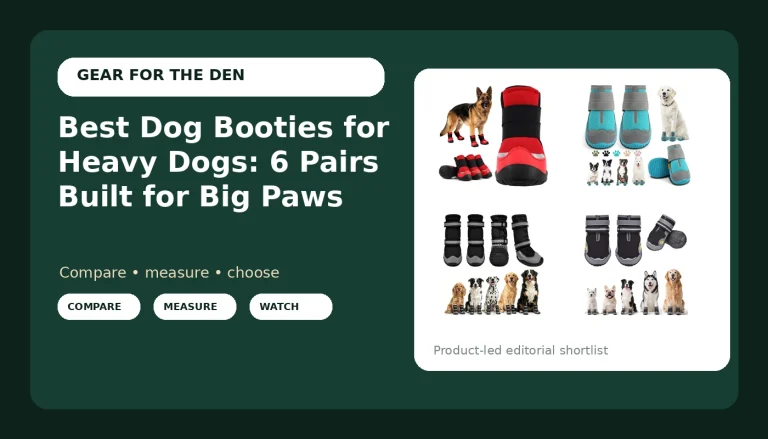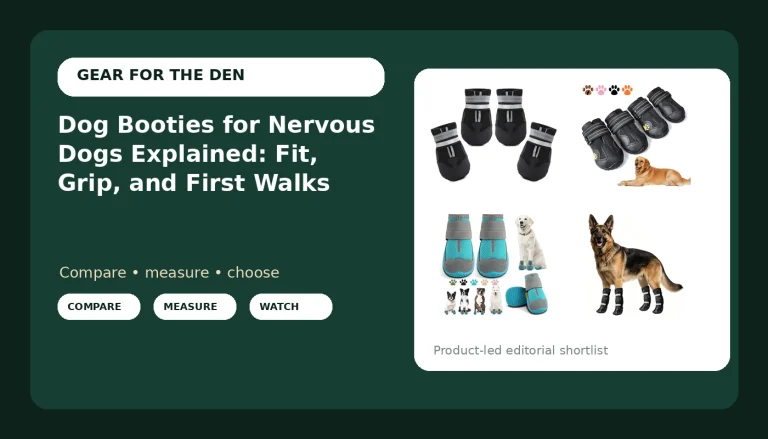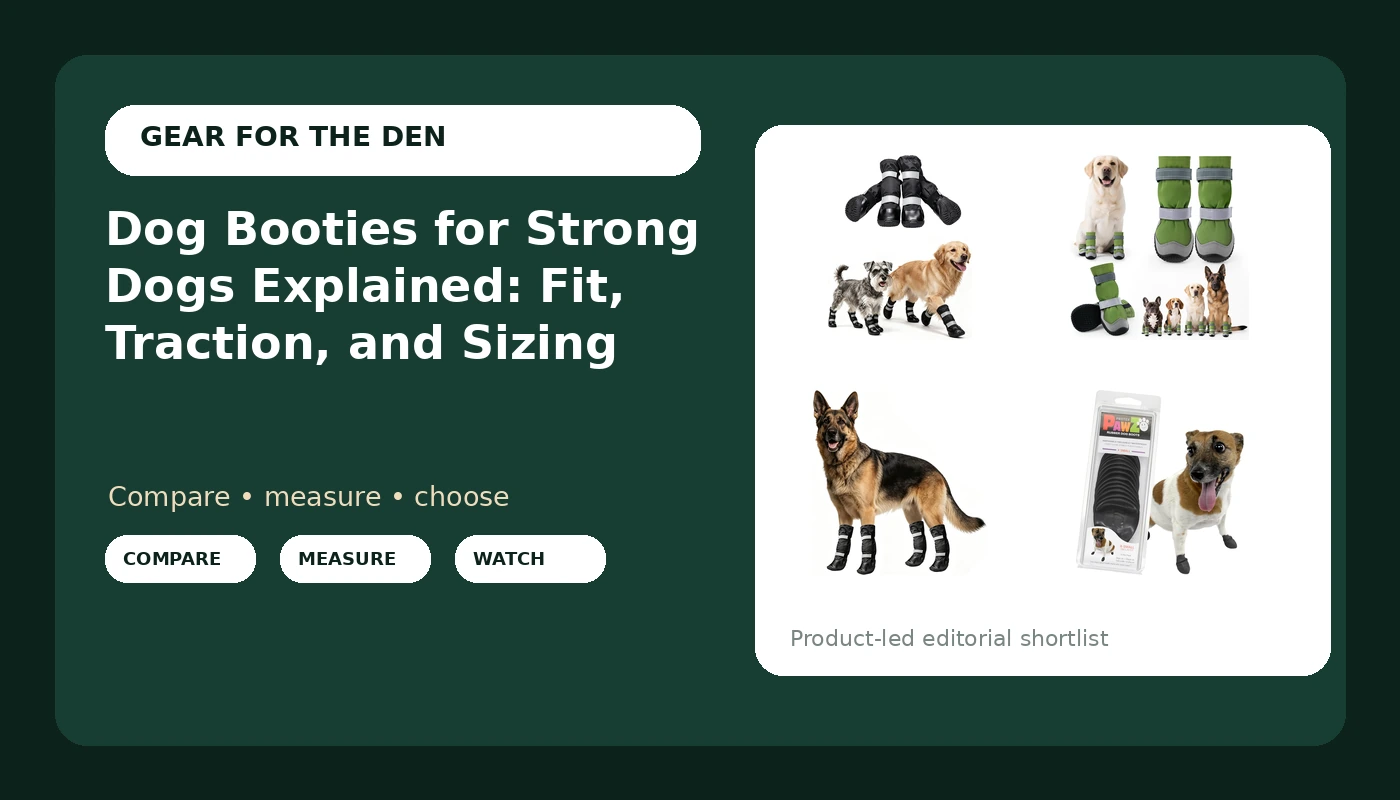
Dog booties do a simple job in theory: cover the paw, keep road salt and ice off the pads, and stay put while the dog walks. In practice, the dog at the other end of the leash decides whether that theory holds. A strong dog loads the boot on every stride, kicks sideways when it turns, and drags a paw through a snowbank without slowing down. That is why dog booties for strong dogs are a retention problem first and a warmth problem second. The boot has to survive acceleration, hard stops, and a paw that never lands quite the same way twice. This dog booties for strong dogs explained guide covers the parts that actually decide whether a boot stays on, how boot sizing works on a wide and heavily loaded paw, and four options that cover different winter surfaces. It does not crown a best or safest boot, because the right choice depends on your dog, your route, and the weather.
Quick answer
Match the boot to the surface first. For deep snow, road salt, and long winter routes, a tall boot with a fleece lining and a secure closure covers more of the leg and resists twisting. For mud, slush, and quick neighborhood loops, a low rubber boot pulls on fast, flexes with the paw, and comes in a multi-pack, so one lost boot does not end the walk. Sizing decides more than brand: measure the standing paw, allow a little room for the nails, and re-check the fit after the first few walks. Look for a flexible traction sole, a closure you can tighten without cutting off circulation, and a shaft that matches how deep the snow gets where you actually walk. Those three points are the difference between an ideal dog booties for strong dogs setup and a set that spends the season in a closet.
4 useful options
| Model | Best fit | What stands out |
|---|---|---|
| PETLESO Dog Boots for Large Dogs, 4 PCS Winter Warm Dog Shoes, Anti-Slip Waterproof Pet Paw Protectors, Snow Rain Mud Outdoor Walking Hiking Tall Dog Booties with Reflective Strips, Black XL(#5) | Deep snow and long cold walks | Tall, warm coverage in a four-piece set with reflective strips |
| Winter Dog Snow Boots with Fleece Lining, Dog Shoes for Medium Large Size Dogs, Waterproof Dog Booties and Paw Protectors, Anti-Slip & Reflective Dog Shoes for Snow Outdoor, Hiking (Green-Size 6) | Medium and large dogs on packed snow and trails | Fleece lining plus reflective trim in a green size 6 |
| NAMSAN Winter Dog Boots for Large Dogs, 4 PCS Size #5(XL), Long Legged Anti-Slip Dog Rain Booties with Reflective Magic Strips, Waterproof Outdoor Warm Dog Shoes for Snowfield Paw Protection, Black | Rain, slush, and snowfield walks | Long-legged shape with reflective magic strips |
| PawZ Rubber Dog Boots – Waterproof Non-Slip Dog Shoes & Booties, 12 Pack | Mud, grit, and short wet walks | Low rubber boot in a 12 pack for easy replacement |
Tall winter coverage: PETLESO Dog Boots for Large Dogs
Tall boots solve the coverage problem and create a fit problem. The higher the shaft, the more material sits against the leg, and the more a strong dog can work the boot loose on a hard turn. Expect to check the closure once or twice on the first few walks and to re-tighten before any long route. The reflective strips earn their place on early morning and evening walks, when drivers are looking for movement more than shape. These are cold-weather boots, so they are the wrong tool for hot pavement in summer; on warm days, shade and a cooling fabric for the dog matter more than rubber on the paws. Watch for rubbing at the top edge during the break-in period, and trim the walk short if the dog starts high-stepping.
Fleece-lined option: Winter Dog Snow Boots with Fleece Lining
The fleece lining is the detail that separates this pair from a plain rubber boot. Fleece adds warmth on long, slow walks and puts a little cushioning between the paw and the outer shell, which helps on packed snow and frozen trails. The trade-off is drying time: a fleece-lined boot that gets soaked through needs to dry fully before the next walk, or the dog is wearing a cold, damp boot for miles. Reflective detailing covers the visibility side, and the size 6 range targets medium and large dogs rather than giant breeds. Check the paw measurement against the size chart rather than the dog's weight alone, since a broad paw can sit between two sizes.
Long-legged option: NAMSAN Winter Dog Boots for Large Dogs
The long-legged shape is the reason to look at this set. Dogs with a taller stance, or a paw that sits well above the ground, often do better with a boot that climbs further up the leg, because there is less exposed skin for snow to ball against. The reflective magic strips handle both closure and visibility, and the waterproof outer is aimed at rain and snowfield conditions. The trade-off is the same as any tall boot: more material to fit correctly. A strong dog that pulls will test the strip tension, so check the fit at the halfway point of a walk and adjust. This listing is a black size #5, described as XL.
Low-profile option: PawZ Rubber Dog Boots
Rubber boots are the low-profile answer. They pull on over the paw, flex with every step, and sit low enough that many dogs notice them less than a tall winter boot. That makes them a good match for mud, grit, slush, and short wet walks where warmth is not the main concern. The 12 pack is the practical part: a strong dog that kicks can lose a boot in a drift, and having spares keeps the walk going. Rubber is not insulation, so in deep cold and on long routes a lined boot will do more. Fit still decides everything, and rubber stretches differently than fabric, so a snug measurement matters more, not less.
Prices and availability may change. Product images, names, and retailer links are matched to verified listings. No current price, rating, stock status, or measured result is stated here without current evidence.
How to size dog booties for strong dogs
Boot sizing is the step most people rush, and it is the one that decides whether the rest of the purchase was worth it. Start with the dog standing on a hard floor, because a paw spreads under load and a measurement taken while the dog lies down will come out short. Measure from the back edge of the pad to the front of the longest nail, then measure the widest part of the paw across. Write both numbers down. A strong dog usually has a wide, well-padded paw, and width is the number that causes boots to twist or bind.
Add a small amount of room for the nails and for the paw to spread on landing, but not so much that the boot slides. If the boot can rotate freely on the paw, it will rotate on a hard turn. If it pinches at the sides, the dog will high-step, drag the foot, or stop entirely, and a dragging foot wears through a boot fast.
Sizes are not consistent between brands. A size 6 in one line can sit close to an XL in another, so measure and compare against each listing's own chart rather than assuming a size carries over from a previous pair. Re-check the fit after the first few walks and again when nails grow out. The standing measurement is the one to trust.
What actually keeps a bootie on a strong dog
Retention comes from three things working together: a closure that holds tension, a shaft or collar that follows the leg, and a sole flexible enough to bend with the paw instead of levering the boot off. Magic strips and straps are the common closures, and both need to be snug without pinching. Check by sliding one finger under the strap. If the strap cannot be tightened any further and the boot still spins, the size is wrong, not the closure.
Break boots in on short walks on soft ground before a long route. Most rubbing shows up in the first twenty minutes, and it is easier to fix at home than two miles out. A dog that pulls hard benefits from a harness with a front clip and a chest strap, because steering from the chest reduces the sideways load that twists a boot. A shorter leash length in the early walks keeps the dog close enough to correct a turning boot without a wrestling match.
If your dog wears a GPS collar, check battery life and gps range before a cold-weather route, since cold drains batteries faster and a boot lost in deep snow is easier to find with a working tracker. None of this replaces fit. A correct dog booties for strong dogs setup is one where the boot stays on through a normal walk without constant adjustment.
- Measure the standing paw from the back of the pad to the longest nail, and across the widest point.
- Compare those numbers with the listing's own size chart, since sizing varies between brands.
- Fit the boots indoors, walk a few steps, and check for spinning, pinching, or high-stepping.
- Break them in on short, soft-ground walks before a long winter route.
- Re-check strap tension and paw condition after every walk for the first week.
Practical guidance for winter walks
- Put the boots on before you leave the house, not at the trailhead in the cold, so you can check the fit with warm hands.
- Carry one spare boot and a small towel, since a wet paw is harder to fit than a dry one.
- Watch for ice balls forming between the boot and the leg, and clear them before they press on the skin.
- Rinse salt and grit off the boots after walks and let them dry fully, especially fleece-lined pairs.
- Skip winter boots on hot summer pavement, where shade, water, and cooling fabric do more for the dog than rubber.
Which option should you choose?
Choose the PETLESO Dog Boots for Large Dogs when your winter routes run through deep snow and salt and you want tall, warm coverage with reflective strips for low light. Choose the Winter Dog Snow Boots with Fleece Lining when your dog is medium to large and you want a fleece lining for long, cold walks on packed snow and trails. Choose the NAMSAN Winter Dog Boots for Large Dogs when your dog has a taller stance and you want a long-legged boot with reflective magic strips for rain and snowfield conditions. Choose the PawZ Rubber Dog Boots when the surface is mud, grit, or slush and you want a low, flexible rubber boot with spares in the box.
If two options seem equally close, let surface and walk length decide, then buy one set and test the fit before committing to a second.
One limitation applies to all four: the listings describe materials, closures, and intended conditions, and that is what this guide can speak to. Fit, wear, and how a particular dog tolerates boots depend on the paw in front of you, so treat any single review as one data point. Sizing charts and closures differ between brands, and a boot that works on one strong dog may not stay on another.
The bottom line
For a strong dog, the boot that stays on wins. Start with boot sizing measured while the dog stands, choose coverage that matches the surface, and expect to adjust closures on the first few walks. Tall, fleece-lined boots handle deep snow and long routes; long-legged boots suit dogs with a taller stance and wet, slushy conditions; low rubber boots handle mud, grit, and quick walks, with spares in the pack. Add a harness with a front clip and chest strap if your dog pulls, and keep a spare boot and a towel in the bag. Get the fit right and the rest of the walk takes care of itself.