Most people buy a cot the way they buy a leash: off the label on the box. That is how you end up with a raised bed that a ninety-pound shepherd hangs off at both ends. This dog cot length guide starts with the one measurement most shoppers never take, the length of the dog lying flat out rather than standing tall, because a dog's footprint on a cot is longer than its height at the shoulder. Get the dog cot length wrong and nothing else about the cot rescues it. Not the fabric, not the frame, not the five-star reviews.
Senior and large dogs are where the math gets unforgiving. A young dog will curl, shift, and spill over an edge without a care. An older dog with joint mobility issues tends to pick one position, hold it, and need the whole body carried, which is when hip support, foam density, weight capacity, and non slip backing stop being marketing words. The four pieces below are the ones I keep coming back to, because they fit the numbers instead of fighting them.
Best Overall: Pawaboo 74" L & 20" W Longest Dog Ramp for Car Foldable
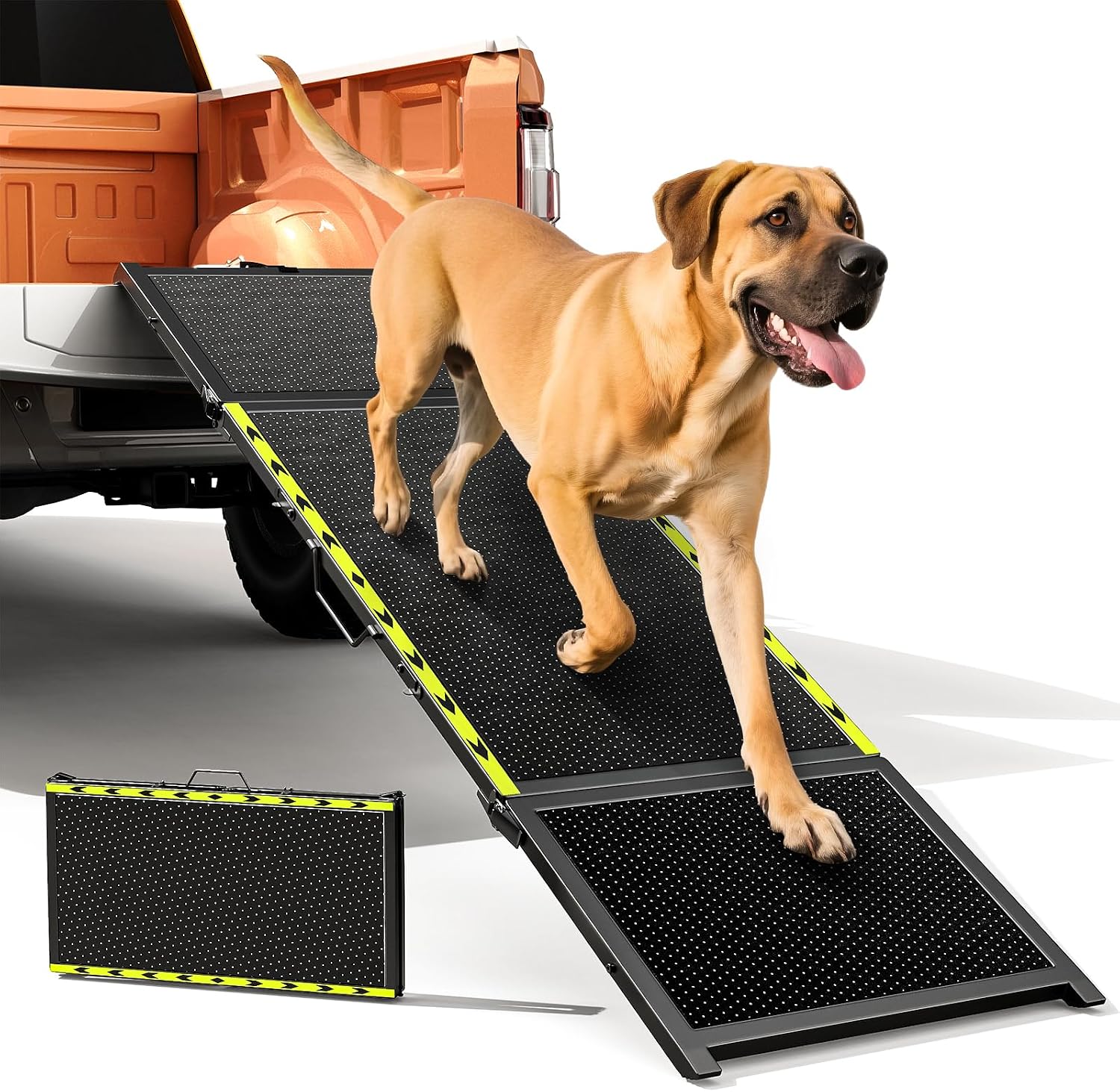
For a senior dog, a cot is only as good as the way onto it, and that is the part most cot shoppers skip entirely. A raised cot puts the sleeping surface well off the floor, which is nothing for a young labrador and a real decision for a twelve-year-old dog with sore hips. This ramp is 74 inches long and 20 inches wide, and those two numbers do two different jobs.
Length sets the ramp angle. Any ramp is a triangle, and the angle at the bottom is the rise divided by the run, so the same rise that turns a short ramp into a staircase turns a 74-inch ramp into a gentle walk. Ramp angle is what decides whether a senior dog uses the thing twice or refuses it forever. Width sets confidence: twenty inches gives a large dog room to place its feet without walking a plank, which matters when the dog is already unsure about its footing.
It folds, so it lives behind a seat or against a wall instead of in the middle of the room. The spec to check before you buy is the listed weight capacity against your dog's actual weight, and if your dog cannot walk at all, no ramp solves that and a mobility harness is the honest answer. For everyone else, a long ramp beats being carried in the one way that counts: the dog keeps doing the work, keeps some joint mobility, and never learns to dread the sound of you approaching with a plan.
Best Value: Cozyide Dog Cooling Mat, Q-Max>0.45, 40 L x 28" W, Blue
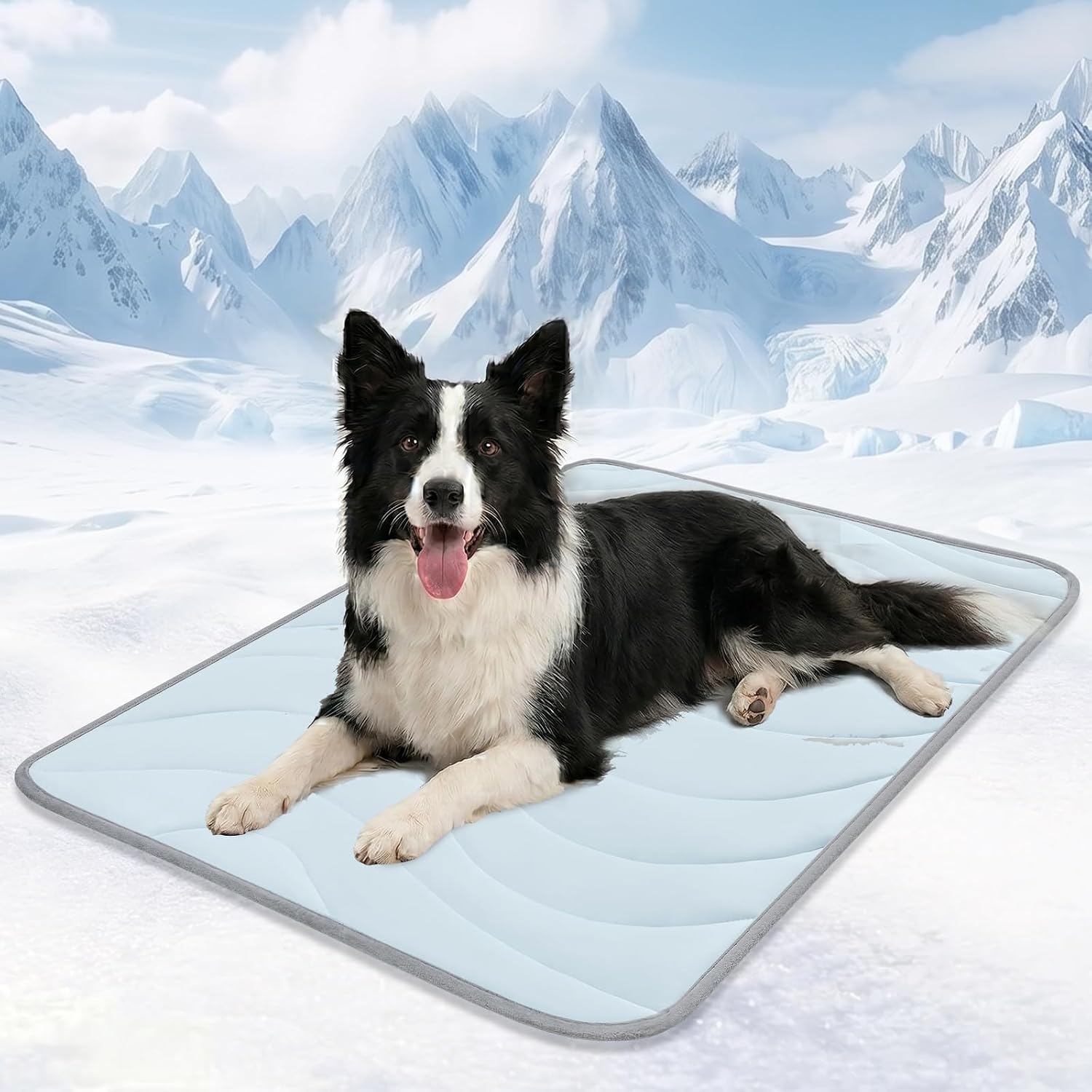
The cooling mat is the cheapest way to change how much of a cot actually gets used. The listed surface is 40 inches long by 28 inches wide, which is a useful reference point for the whole dog cot length question: a dog that measures roughly 34 inches nose to tail when stretched out needs a surface longer than 34 inches to have any margin at all, and 40 inches gives it that.
Q-Max above 0.45 is the listed cooling rating. Higher numbers mean heat moves away from the dog faster, and it is one of the few specs in this category that is measurable rather than decorative. A senior dog that runs hot will abandon a cot in summer, and a cooling mat on top of the deck brings the cot back into rotation. Watch the non slip backing, since a mat on a taut deck will slide if the base is smooth. It is thin enough to fold and travel.
How I tested
Every piece of gear here went through the same four checks, and none of them need a lab.
First, the dog measurement. Nose to tail on a flat floor, lying stretched out the way the dog actually sleeps, taken twice. Standing height tells you nothing about cot length.
Second, the usable surface. Cot frames have end bars, corner fittings, and legs that sit inside the listed footprint, so the deck a dog actually lies on is shorter than the number on the box. Measure the deck, not the frame. The same rule applies to pads and mats: a pad listed for a 30 by 20 crate is telling you the footprint a mid-size dog occupies when it curls, and that number is worth holding next to your dog's stretched-out length. If you have ever gone through measuring a dog for a mobility harness, it is the same tape and the same patience.
Third, weight capacity against the dog's real weight, with margin. A cot rated just above your dog will sag in the middle, and a sagging cot is a cot a senior dog stops using.
Fourth, access. Bed height for a dog that can still step up, ramp angle for a dog that cannot, and lift capacity for the days when neither works.
Analysis and test results
The most common sizing mistake is buying the cot length that matches the dog's crate. Crates are sized for confinement, cots for sprawl, and the two numbers are not interchangeable. The rule I use is the stretched-out length plus a margin of six to twelve inches, and the margin grows with the dog's sleeping style. A curler can live with less. A dog that sleeps on its side with its legs out needs every inch.
Weight capacity is the second mistake. Large dogs do not just weigh more, they concentrate weight differently. A cot that holds a sixty-pound dog fine can bow under a ninety-pound dog that always lies in the same spot. Check the rating against the dog, then ask whether the frame has enough support in the middle rather than around the perimeter.
Foam density and hip support matter most on the pads and mats that sit on top of a cot, not on the cot itself. A thin pad does nothing for a dog with arthritic hips. A dense one keeps the joints from bottoming out against a taut deck. That is the difference between a cot that gets used all evening and one that gets used for twenty minutes.
Bed height decides whether a senior dog gets on at all. Low is easier. The tradeoff is airflow, which is the whole point of a cot in the first place, so the answer is usually the lowest height your dog can manage, plus a ramp for the days it cannot manage even that. The Pawaboo ramp answers that question with length, because ramp angle falls as length rises.
For dogs on crate rest or restricted activity, enrichment is the other half of the setup. The Potaroma puzzle feeder is flat enough to sit on a cot deck, and it turns fifteen minutes of a senior dog's day into problem solving instead of pacing. It has no listed size, so it is not part of the length math, but it belongs in the same conversation about keeping a big dog still.
The dog cot length chart
The chart below is the version I keep on my phone in a store aisle. The listed size column is what the product tells you. The third column is how that number relates to the dog cot length you are trying to find. None of these are cots, and that is deliberate: the surface, the pad, the ramp, and the enrichment are the four things that decide whether the cot you already own gets used.
| Gear | Listed size | How it relates to dog cot length | Check it |
|---|---|---|---|
Pawaboo 74" L & 20" W Longest Dog Ramp for Car Foldable | 74" L x 20" W | Length sets ramp angle, width sets footing | Check current Amazon price |
Cozyide Dog Cooling Mat, Q-Max>0.45, 40 L x 28" W, Blue | 40" L x 28" W | A 40-inch surface suits a dog that stretches to about 34 | Check current Amazon price |
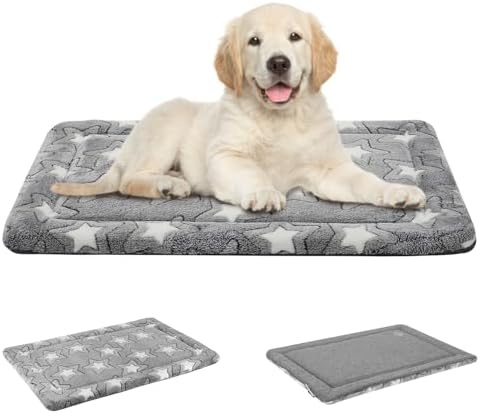 EMPSIGN Dog Crate Pad for 30"x20" Dog Crate, Star Pattern/Grey | Fits a 30" x 20" crate | The curled-up footprint of a mid-size dog | View on Amazon → |
 Potaroma Dog Puzzle Feeder Toy, Interactive IQ Training | No size listed | Not a length number; the stay-busy piece | View on Amazon → |
Measuring a dog who sleeps stretched out
The ideal dog cot length comes from one measurement taken in one position. Put the dog on a hard floor, let it settle into the position it sleeps in, and measure nose to tail if it curls, or nose to the back of the hind foot if it stretches out. Do it twice, because dogs shift. Then add your margin.
The margin is where people go wrong in both directions. Six inches is the floor for a curler. Twelve is right for a big dog that sprawls. A greyhound-shaped dog that sleeps on its side with its legs out will use the entire length of a cot sized to the stretch measurement, and then some, so an extra few inches of deck costs nothing and buys years of use.
Two more numbers belong next to that measurement. Shoulder width tells you whether a cot is wide enough for the dog to turn around on, which a senior dog does more slowly and more often. Weight tells you what the frame has to carry. Write all three down before you shop, because the label on the box is not going to ask.
Weight capacity, bed height, and the ramp question
The correct dog cot length is only half the answer, because a cot that is the right length and the wrong height is still a cot your dog will not use.
Start with weight capacity. A cot rated close to your dog's weight will sag, and sag is the enemy for a dog with joint mobility issues: the middle of the deck becomes a hammock, the dog has to climb out of the dip every time it shifts, and the hips take the load. Buy well above the dog's weight, then check that the frame has support in the center rather than a single perimeter rail.
Bed height is the second half. A low cot is easier to step onto, and a high cot is cooler because more air moves underneath. For a senior dog, pick the lowest height the dog can step onto without a pause, and solve the rest with a ramp. Ramp angle drops as ramp length grows, so the question is not whether a ramp is steep but how long it is. Measure the rise from floor to deck, then choose a ramp long enough that the angle stays shallow. That is the whole calculation, and it is the one that keeps a big dog off your back.
Should you buy the Pawaboo 74" L & 20" W Longest Dog Ramp for Car Foldable?
Yes, if your dog can still walk. The 74-inch length is what makes it work: a long ramp produces a shallow ramp angle for the same rise, which is the difference between a senior dog using it and refusing it. The 20-inch width gives a large dog a real walking surface rather than a balance beam, and it folds flat enough to live behind a seat.
It is not the answer for a dog that cannot bear weight at all. That dog needs a mobility harness and a person strong enough to do the lifting, and the lift capacity question is about your back as much as the dog's. For a dog that can walk but will not jump, this is the piece that keeps a cot, a couch, and a car within reach, and it is the reason a cot stays in rotation past the age where jumping stopped being an option.
Should you buy the Cozyide Dog Cooling Mat, Q-Max>0.45, 40 L x 28" W, Blue?
Yes, and it is the cheapest change you can make to an existing setup. The 40 by 28 inch surface is a genuinely useful size reference: a dog that measures about 34 inches stretched out fits on it with margin, which is roughly the margin you want on a cot. The Q-Max rating above 0.45 is the listed spec that tells you heat moves off the dog rather than sitting on top of it.
The caveats are simple. A cooling mat is not a cot, it is a layer for one, and it will slide on a taut deck if the backing is smooth, so check the non slip backing. It is also a warm-weather tool. In a cold room, a senior dog wants foam density and hip support, not a cooling surface. Buy it for summer, pair it with a dense pad in winter, and the same cot covers both seasons.