Aquarium lighting is the piece of freshwater gear that gets the least attention in the store and the most second-guessing afterward. The box lists a kelvin rating, a wattage figure, and a spectrum chart, but none of that tells you whether the fixture will fit the rim of your tank, whether plants will grow under it, or whether the light will look harsh in the room where the tank actually lives. Small tanks make the choice harder rather than easier, because a 12 to 18 inch tank has a small tank volume and a short distance between the light and the substrate grain at the bottom of the glass.
This guide covers what a light really changes in a small freshwater tank, how four 12 to 18 inch fixtures differ in the ways that matter, and where each one tends to fit. The short version: a full-spectrum LED sized to the tank covers the basics, and the useful differences between models are the mounting, the control, and how much light reaches the bottom.
Quick answer
A full-spectrum LED sized for the tank is the practical starting point for a 12 to 18 inch freshwater setup. Plants respond to how much usable light reaches them and for how many hours; fish mainly need a steady day and night rhythm. Wattage on the label is a starting number rather than an answer, because a lower-wattage fixture mounted close to the water can put more light on the substrate than a higher-wattage fixture with a wide spread and a greater height. Look for adjustable brackets so the light fits your rim, and plan to run it on a schedule instead of switching it by hand. None of the four lights below wins in every situation; each is built around a different way of controlling and mounting the light.
Four useful options
| Model | Best fit | What stands out |
|---|---|---|
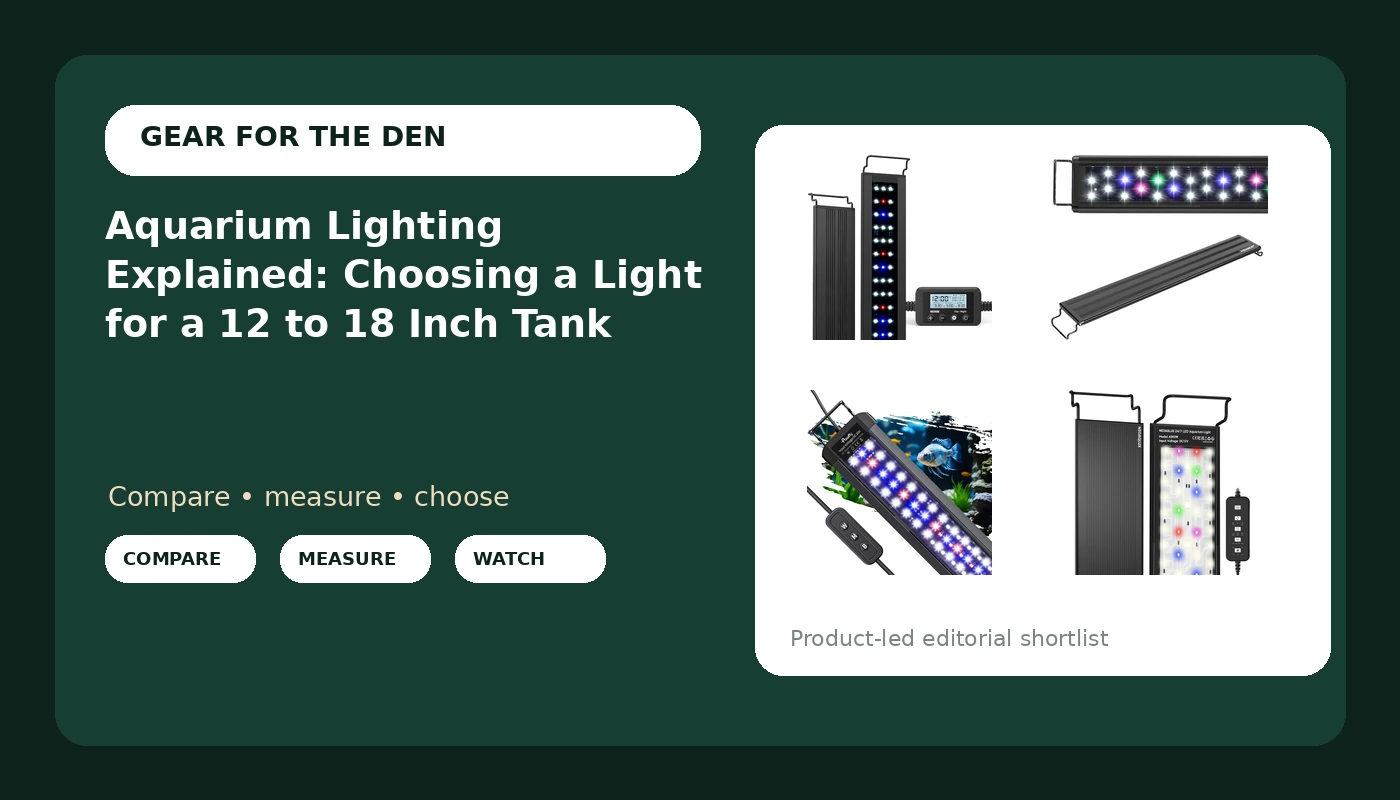
| NICREW C10 Plant Aquarium Light, 12-18 in, 9W, Full Spectrum with Timer | Planted tanks that need a repeatable schedule | Built-in timer with a plant-oriented full-spectrum output |
| AQUANEAT LED Aquarium Light Full Spectrum 12 Inch Fish Tank Light Fresh Water | Simple fish-only or low-light tanks | Slim 12 inch strip with a straightforward full-spectrum output |
| Pawfly 11W Aquarium LED Light for 12 to 18 Inch Fish Tanks Extendable Fish Tank Light with Full Spectrum Brilliant White Blue Red Lights with Daytime & Night Modes and Adjustable | Tanks where you want a visible day and night look | Extendable brackets plus daytime and night modes with white, blue, and red output |
| NEOAQLUX 24/7 LED Aquarium Light for 12-18 Inch Plant & Fish Tank, 12-Color & Gradient & Full Spectrum with Auto On/Off, Sunrise-Daylight-Moonlight, Extendable Brackets for Freshwater IP68 | Keepers who want the light to run itself | Automatic 24/7 scheduling with color and gradient options and an IP68-rated housing |
Planted tank with a timer: NICREW C10 Plant Aquarium Light, 12-18 in, 9W, Full Spectrum with Timer
A built-in timer trades flexibility for consistency. You still choose how long the light runs, but the fixture removes the daily decision, which matters on a tank that sits in a room where the lights get switched on and off at random hours. On a shallow planted tank with undemanding species, 9W across a 12 to 18 inch footprint is a reasonable low to medium level. Tanks with demanding carpeting plants or greater depth may want more output and a way to dim it, and this style of fixture does not offer that. Keep the rest of the system in balance too: a filter rated well above the tank volume makes the light the only variable you are tuning.
Slim strip for simple tanks: AQUANEAT LED Aquarium Light Full Spectrum 12 Inch Fish Tank Light Fresh Water
The trade-off here is control. There is no timer in the fixture and no day or night mode, so the light is only as consistent as whatever you plug it into. A cheap plug-in timer solves that for most people, which is why a simple strip is still a sensible choice for a fish-only tank, a quarantine tank, or a low-light planted setup with java fern and anubias. The other thing to check before ordering is length: a 12 inch strip suits a 12 inch tank, and on a longer rim you would rather have a fixture with extendable brackets than a light that leaves the ends of the tank dark.
Day and night modes: Pawfly 11W Aquarium LED Light for 12 to 18 Inch Fish Tanks Extendable Fish Tank Light with Full Spectrum Brilliant White Blue Red Lights with Daytime & Night Modes and Adjustable
Mode-based control is a different idea from a timer. You decide when the tank switches from the bright daytime setting to the dimmer evening setting, which means the schedule is still yours to keep, but the fixture gives you a low-light look for the hours before you turn in. Treat the night mode as viewing light rather than growing light: plants do their work during the bright period, and a long blue evening adds hours of light without adding hours of useful photosynthesis. Check that the bracket span covers your rim before you commit, since an extendable fixture that barely reaches is worse than a simple one that fits.
Automatic 24/7 control: NEOAQLUX 24/7 LED Aquarium Light for 12-18 Inch Plant & Fish Tank, 12-Color & Gradient & Full Spectrum with Auto On/Off, Sunrise-Daylight-Moonlight, Extendable Brackets for Freshwater IP68
More control is not automatically better. A 24/7 program is convenient because it removes the timer and the daily switching, but the automated ramp does not know how much light your specific plants can use, and a long sunrise-to-moonlight cycle can add up to more hours of light than a small tank needs. Colors and gradients are viewing tools; the full-spectrum setting is the one that does the growing. If you like the idea of a light that behaves the same way every day without your input, this is the category to look at, and if you like to change things week to week, a timer-based fixture gives you more say.
Prices and availability may change. Product images, names, and retailer links are matched to verified listings. No current price, rating, stock status, or measured result is stated here without current evidence.
What aquarium lighting actually does in a planted tank
Light is the fuel for photosynthesis, and the leaves in your tank use blue and red wavelengths most efficiently. A full-spectrum mix is designed to cover those regions while still looking white to your eye, which is why two fixtures with similar wattage can look and grow very differently. The kelvin rating describes the color appearance of the light, not how well plants use it, so a 6500K label is a starting point for comparison rather than a promise.
The two numbers that matter most are how much light reaches the leaves and how many hours it runs. Algae respond to the same light as plants, so extending the photoperiod past what the plants can use usually grows algae rather than growth. Lighting also never works alone. Tank volume sets how quickly conditions shift, the filtration stage and the flow rate handle waste, a filter's gallons per hour rating tells you how much water moves through it, and the thermostat range of your heater keeps the temperature steady. If you are still sorting out the hardware side, our nano aquarium filtration basics covers how those pieces fit together before you tune the light.
Matching a fixture to your tank and routine
- Measure the tank length and the rim width, then note the water depth from the mounting point to the substrate.
- Decide what the tank needs to grow: a fish-only or low-light tank needs far less output than a planted tank with demanding species.
- Check the mounting method. Extendable brackets suit a range of rim sizes; a fixed strip suits one length and one length only.
- Choose the control you will actually use. A built-in timer, a day and night mode, or a 24/7 program each shift how much of the schedule you manage yourself.
- Set a starting photoperiod of roughly six to eight hours, then adjust it slowly based on plant growth, algae, and how the tank looks to you.
Practical setup and scheduling tips
- Wipe the lens or splash cover weekly, since a film of mineral deposits cuts output before you notice the change.
- Put the light on a schedule you can repeat, whether that is a timer in the fixture or a plug-in timer at the outlet.
- Watch algae as a signal rather than a failure: more light for longer is the usual cause in a small tank with modest plant load.
- Think about the room, not just the tank. A small setup often ends up as aquarium desk lighting for a home office or shelf, and a low-profile fixture is easier to live with than a bare bright strip.
- Keep a separate light for maintenance. Aquarium task lighting you can aim while you trim plants or siphon the substrate is more useful than tilting the main fixture, and an ordinary desk light clamped nearby is not a substitute for a proper aquarium fixture over the water.
Which option should you choose?
Choose the NICREW C10 Plant Aquarium Light, 12-18 in, 9W, Full Spectrum with Timer when you keep plants and want the schedule handled inside the fixture. Choose the AQUANEAT LED Aquarium Light Full Spectrum 12 Inch Fish Tank Light Fresh Water when you have a 12 inch fish-only or low-light tank and prefer a simple strip with no programming. Choose the Pawfly 11W Aquarium LED Light for 12 to 18 Inch Fish Tanks Extendable Fish Tank Light with Full Spectrum Brilliant White Blue Red Lights with Daytime & Night Modes and Adjustable when you want extendable brackets and a dimmer evening look for viewing. Choose the NEOAQLUX 24/7 LED Aquarium Light for 12-18 Inch Plant & Fish Tank, 12-Color & Gradient & Full Spectrum with Auto On/Off, Sunrise-Daylight-Moonlight, Extendable Brackets for Freshwater IP68 when you would rather set a program once and let the light run itself.
Those distinctions come from the listings rather than from side-by-side measurements. Spectrum charts, timer behavior, and bracket fit vary by tank and rim, so check the current product details against your tank length and mounting style before you order, and treat any recommendation here as a starting point for your own setup.
The bottom line
With aquarium lighting explained in practical terms, the decision comes down to three things: pick a size that mounts securely on your tank, pick a spectrum that suits what you are growing, and pick a control method you will actually maintain. A timer or an automatic program beats good intentions, and a modest fixture run consistently outperforms a strong one run erratically. Match the light to the tank, give the plants a stable photoperiod, and keep the rest of the system, from flow rate to heater settings, in the same steady rhythm.