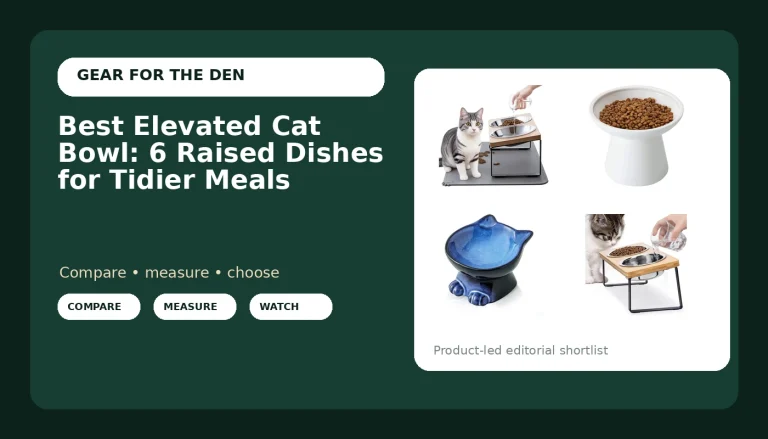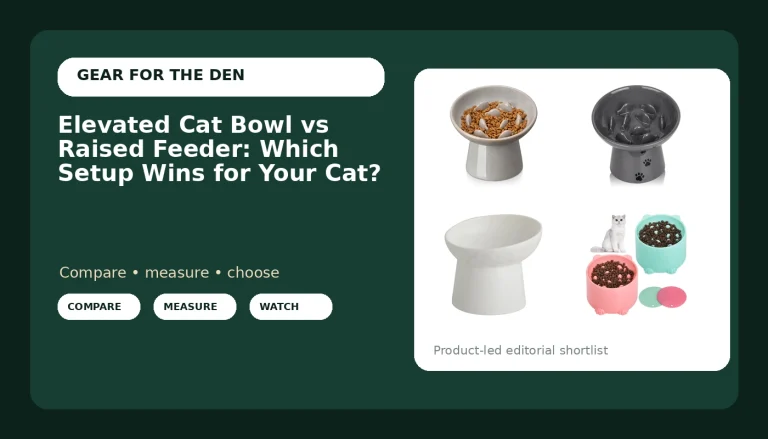
Raised dishes look like a minor upgrade until you watch a cat eat from one. Elevated cat bowls change the angle of the neck, the reach of the shoulders, and the way the whiskers meet the rim, and those three things decide whether a raised dish helps or simply moves the mess. Most owners arrive with a specific complaint: the cat crouches low over a floor-level dish, food gets pushed over the edge, or a fast eater vomits within minutes of finishing. Height is only one variable in that puzzle. Bowl width, whisker clearance, and the elevation angle matter just as much, and so does the material the dish is made from. What follows is a plain explanation of what each feature does, followed by four verified listings and the households they suit.
Quick answer
The short version of elevated cat bowls explained: the rim of a raised dish should sit somewhere between the cat's lower chest and the point of the shoulder, and the bowl itself should be wide enough that the whiskers never press against the sides. There is no single number that fits every cat, because a kitten, an average adult, and a large senior all stand at different shoulder heights. Start with a dish that lifts the food a few inches off the floor, watch whether the neck stays roughly level while the cat eats, and adjust from there. Claims that a dish is the quietest, fastest, safest, or best option need evidence behind them, and the listings below are described only by what they are.
Four useful options
| Model | Best fit | What stands out |
|---|---|---|
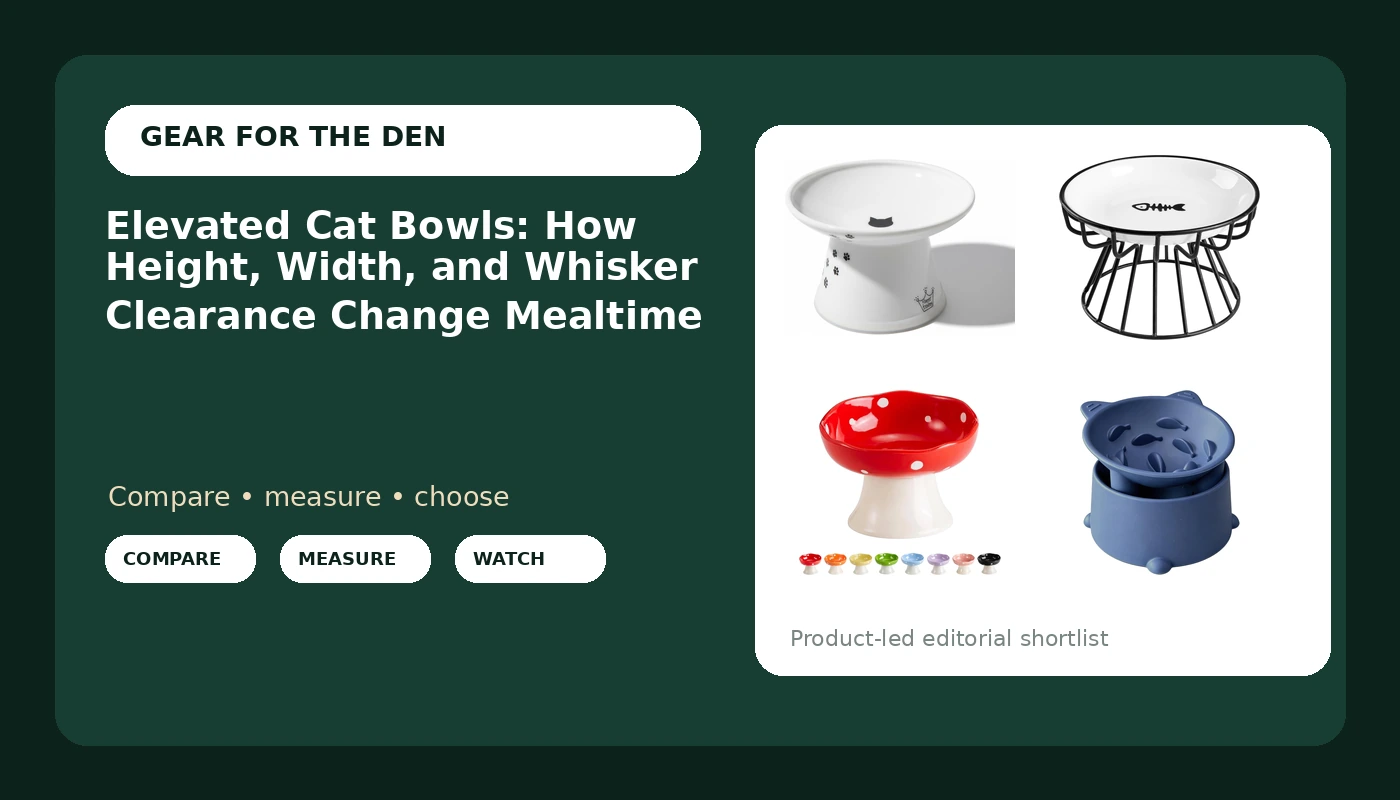
| Necoichi Pocelain Ceramic Extra-Wide Elevated Cat Food Bowl (Cat, Extra Wide) | Cats that flatten their whiskers against the sides of narrow dishes | Extra-wide ceramic dish on a matching raised stand |
| Wellbro Cat Bowls, Elevated Cat Bowl, Raised Ceramic Dish with Metal Stand, Pet Water or Food Feeding Station for Indoor Cats, Kitten, Puppies and Small Dogs, Dishwasher Safe | A first raised dish in a home with a kitten or a small dog | Ceramic dish seated in a metal stand, listed as dishwasher safe |
| Red Mushroom Cat Bowl, Elevated Ceramic Bowl for Cats | Shallow, low-rim feeding for cats that dislike deep dishes | Ceramic bowl with a mushroom shape and a wide, low profile |
| Raised Slow Feeder Cat Bowl, Silicone Elevated Tilted Cat Slow Feeder Bowl | Fast eaters and households watching portion size | Tilted silicone slow feeder on a raised base |
Extra-wide pick: Necoichi Extra-Wide Ceramic Bowl
The reason the extra-wide shape matters comes down to whisker clearance. Cats use their whiskers as touch sensors, and a narrow dish forces those whiskers to bend against the rim with every bite, which some cats tolerate and others clearly do not. A dish with a wider mouth and a lower rim lets the whiskers sit outside the food instead of inside it. That is the whole case for the ideal elevated cat bowls shape in most homes: not a gadget, just more room at the rim. The trade-off is counter space and cleaning. A wide ceramic dish takes up more room than a small saucer and is heavier to lift, though ceramic generally holds its shape and tends to stay put better than a light plastic dish. If your cat backs away from a narrow bowl, or eats from the edge and leaves a mound in the middle, width is the first thing to test.
Starter pick: Wellbro Ceramic Dish with Metal Stand
A first raised dish does not need to be complicated. This one pairs a ceramic dish with a metal stand, which keeps the food off the floor without taking up a wide footprint, and the ceramic insert is listed as dishwasher safe. That combination suits a household where the cat is still growing and the dish may need to move between rooms, and it also works for a small dog sharing the same feeding corner. The catch is that a stand with a fixed height gives you one elevation angle and nothing else. If the cat eats comfortably, that is enough. If the cat still crouches, you have learned something useful about where the correct elevated cat bowls height sits for your cat, and you can shop for a taller or shorter stand with that information in hand. Fixed height is a limitation, not a flaw.
Low-profile pick: Red Mushroom Cat Bowl
Some cats dislike eating from a deep well because the sides crowd the face and the food sits below the rim. A shallow, wide bowl with a low profile solves that by keeping the food close to the top of the dish. The mushroom shape here is mostly a design choice, and a red ceramic bowl is easy to spot on a shelf, but the useful part is the low rim. A shallow dish also suits cats that eat quickly and swallow a lot of air, since they do not have to push their muzzle as deep to reach the food. The trade-off is capacity. A shallow bowl holds less, so if you serve a large portion size in one sitting, you may end up refilling it or splitting the meal across two dishes. That is often fine, and for some cats splitting the meal is the point.
Slow-feeder pick: Raised Slow Feeder Cat Bowl
A slow feeder changes the shape of the meal rather than the height of the dish. The raised base adds elevation angle, and the tilted silicone surface with its ridges forces the cat to work around obstacles instead of scooping a whole portion in a few seconds. For a cat that finishes in under a minute and then vomits or begs, that slower pace is the point. Silicone has practical advantages: it is flexible, quiet against a counter, and generally easy to rinse. It also has limits. Some cats find a slow feeder frustrating and simply stop eating, and a textured silicone surface needs more thorough washing than a smooth ceramic dish because food catches in the grooves. Introduce it for one meal, not for the whole day, and watch what the cat actually does.
Prices and availability may change. Product images, names, and retailer links are matched to verified listings. No current price, rating, stock status, or measured result is stated here without current evidence.
What elevated cat bowls actually change
Elevation is about the neck, not the floor. When a cat eats from a floor-level dish, the neck drops and the shoulders roll forward. A raised dish reduces that bend, which is why owners of senior cats, and owners of cats with joint stiffness, are often the ones asking about it. The elevation angle describes how much a dish is lifted or tilted. A slight lift is usually easier to introduce than a dramatic one, because cats are creatures of habit and a dish that suddenly sits at chest height can be refused for a day or two.
Whisker clearance is the second variable. Whiskers are touch sensors, and many cats eat from the middle of a wide dish for exactly that reason. Bowl width and rim height together decide whether the whiskers touch anything at all. If you can see the whiskers bending back against the sides while the cat eats, the dish is too narrow for that cat, regardless of how good the height looks.
Portion size is the third. A deep, narrow dish can hold a full day of dry food, but it also makes the food harder to reach as the level drops. Two shallower meals often work better than one deep one, and a slow feeder can stretch a small portion across a longer stretch of time.
Some features that matter for other cat gear do not apply here. Water capacity, pump noise, and filter type belong to fountains, and microchip range belongs to automatic feeders. A plain raised dish has none of those parts, which is part of its appeal: nothing to plug in, nothing to program, and nothing to fail.
How to match a dish to your cat
Measuring is less useful than watching. Put the current dish on a stack of books or a low box, watch one meal, and adjust from there. A cat eating comfortably keeps the neck roughly level, keeps the front paws on the floor, and does not back away between bites. A cat that crouches, hooks food out with a paw, or walks off after two bites is telling you the setup is wrong.
Material matters less than fit, but it is not irrelevant. Ceramic is heavy enough to stay put and does not hold odors the way some plastics can. Stainless steel is durable and easy to clean. Silicone is flexible and quiet. Whichever you pick, the dish needs frequent washing, because a raised dish at nose height collects drool and food debris that a floor-level dish does not.
Then run the same five decisions for any dish you are considering.
- Measure the cat's shoulder height while it stands, then aim for a rim somewhere below that line.
- Watch one full meal and note whether the neck stays level or drops toward the dish.
- Check whisker clearance by watching whether the whiskers bend against the rim.
- Decide how many meals per day you serve, and pick a bowl that holds one meal comfortably.
- Choose a material you will actually wash, then place the dish where the cat already eats.
Practical guidance for the first week
- Introduce the raised dish with a familiar food at a familiar time of day.
- Keep the old dish nearby for a day or two if the cat refuses the new one.
- Wash the dish after every wet food meal, and rinse it after dry food.
- Put a mat underneath, since a raised dish spills from a greater height than a floor-level one.
- Watch for a cat that eats less, not just slower, and switch back if intake drops.
Which option should you choose?
Choose the Necoichi extra-wide ceramic bowl when whisker clearance is the problem and your cat eats from the edge of a narrow dish. Choose the Wellbro raised ceramic dish with metal stand when you want one simple raised dish for a growing kitten or a small dog. Choose the red mushroom ceramic bowl when a shallow, low-rim dish suits a cat that dislikes deep bowls. Choose the tilted silicone slow feeder when a fast eater needs a slower meal and you are willing to watch how the cat responds to the ridges.
None of these four listings comes with a published measurement that fits every cat, and none of them is a medical device. If a cat is losing weight, vomiting repeatedly, or showing pain around the neck or shoulders, that is a conversation with a veterinarian, not a shopping decision. Elevation is a comfort adjustment, and comfort is something you observe at the dish, not something a product page can promise.
The bottom line
Elevated cat bowls are a fit question, not a features question. Get the rim to roughly chest or shoulder height, get the bowl wide enough for the whiskers, and match the depth to one meal rather than a whole day. The extra-wide ceramic dish is the starting point for cats that avoid narrow bowls, the ceramic dish in a metal stand is the sensible first raised dish, the mushroom bowl suits cats that prefer shallow dishes, and the tilted silicone slow feeder is the option for fast eaters. Whichever you choose, introduce it over a few meals and let the cat's posture tell you whether the height is right. Nothing in this category costs enough to justify forcing a dish that a cat clearly dislikes.