A hike is only as relaxed as the weakest link in your recall, and off leash miles in unfamiliar country are where that link gets tested. A gps dog collar for hiking dogs is the gear category that answers the question every trail owner eventually asks: if my dog vanishes over a ridge, what actually brings them back? The honest answer has less to do with the gadget than with the physics of the place you hike. GPS reception, radio or cellular signal, battery life, and the way the tracker reports to you all change the moment you leave the trailhead parking lot. This gps dog collar for hiking dogs explained guide works through what each type of tracker does, where it stops working, and which of four current options fits a particular trail, dog, and phone. Nothing here assumes a subscription is acceptable, and nothing assumes it is avoidable.
Quick answer
Start with cell coverage, because it splits the category in half. Tags that push location through a phone app rely on a cellular or Bluetooth link, cost less up front, and stop reporting where there is no service. Trackers that use their own radio link or a dedicated handheld keep working past the last bar of signal, and they cost more. After coverage, weigh gps range against the terrain you actually hike, then battery life against the length of your longest day, then whether a monthly fee is required. Waterproofing and a secure fit on the collar matter on every hike. No single tracker suits every trail, so match the tool to the walk rather than chasing a range number printed on a box.
Four useful options
| Model | Best fit | What stands out |
|---|---|---|
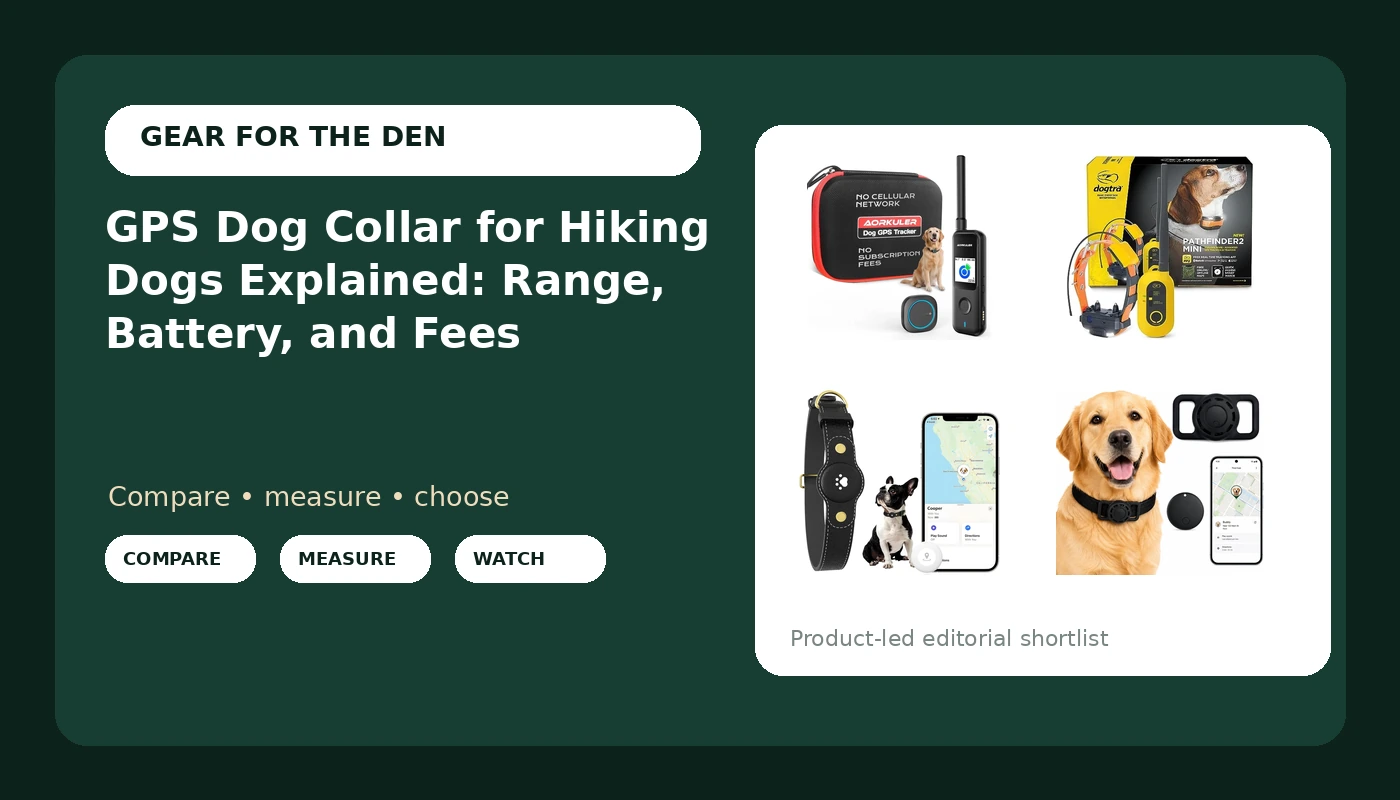
| Aorkuler GPS Dog Tracker, Track Your Dog Up to 3.5 Miles Without Phone or Cell Signal | No App, No Monthly Fees | Ideal for Hiking, Rural & Remote Areas (Tracker 2) | Hikes past cell coverage | Standalone tracking, no app, no monthly fees |
| Dogtra Pathfinder 2 Mini GPS Dog Tracker e Collar 4 Mile Long Range LED Light No Monthly Fees Free App Waterproof Smartwatch Control Based Real Time Tracking Multiple Dogs Smartphone Required | Long range and multiple dogs | Four mile quoted range, e collar, smartphone required |
| GPS Tracker for Dogs, Smart Dog Collar & Pet Tracker with Real-Time Location, No Monthly Fee, Unlimited Range (iOS & Android), Fits Small to Large Dogs(Locator Included) | App based everyday tracking | Real time location on iOS and Android, locator included |
| GPS Smart Collar for Dogs, Android Pet Tag. Waterproof, Google Find My Compatible, No Monthly Fee. Advanced Tracker ensures Safety for Small to Large Dogs. (Tracker for Dog) | Android users watching cost | Google Find My compatible, waterproof, no monthly fee |
For trails past cell signal: Aorkuler GPS Dog Tracker
The trade off with any tracker that skips the phone is that it needs its own screen and radio link somewhere on the trail, which in practice means a handheld or wrist unit in your pack. It also means the practical gps range shrinks in timber, gullies, and dense canopy, because radio does not bend around terrain the way a map suggests. What you gain is independence: no coverage map to check, no subscription to keep active, and no phone battery to protect. For a dog that ranges ahead on forest service roads and open ridgelines, that is often the more useful bargain. For a dog that stays within sight on a city greenway, it is more hardware than the job requires.
For long range and multiple dogs: Dogtra Pathfinder 2 Mini
Combining tracking with an e collar changes the decision. You get one unit on the dog, one interface in your hand, and no monthly fee, which suits households with more than one dog on the same walk. The catch is that smartphone required means your phone is the display, so battery life and a charged power bank become part of your kit list. E collar functions also carry a training responsibility: they belong in the hands of someone who has conditioned the dog to the cue, not as a first response to a dog that has already broken away. If you only want location, a plain tracker does the same job with less to learn.
For app based tracking: GPS Tracker for Dogs Smart Collar
Unlimited range in a phone app design describes the network rather than the radio. There is no handheld to carry, which keeps the kit light, but the tracker can only report where your phone can reach it, so a canyon with no service is a canyon with no dot on the map. That makes this style a good fit for greenways, suburban parks, and national park front country where coverage is decent, and a poor fit for the back side of a wilderness peak. The locator included and the size range are the practical details worth checking against your own dog before you buy.
For Android users: GPS Smart Collar for Dogs Pet Tag
A tag that leans on a shared finding network works best where other people's phones are. Around a neighborhood, a campground, or a busy trailhead, that crowd is the system. Deep in a quiet forest with no hikers between you and the dog, there is nothing to relay a position, so treat this as a safety net for the places you actually walk rather than a backcountry instrument. It is the cheapest way to add a tracker to an Android household, and waterproofing plus the size range make it a realistic everyday collar addition. Buy it for the walks you take weekly, not the expedition you take yearly.
Prices and availability may change. Product images, names, and retailer links are matched to verified listings. No current price, rating, stock status, or measured result is stated here without current evidence.
How gps range and battery life behave on a real hike
Three different systems share the name GPS tracker, and they fail in different places. A satellite receiver in the collar or tag works out where the dog is. The question is how that position reaches you. One design sends it over a radio link to a handheld or a paired unit, one pushes it through a phone app over a cellular network, and one hands it to a phone over a short range wireless connection. The first keeps working where there is no service, the second depends on coverage, and the third depends on proximity.
Terrain decides how much of the quoted gps range you actually see. Open ridgelines and fields give a radio link its best chance, while dense timber, canyon walls, and wet foliage cut it down. A manufacturer's number describes a best case, not your trail.
Battery life follows the same logic. Frequent position updates, a bright screen, cold mornings, and a phone running navigation in the background all drain faster than a mild day on a familiar path. A tracker that dies at mile six is a leash you forgot to bring. Check the charging routine before you trust the number on the box.
Choosing a gps dog collar for hiking dogs
There is no single ideal gps dog collar for hiking dogs, because the deciding variable is your trail rather than the hardware. The correct gps dog collar for hiking dogs is the one whose signal path matches where you walk, whose battery outlasts your longest day, and whose fit your dog will tolerate for hours at a time. Work through it in this order:
- Map your regular trails against cell coverage, because that single fact separates app based tags from standalone trackers.
- Measure how far your dog actually ranges ahead. A dog that works close suits a simple tag, while a dog that quarters a hillside at 300 yards needs genuine gps range.
- Decide whether a monthly fee is acceptable before you compare hardware, since subscription free designs are a smaller pool.
- Compare battery life against your longest planned day, not your average neighborhood loop.
- Confirm the collar or tag fits your dog's neck size and is rated waterproof, then test the link at the trailhead before you rely on it.
Trail day habits that keep the tracker useful
- Fit the harness or collar properly. A snug chest strap and a front clip that does not shift keep the tag oriented and reduce rubbing on long descents.
- Set your leash length deliberately. A short leash on the climb and a long line on open ground keeps the dog inside the range you have already tested.
- Match footwear to the surface. A traction sole for wet rock and correct boot sizing for hot granite or winter ice prevent the paw injuries that end hikes early.
- Carry a cooling fabric bandana or vest on hot days. Heat is a bigger trail risk than getting lost for most dogs.
- Start every hike at full charge, and switch the tracker on before you leave the car so you know the link works where you are standing.
Which option should you choose?
Choose the Aorkuler GPS Dog Tracker when your hikes run past cell coverage and you want tracking that does not depend on a phone. Choose the Dogtra Pathfinder 2 Mini GPS Dog Tracker e Collar when you want the longest quoted range and multi dog tracking in one system. Choose the GPS Tracker for Dogs smart collar when your trails stay inside network coverage and app based real time location is enough. Choose the GPS Smart Collar Android Pet Tag when you are on Android, watch the budget, and walk where the Google Find My network reaches.
Range and feature claims above come from the manufacturers' own listings. Terrain, canopy, battery state, and network coverage change what any of these delivers on a given day, and no measured result is claimed here.
The bottom line
Tracking a dog on a hike is a signal problem before it is a shopping problem. Decide where you walk, how far your dog ranges, and how long your longest day runs, and the shortlist shrinks quickly. Hikers who leave coverage behind are choosing between a standalone tracker and a long range system with a handheld or phone interface. Hikers who stay inside coverage can spend far less and let a phone app do the work, accepting that the dot on the map disappears with the signal bars. Whichever you pick, fit it well, charge it fully, test it at the trailhead, and treat the quoted range as a ceiling rather than a promise.