Every argument about hamster cage size comes back to one number: floor area. Length times width, in inches, multiplied out. Not the height of a second level, not the footprint of the base plus a tube run, and not the word large printed on the box. This hamster cage size guide is the checklist I run before I buy anything for a dwarf hamster, and it starts with the same question every time: how much uninterrupted floor can this animal actually walk on?
I have kept dwarf hamsters long enough to know the cage is the whole environment. Burrow, bathroom, pantry, and running track share one footprint, and the animal cannot leave when the layout is wrong. There is no single ideal hamster cage size, only a floor you should not go below and a lot of room above it. Get the size wrong and no accessory fixes it. Get it right and a modest setup works, because a hamster with room to dig and a wheel that fits will use every inch you give it.
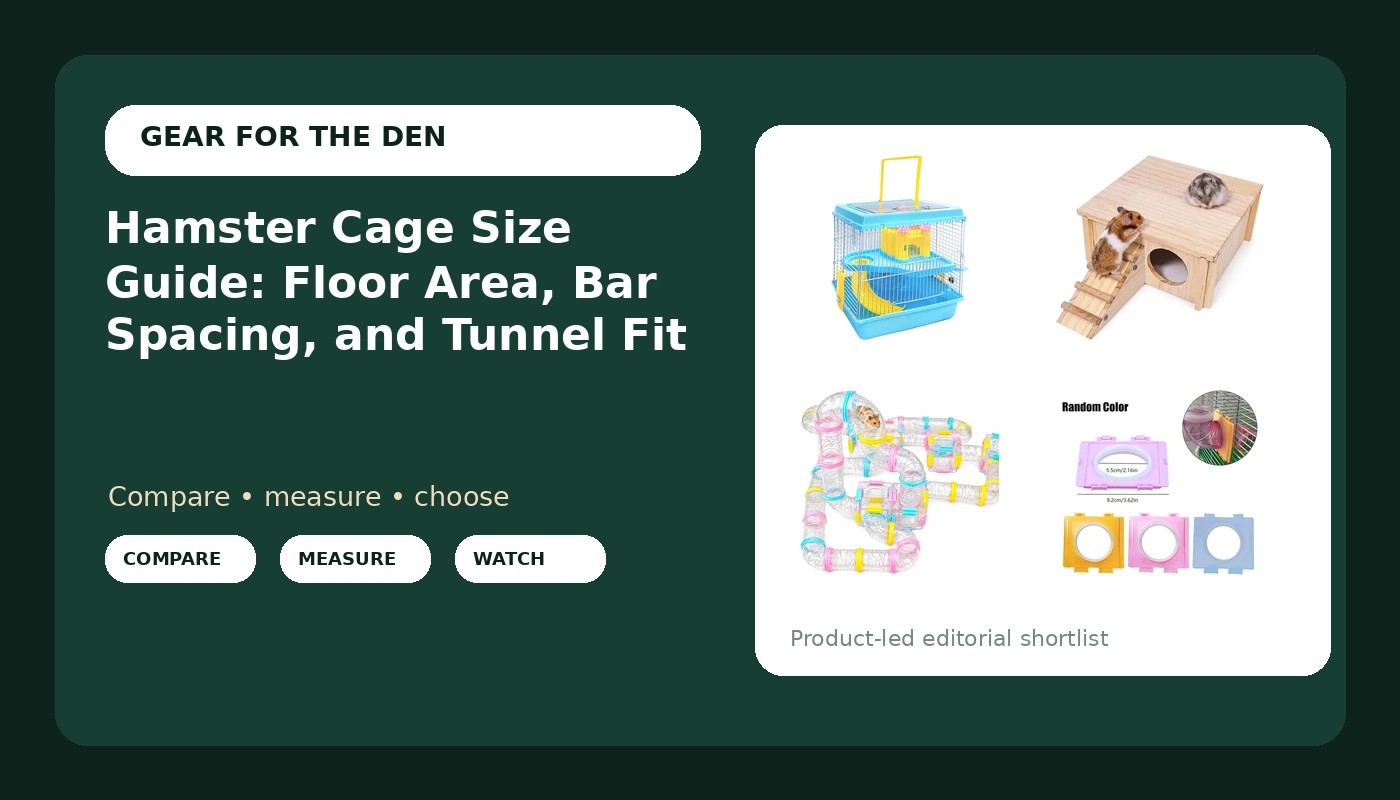
Best Overall: Tfwadmx 2-Tier Portable Dwarf Small Hamster Carrier Travel Cage,Blue
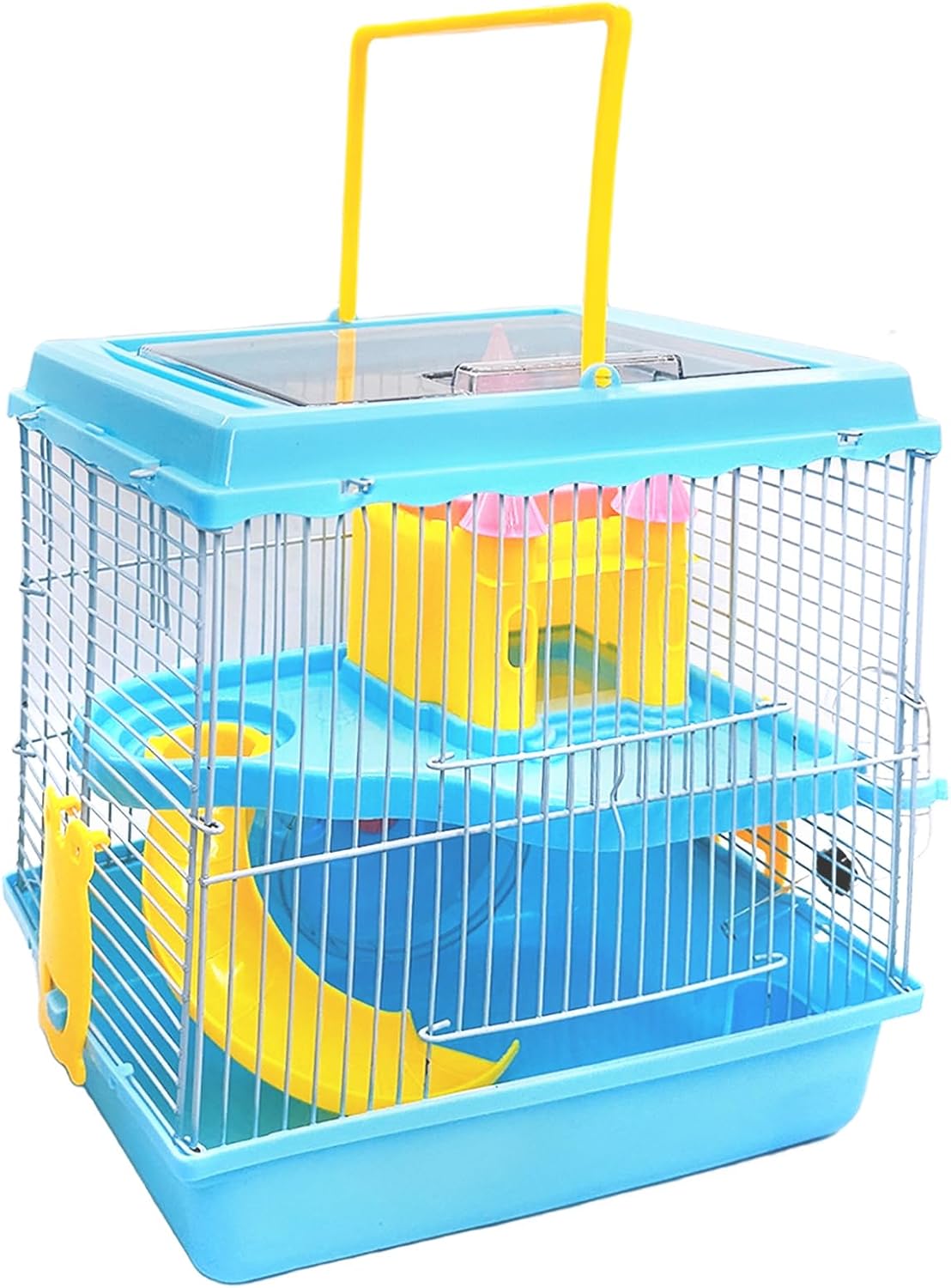
If you have ever moved a hamster in a shoebox with holes punched in the lid, you know why a real carrier earns the top spot in a cage size guide. This Tfwadmx carrier is a two-tier travel cage sized for dwarf hamsters, and the word travel is doing a lot of work here. It is not a habitat. It is the enclosure you reach for on vet day, on full clean-out day, during the first week a new hamster comes home, and on any car trip where a glass tank stays behind.
Two tiers matter more than they sound. In a strange room a hamster paces, and a second level gives it somewhere to tuck away from the open part of the box. The small footprint fits a passenger seat or a bathroom counter without rearranging the room, and blue plastic wipes down, which is what you want from something that spends most of its life in a closet between trips.
What it is not: the main cage. A carrier's floor area is a fraction of what a dwarf needs for a permanent setup, and a hamster housed in one will pace, chew bars, and sleep in its own waste corner. Use it as the second enclosure in a two-cage system and shop the main cage against the floor area numbers in the table below. If your hamster is a Syrian rather than a dwarf, skip it, this one is sized for the small species.
Best Value: Multi-Chamber Wooden Hamster House Hideout Maze Cage Accessories Decor
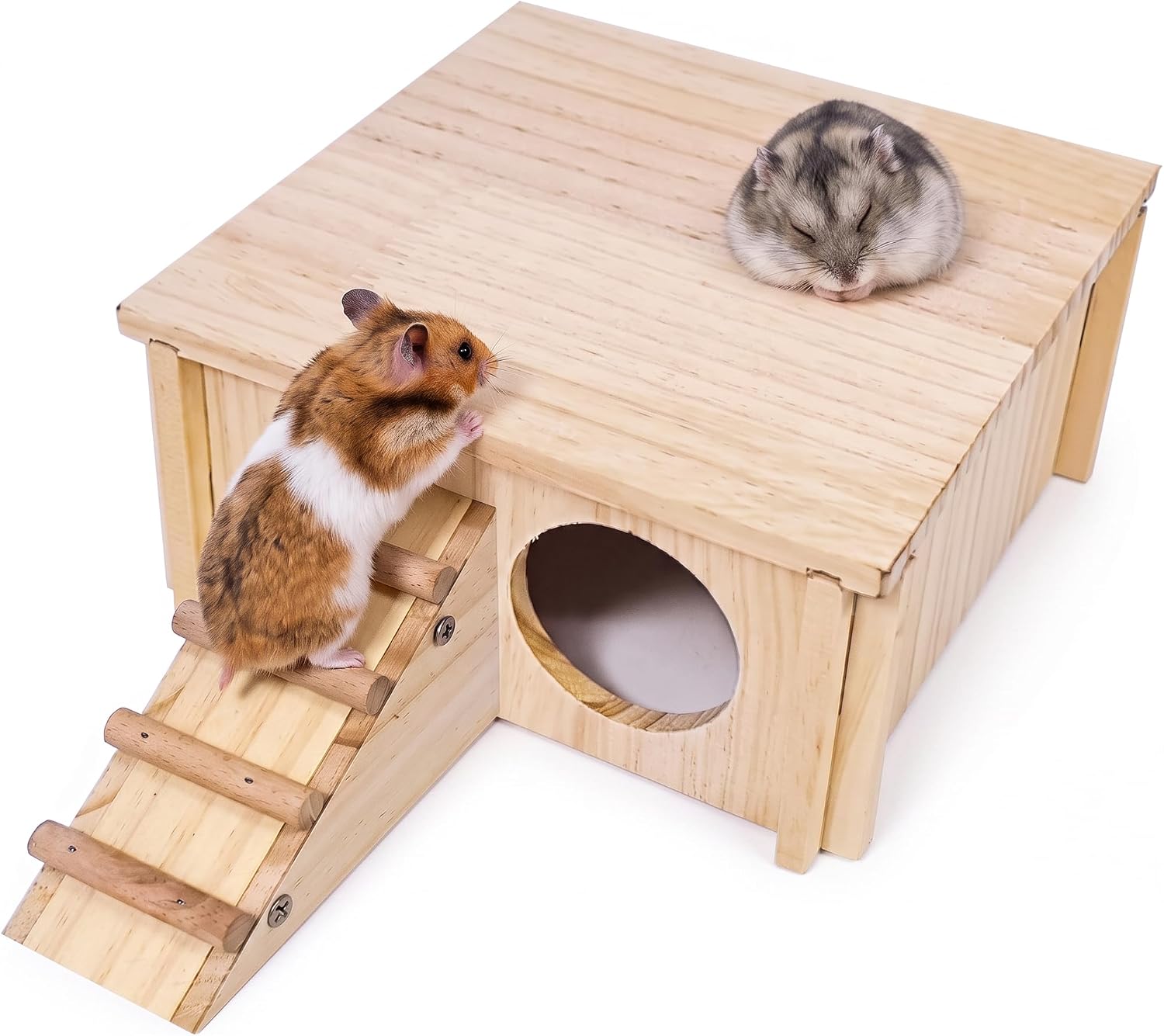
Most cages fail the size test in one of two ways: not enough floor, or enough floor and nothing on it. This wooden hideout is the cheap fix for the second problem. It is a multi-chamber maze, so a hamster gets a sleeping chamber, a hoarding chamber, and a reason to cross the cage instead of circling one corner of it.
Hideout size is the spec nobody checks. A hideout that is too large for a dwarf hamster feels like an open field, and the animal sleeps beside it rather than inside it. Multiple chambers solve that, because the hamster can pick the tight one and store food in the loose one. Wood is also a chew surface, which counts for a rodent that needs to wear down its teeth.
The trade-off is cleaning. Wood soaks up urine and cannot be scrubbed the way ceramic can, so plan on replacing it eventually and spot clean the chambers more often than you would a plastic hide. Check the entrance width before you buy, because an entrance that is too narrow turns a hideout into a decoration. For the money, it is the fastest way to make a correctly sized cage feel like a territory instead of a box.
How I tested
I do not trust a cage until I have measured it, and the measurements that matter are boring.
Floor area first. Tape measure along the inside of the base, length times width, ignoring levels, tube runs, and anything a listing counts twice. A cage advertised at a big number often measures much smaller once the wheel, the bottle, and the hideout take their share of the floor.
Bar spacing second. I check the gap at three points along the wire, top, middle, and bottom, because a dwarf hamster will find the widest one. If the gap is wider than the animal's skull, the cage is a one-way door.
Tunnel diameter third. I measure the opening rather than the tube, since fittings and connectors narrow the passage. Anything under the hamster's body width is a trap.
Then the softer checks. Bedding dust: run a handful through your fingers over a dark surface and look at what falls. Hideout size: entrance width against body width, not species name. Bottle capacity: fill it, mark the level, and count the days until it runs dry, because a bottle that empties between refills is a cage problem wearing a water bottle costume. And the floor plan test, where wheel, hideout, bottle, and food dish all have to sit on the floor at once without overlapping. If they do not fit, the cage is too small no matter what the label says.
Analysis and test results
Sort every cage spec into two piles: the ones you can fix later and the ones you cannot. Bar spacing, hideout size, tunnel diameter, bottle capacity, bedding dust, all fixable with accessories. Floor area is locked in at purchase, which is why the correct hamster cage size is the only number worth arguing about before you pay, and why both headline picks here are accessories rather than cages.
Size behaves differently at different scales. A dwarf hamster wants a wide, shallow floor, because its natural behavior is to run long distances in a straight line and dig down when it stops. A tall cage with the same volume gives you more climbing surface and less floor, and floor is what the animal actually uses. That is the most common mistake in cage listings, and it is why the minimums below are written as floor area rather than volume.
Multi-level cages complicate the math. A second level adds surface and a hamster will use it, but it does not add floor. The two-tier carrier above is the proof: the upper tier makes it a better travel box and does not make it a bigger home. Count the base, then treat levels as a bonus.
Tube runs are the other place where usable space and official floor area diverge. A long run gives a dwarf real exercise, and I would rather see a hamster in a modest cage with a good run than in a bare cage at twice the size. But a hamster cannot be shut inside a tube, so tube footage never counts toward the minimum. Build the cage to the minimum first, then add the run.
Bedding is the last variable. A hamster that can dig six inches down is a different animal from one pushing bedding around a bare floor, and deep bedding needs a taller base or a deeper tray. Low-dust bedding matters here too, because bedding dust settles on the water bottle and the food, and it is one of the few cage problems you can solve with a purchase instead of more floor space.
The hamster cage size reference table
These are the floors I work from. They are published husbandry minimums rather than numbers I invented, and they are the point where a cage becomes acceptable, not the point where it becomes good. Bigger is better in every row.
| Item | Minimum floor area | Bar spacing | Tunnel diameter | Hideout size | Notes |
|---|---|---|---|---|---|
| Syrian hamster (golden) | 450 sq in, and a 40 gallon tank is easier to find than a cage that hits it | 0.25 to 0.5 in, and only 0.5 in for a full grown adult | 2.5 to 3 in | 6 in cube with a 2.5 in entrance | Solitary. One hamster per cage. |
| Dwarf hamster (Campbell, winter white) | 360 to 450 sq in | 0.25 to 0.35 in | 2 in | 5 in cube with a 2 in entrance | Long and shallow beats tall. |
| Roborovski dwarf | 450 sq in | 0.25 in | 2 in | 4 to 5 in cube with a 1.5 to 2 in entrance | Small gaps matter most with this species. |
| Chinese hamster | 360 to 450 sq in | 0.25 in | 2 in | 5 in cube with a 2 in entrance | Climbs well, so lid security counts. |
 View on Amazon → 94 Pcs DIY Hamster Tunnel Tube Set | Not a cage | Not a cage | 2 in | Not a cage | Adds usable space for dwarf hamsters, mice, and gerbils. Never counts toward the minimum. |
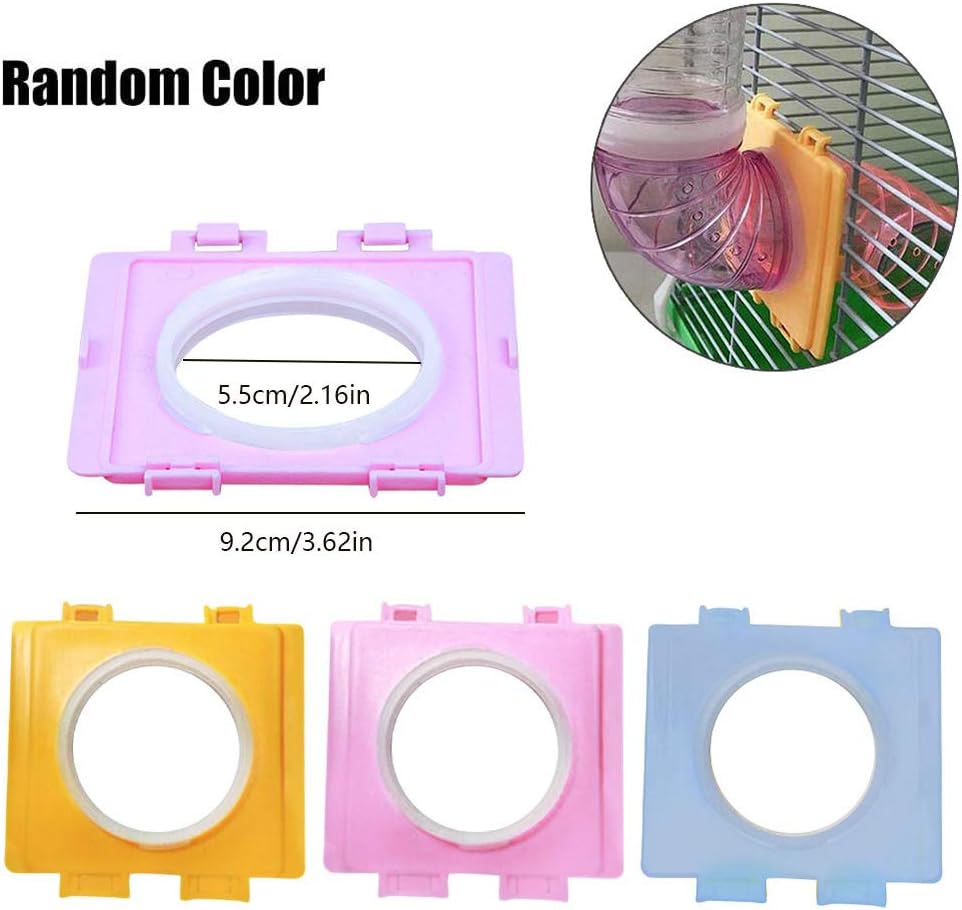 View on Amazon → 2 Set Small Animals Hamster Tunnel Cage Cover with Ventilation Holes External Pipe Interface Fitting Connection Board Tube Connector | Not a cage | Not a cage | 2.17 in inner diameter | Not a cage | Connects a tube run to a cage wall through the ventilated cover panel. |
Read it left to right for a species and you have a shopping list: floor area for the cage, bar spacing for the wire, tunnel diameter for the run, hideout size for the accessory.
Tunnel diameter and how a tube run changes usable floor area
Tunnel diameter is a body measurement, not a species measurement. A young hamster of any species can pass through a 2 inch tube and a full grown Syrian cannot, which is why the 94 piece tube set in the table is a dwarf, mouse, and gerbil product despite the broad hamster labeling. Buy the diameter the adult will need rather than the one the baby fits today, or you will be shopping again in three months.
The other half of the fit is the connection. A run that dead-ends against a cage wall is a toy. The 2.17 inch inner diameter cover and connector set solves that by replacing part of the cage cover with a ventilated panel and an external pipe interface, so a run attaches to the cage instead of sitting beside it. The stretch resistant material and the slightly wider inner diameter are what let it work with a 2 inch tube without pinching the passage, and a pinched passage is exactly where a hamster gets stuck.
Use tube runs as a bonus, never as square footage. A run that adds two feet of travel is worth more to a hamster than a second hideout, but the minimum floor area still has to exist inside the cage, because a tube is not a place an animal can be left.
Bar spacing, bedding dust, and bottle capacity
Bar spacing is the quiet killer. A dwarf hamster needs 0.25 to 0.35 in, and wire cages often run wider at the corners where panels meet. Check the gap with a ruler instead of your eye, because a hamster that fits through the bars is gone in an evening.
Bedding dust matters more than most owners expect. A hamster's airway is small and its nose sits inches from the bedding all day. Low-dust paper or aspen bedding, changed often, does more for a cage than any accessory, and it keeps the water bottle and the food from getting coated. Skip pine and cedar shavings and skip anything scented.
Bottle capacity is a cage size question in disguise. A small bottle is fine in a small cage and annoying in a large one, because a bigger floor means a longer walk to the water and a bigger mess if the bottle leaks. A 4 ounce bottle suits a dwarf setup, an 8 ounce bottle suits a Syrian, and a spare bottle costs less than a vet visit for dehydration. A hay rack, meanwhile, is not a hamster item. Hay racks belong in rabbit and guinea pig cages where hay is the bulk of the diet, so hanging one in a hamster cage takes up space and does nothing. Spend that budget on hideout size instead.
Should you buy the Tfwadmx 2-Tier Portable Dwarf Small Hamster Carrier Travel Cage,Blue?
Yes, as the second enclosure in your setup, and no if you are hoping it can be the only one. This is the box for the vet, for the clean-out, for the road trip, and for the first week with a new hamster. Two tiers and a small footprint make it easy to carry and easy to park in a bathroom while you rebuild the main cage, and the dwarf sizing means a small hamster is not rattling around in a box built for a rabbit.
What it will not do is satisfy the floor area minimum in the table above. A hamster kept in a carrier full time will pace, chew the bars, and sleep in the corner it also uses as a bathroom. Buy it for the trips and buy a proper cage for the rest of the year. If your hamster is a Syrian, this is the wrong size, so start with the floor area row instead.
Should you buy the Multi-Chamber Wooden Hamster House Hideout Maze Cage Accessories Decor?
Yes, if your cage already meets the minimum floor area and still looks bare. It is the cheapest way to turn a correct cage into a good one, and the multi-chamber layout is the part that matters, because it gives a hamster a reason to move. It is also the accessory most likely to settle a pacing hamster, since pacing usually means the animal has nowhere to hide and nothing to do.
Two cautions. Check the entrance width against your hamster before you buy, because a hideout it cannot fit through is furniture. And expect to replace it sooner than a ceramic hide, because wood holds urine and odor and cannot be scrubbed. If you want the longest lasting hideout, buy ceramic. If you want the one that changes a cage this week for the price of a coffee, buy this one.