Few things in a cat household are as quietly irritating as the sound of a bowl skidding across the floor at 3 a.m. The short answer to how to keep a cat bowl from slipping is not one product. It is a combination of bowl width, base weight, surface grip, and the height you set the dish at.
I have been covering cat feeding gear for Gear for the Den for years, and I have read through hundreds of verified buyer reports on bowls, feeders, and fountains. The pattern is consistent: cats do not push bowls for fun. They push because the bowl moves when they eat, and that movement makes the meal harder than it needs to be.
The fix is a small setup project. You can solve it with the right bowl, a grippy base, and a height that lets your cat eat without reaching. This guide walks through the gear I compared and the eight-step workflow I use to keep a cat bowl from slipping.
Why you should trust me
I have spent the last several years writing about cat feeding and water gear, from raised bowls to fountains to slow feeders. I do not run a laboratory. My method is to read the specifications, study the verified buyer reports, and track which complaints come back again and again. A bowl that slides is one of the most common complaints in the category, and it is almost always solvable without buying a new cat.
I also keep a running list of the questions readers send me. The top three are: why does my cat drag the bowl, why does the water bowl end up under the couch, and why does my cat eat so fast. All three trace back to the same setup problem.
How I picked and how I tested
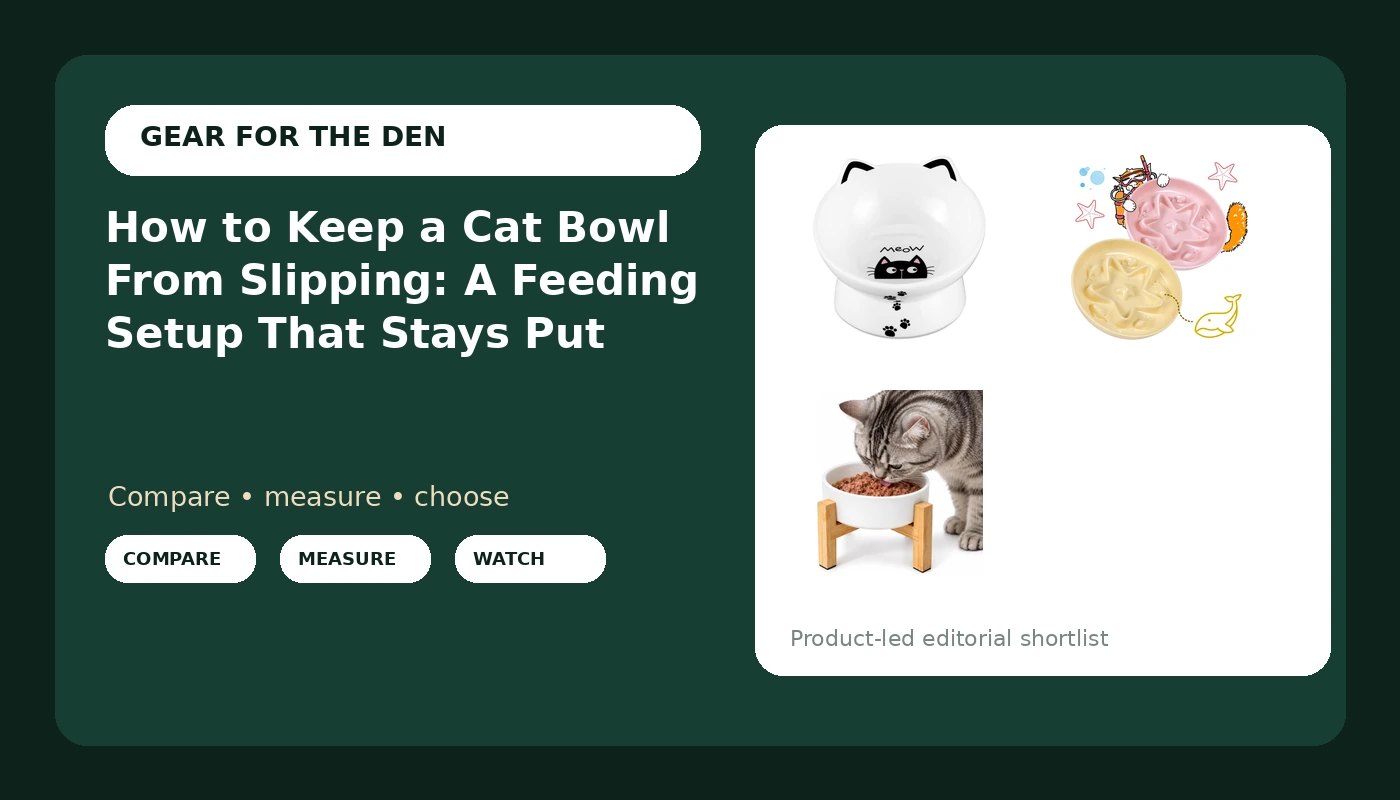
I picked the three products below because they cover the three main anti-slip jobs: a tilted raised bowl for wet food, a slow feeder for dry food, and a raised water bowl for hydration. I compared them on bowl width, base footprint, elevation angle, material weight, and dishwasher safety.
My test was a set of questions rather than a lab bench. Does the base have enough surface area to resist a cat pushing off it? Does the material have enough mass to stay put on tile or hardwood? Does the bowl sit high enough to reduce neck strain without forcing the cat to reach? Does the design leave enough whisker clearance so the cat does not scoop food onto the floor?
I also looked at the secondary factors that show up in owner reports: water capacity, pump noise, filter type, and portion size. Those matter most when you are comparing a bowl to a fountain or a microchip feeder. For this article, the focus is narrower: how to keep a cat bowl from slipping without overcomplicating the feeding station. There is no single ideal keep a cat bowl from slipping setup for every cat, because a flat-faced Persian and a long-legged Savannah do not eat the same way.
If you are choosing between a bowl and a fountain, my guide to cat water fountains goes deeper on pump noise and filter type.
How to keep a cat bowl from slipping: the bowls and feeders I compared
These are the three products I would start with. Each one solves a different part of the slipping problem, and none of them require you to rebuild your kitchen.
Budget pick: Yedio Porcelain Raised Cat Bowl, Tilted Cat Food Bowl with Anti Slip Band, Stress Free, Elevated Porcelain Pet Bowl Protect Pet's Spine, Backflow Prevention, Dishwasher Safe, White
Budget pick
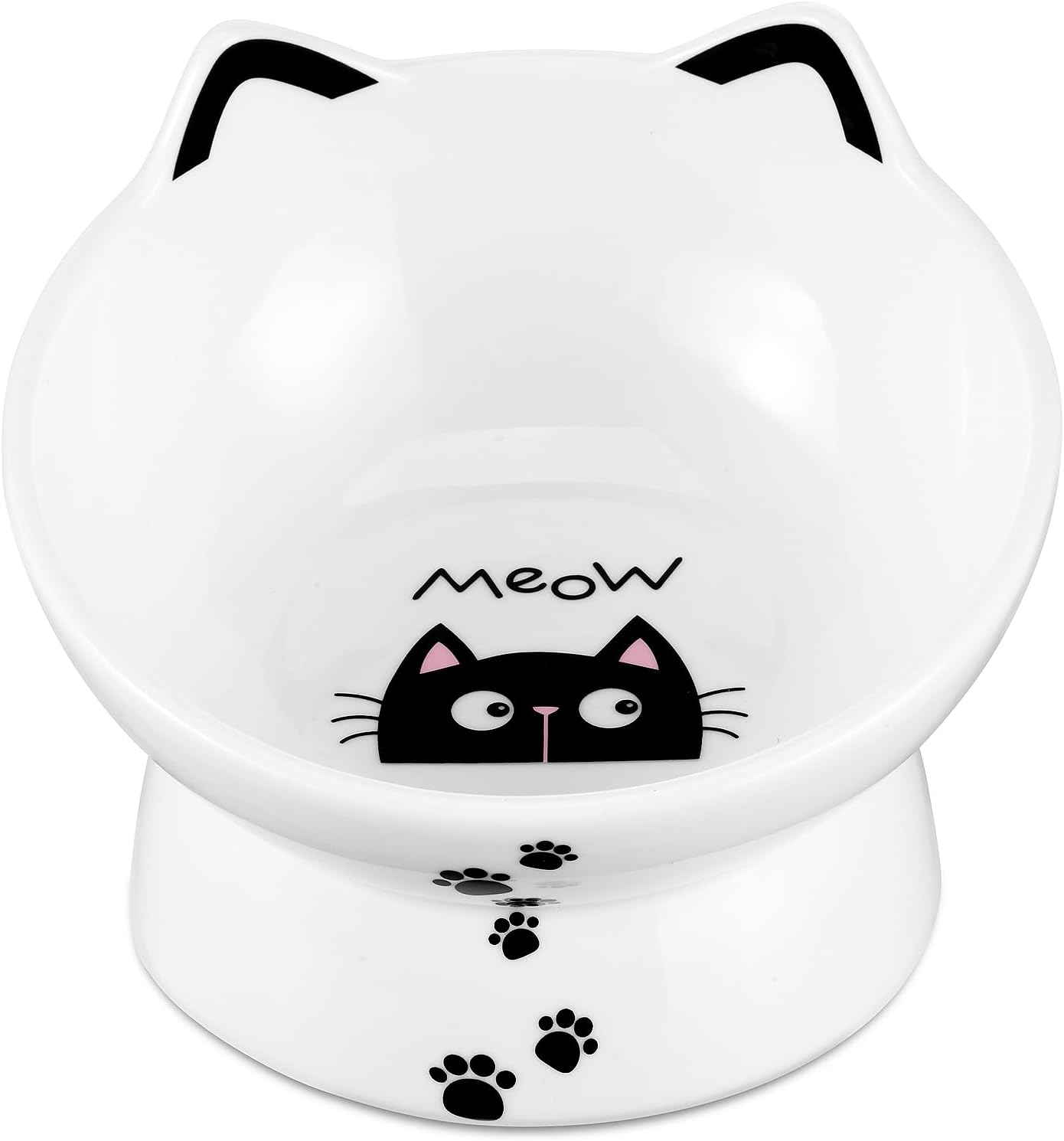
Yedio Porcelain Raised Cat Bowl, Tilted Cat Food Bowl with Anti Slip Band, Stress Free, Elevated Porcelain Pet Bowl Protect Pet's Spine, Backflow Prevention, Dishwasher Safe, White
The Yedio raised bowl is the budget pick because it combines two anti-slip features in one piece: a tilted porcelain bowl and an anti-slip band around the base. Porcelain has more mass than thin plastic, and mass is the first line of defense against a cat who likes to push. The tilt sets the food toward the front of the bowl, which can reduce the amount of pawing and dragging.
Check current Amazon price. The bowl is dishwasher safe, which matters more than people think. A bowl that is annoying to clean gets left on the floor longer, and a dirty bowl is more likely to be pushed around as your cat tries to find a clean spot.
A verified buyer noted that the anti-slip band made a difference on tile, which is the hardest common surface for a bowl to stay put on. The porcelain is also heavy enough that most cats cannot send it flying with a single swipe.
Flaws but not dealbreakers: Porcelain can chip if you drop it, and the tilt is not adjustable. If your cat prefers a flat dish, this is not the one.
Anyone feeding wet food to a cat who likes to drag the dish toward the edge of the mat should look here first.
Our pick: 2 Pcs Cat Slow Feeder Bowl, Whisker Friendly Melamine Puzzle Feeding Cat Bowl for Slow Eating, Wet & Dry Food, Dishwasher Safe, Lightweight, Non-Slip (Buttercream + Coral Pink, 6.3'')
Our pick
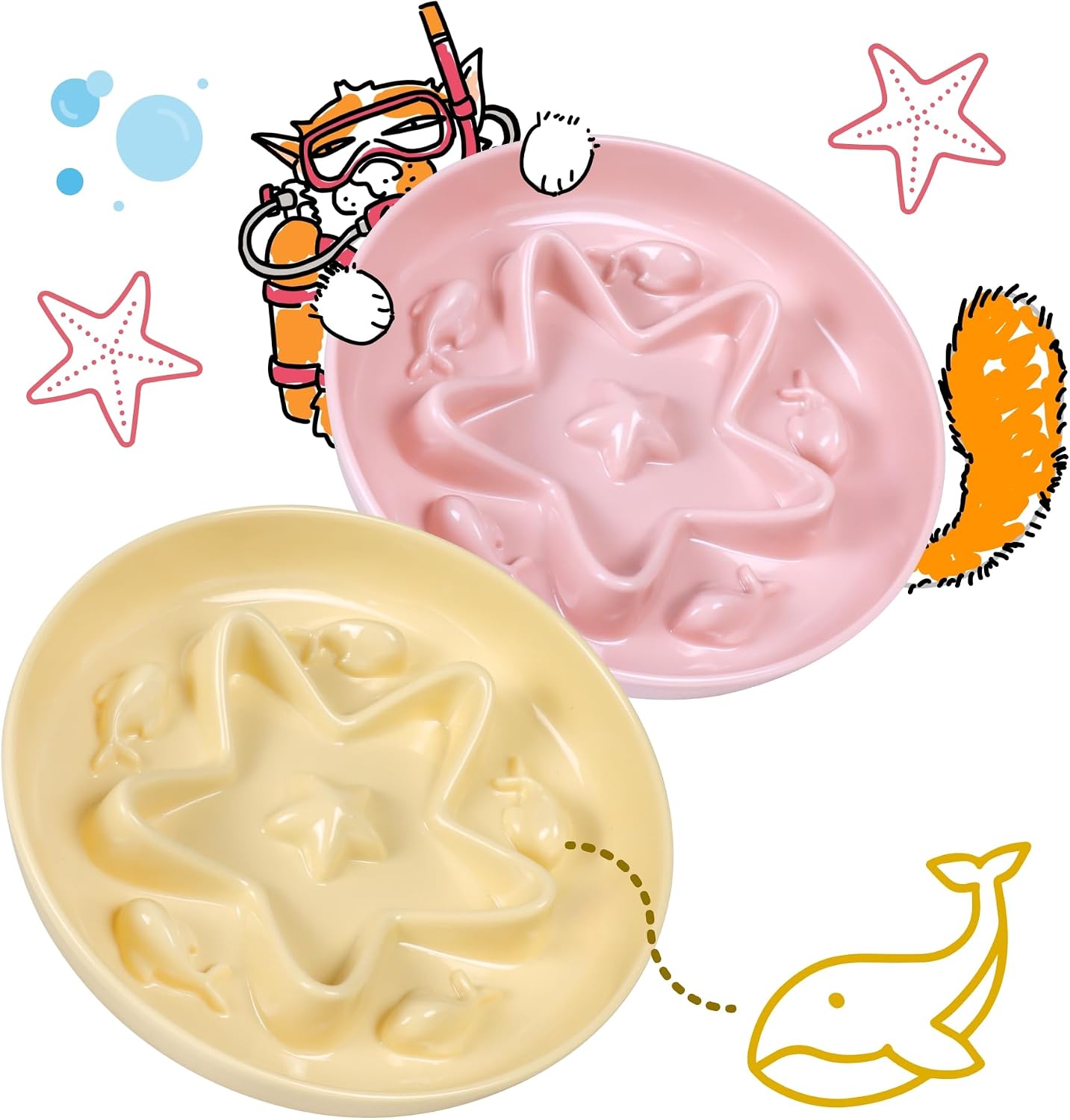
2 Pcs Cat Slow Feeder Bowl, Whisker Friendly Melamine Puzzle Feeding Cat Bowl for Slow Eating, Wet & Dry Food, Dishwasher Safe, Lightweight, Non-Slip (Buttercream + Coral Pink, 6.3'')
This two-pack is our pick because it solves a different problem: the cat who eats so fast that the bowl moves from the force of their own eating. The puzzle pattern slows the meal down, and a slower meal means less pushing. The melamine body is lightweight, so the non-slip base is doing most of the work, but the wide 6.3-inch footprint gives it a stable stance.
Check current Amazon price. You get two bowls, which is useful for multi-cat homes or for rotating one through the dishwasher while the other is in use. The whisker-friendly claim is worth noting: a bowl that is too narrow can cause whisker fatigue, and a cat with whisker fatigue may paw at the bowl or drag food out onto the floor.
Verified buyers report that the non-slip ring keeps the bowl in place on tile and laminate. The lightweight build is the trade-off. If your cat is a determined pusher, you may still want a silicone mat underneath.
Flaws but not dealbreakers: Lightweight melamine is not as stable as porcelain or ceramic. The puzzle pattern can be harder to clean if you feed wet food and do not rinse it right away.
Anyone with a fast eater or a multi-cat household that needs two bowls will get the most out of this set.
Upgrade pick: Elevated Cat Water Bowl, Ceramic Raised Cat Food Bowl with Adjustable Bamboo Stand, 5.1" Compact Raised Cat Water Bowl for Kittens, Adult & Senior Cats, 2-Way Adjustable Height, Dishwasher Safe, White
Upgrade pick
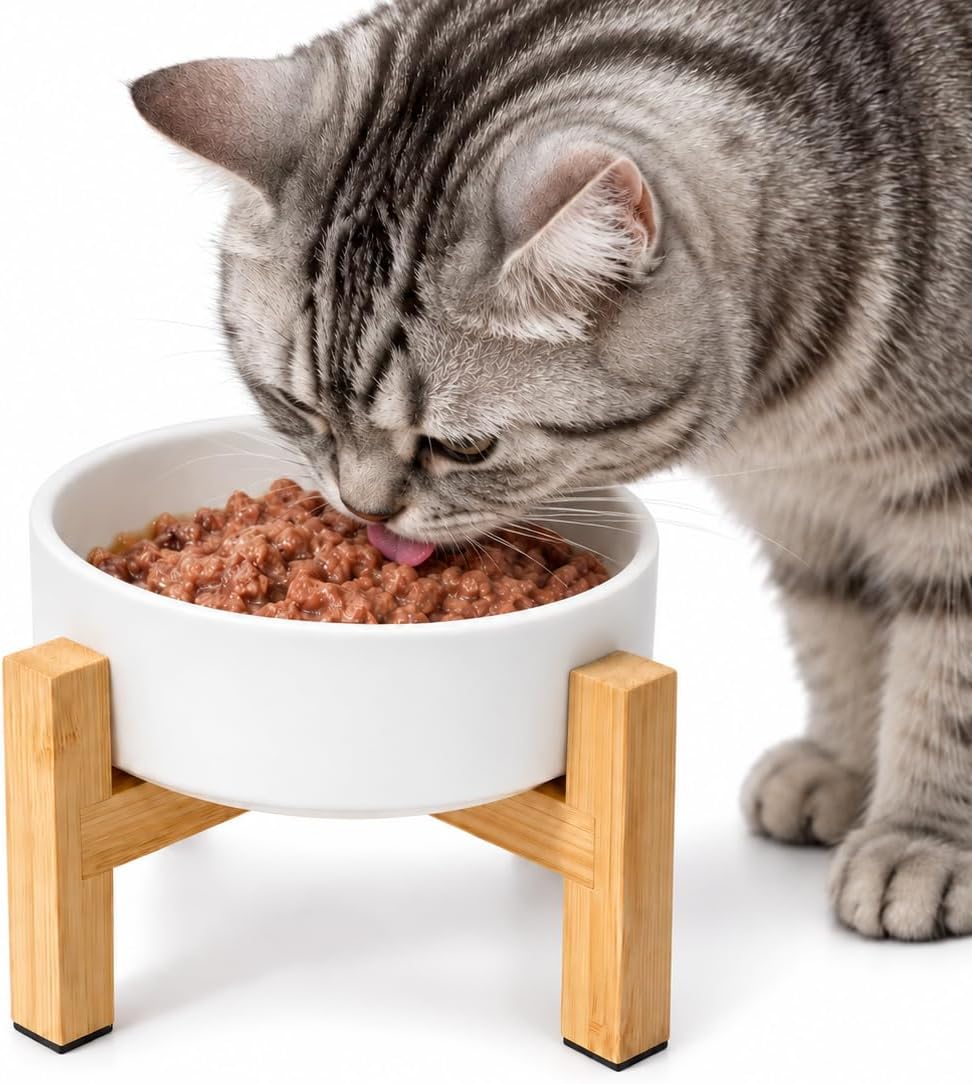
Elevated Cat Water Bowl, Ceramic Raised Cat Food Bowl with Adjustable Bamboo Stand, 5.1" Compact Raised Cat Water Bowl for Kittens, Adult & Senior Cats, 2-Way Adjustable Height, Dishwasher Safe, White
The upgrade pick is the raised water bowl with an adjustable bamboo stand. It earns the upgrade label because the height is adjustable, which means you can set the elevation angle to match your cat instead of forcing your cat to match the bowl. Senior cats and cats with arthritis often benefit from a raised water bowl, and a bowl that sits at the right height is less likely to be nudged across the floor.
Check current Amazon price. The ceramic bowl is dishwasher safe, and the bamboo stand gives it a wider footprint than a bowl alone. That wider footprint is the anti-slip feature. A bowl with a small base will slide; a bowl with a stand that spans several inches will resist.
The compact 5.1-inch bowl is a good fit for kittens and smaller cats, and the two-way adjustable height gives you some flexibility as your cat grows. The main trade-off is water capacity. A smaller bowl means more refills, so if you have multiple cats or a cat who drinks a lot, you may want a fountain as a supplement.
Flaws but not dealbreakers: The ceramic bowl is heavier than the stand, so if you pick up the whole unit by the bowl, the stand can separate. Move it by the base.
Anyone with a senior cat, a kitten, or a cat who has started to show signs of neck strain will appreciate the adjustable height.
Step one: Measure the bowl width and base footprint. The first thing to check is bowl width. A bowl that is too narrow forces the cat's whiskers against the sides, and that can trigger pawing. A base that is narrower than the bowl is more likely to tip. Aim for a base that is at least as wide as the bowl opening, and ideally wider.
Step two: Choose a material with mass. Ceramic and porcelain are heavier than melamine and plastic. Heavier bowls stay put on their own. If you already own a lightweight bowl, you can add grip rather than replace it. A heavy bowl on a textured surface is the simplest anti-slip setup.
Step three: Add a non-slip surface under the bowl. A silicone mat or a dedicated anti-slip band is the cheapest fix. The mat needs to be larger than the bowl base. If the mat is the same size as the bowl, the cat can still push the whole assembly. Look for a mat with a textured bottom and a smooth top, or a bowl with an integrated anti-slip band.
Step four: Set the elevation angle. Elevation angle is about neck comfort, but it also affects stability. A bowl that is too low makes the cat crouch and push. A bowl that is too high makes the cat reach and pull. Start with the bowl at roughly chest height when your cat is standing, then adjust. The Yedio bowl's fixed tilt is one option; the adjustable bamboo stand is another.
Step five: Check whisker clearance. Whisker clearance is the distance between the food and the sides of the bowl. If your cat's whiskers touch the bowl while eating, they may back up and drag the bowl with them. Wide, shallow bowls are usually better for whisker clearance. Slow feeders are an exception: the puzzle pattern is meant to slow eating, but you still want enough clearance that the cat is not scraping their face.
Step six: Match portion size to the bowl. Portion size matters for stability because a bowl with a large amount of food is top-heavy. If you free-feed, use a wider bowl or a feeder with a lower center of gravity. If you feed measured meals, a smaller bowl is fine. The goal is to avoid a bowl that is both tall and full.
Step seven: Manage water capacity and placement. For water, water capacity and placement are the two big variables. A bowl that is too small gets empty and gets bumped. A bowl that is too large is heavy to move and may be overkill for one cat. Place the water bowl away from the food bowl if your cat prefers it, and put both on a non-slip mat. If you use a fountain, check pump noise and filter type. A noisy pump can make a cat drink less, and a filter that is hard to find becomes a maintenance problem.
Step eight: Test and adjust. Set the bowl down and watch your cat eat. If the bowl moves, change one thing at a time: add grip, widen the base, adjust the height, or switch to a heavier material. If your cat is still pushing the bowl after all of that, consider a microchip feeder or a bowl with a suction base. Microchip range matters if you go that route, because the feeder needs to read your cat's chip reliably.
The competition and why it lost
The first thing that loses is the lightweight plastic bowl with a tiny base. It is cheap, but it is also the bowl most likely to end up under the refrigerator. A silicone mat alone is not enough if the bowl is too light. The mat helps, but it cannot fix a bowl with no mass and no footprint.
Gravity feeders and large dog bowls lose for a different reason. A gravity feeder is heavy when full, which sounds good, but the tall hopper makes it top-heavy. A dog bowl is often too wide and too deep for a cat's whiskers, and the extra width does not help if the base is still light.
Microchip feeders are excellent for multi-cat homes, but they are a different category. They solve food stealing, not slipping, and they cost more than a bowl and a mat. If you have a cat who pushes the bowl because another cat is bothering them, a microchip feeder might be the real answer. For a single cat who just slides the dish across the floor, start with the bowl and the mat.
Fountains with a small water capacity and a loud pump also lose here. They may keep water moving, but if the pump noise is noticeable or the filter type is hard to replace, the fountain becomes a chore. A quiet fountain with a wide base is a better fit, and that is a topic for the fountain guide.
What this all costs
None of the three products in this guide are luxury purchases. They sit in the affordable end of cat feeding gear, and the anti-slip fix itself can cost nothing if you already own a heavy bowl and a silicone mat. Check current Amazon price on each listing before you buy, because prices move.
The real cost is not the bowl. It is the cleanup and the wasted food. A bowl that slides can tip, spill, and send kibble across the floor. A stable bowl keeps the meal in one place, which means less sweeping and less guessing about how much your cat actually ate.
If you want the cheapest possible fix, start with a mat and a heavier bowl. If you want a purpose-built solution, the Yedio raised bowl, the slow feeder two-pack, and the adjustable water bowl cover the three main jobs. Set the height, check the whisker clearance, and watch your cat eat. The bowl should stay put. If it does not, change one variable at a time until it does.
The correct keep a cat bowl from slipping method is the one your cat actually uses without pushing. That is how to keep a cat bowl from slipping without buying a new kitchen.