Basking temperature is the one number that decides whether a reptile tank works or merely looks warm. A bearded dragon, leopard gecko, or ball python does not read the thermometer on the wall of the room. It reads the surface under the heat lamp, and it moves toward or away from that spot to hold its body where digestion and immune function need it. Get the number wrong in either direction and the animal pays for it: too cool and food sits undigested, too hot and it dehydrates while trying to escape the beam. This guide covers what the number means, how heat and UVB work together, and which pieces of gear let you set and hold a range instead of guessing.
Quick answer
Basking temperature explained in plain terms is the surface temperature at the hottest spot in the tank, not the air temperature and not the number printed on the bulb box. Most commonly kept pet reptiles want that surface somewhere in a band that runs from roughly the mid 80s to about 110 degrees Fahrenheit, with the exact target depending on species, age, and how the animal is housed. The practical method is to measure the surface with an infrared thermometer or a probe resting on the basking spot, then adjust fixture height or thermostat range until the reading holds steady through the day. A lamp on its own cannot hold a number. A lamp plus a controller can.
Four useful options
| Model | Best fit | What stands out |
|---|---|---|
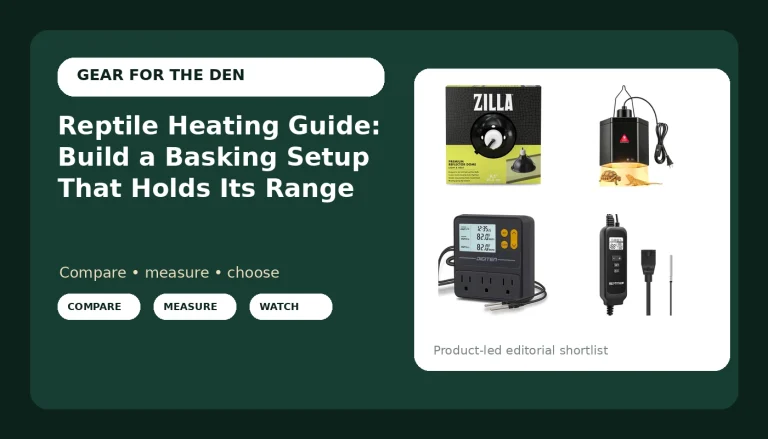
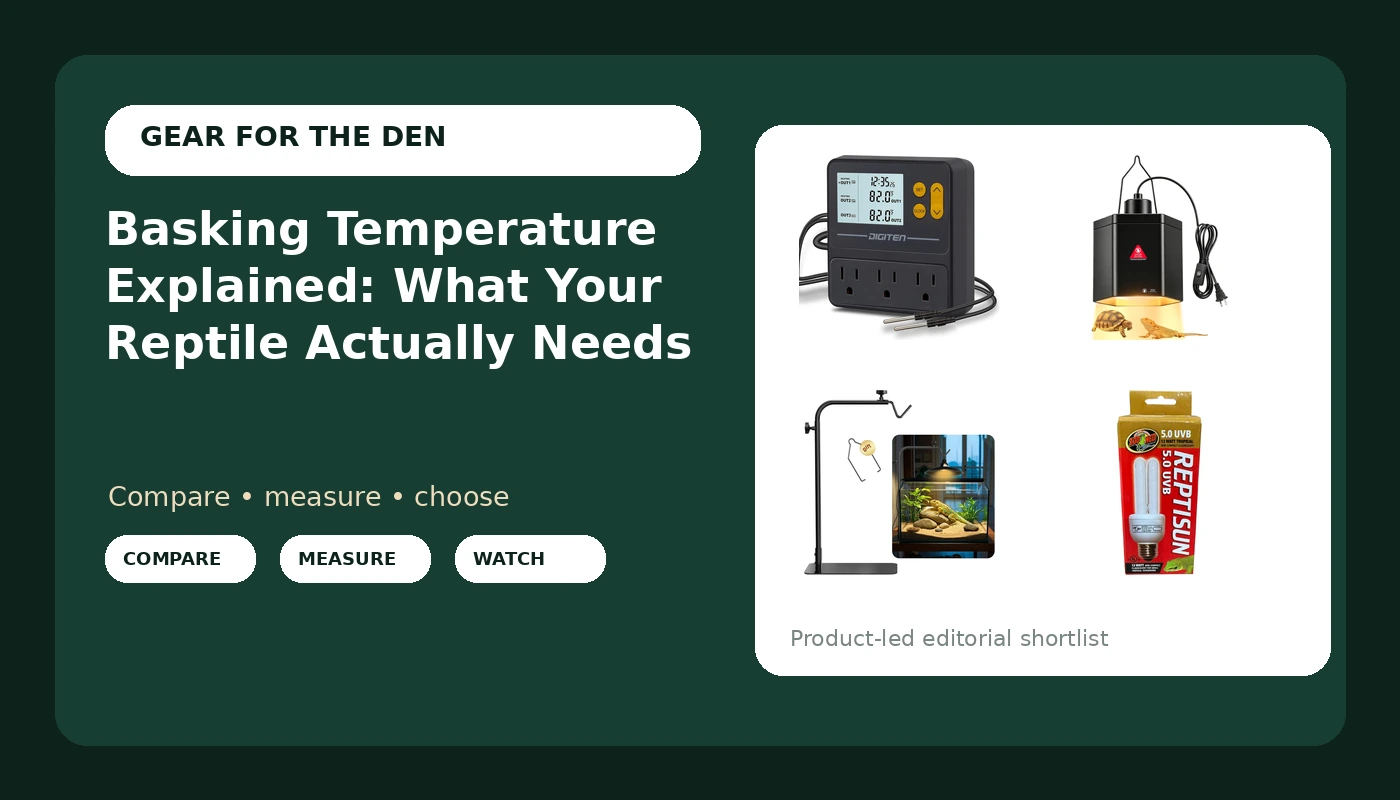
| DIGITEN Day-Night Reptile Temperature Controller with Timer | Tanks where heat should switch on and off on a schedule | Day and night temperature settings with a built-in timer in one unit |
| 5.9" Reptile Heat Lamp Fixture, 150W Hexagonal Reflector with Hook | Building the basking spot above a screen top | Hexagonal reflector rated up to 150W with a hook for hanging |
| Reptile Heat Lamp Stand, Adjustable 18"-32"H Light Holder, Heavy Base | Enclosures with no good place to clamp a lamp | Free-standing holder that adjusts from 18 to 32 inches tall |
| Reptisun 5.0 UVB Mini Compact Fluorescent (Pack of 2) | Adding UVB over a small or mid-size tank | Compact fluorescent UVB sold as a two-pack for rotation |
The control layer: DIGITEN Day-Night Reptile Temperature Controller with Timer
A lamp plugged straight into the wall runs whenever the switch is on, which means the basking surface drifts with the temperature of the room. A controller closes that loop: the sensor reads the spot, and the outlet cuts or restores power when the thermostat range is reached. The trade-off is sensor placement. Clip the probe under the beam and you control the beam; leave it on the far wall and you control the room instead. Pair it with a fixture you can move, because a controller can only cut heat, it cannot widen a beam.
The heat source: 5.9" Reptile Heat Lamp Fixture, 150W Hexagonal Reflector with Hook
Distance is the cheapest thermostat you own. Move this fixture two inches closer and the surface reading climbs; move it two inches away and the reading drops. That is why the fixture and the stand matter more than the wattage on the box. A wide, shallow dome spreads heat across a large area, while a deeper reflector concentrates it into a smaller, hotter patch. Match the beam to the animal. A hatchling on a small tile wants a tight spot, and a large adult wants a patch wide enough to cover most of its body.
The positioning layer: Reptile Heat Lamp Stand, Adjustable 18"-32"H Light Holder, Heavy Base
Tanks with screen tops usually accept a clamp lamp, but clamps fail, and a hot bulb falling into an enclosure is a bad afternoon. A stand also makes the basking temperature adjustable in a way a fixed clamp does not. You raise the fixture when the surface reads too hot, and you lower it when the animal spends all day flattened under the beam. Set the height once, then check the reading at the surface rather than at the top of the tank, because the air two inches under a bulb is always cooler than the rock below it.
The spectrum layer: Reptisun 5.0 UVB Mini Compact Fluorescent (Pack of 2)
New keepers often assume UVB warms the tank. It does not, at least not in any meaningful way. UVB output drives vitamin D synthesis, and the basking lamp drives digestion, so the two run on the same daytime schedule from different fixtures. That is another argument for a controller with two outlets and a timer: one outlet for heat, one for light, both off at night.
Prices and availability may change. Product images, names, and retailer links are matched to verified listings. No current price, rating, stock status, or measured result is stated here without current evidence.
What basking temperature actually means
Basking temperature is a surface reading, and this is the point almost every new keeper misses. A rock under a 100 watt bulb can read well over 100 degrees while the air two inches above it sits in the low 80s. That gap is the whole reason a reptile can warm up quickly and then move off to cool down, and it is why an air thermometer taped to the glass tells you almost nothing about whether the setup is right.
Reptiles are ectotherms. They do not generate their own body heat, so they borrow it from the environment and regulate by moving. A healthy enclosure gives them a gradient: a hot spot at one end, a cooler zone at the other, and enough floor space to choose a position in between. The basking temperature is the top of that gradient, and everything else in the tank, the cool side, the hide, the water bowl, is defined relative to it.
There is no single ideal basking temperature that fits every reptile. Desert species that bask in open sun generally want a hotter surface than forest species that spend their days in filtered light, and juveniles of many species prefer warmer spots than adults because they are digesting growth. Rather than quoting one universal figure, look up the target band for your species from a care sheet or a reputable keeper community, then treat that band as the goal for the surface under the lamp. The correct basking temperature is the one your species evolved around, not the one a bulb box advertises.
Measure it properly. An infrared temperature gun aimed at the basking surface gives you an instant reading, and a probe thermometer left in place gives you a trend. Use both if you can. The gun tells you what the rock reads right now, and the probe tells you whether the thermostat range you set is holding that reading through the afternoon. Neither tool is expensive, and together they replace guesswork with a number you can adjust. For a broader look at the rest of the enclosure, see this reptile tank setup guide.
Tank size, substrate depth, and humidity change the plan
Basking temperature does not exist in isolation. The surrounding setup decides how much of it the animal actually gets.
Tank size sets how far the gradient can stretch. A large enclosure can hold a hot basking zone and a genuinely cool retreat at the same time. A small one compresses both ends, so a bulb that is perfect in a 40 gallon tank can turn a 10 gallon tank into an oven. If the enclosure is small, use a lower wattage bulb and raise the fixture rather than fighting the room.
Substrate depth matters more than most keepers expect. A deep layer of loose substrate insulates the floor and slows heat transfer, so the surface under the lamp may read cooler than bare tile at the same distance. A thin layer over glass or tile heats fast and holds heat. Whichever you use, measure the surface the animal will actually touch, because that is the number that counts.
Hide size and placement shape behavior. A hide directly under the beam gives the animal a warm retreat, while a hide on the cool end gives it a way to escape heat entirely. Both are useful, and a single hide in the middle does neither job well. Humidity range interacts with all of this, because warm air holds more moisture than cool air. A hot basking spot under a screen top dries the air quickly, which is fine for desert species and a problem for tropical ones that need a humid retreat.
Heat mat wattage is the other half of the heat plan. A mat under the tank warms a contact patch and is often used for belly heat, while a lamp warms the air and the surface below it. They are not interchangeable, and stacking both without a controller is how tanks get too hot. UVB output also fades with distance and with time, so a lamp that was adequate when new may be underpowered months later. Replace UVB on the manufacturer's schedule rather than waiting for it to burn out.
A practical sequence for dialing in a new setup:
- Look up the target band for your species and the age of your animal, and write the range down before you buy anything.
- Set the fixture at a starting height, hang or clamp it in place, and run the heat with no animal in the tank.
- Wait at least 30 minutes for the surface to stabilize, then read the basking surface with an infrared thermometer.
- Adjust height first, then bulb wattage, then the thermostat range, rechecking after each change.
- Check the cool end and the humid hide as well, and confirm the gradient spans the enclosure rather than clustering at one end.
Practical guidance
- Put the probe where the animal basks, not where it is convenient to clip.
- Keep a spare UVB lamp so a burned-out bulb does not become a week without UVB.
- Run heat and UVB on the same daytime schedule, and turn both off at night unless the species needs a night drop above room temperature.
- Recheck the basking surface after every change to the room, the season, or the air conditioning.
- Keep the enclosure away from direct sun through a window and away from heating vents, since both fight the controller.
Which option should you choose?
Choose the DIGITEN Day-Night Reptile Temperature Controller with Timer when you want the basking spot to hold a set range on a schedule instead of drifting with the room. Choose the 5.9" Reptile Heat Lamp Fixture, 150W Hexagonal Reflector with Hook when you are building the hot spot itself and need a reflector that aims heat downward. Choose the Reptile Heat Lamp Stand, Adjustable 18"-32"H Light Holder, Heavy Base when the enclosure has no good place to clamp a lamp and you want height adjustment as your main tuning tool. Choose the Reptisun 5.0 Uvb Mini Compact Fluorescent (Pack of 2) when the heat side is settled and you need to cover the UVB half of the daytime cycle with a spare on the shelf.
Most setups end up using more than one of these, because a basking spot is a system: a fixture makes the heat, a stand positions it, a controller holds it, and a UVB lamp covers the part of the spectrum that heat cannot. The limitation is that none of these devices knows the right number for your species. A controller will hold whatever range you give it, including a wrong one, so the care sheet comes before the shopping cart.
The bottom line
Basking temperature is a surface measurement, and it is the number that matters most in a reptile enclosure. Set the hot spot for your species, measure the surface rather than the air, give the animal a cooler end to move to, and use a controller to keep the range steady across the day. The gear here covers the four jobs that make that possible: making heat, aiming it, holding it steady, and covering UVB on the same schedule. Get the surface reading right and most other husbandry decisions get easier, because a reptile that can thermoregulate properly will eat, digest, and shed on a more predictable rhythm.