It starts as a click. Then a rattle, then a steady metallic grind at six in the morning, and suddenly the bird you bought for quiet company is doing percussion on the cage wire. If you want to stop a bird chewing cage bars, the fix is almost never a spray bottle, a lemon-soaked bar, or a stern word. Bar chewing is a setup problem, and setup problems have hardware answers.
Every parrot and parakeet chews. That is what a beak is for. The behavior only turns into a problem when the beak runs out of legitimate work and the bars become the nearest available thing to destroy. The usual culprits are a cage with nothing in it worth chewing, a perch setup that gives the feet and the beak no variety, a sleep schedule that leaves the bird wired at dusk, and a bird that wants out of the cage and has learned that chewing gets a reaction.
This guide covers the gear side of that list: three accessories that change what the beak touches, and an eight step workflow for putting them in the right places. The full answer to how to stop a bird chewing cage bars has three parts, what the beak touches, where the bird sleeps, and how the day is structured, and only the first two of them cost money. Before any of it, though, there is one rule. A sudden change in a bird that never chewed before is a vet question, not a shopping question. If you are starting from zero on cage layout, cage setup basics are worth reading alongside this.
Why you should trust me
I write about bird and small pet gear for a living, and bar chewing is the question I get more than any other. Knowing how to prevent a bird chewing cage bars is really about the cage, not the bird, and the advice that circulates online is mostly punishment dressed up as help: squirt bottles, bitter sprays, covering the cage for a week. None of it works, because none of it gives the bird something else to do.
What I do is read the specs, compare materials, and pay attention to what owners report after the first month. I care about four things: whether a material is safe to put in a beak, whether the hardware survives a bird that is actively trying to dismantle it, whether the size suits the species, and whether the thing can be cleaned without a full cage teardown. That is the filter everything below went through.
How I picked and how I tested
Bar chewing is not solved by a single product. It is solved by giving the beak three different jobs: texture to work against, wood to strip, and a flat surface to stand on while foraging. So I picked one accessory for each job rather than three versions of the same thing.
Everything here was checked against the same short list. Material first, because a galvanized or chipped powder-coated surface is a zinc risk for a bird that chews metal, and stainless steel or untreated natural wood sidesteps that entirely. Then bar spacing, because the accessory has to mount on the wire your cage actually has, and a perch that swings loose because the mount is too wide is worse than no perch at all. Then perch diameter range, since a bird that grips the same diameter all day is a bird with sore feet. Then the practical details: cage height, how much of the cage the piece eats up, and how the tray liner gets cleaned around it.
I skipped anything that only exists to look cute in a product photo. A mirror, a plastic ladder with no grip, a toy with a bell and nothing to shred. None of those change the behavior. The three below do.
Perches and platforms that stop a bird chewing cage bars
You need texture, variety, and a flat surface. Here is one pick for each job, in ascending order of what it costs.
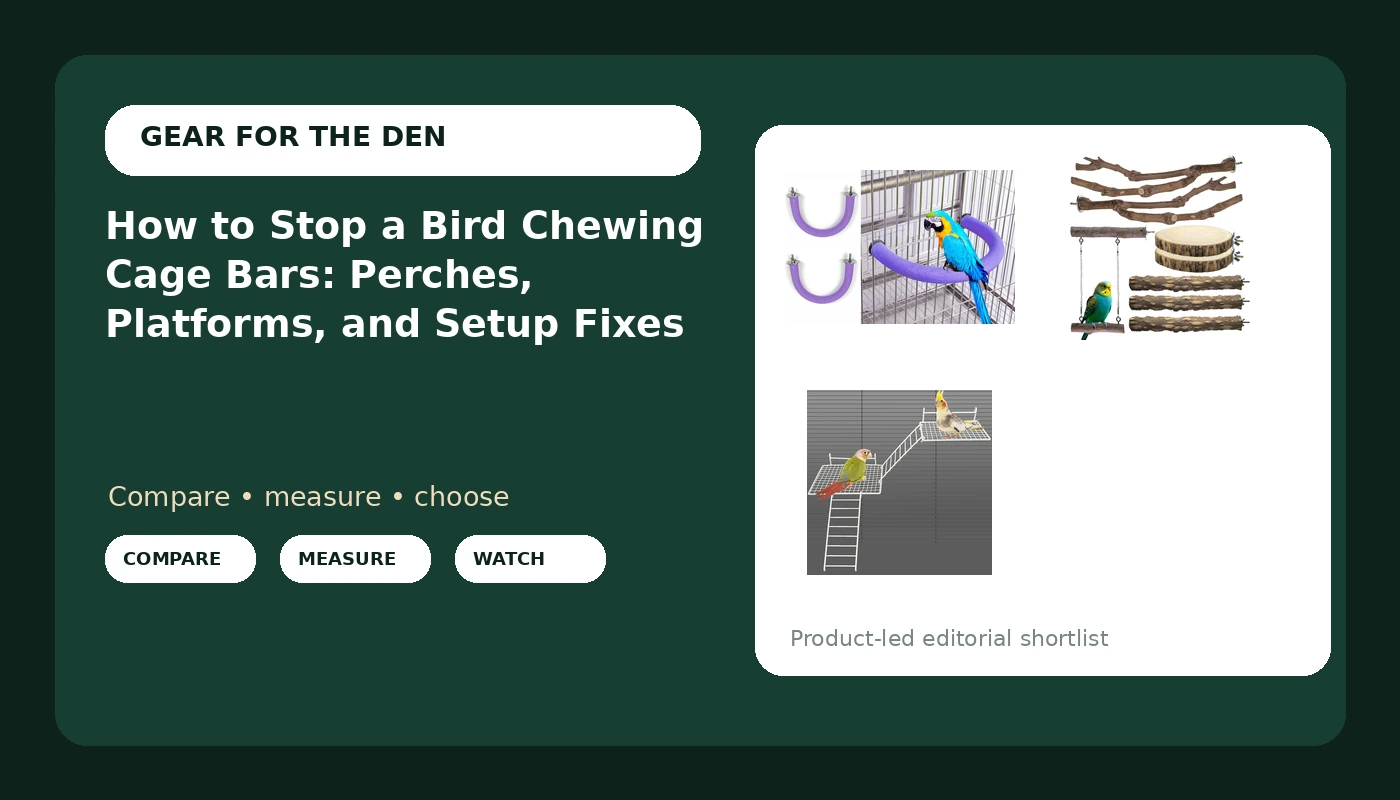
Budget pick: 2Pcs 6.1Inch Purple U Shape Rough-surfaced Sands Stick Bird Perches Bird Cage Perches Toy for Regular to Large Bird Amazon, Grey Parrots, Parakeets,Macaw
Budget pick
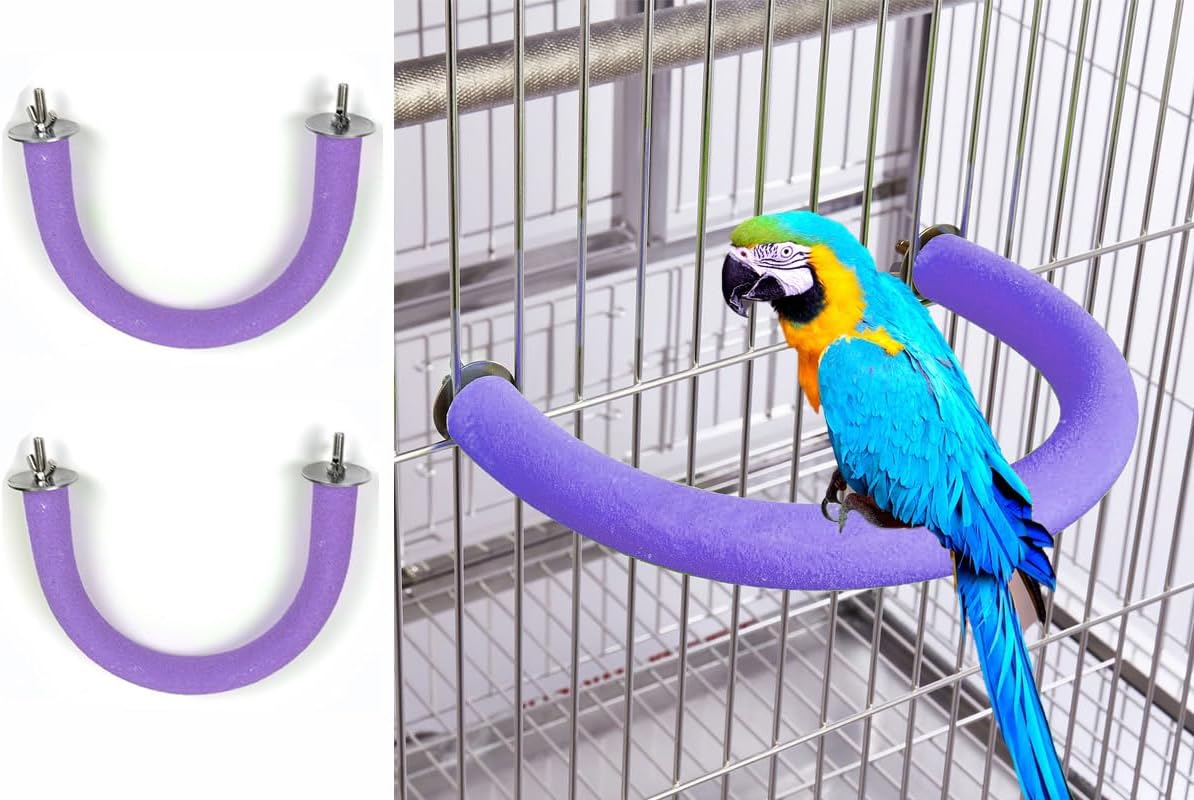
2Pcs 6.1Inch Purple U Shape Rough-surfaced Sands Stick Bird Perches Bird Cage Perches Toy for Regular to Large Bird Amazon, Grey Parrots, Parakeets,Macaw
Check current Amazon price.
The rough sand surface is the whole point. A bird that has just eaten wipes its beak on something, and if the nearest something is a cage bar, that wipe turns into a chew. Give it a textured perch at beak height and the wipe lands there instead. The U shape hooks over the wire, so it mounts without tools and moves when you want it to.
Two perches per pack, at a length that suits regular to large birds including greys, Amazons, and macaws. On a big cage, that covers the feeding station and the sleeping spot.
Flaws but not dealbreakers: A sand perch is a seasoning, not the meal. A bird that lives on sand all day can end up with sore foot pads, so keep it as one of three or four perches and rotate it. The grit also wears down over months of beak wiping, and a smooth sand perch stops doing its job.
Anyone with a chewer who needs the cheapest possible first change should start here.
Our pick: CAMATET 8pcs Natural Bird Perches for Cage, 5.9“ Small Wood Bird Perch for Parakeet/Cockatiel, Bird Cage Stick, Bird Branches for Cages, Birdcage Accessories for Parrot Conure
Our pick
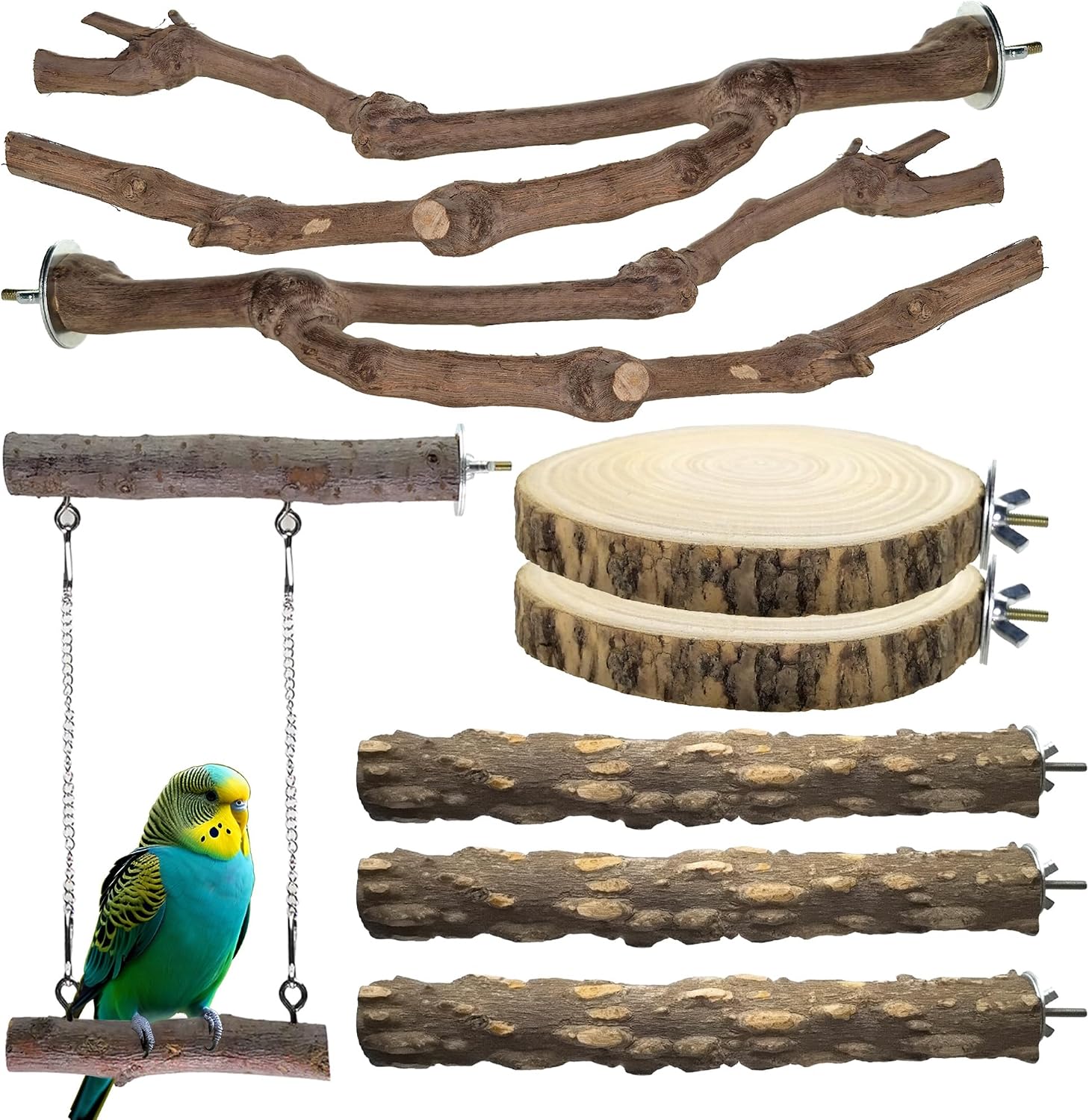
CAMATET 8pcs Natural Bird Perches for Cage, 5.9“ Small Wood Bird Perch for Parakeet/Cockatiel, Bird Cage Stick, Bird Branches for Cages, Birdcage Accessories for Parrot Conure
Check current Amazon price.
Eight natural branches in mixed diameters is the best value in this guide, because variety is the thing dowel perches never give you. Natural wood also gives the beak a legal target: bark comes off in strips, and stripping bark is exactly the behavior you want to redirect a bar chewer toward.
Perch diameter variety is the quiet win here. A foot that wraps the same distance around the same dowel every day for years is a foot that can develop pressure problems. Branches in a few thicknesses let the bird shift its grip.
Flaws but not dealbreakers: Natural wood is not uniform, so inspect each branch for cracks before it goes in, and expect some bark shedding on the tray liner for the first week. The smaller sizes suit parakeets, cockatiels, and conures better than a macaw.
If you only buy one thing from this page, buy this one, then add the sand perch for texture.
Upgrade pick: BNOSDM 4 PCS Bird Perches Platform, Stainless Steel Grid Platform for Parakeet Parrot Stand with Climbing Ladder Bird Cage Accessories for Small to Large Birds (White)
Upgrade pick
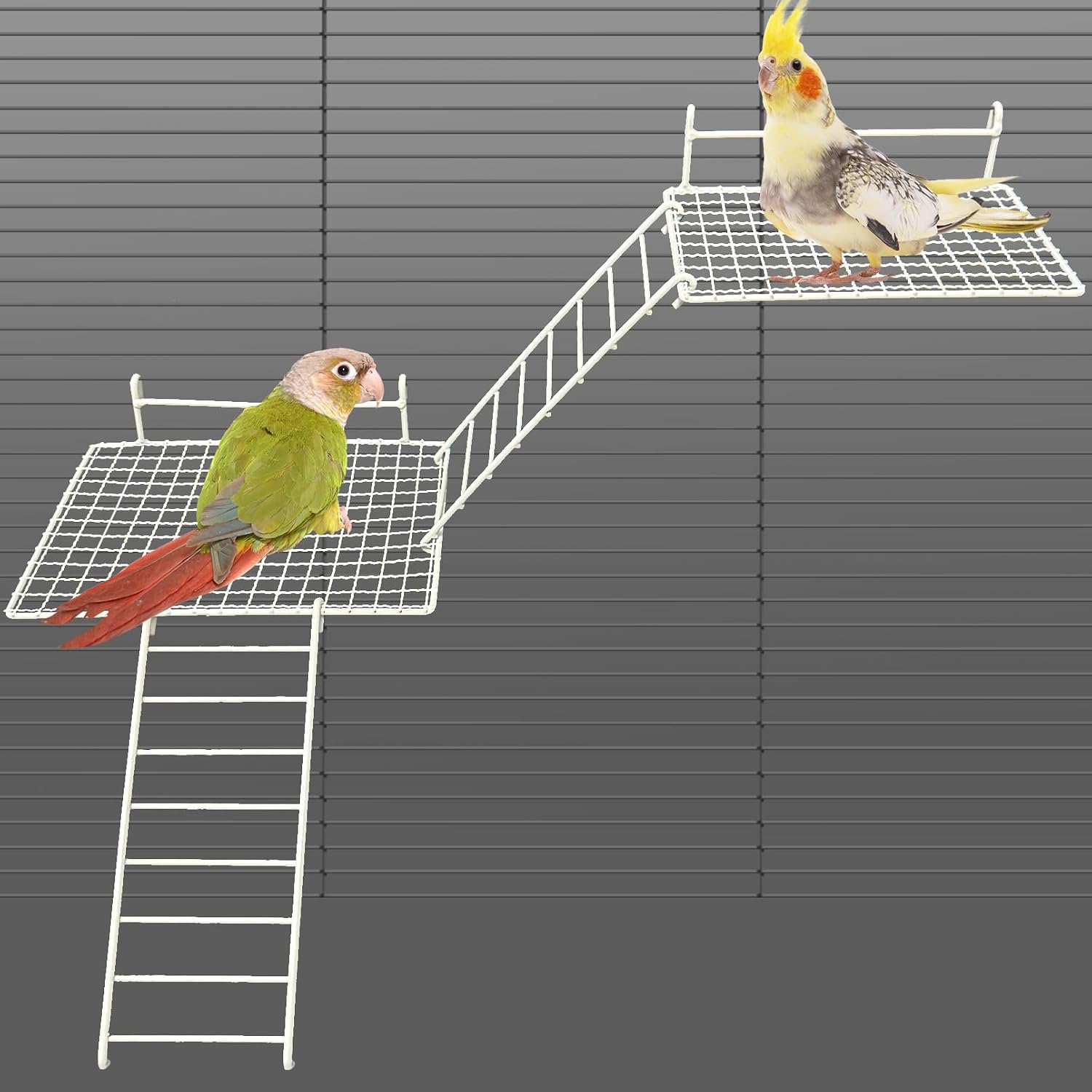
BNOSDM 4 PCS Bird Perches Platform, Stainless Steel Grid Platform for Parakeet Parrot Stand with Climbing Ladder Bird Cage Accessories for Small to Large Birds (White)
Check current Amazon price.
Flat surfaces are the piece most cages are missing. A platform gives a bird somewhere to stand and eat that is not a perch, and it is the natural place to set up foraging. This set is stainless steel grid with a climbing ladder, four pieces total, sized for small to large birds.
Stainless steel matters more than it sounds. If your bird is already chewing at the bars, the last thing you want is a coated or galvanized surface flaking into its mouth. Grid platforms also let crumbs and droppings fall through instead of sitting in a pile.
Flaws but not dealbreakers: The grid design means whatever falls through lands on the tray liner, so plan on a daily liner swap rather than a weekly one. The white finish shows mess quickly. And the ladder needs clearance, so do not mount it directly above a food cup.
Anyone whose bird already has a chew spot on the bars should put the platform right there.
The actual cage-setup workflow
The order matters. Work through these in sequence and you will usually see the chewing drop inside a month.
Step one: Rule out a medical cause. Bar chewing can be beak overgrowth, a crop issue, or zinc toxicity from chewing galvanized wire. If a bird that never chewed starts suddenly, or is also plucking, book an avian vet visit first. No accessory fixes a medical problem.
Step two: Check the cage against the bird. Bar spacing should be narrow enough that the bird cannot fit its head through the gap. Cage height matters less than width for parakeets and cockatiels, which move horizontally. If the cage is genuinely too small, no amount of enrichment will stop the chewing, because the bird is chewing to get out.
Step three: Rip out the dowels. Uniform perches give feet and beak nothing to work with. Replace them with natural branches in several diameters, aiming for a perch diameter that lets the foot wrap roughly two thirds of the way around.
Step four: Give the beak a job. This is where the three picks come in: a sand perch for texture, natural branches for stripping, a platform for standing and foraging. Scatter food instead of piling it in one dish, wrap a treat in paper, and start with low foraging difficulty so the bird wins early. Food cup size matters too, since a deep narrow cup the bird has to reach into keeps it busy longer than a wide open bowl. The cheapest way to prevent a bird chewing cage bars is to make sure the bars are never the most interesting surface within reach.
Step five: Put the platform where the chewing happens. Birds pick a spot. If the bars by the door or the corner nearest the window are the chewed ones, mount the flat surface and the foraging setup there, not on the far side of the cage.
Step six: Rotate, do not pile. Four to six toys in the cage, rotated two or three at a time, keeps novelty high without turning the cage into a storage unit. Add a swing mount near the top for a change of level, and keep a stack of tray liners so cleanup takes seconds.
Step seven: Fix the schedule. Parrots need ten to twelve hours of dark, quiet sleep, and a covered cage at dusk cuts the late-day chewing that comes from a bored, overtired bird. Add out-of-cage time on a stand every day. If your bird travels, check carrier size as well, because a cramped carrier is the same bar-chewing trigger in miniature.
Step eight: Track it and escalate if nothing changes. Note when the chewing happens: morning, dusk, or the moment you walk into the room. If the goal is to stop a bird chewing cage bars, four to six weeks of consistent enrichment is a fair window. If the chewing continues past that, or the bird is also screaming, plucking, or losing weight, ask an avian vet for a behavior referral.
The competition and why it lost
A few things you will find in the same search results did not make this list, and it is worth knowing why.
Anti-chew sprays and bitter coatings lose because birds are not dogs. Many parrots ignore the taste, some seem to like it, and the spray does nothing about the reason the beak is on the bars. Squirt bottles lose for the same reason plus one more: they teach the bird that chewing gets your attention.
A cage cover alone is a good sleep tool and a poor enrichment tool. Used on its own, it just gives the bird a dark room to chew in.
Mirrors and companion birds are the two most common suggestions from other owners and the two most likely to backfire. A mirror can push a single bird into hormonal frustration, and a second bird doubles the noise and the mess without fixing the layout.
Mineral blocks and beak conditioning stones are fine for beak wear, but a bored bird chews the bars anyway. A bigger cage, on its own, just gives the bird more bars to chew unless you fill it with perch diameter variety, foraging, and a flat surface to stand on.
The one item on this list that is not a product: if your cage has chipped powder coat or exposed galvanized wire, that is not a behavior problem, it is a health risk. Replace the cage, not the bird.
What this all costs
The three accessories here cover the three jobs, and all of them sit in the budget tier of bird gear, which is the point. You are not buying a new cage or a behavior consult to solve this. You are buying a textured perch, a bundle of natural branches, and a flat platform, and you can check current Amazon price on each one before you commit.
The ongoing cost is consumables: shreddable toys, tray liners, and food that can be scattered instead of dumped in a bowl. That is the part most owners underbudget, and it is the part that keeps the chewing from coming back.
The other line item is a vet visit. If step one sends you to an avian vet, that is money well spent, because zinc toxicity and beak problems do not respond to a better perch.
Do the math against the alternative. A bird that chews bars chews them for years, wears the coating off the cage, and often ends up rehomed for a behavior that a budget accessory and an hour of setup would have redirected. Buy the perch set, mount the platform, move the food, and give the beak something worth doing.
That is the job. The bars were never the problem. The empty cage was.