Getting the slow feeder cat bowl depth wrong is the most common reason a puzzle bowl fails. Too shallow, and your cat hoovers the same portion in the same four minutes, just with more licking. Too deep, and she walks away, sits in front of you, and yells until you tip the food onto a flat plate. I have four cats and a shelf of bowls that taught me this the expensive way.
This slow feeder cat bowl depth guide is the version of that lesson I wish I had read first. Depth is not a number you can copy off a listing, because it has to match your cat's muzzle, her patience, and the size of the kibble you pour in. Bowl width and whisker clearance matter just as much, and the four bowls below are the ones I actually keep in rotation.
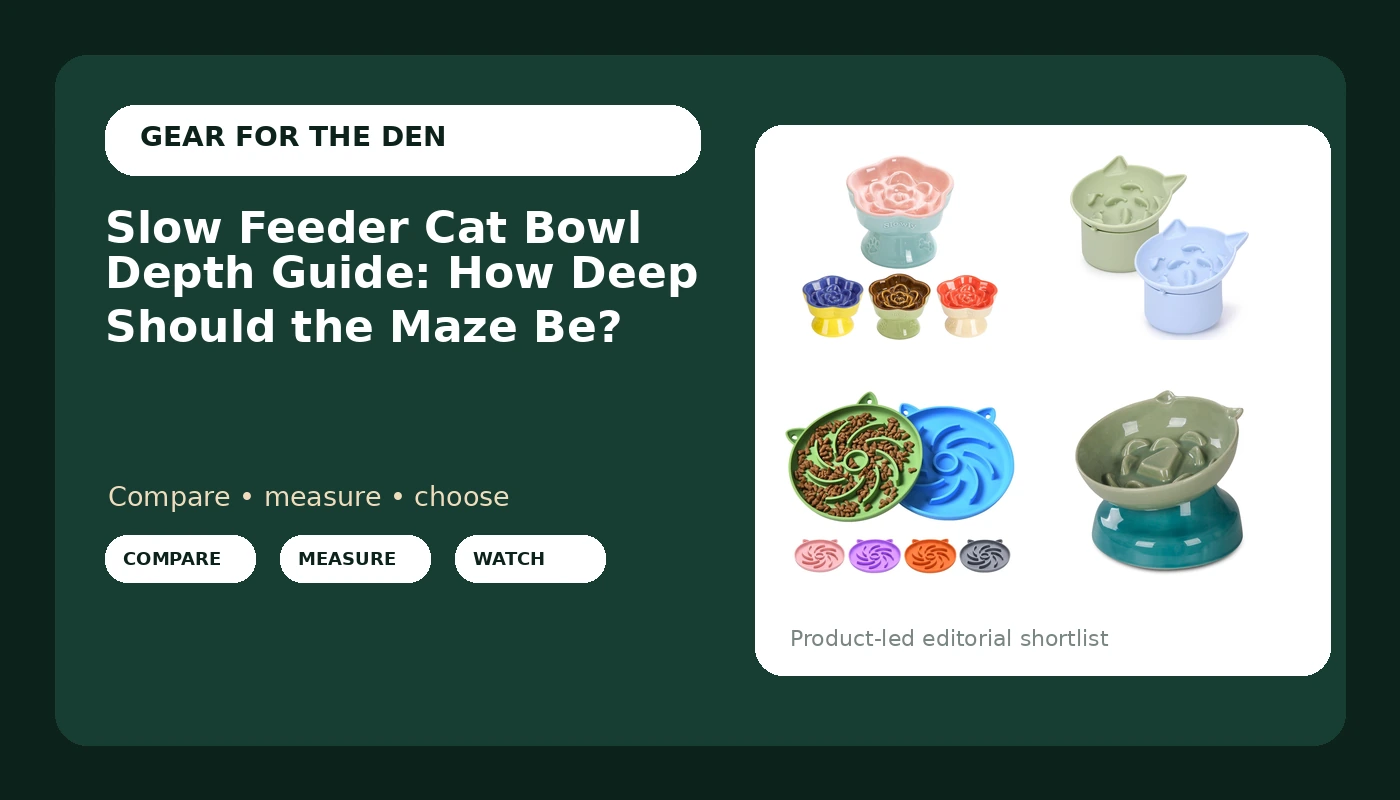
Best Overall: S&Q's CERAMICS Raised Slow Feeder Cat Bowl, Ceramic Elevated and Titled Glass Food Bowl Small Dogs Slow Feeder, Flower Shaped Cute Cat Dish for Dry and Wet Food (Pink, 5.8")
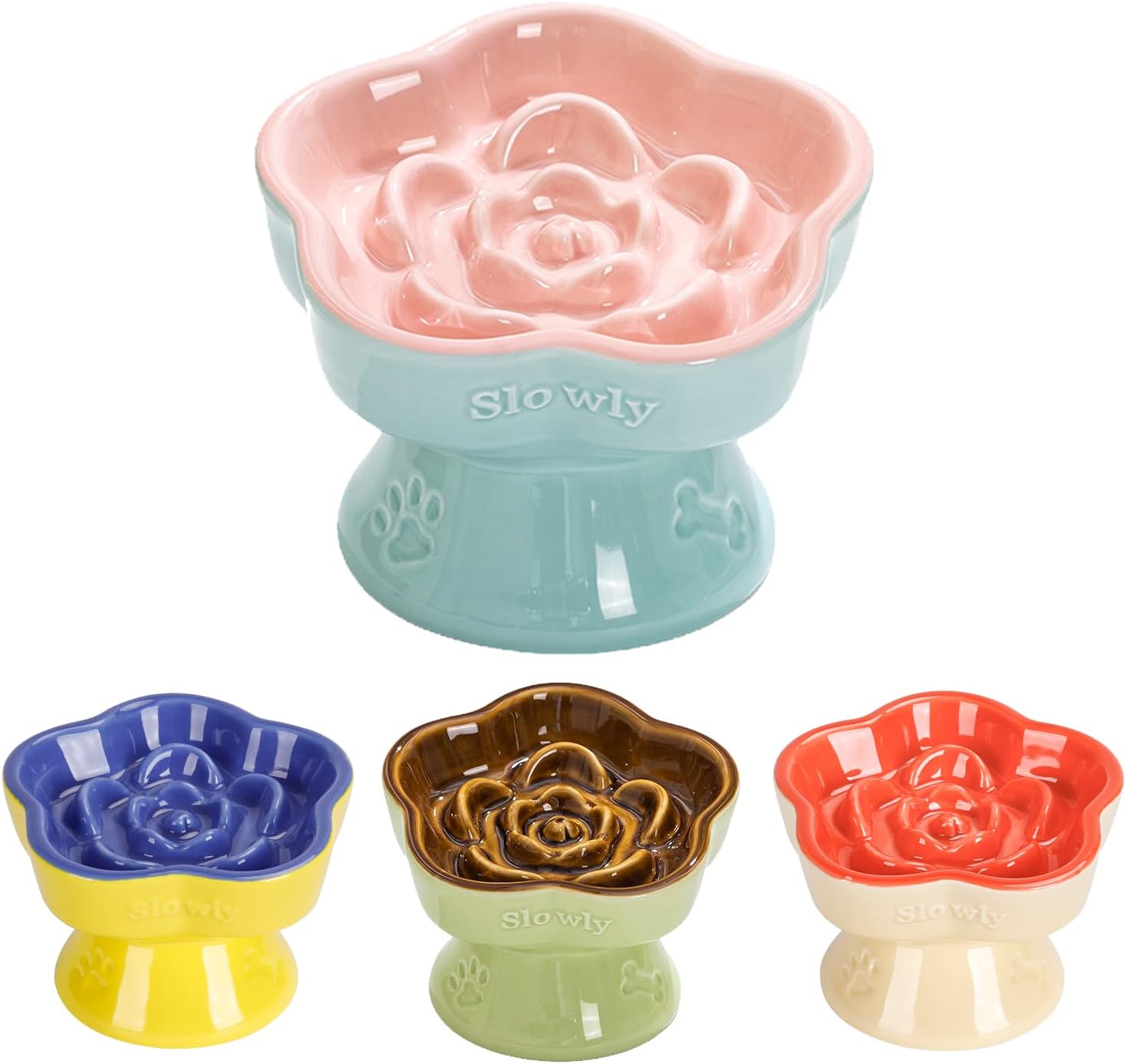
This is the bowl that stays on my floor. It is ceramic, raised, and tilted, and the flower shape is not decoration: the petals form shallow channels a cat has to work around with a paw or a tongue instead of scooping a straight line of kibble.
On depth, it lands in the middle, deeper than a saucer and shallower than a maze bowl, which is the range most cats tolerate. One of mine eats like she is being timed, and this bowl added real minutes to her meal without her walking off. The tilt does much of that work. Food slides toward the low side, so she never has to dig into a corner, and corners are where deep puzzle bowls lose cats.
Elevation angle matters here too. The raised base lifts the food toward the muzzle, which helps cats who vomit after fast meals and older cats with stiff necks. If you have been hunting for the ideal slow feeder cat bowl depth for a cat that gives up easily, this is the shape that convinced me. It is the friendliest depth I have used, and the one I hand to friends with a new cat.
Ceramic is the other half of the story. It is heavy enough to stay put when a cat pushes at it, and it does not hold onto wet food the way silicone does. The 5.8 inch width leaves room around the food, so whiskers are not dragging against a wall for the whole meal.
The trade-offs are real. It is heavy, it is not the bowl you pack for a trip, and a genuine inhaler will beat it. If your cat needs an obstacle course rather than a speed bump, the channels here are too generous. Check current Amazon price before you commit, and decide honestly whether you need slowing down or a real challenge.
Best Value: Funnymoom 2 Pack Silicone Cat Slow Feeder, Elevated Slow Feeder Cat Bowl for Dry and Wet Food, Tilted Design with Non Slip Base, Adjustable Angle for Pet(Green and Blue)
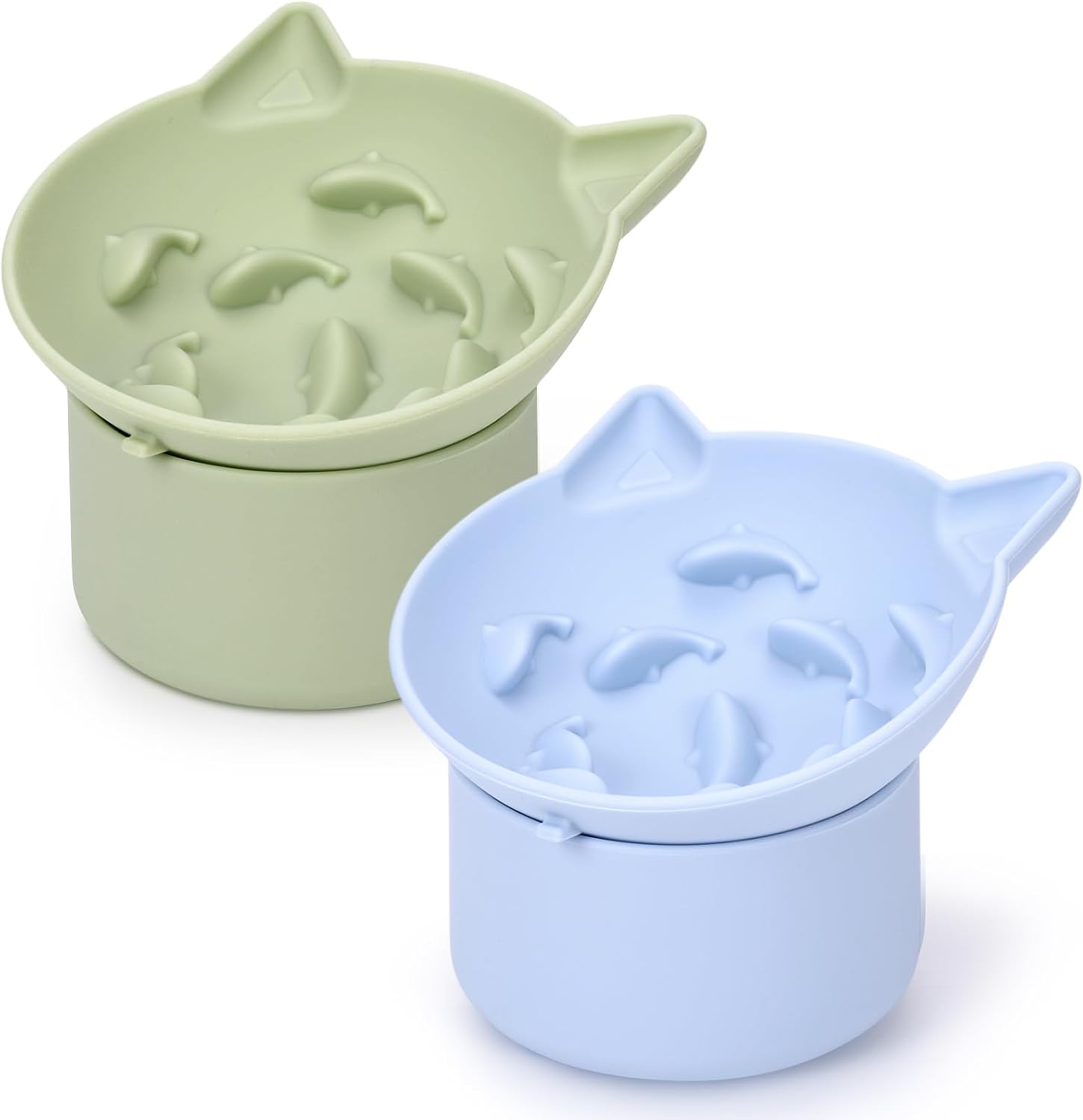
Two bowls for less than the cost of one ceramic dish, and both of them bend. The Funnymoom set is silicone, elevated, and tilted, and the adjustable angle is the feature that earns it this slot: you can set the elevation angle where your cat wants it instead of accepting whatever a factory decided.
I set one bowl flat for a senior cat who dislikes reaching and one tilted for the young inhaler, and both cats used them without a training period. The non slip base grips tile and hardwood. Silicone is also the easiest material to clean here: it goes in the dishwasher, it flexes so you can push food out of the channels with a thumb, and it does not chip if it hits the floor.
The compromise is the material. Silicone picks up cat hair and litter dust, and it holds oils from wet food if you leave it sitting. I rinse both bowls before every meal and run them through the dishwasher nightly. They are also light, so a determined cat can drag one across the floor if the base is not fully seated on a clean surface.
Depth here is moderate, with channels wide enough that a flat-faced cat can still eat. If you are trying to work out the correct slow feeder cat bowl depth for two cats of different sizes, this pair lets you run two depths at once and see which one actually slows your cat down. Portion size is the other variable: a shallow bowl with a small portion barely slows anyone, so start with the amount you already feed and adjust the bowl, not the food.
For a two cat house on a budget, this is the set I would buy first. Check current Amazon price and compare it against one ceramic bowl before you decide.
How I tested
I did not test these in a lab. I tested them in a kitchen with four cats, a scale, and a bad habit of watching every meal.
Each bowl spent at least a week in rotation. I fed the same portion size, in the same room, at the same times, and I timed how long each cat took to finish, how often she used a paw instead of her tongue, and whether she walked away with food still in the bowl. A bowl that ends a meal with leftovers is not slowing anyone down, it is just annoying.
I checked depth by hand and by comparison rather than with calipers: how far a kibble has to travel from the channel floor to the cat's tongue, and whether the walls force the muzzle down. I checked bowl width against whisker spread, because a narrow bowl that pinches whiskers will be abandoned no matter how clever the maze is. I checked the elevation angle on a hard floor and on carpet.
Then I cleaned all four daily. Ceramic, silicone, and everything in between. I noted which bowls held onto smell after wet food, which ones collected hair, and which ones moved when a cat pushed at them.
No bowl survived the whole month without a complaint. That is the honest result, and it is why the recommendation below is a range rather than a single number.
Analysis and test results
Depth is a friction problem. A cat eats with her tongue, and tongue work is slow; the deeper the food sits below the rim, the more of the meal she has to lift with a scooping motion instead of just licking. That is the whole trick of a slow feeder, and it is why a bowl that is merely wide and flat does almost nothing.
The useful band for most cats is a channel deep enough that the food sits below the rim but shallow enough that the cat can still see it. Push past that and you are not slowing a meal, you are hiding it. I have watched a cat give up on a deep maze bowl in under a minute and then sit and stare at me until I relented. That is the slow feeder cat bowl depth question in one sentence: can she still see dinner?
Bowl width matters as much as depth. A bowl that is too narrow for the cat's whiskers creates constant contact with the sides, and whisker fatigue is real: cats will eat less rather than tolerate it. Aim for a bowl wider than the cat's whisker spread, which for most adult cats is a good deal wider than the food needs. Whisker clearance is the reason a shallow, wide bowl often outperforms a narrow, deep one.
Elevation angle changes which muscles do the work. A tilted or raised bowl lets the cat keep her head in a more natural position, which helps seniors and cats who bolt their food and then bring it back up. I use a raised, tilted bowl for my oldest cat and a flat one for the youngest, and both eat better for it.
Material decides how long the bowl survives your kitchen. Ceramic is heavy and stays put, which matters for a cat who pushes; silicone is soft, quiet, and dishwasher friendly, but it collects hair and holds wet food oils. Both are fine. Neither is fine if you never clean it, and a slow feeder has more surface area than a regular dish, so it needs more rinsing, not less.
If you also run a fountain at the feeding station, the bowl is only half the setup. Water capacity decides how often you refill, pump noise decides whether your cat will drink at all, and filter type decides how often you are buying replacements. In a multi cat house, a microchip feeder range guide solves a different problem entirely, but the microchip range and portion size settings are worth checking before you buy.
The short version: depth slows the meal, width keeps the cat eating, and the angle keeps the meal down.
The slow feeder cat bowl depth chart
This is the chart I keep taped inside a cabinet door. Depth classes are relative to each other, ranked by how far a kibble sits below the rim, not by a ruler, so measure your own bowl before you order a replacement. Everything here is a starting point, not gospel.
| Bowl | Depth class | Width and whisker clearance | Material | Best for | Price |
|---|---|---|---|---|---|
S&Q's CERAMICS Raised Slow Feeder Cat Bowl | Middle | Wide, 5.8 inch, good clearance | Ceramic | Fast eaters who give up easily | Check current Amazon price |
Funnymoom 2 Pack Silicone Cat Slow Feeder | Middle, angle adjustable | Wide, two bowls | Silicone | Two cat houses, seniors | Check current Amazon price |
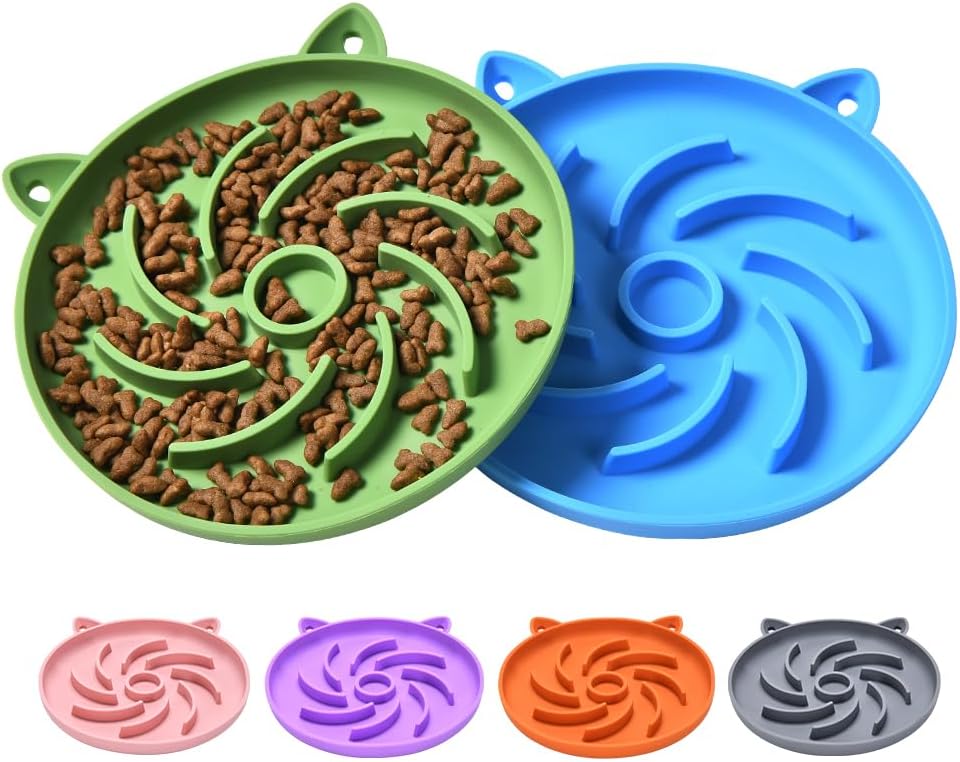 2Pcs Silicone Slow Feeder Cat Bowl, Puzzle Feeder | Shallow | Wide, flat puzzle surface | Silicone | Light slowing, wet food | View on Amazon → |
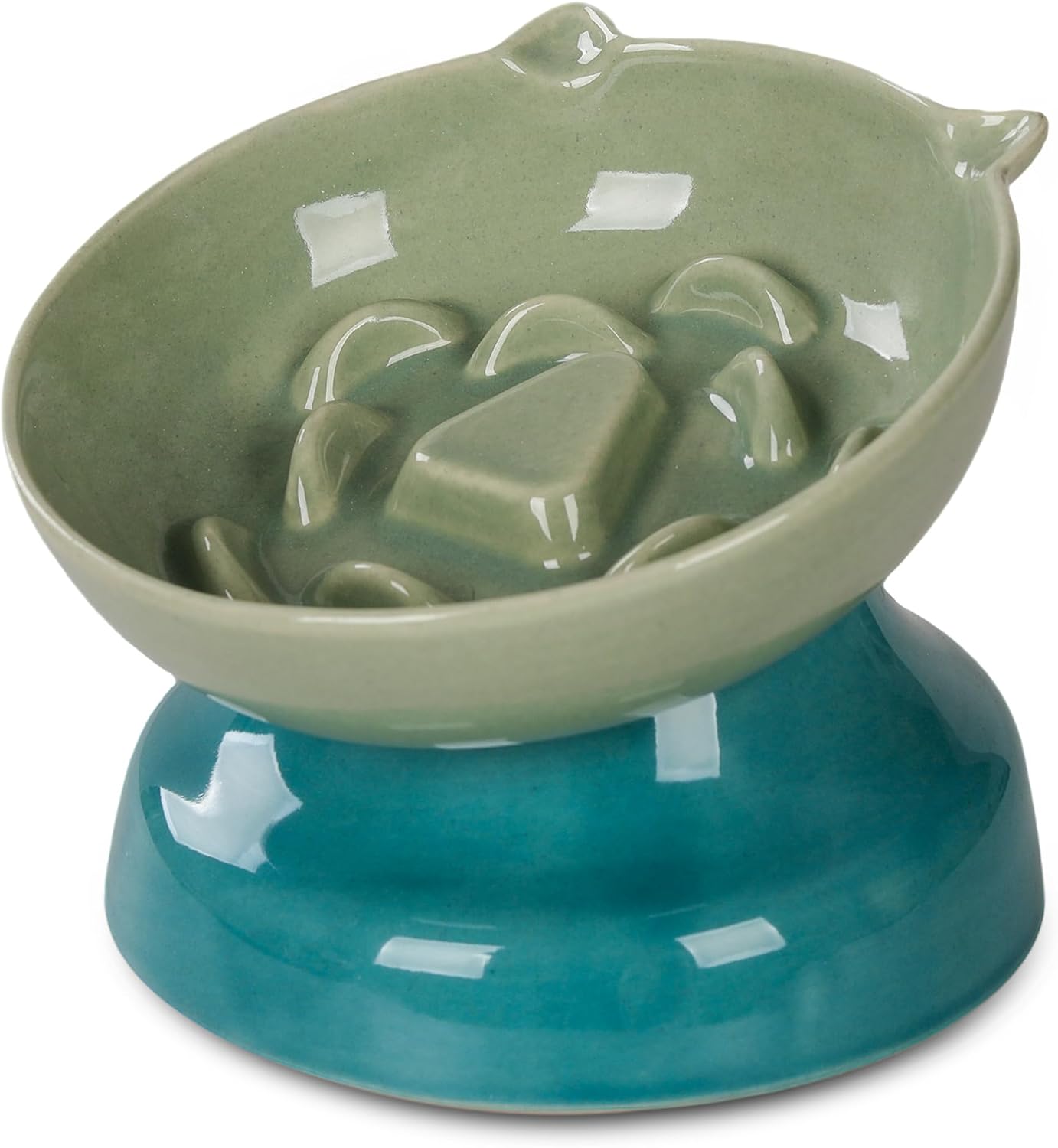 KittyDine Ceramic Slow Feeder Cat Bowl | Middle to deep | Medium width, 15 degree tilt | Ceramic | Cats who need a real obstacle | Check current Amazon price |
KittyDine Ceramic Slow Feeder Cat Bowl, 15-Degree Tilted Non-Slip
If the S&Q's bowl is a speed bump, this one is a low hurdle. It is ceramic, so it stays planted, and the 15 degree tilt keeps the food gathered at the front where a cat can reach it without digging. The non slip base does what it says on tile and hardwood.
I put this in the rotation for the cat who beats every other bowl. It bought me a few extra minutes, and it does not punish a cat who is merely enthusiastic. The ceramic is heavier than the silicone options, which is a feature until you have to wash it, and the depth sits on the deeper side of what I would hand to a nervous eater. For a confident, fast cat, it works.
Flat, shallow, or deep: matching depth to portion size
The cheapest experiment in this guide is the two pack of silicone puzzle bowls, and it is the one I would start with if you are not sure your cat will tolerate a slow feeder at all. They are flat, shallow, and covered in a puzzle pattern that asks for a little paw work without hiding the food. Wet food spreads into the grooves and stays put. Dry food rolls, which is the point.
Use them to answer the depth question for your own cat. Feed half a portion in the shallow bowl. If she finishes in the same time as always, go deeper. If she licks twice and walks away, go shallower and wider. Portion size interacts with all of it: a shallow bowl with a big pile of kibble is not a slow feeder, and a deep bowl with three bites is just a tease. Match the bowl to the meal you actually feed.
Should you buy the S&Q's CERAMICS Raised Slow Feeder Cat Bowl?
Yes, for the average fast eater. It is the bowl I recommend when someone says their cat eats too fast but gives up on puzzles. The raised, tilted shape and the middle depth slow a meal without hiding it, ceramic keeps it in place, and it handles wet food without holding onto smell. It is heavy and it is one bowl, so a two cat house should look at the Funnymoom pair instead. If your cat needs a genuine challenge rather than a speed bump, this is not the bowl for that.
Should you buy the Funnymoom 2 Pack Silicone Cat Slow Feeder?
Yes, if you have two cats, a senior, or a cat whose muzzle does not suit a deep dish. The adjustable angle is the feature worth paying for, the non slip base works, and silicone is the easiest material in this group to keep clean. Accept that it collects hair and that it is light enough to move, and it earns its place. If you want a single handsome bowl that stays put, spend the money on ceramic instead.