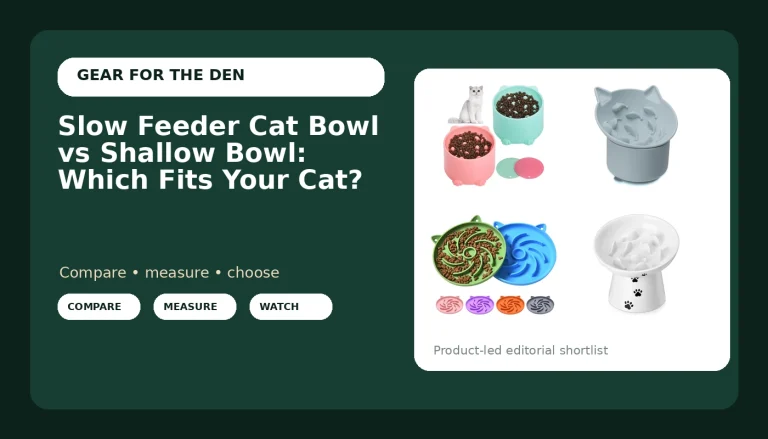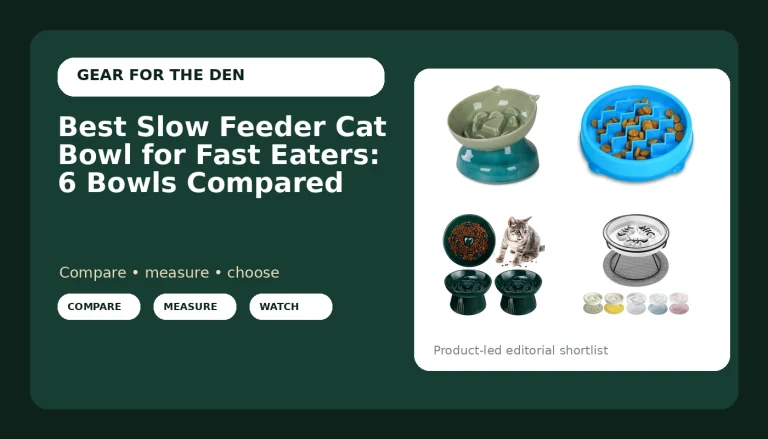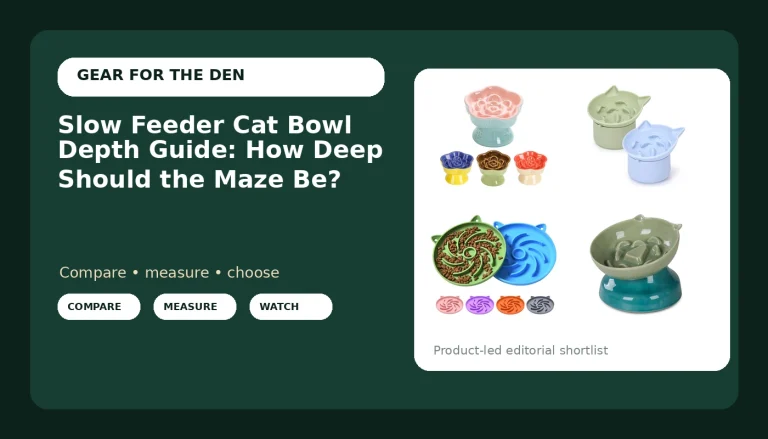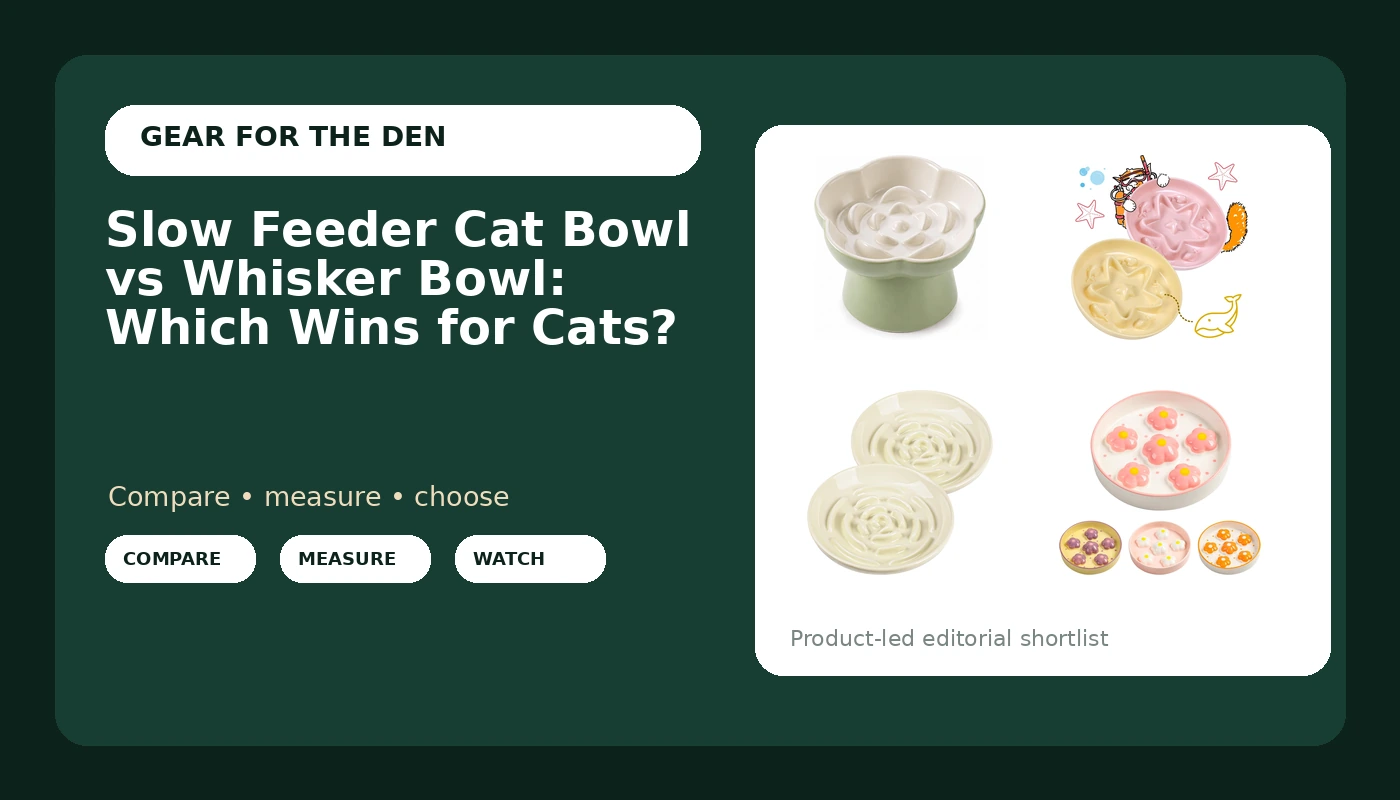
The slow feeder cat bowl vs whisker bowl question sounds like a category argument, but it is really a question about your cat's face and your cat's stomach. A slow feeder puts obstacles between the cat and the food so a gulper has to work for every bite. A whisker-friendly bowl is wide and shallow so long whiskers never drag across the rim. Most bowls sold in 2026 do both at once, which is exactly why the shopping gets confusing.
The short answer: for most cats, a wide ceramic bowl with a shallow maze solves both problems at once. The maze slows the meal, and the width keeps whiskers off the rim.
Below are the four designs worth comparing in this category, with what each one gets right and where it falls short. Prices move around on Amazon, so every row links to the live listing instead of a number that goes stale.
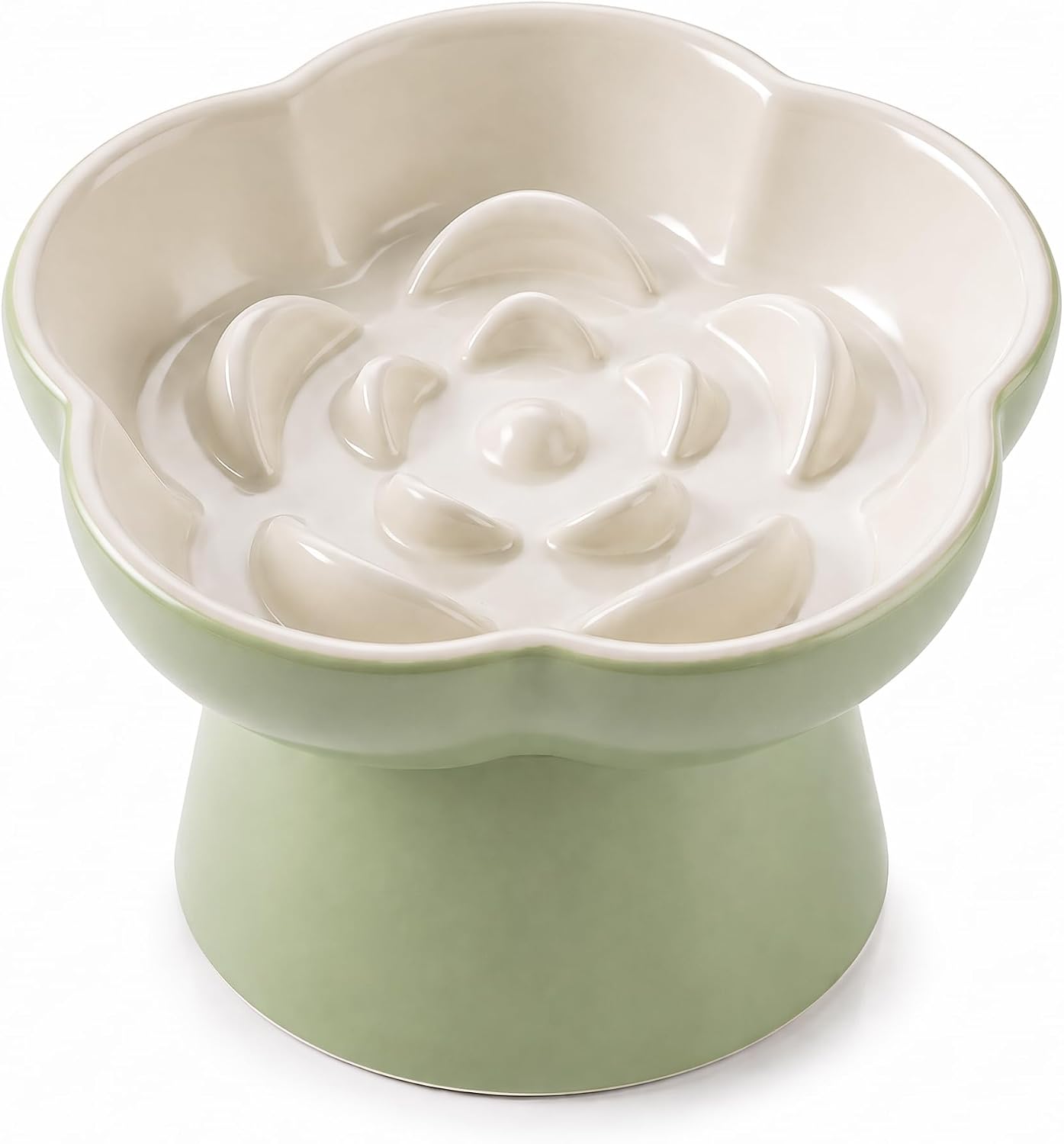
FOCPB Ceramic Elevated Slow Feeder Cat Bowl (Green/Ivory)
The only raised, gently tilted bowl here, so the maze slows the meal while the elevation angle keeps food gathered at the low edge. Ceramic gives it enough weight to stay put, and the whisker-friendly rim is wide enough to eat from without pinning the whiskers.
One bowl, not a set. The tilt suits a cat that eats head-down and can be awkward for a flat-faced cat. Heaviest of the group to lift and wash.
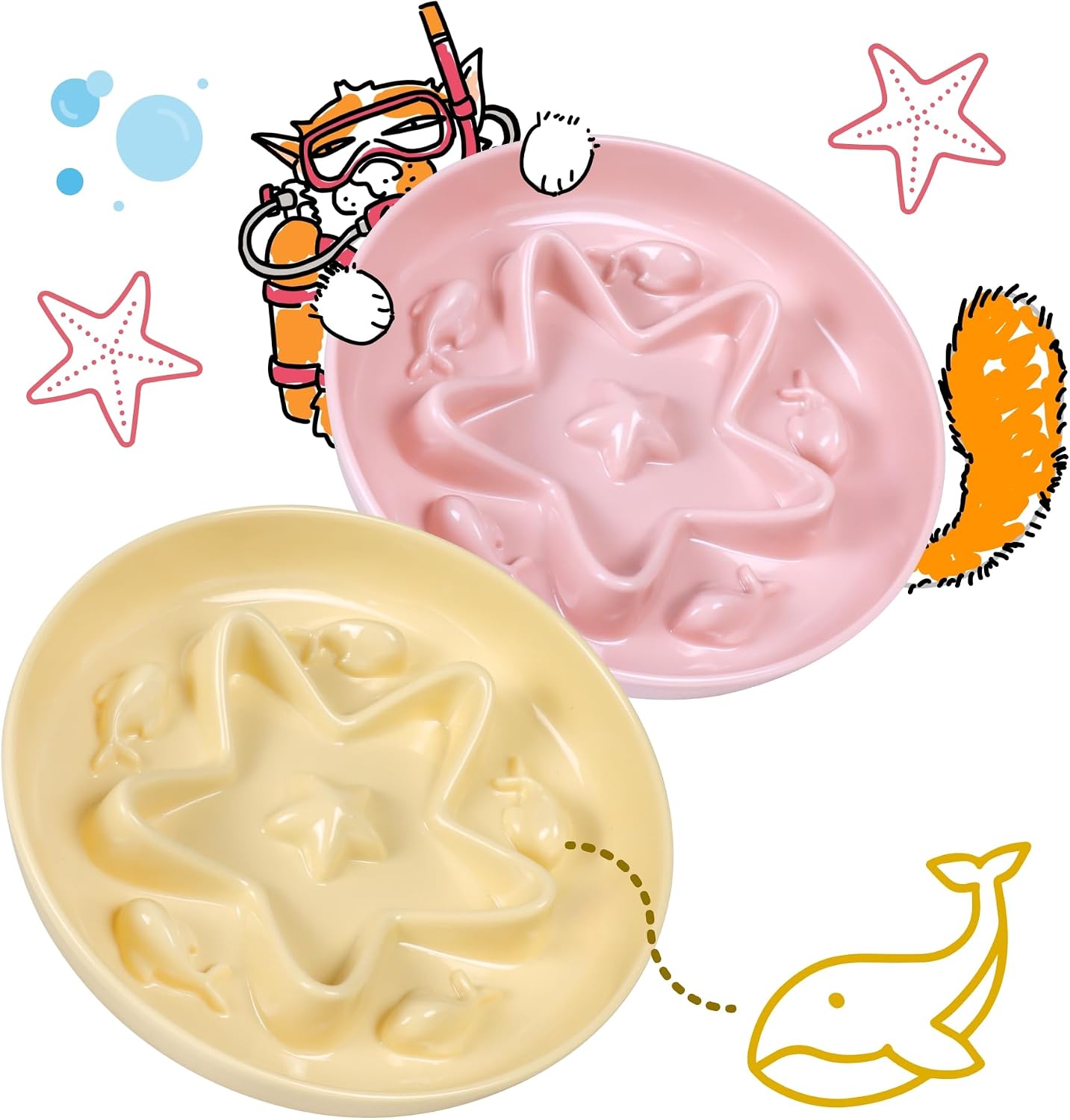
2 Pcs Cat Slow Feeder Bowl, Whisker Friendly Melamine Puzzle Bowl (Buttercream + Coral Pink)
Two bowls in the box, dishwasher safe, lightweight with a non-slip base, and rated for wet and dry food. The 6.3 inch width gives real whisker clearance.
Melamine is light, so a determined cat can still shift it. It will not hold a chill the way ceramic does, and two identical mazes mean no variety.
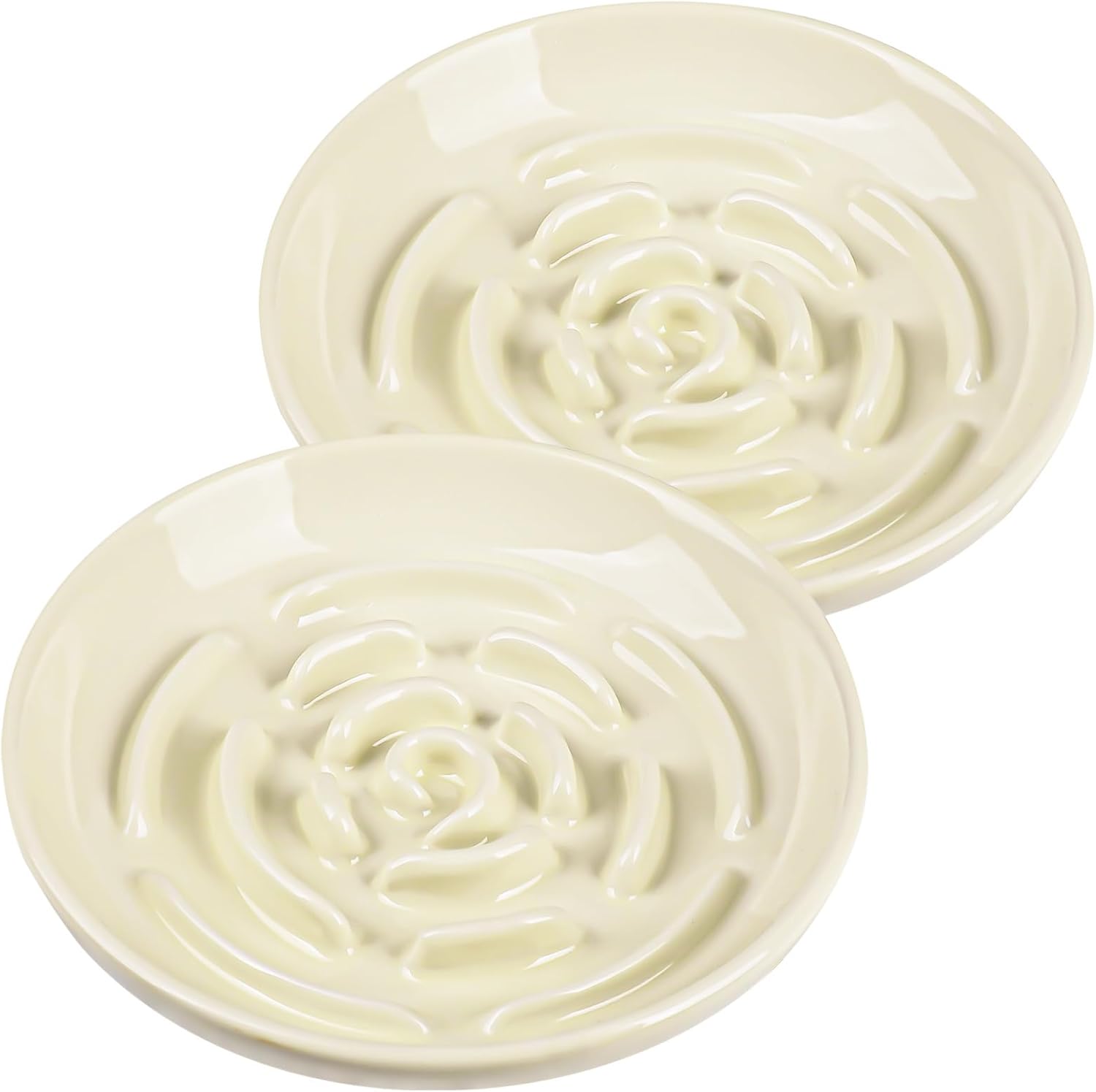
Slow Feeder Cat Bowl Set of 2, Ceramic Maze Bowl
Two ceramic maze bowls, so you can keep one clean while the other is in use. Handles dry and wet food, and the maze is the most maze-like of the group, which matters for a serious gulper.
Ceramic plus a set means more weight and more cabinet space. Deep grooves and wet food are the worst cleaning combination in this category.
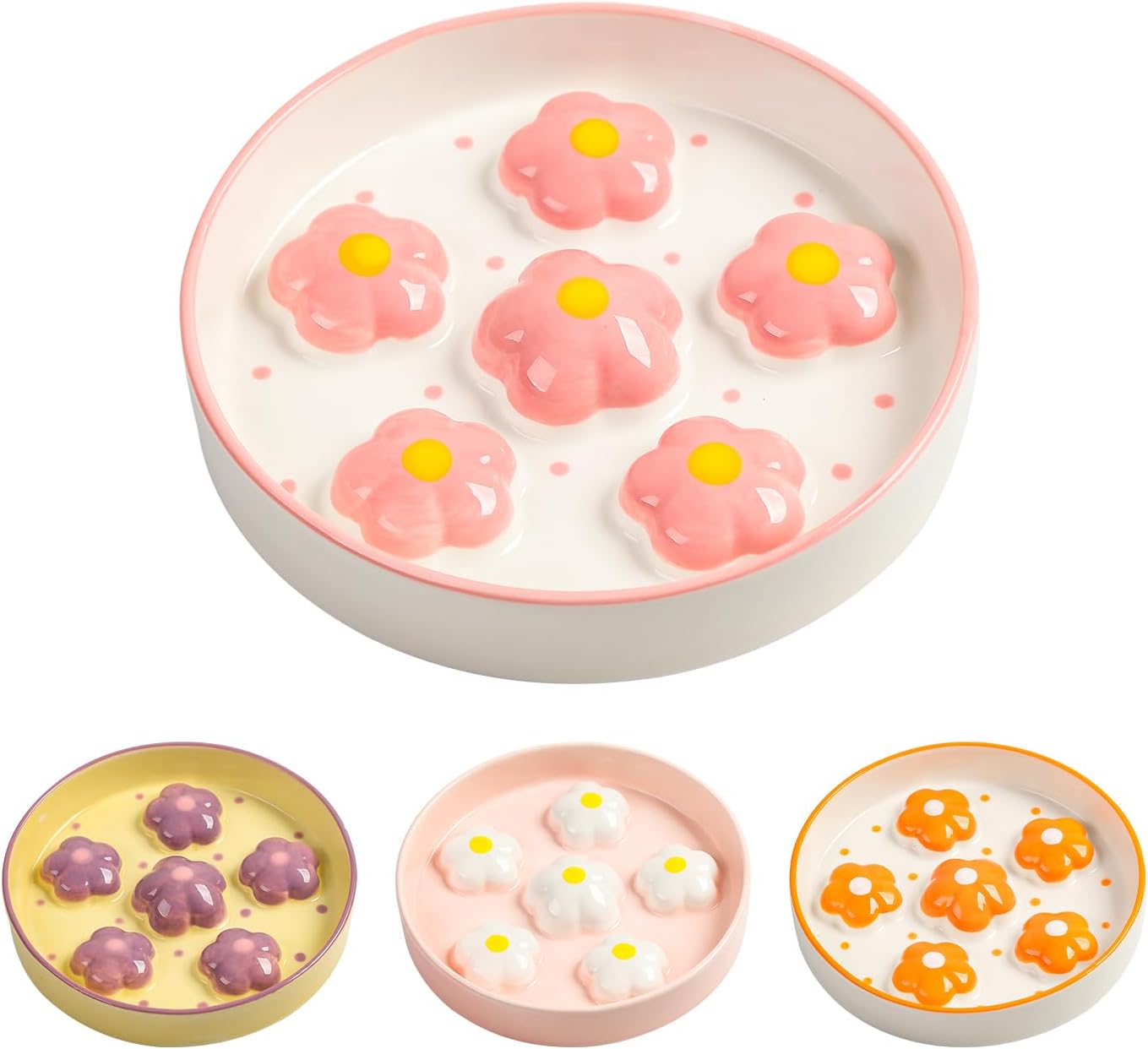
Ceramic Slow Feeder Cat Bowl, 6.3" Whisker Friendly Anti-Vomit, Blush
The simplest single bowl here: 6.3 inches wide, whisker friendly, a shallow anti-vomit maze, and a blush ceramic finish that wipes clean. Lowest commitment of the four.
No elevation, no tilt, no second bowl. Shallowest maze in the group, so a very fast eater may finish sooner than you would like.
Prices and availability may change.
Slow feeder cat bowl vs whisker bowl: the real difference
A slow feeder is a puzzle. The food sits in valleys between ridges, and the cat has to work it loose with a tongue or a paw. That adds time to the meal, which is the entire point for a cat that inhales a portion and then brings it back up on the rug. A whisker bowl is a shape rather than a mechanism. It is wide and shallow, often with a low curved rim, so the cat can eat without the sides pressing its whiskers back toward its face.
Search whisker bowl vs slow feeder cat bowl and you will notice something odd: most of the results are the same products listed twice. Manufacturers worked out that the two ideas sell to the same shopper, so the current generation of bowls stacks a shallow maze inside a wide dish and markets it as both. That is not marketing nonsense. It is a genuinely better design. The maze slows the meal, and the width keeps the whiskers clear.
The one place the two ideas pull apart is depth. A deep maze slows eating more, but a deep bowl is harder on whiskers and harder to clean. A shallow maze is easier on both counts, but a determined gulper can clear it quickly. That is the whole slow feeder cat bowl vs whisker bowl argument in one paragraph, and it runs through all four bowls above.
Bowl width and whisker clearance decide more than the maze pattern
The practical difference between slow feeder cat bowl and whisker bowl comes down to two numbers you can check with a tape measure before you buy: bowl width and whisker clearance. Whiskers are not decoration. They are sensory tools, and a cat's whisker span is roughly the width of its body. A bowl narrower than that span forces the cat to fold its whiskers back against its face for the whole meal, which is uncomfortable enough that some cats eat less, eat faster, or simply walk away.
Six inches is the practical floor for most adult cats, and the two listings here that name 6.3 inches clear it with a little room. That extra fraction of an inch sounds trivial and is not, because it is the difference between whiskers brushing the rim and whiskers floating free. If you have a large cat, measure across the whiskers with a soft tape and add an inch of margin.
The maze pattern matters less than the width. A cat that eats too fast will slow down for almost any obstacle, even a shallow one. A cat with sensitive whiskers will not tolerate a narrow bowl no matter how clever the maze inside it is.
Ceramic or melamine: what the material changes
Three of these four bowls are ceramic and one is melamine, and the choice changes more than the look.
Ceramic is heavy, which is the point. A ceramic maze bowl stays where you put it, even when a cat pushes food toward the edge with a paw. It also holds temperature longer, so wet food stays cool a few minutes longer on a warm afternoon, and the glaze wipes clean without staining. The cost is weight in your hand, weight on the shelf, and a real risk of chips if it lands on tile.
Melamine is light, dishwasher safe, and usually sold with a non-slip ring on the base. It is the better choice if you travel with the bowl, if you hand wash everything in a small sink, or if you have a cat that likes to shove its dish across the kitchen floor. The trade-off is that light is light. A melamine bowl can be shifted by a determined cat, and it will not hold a chill.
For wet food, ceramic wins. For dry food and convenience, melamine is fine. Neither material is safer than the other as long as the listing says food grade and dishwasher safe.
Elevation angle, portion size, and the anti-vomit claim
"Anti-vomit" appears on three of these listings, and it is worth being precise about what that means. It does not treat a medical problem. It reduces one common cause of post-meal vomiting, which is eating too much, too fast, and swallowing air along the way. A maze slows the pace, and a raised bowl changes the angle of the swallow.
That is where the elevated, tilted bowl in this group earns its place. The elevation angle lifts the dish a few inches so the cat is not crouching with its neck bent, and the gentle tilt keeps food gathered at the low edge instead of scattered across the whole maze. Cats that gulp and then bring it right back up are the ones most likely to notice the difference.
Portion size is the other lever, and it belongs to you rather than the bowl. A maze does not stop a cat from eating a large portion, it just makes that portion take longer. If your cat is on a measured diet, measure the food, not the bowl. And if vomiting continues after you slow the meal down, that is a vet conversation, not a bowl-shopping problem.
What these bowls will not fix: water capacity, pump noise, filter type, microchip range
None of these four bowls holds water, and that matters because hydration is the other half of feeding a cat. A fountain is a separate purchase with its own specs. Water capacity tells you how often you refill, pump noise tells you whether you will hear it from the next room, and filter type tells you what the pump is actually catching. A food bowl cannot substitute for any of that.
The other thing a food bowl cannot do is keep one cat out of another cat's dinner. In a multi-cat house, that job belongs to a microchip feeder, and the number that matters there is microchip range, which decides how close the cat has to be before the lid opens. If you are setting up a feeding station for several cats, sort out the bowls first and the access control second.
Should you buy one bowl or a set of two?
A single bowl is enough for one cat eating one meal at a time, and two of these listings are singles. A set of two earns its shelf space for three reasons: you can run one bowl through the dishwasher while the other is in use, wet food can soak in a second bowl while the first dries, and two cats can eat at the same time without one guarding the dish.
If your cat eats wet food twice a day, the rotation argument is the strongest one. Maze grooves are the hardest part of any of these bowls to clean, and a spare means you are never scraping dried food out of a valley before your first coffee. If your cat eats dry food from a single dish, a set is a convenience rather than a necessity.
The trade-offs, in plain terms
If you are still deciding whether you need a slow feeder cat bowl or whisker bowl, the honest answer is that the best designs are both, and the differences between them come down to your routine rather than your cat's health. The elevated ceramic bowl (Visit on Amazon) is the only one here that changes the height and angle of the meal, which is the feature a gulper notices first. The two-bowl sets, the ceramic maze pair (Visit on Amazon) and the melamine pair (Visit on Amazon), solve the cleaning rotation and cover a second cat. The single blush ceramic bowl (Visit on Amazon) is the least complicated way to test whether your cat tolerates a maze at all.
Ceramic stays put and cleans up well, and it is heavy. Melamine is light, dishwasher friendly, and easier for a cat to push around. Height and tilt help a gulper and can be awkward for a flat-faced cat. Pick the material first, then the height, then whether you want a spare. The maze pattern should be the last thing that decides it, because every bowl here has one and every one of them will slow a fast eater at least a little.
What to check before you order
Measure the width of your cat's whiskers with a soft tape while it is relaxed, and compare that to the listed bowl width. If the two numbers are within an inch of each other, size up.
Decide whether the bowl needs to go in a dishwasher. Melamine almost always can. Ceramic usually can, but read the listing, because some glazed ceramics are hand wash only.
Check the base. A non-slip ring matters more on tile and laminate than on carpet, and it matters more for a light bowl than a heavy one.
Think about your cat's face. A tilted bowl is a comfort upgrade for a cat with a normal muzzle and a nuisance for a flat-faced cat that already struggles to reach the bottom of a dish.
Buy one and live with it for a week before you buy a second. Bowl preferences are personal, and a cat that ignores a maze on Monday may be eating out of it happily by Friday.
None of the four bowls here is a bad purchase. The elevated ceramic is the most thoughtful design, the two-bowl sets make the most sense for a household with more than one cat or more than one daily wet-food meal, and the single blush bowl is the simplest way to find out whether your cat tolerates a maze at all. Start there, and let your cat's eating speed tell you whether you need to go further.