Most cage shopping conversations start and stop with the cage itself, which is why so many first setups end up crowded and underused. A bird cage for parrots is really a system: the shell sets the limits, including bar spacing, cage height, door size, and how a tray liner will sit, while everything you hang inside decides how much of that space the bird can actually use. A large cage with a single dowel running through the middle gives a bird almost nothing to do.
This is a bird cage for parrots explained from the inside out, because the fittings are the half of the setup you will change, replace, and rearrange over the life of the cage. It is written for owners of small and medium parrots such as budgies, cockatiels, conures, and finches, and it stays with what the product listings actually describe.
Quick answer
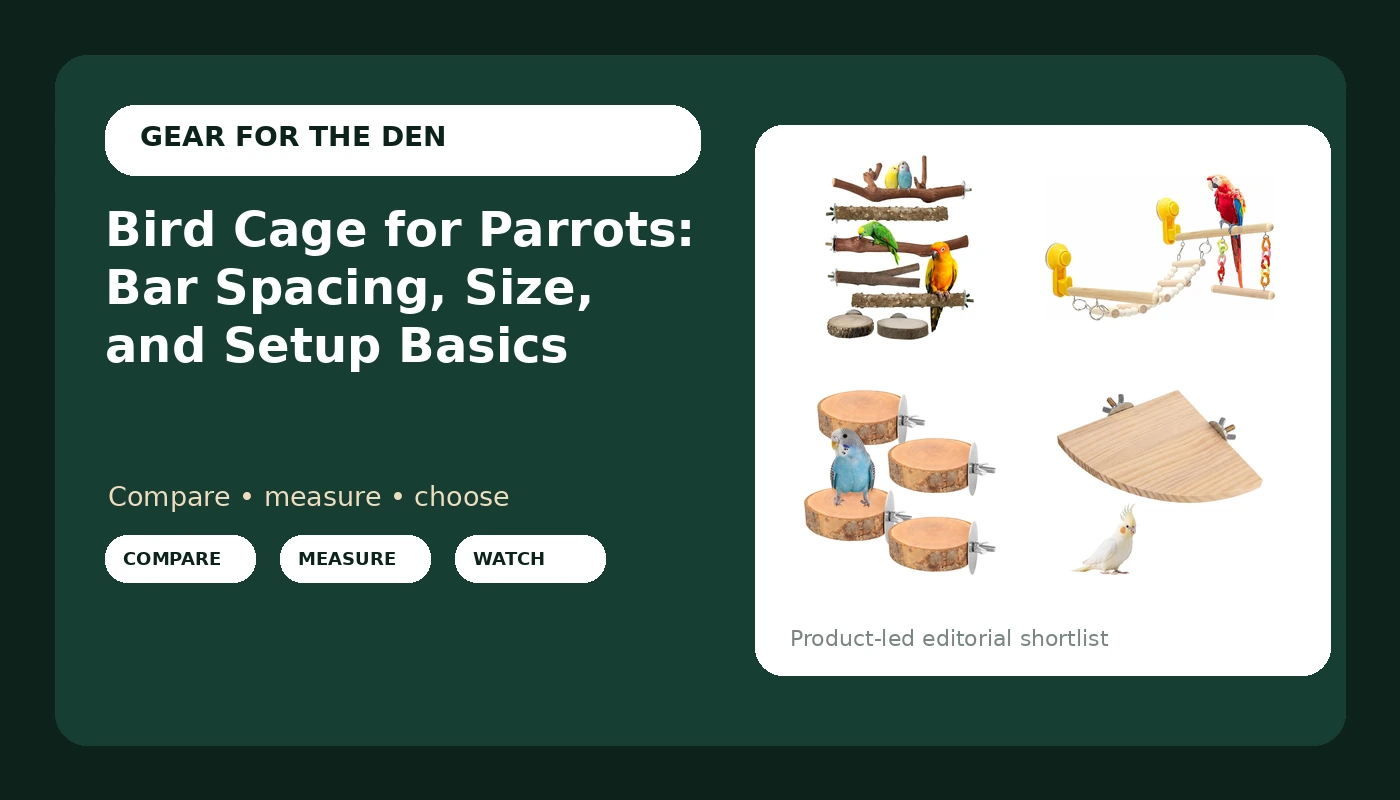
There is no single ideal bird cage for parrots, because the correct bird cage for parrots is matched to the bird's body size and activity level rather than to the wall space you happen to have. Start with bar spacing that is narrow enough that your bird cannot push its head between the bars and wide enough that toes can grip without being trapped. Then buy the tallest and widest shell you can furnish properly, since an empty large cage serves a bird no better than a small one. Perches, platforms, and food cups are the replaceable half of the setup, so plan for more than the one perch that ships in the box. The four options below are interior fittings rather than cages: a seven-piece natural wood set, a suction cup perch with a climbing ramp, a four-pack of round apple wood platforms, and a corner shelf.
Four useful options
| Model | Best fit | What stands out |
|---|---|---|
| Bissap Bird Perch Stand 7PCS, Natural Grape Wood Pole Standing Parrot Cage Branch Paw Grinding Fork Parakeet Platform Hammock for Conures Budgies Finches Cockatiels Small Birds Exercise Training | A bare cage that needs several shapes at once | Seven pieces in one set, mixing a standing pole, branch style perches, a platform, and a hammock style piece |
| Wood Window Bird Perch Toy with Suction Cup, Climbing Ramp Ladder Platform, Enrichment Accessories Stuff for Parrot, Parakeet, Budgie, Cockatiel, Finches to Playstand Bath Car, Love Travel Inside Cage | Birds that need a change of scene, or owners who travel | Suction cup mount plus a climbing ramp and ladder, so the perch can move between cage, window, and carrier |
| CZWESTC 4 Pcs Natural Apple Wood Round Bird Perch Platform for Cage | Simple flat standing spots, bought in multiples | Four round natural apple wood platforms in a single order |
| 6.7" Corner Bird Cage Platform, Wooden Bird Perch Shelf for Birds | Cages with unused corner space | A corner shaped wooden shelf, listed at 6.7 inches, that uses room a straight perch cannot |
The starter set: Bissap Bird Perch Stand 7PCS
Variety is the point of a set like this. A bird that has only a dowel tends to stand in one place, and foot health depends on the foot wrapping a perch at slightly different diameters through the day. Mixed shapes also give a bird choices about height, which matters in a cage where the top half is the desirable territory. The trade-off is that a mixed box rarely suits one bird perfectly: the thickest fork may be too much for a finch, and the thinner branch pieces are light for a large conure. Expect to use most of the set rather than all of it, to rotate pieces between cleanings, and to treat natural wood as a wear item that gets chewed and eventually replaced.
The movable perch: Wood Window Bird Perch Toy with Suction Cup
The suction cup is the whole idea: a second location that is not the cage. Birds that spend most of the day in one room benefit from a station near a window, and a perch that moves means the same object can serve as a travel perch or a bath station. The trade-offs are practical. Suction cups need a clean, smooth, non porous surface, and they can release over time, so test the mount before trusting it above a floor. The ramp and ladder suit climbers more than species that prefer to hop, and none of it replaces the main perch inside the cage. If you travel with your bird, carrier size matters as much as the perch you put in it, so it is worth reading a bird carrier size guide before you plan a trip.
The round platform set: CZWESTC 4 Pcs Natural Apple Wood Round Bird Perch Platform for Cage
Flat platforms solve a specific problem that round perches cannot. A bird recovering from a foot injury, an older bird, or a species that spends long stretches resting does better with a flat surface than with a dowel, and a platform also gives you a stable place to set a food cup or a shallow bath. The trade-offs are upkeep and space. Flat surfaces catch droppings more visibly than thin perches, so they need wiping more often, and four platforms will not all fit in a small cage at once. Use two, keep the rest for rotation, and expect the wood to show wear where the bird chews the edges.
The corner shelf: 6.7" Corner Bird Cage Platform
Corners are the most wasted real estate in most cages. A perch crosses open space, but a corner shelf adds standing area without adding footprint, which matters in a cage that is tall rather than wide. The trade-offs are scale and geometry. One shelf will not transform a bare cage the way a multi piece set will, and it only helps if it actually fits your cage's corner and its mounting does not collide with the door swing or a food cup. Place it below the highest perch so droppings fall past it, and check that the bird can step onto it from an adjacent perch rather than climbing the bars to reach it.
Prices and availability may change. Product images, names, and retailer links are matched to verified listings. No current price, rating, stock status, or measured result is stated here without current evidence.
How to size a bird cage for parrots before you furnish it
Bar spacing is the first filter, and it is about the bird's head rather than about a chart. If the head fits between the bars, the body can follow, and that is both an escape and an injury risk. Spacing that is too narrow is a smaller problem, though it can catch toes on some cage designs, so the head test is the one that matters most, particularly with a young bird that is still growing. If you keep more than one species, size the cage for the smallest bird in the room.
Cage height and floor area come next. Birds generally use the upper portion of a cage far more than the floor, so vertical room is valuable, but horizontal space allows short flights and gliding between perches. A tall cage stacked with perches at different heights often gives more usable area than a short, wide cage, provided the perches are actually placed rather than crammed in. Door size and tray liner access decide how often you clean: a door you can reach through with both hands, and a liner that slides out without dismantling anything, keep maintenance realistic.
Materials and hardware round out the shell. Powder coated steel is the common choice for parrot cages, and chipped or rusting surfaces are a reason to keep looking. Food cup size should match the bird, since cups that are too deep hide food and make foraging harder, while shallow cups spill. Finally, the shape of the cage decides what fits inside it: corner space, door swing, and cup placement all limit where a platform or a swing mount can go.
Bar spacing, perch diameter, and the fit checklist
Once the shell is chosen, the interior is a question of perch diameter, variety, and placement. A perch should let the foot wrap most of the way around it without the toes overlapping or the bird balancing on its belly. One diameter is not enough. A useful layout mixes a main perch, a thinner perch for grip, and a flat platform for resting, which is where the four fittings above come in. Foraging difficulty is the other dial you can turn: scattering food or wrapping it gives a bird work to do, and a bird with work to do is a bird that is not screaming out of boredom.
Placement matters as much as the item. Keep the highest perch off center so droppings fall into open space, keep perches clear of the food cup approach, and leave the door swing free. A swing mount adds movement, but it should never be the only perch, since some birds avoid a moving surface. Wood is chewable by design, so plan on replacing pieces as they wear.
- Check the head test on the bars, then match perch diameter to the foot rather than to the bird's overall size.
- Compare cage height and floor area against the bird's habits: climbers want vertical space, and gliders want length.
- Confirm door size and tray liner access before adding interior fittings, because a platform can block a door.
- Plan at least three standing points at different heights and diameters, including one flat platform.
- Rotate and replace wood pieces as they wear, and recheck mounts, cups, and any suction fitting weekly.
Setting up the inside of the cage
- Place the highest perch off center so droppings land in open space instead of on another perch or a food cup.
- Put the flat platform where the bird rests quietly, usually high on one side, and keep a thinner perch where it climbs.
- Match food cup size to the bird, and position cups so the bird can reach them from a perch rather than from the floor.
- Use a swing mount only where the bird can step across to it easily, and remove it if the bird consistently avoids it.
- Wipe flat platforms more often than thin perches, since flat surfaces show mess, and inspect suction mounts and plastic fittings regularly.
Which option should you choose?
Choose the Bissap Bird Perch Stand 7PCS, Natural Grape Wood Pole Standing Parrot Cage Branch Paw Grinding Fork Parakeet Platform Hammock for Conures Budgies Finches Cockatiels Small Birds Exercise Training when you are starting from a nearly empty cage and want several shapes and diameters at once. Choose the Wood Window Bird Perch Toy with Suction Cup, Climbing Ramp Ladder Platform, Enrichment Accessories Stuff for Parrot, Parakeet, Budgie, Cockatiel, Finches to Playstand Bath Car, Love Travel Inside Cage when your bird needs a second station outside the cage or you want one perch that travels. Choose the CZWESTC 4 Pcs Natural Apple Wood Round Bird Perch Platform for Cage when you want flat standing spots in multiples, so each level gets one and spares stay ready for cleaning day. Choose the 6.7" Corner Bird Cage Platform,Wooden Bird Perch Shelf for Birds when your cage has dead corner space and you want one extra flat spot without adding bulk.
None of these four products is a cage, and none of them rescues a cage that is the wrong size or has bar spacing that does not suit the bird. Listings describe materials, dimensions, and intended species; they do not tell you how the piece will hold up to your bird's beak or how it will fit your specific cage model. Measure the cage, check the mounting, and treat wood as a wear item rather than a permanent fixture.
The bottom line
The cage decision and the furnishing decision are separate, and the second one is the one you can improve this week. Get bar spacing right, then buy as much usable height and floor area as you can actually fill, then add perches and platforms until the bird has choices at several heights and diameters. For most small parrot setups, a multi piece natural wood set covers the first refit, a couple of round platforms handle resting and feeding spots, and a suction cup perch adds flexibility for travel or a window station. Recheck the fit as the bird grows, as pieces wear, and as your routine changes, and let the bird's behavior tell you which perch it actually uses. Prices and availability shift, so check the current Amazon price on any of these before you commit, and measure your cage before you order.