Cat hairballs are a grooming problem wearing a cleanup costume. A cat swallows loose fur while it grooms, most of that fur passes through the digestive tract, and a fraction of it clumps in the stomach and comes back up, often on a rug at three in the morning. A cat brush for hairballs does not change feline biology, but it removes a large share of the loose undercoat before your cat ever swallows it. That is the premise of this page: cat brush for hairballs explained in practical terms, so you can match a tool to coat length, temperament, and the surfaces you have to clean.
Quick answer
No brush stops a cat from grooming, so the goal is reducing the loose fur available to swallow. The correct cat brush for hairballs is usually the one your cat tolerates long enough for you to finish the job. For short and medium coats, a deshedding tool with fine, tightly spaced teeth reaches the undercoat where shedding fur collects. For long coats, a comb with suitable spacing plus a dematting side handles the tangles that a deshedding edge alone will skip over. Glove-style brushes and fabric tools are pickup tools: good at lifting fur off a sofa, less effective at reaching the skin. The ideal cat brush for hairballs is often two tools, one that reaches the undercoat and one that collects what you lift.
Four useful options
| Model | Best fit | What stands out |
|---|---|---|
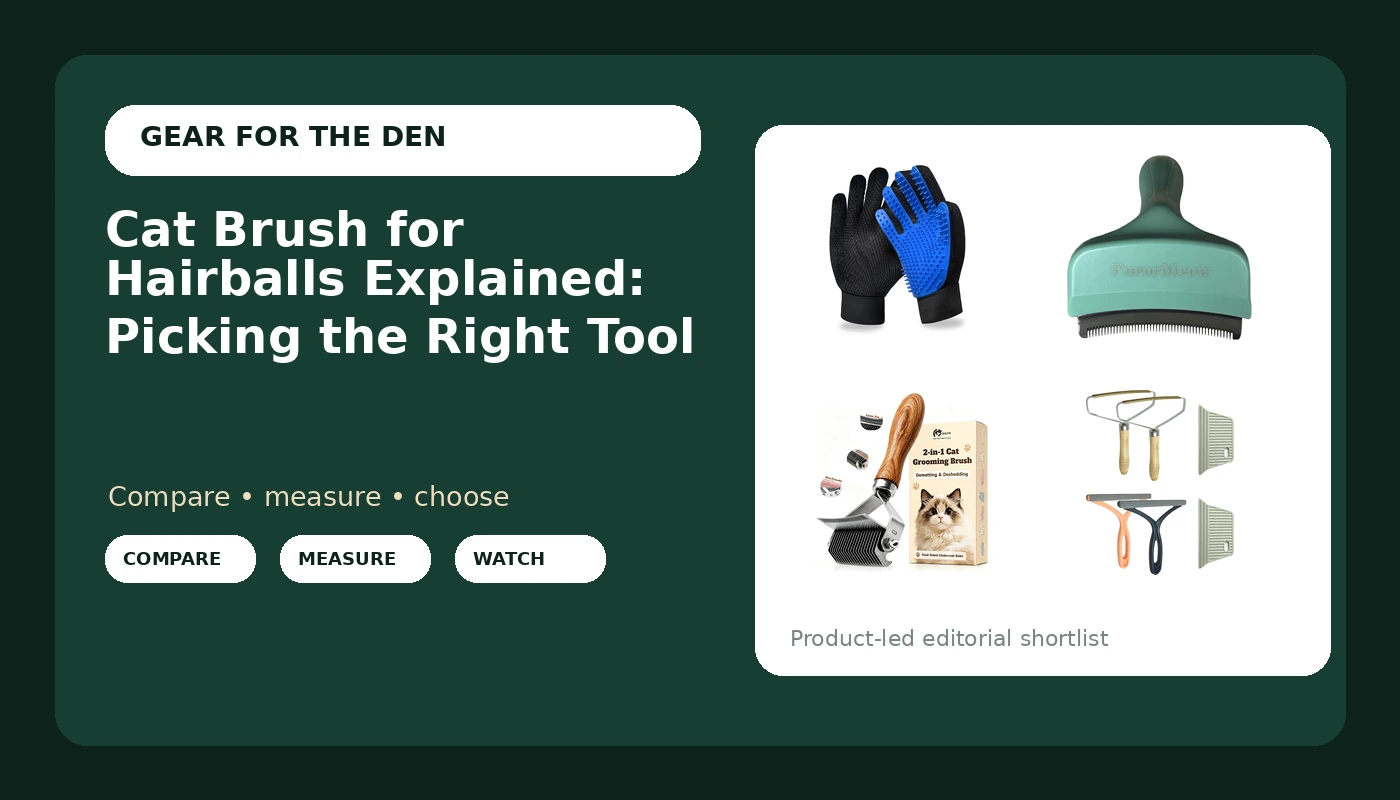
| GJEASE Cat Grooming Glove Brush 2-Pack, Pet Hair Remover Tool | Cats that dislike combs and short sessions | Two glove brushes in one pack, worn on the hand |
| FurorMeow Pet Deshedding Tool with Curve Blade, Cat Grooming Brush, Tight V-shaped Teeth Shedding Comb for Cats and Dogs (Green, Small) | Dense short and medium coats | Curved blade with tight V-shaped teeth, small size |
| Cat Brush for Long Haired Cats, 2-in-1 Dematting & Deshedding Comb | Long coats with tangles | Two working sides, dematting and deshedding |
| 6-Pack Pet Hair Removal Tool, Cat Hair Remover Furniture | Sofas, beds, and car seats after brushing | Six reusable fabric tools in one pack |
For cats that dislike combs: GJEASE Cat Grooming Glove Brush 2-Pack, Pet Hair Remover Tool
Glove fit matters more than most shoppers expect. A glove that shifts on the hand wastes motion, and one that pinches makes you grip harder and shorten the session. The trade-off is depth: a glove works the topcoat and the loose surface fur, so on a dense coat it collects what is already loose rather than pulling deeper shed hair free. Treat it as a finishing and pickup tool, or as the main tool for a cat that genuinely will not tolerate anything else.
For dense short and medium coats: FurorMeow Pet Deshedding Tool with Curve Blade, Cat Grooming Brush, Tight V-shaped Teeth Shedding Comb for Cats and Dogs (Green, Small)
A deshedding edge is the closest thing to a direct answer for a cat that sheds heavily, because it reaches the undercoat where loose fur accumulates. The caution is technique. Repeated passes over the same patch can irritate skin, and a deshedding tool is not a dematting tool: it slides over a tangle rather than through it, which leaves the mat in place and the cat increasingly unwilling. Keep strokes light, cover the body once, and stop while your cat is still relaxed.
For long coats with tangles: Cat Brush for Long Haired Cats, 2-in-1 Dematting & Deshedding Comb
Long coats need wider comb spacing than short coats, because hair has to pass between the teeth without being yanked. When you compare dematting tools, look for a nail guard or blade guard, a safety edge that keeps the sharp part of the blade from contacting skin. Work in small sections, hold the hair above the tangle so you are not pulling directly on the skin, and accept that a stubborn mat may need several short sessions rather than one long one.
For the furniture afterward: 6-Pack Pet Hair Removal Tool, Cat Hair Remover Furniture
Cleanup tools do not reduce hairballs, and it is worth being clear about that. What they do is remove the fur your cat deposited on the couch before it becomes airborne or gets groomed off a paw. A reusable sweeper is the more economical route on large surfaces; a roller adhesive is better for a jacket or a car seat where you want a fresh tacky surface. Either way, this is the step after brushing, not instead of it.
Prices and availability may change. Product images, names, and retailer links are matched to verified listings. No current price, rating, stock status, or measured result is stated here without current evidence.
How a cat brush for hairballs actually reduces the load
A hairball is a mass of swallowed hair that did not pass through the digestive tract. Cats spend a large part of the day grooming, and every stroke of the tongue picks up loose fur. Most of it moves through and out the other end. The part that stays behind accumulates in the stomach, and when it cannot pass, it comes back up. That is why the useful intervention is not a supplement or a food alone, it is removing loose hair from the coat before it reaches the tongue.
Two factors decide how much loose fur is available. The first is coat length: a long coat holds shed hair in place, so it builds up until a comb pulls it out, while a short coat releases it onto every surface you own. The second is the undercoat, the dense insulating layer beneath the longer guard hairs. Most shedding happens there, which is why a tool that only touches the topcoat feels like it is doing nothing while the fur keeps coming.
It is also worth being realistic about limits. Brushing reduces the fur your cat can swallow; it does not eliminate hairballs, and it will not fix a cat that is over-grooming because of a skin problem, stress, or an allergy. If hairballs are frequent, or if your cat is retching without producing anything, is losing weight, or seems off its food, that is a veterinary question rather than a grooming-tool question.
Bristle type, comb spacing, and coat length
Bristle type decides what a tool actually does. Fine, closely spaced metal teeth are built to trap shed hair and are the basis of most deshedding edges. Softer bristles are gentler and better for polishing a short coat or distributing natural oils, but they will not clear an undercoat. Combs with wider comb spacing let long hair pass through without tearing, and dual-sided dematting combs put a cutting edge on one side and a deshedding row on the other.
Then there is the cat. Skin sensitivity, tolerance for handling, and how much of the body you can actually reach all matter more than marketing language. A tool that reaches the undercoat perfectly but only stays on the cat for ten seconds removes less hair than a glove that gets used for five minutes.
- Judge coat length and density first. Short, dense coats and long, fine coats need different comb spacing.
- Start with a wide-spaced comb on any coat with length, working out tangles before anything with a blade goes near them.
- Switch to a deshedding edge for the body once the coat is tangle-free, using light strokes and covering each area once.
- Check for a nail guard or blade guard on any dematting tool, and keep the blade flat to the skin rather than digging in.
- Finish with a glove or a fabric tool to collect the fur you lifted, and stop while your cat is still willing.
Practical guidance for a routine that sticks
- Keep sessions short and frequent. Two five-minute sessions a week beat one long battle, especially in spring and autumn shedding peaks.
- Brush in the direction the coat grows, in small sections, and support the skin with your free hand so you are not pulling it.
- Do not overwork one spot with a deshedding edge. If the skin reddens or your cat flinches, move on and come back another day.
- Pair brushing with something good: a treat before, a treat after, and a calm voice. See how often to brush a long-haired cat for a schedule that fits a longer coat.
- Clean the tool after each session. Fur packed between teeth stops grabbing hair, and a glove with a matted surface is just a glove.
Which option should you choose?
Choose the GJEASE Cat Grooming Glove Brush 2-Pack, Pet Hair Remover Tool when your cat avoids handled tools and you need grooming to feel like petting. Choose the FurorMeow Pet Deshedding Tool with Curve Blade, Cat Grooming Brush, Tight V-shaped Teeth Shedding Comb for Cats and Dogs (Green, Small) when you have a dense short or medium coat and the main job is pulling loose undercoat free. Choose the Cat Brush for Long Haired Cats, 2-in-1 Dematting & Deshedding Comb when the coat is long enough to tangle and you want one tool for both stages. Choose the 6-Pack Pet Hair Removal Tool, Cat Hair Remover Furniture when the grooming is handled and the remaining problem is fur on the sofa, the bed, and the car seats.
A caveat worth repeating: none of these listings is a guaranteed hairball cure, and no brush replaces veterinary advice when hairballs are frequent. Tool descriptions above come from the product listings themselves, not from hands-on measurement, and the right choice depends on a coat and a temperament that no product page can see.
The bottom line
A cat brush for hairballs works by removing loose undercoat before your cat swallows it, which means the useful tool is the one that reaches the undercoat and stays on the cat long enough to matter. For most households that is a deshedding tool for the body, a comb for a long or tangled coat, a glove for a nervous cat, and a fabric sweeper for everything the cat leaves behind. Match the tool to coat length first, keep sessions short, and treat frequent hairballs as a reason to call your vet rather than to buy another brush.