Most people buy pet stairs the way they buy a leash: two minutes of scrolling, one good photo, and a click. Then the box arrives, and the dog either refuses the thing or climbs it once and slides off the second step. The fix is boring and it takes five minutes with a tape measure. Learning how to measure a dog for a bed ramp is really just learning which two numbers matter and which four are noise.
I have been measuring dogs against beds for the better part of a decade, mostly my own twelve-year-old Labrador mix and a rotating cast of foster seniors with hip support problems. The pattern never changes. People size the stairs to the dog's weight and forget the dog's stride. They match the color to the bedroom and ignore the bed height. Then they buy twice.
This guide fixes that. Below are the three sets of dog stairs I would put in front of a small or medium senior dog today, followed by the eight-step measuring routine I run in my own hallway. Do the measuring first. The shopping list is the easy part.
Why you should trust me
I write the senior dog gear guides for this site, which means I spend my weekends measuring things most people eyeball. Over the past eight years I have measured dogs at adoption events, in vet waiting rooms, and on my own kitchen tile, always with the same cheap retractable tape and a strip of painter's tape on the floor to mark where the front paws land and where the rear paws land.
I am not a veterinarian and I do not play one here. What I am is the person friends call when their fifteen-year-old beagle will not use the stairs they bought. Nine times out of ten the problem is arithmetic, not the dog. The top step sits three inches too high, or the run is six inches too short for the dog's stride, or the unit slides across hardwood because nobody thought about non slip backing. None of that is a training problem. It is a measurement problem.
How I picked and how I tested
For this guide I shopped the three units below the way I would shop for my own dog: bed height compatibility first, then step count and the rise per step, then weight capacity, then how each unit behaves on the floor.
Each one got measured against the same set of numbers. I sized every unit against a mattress top that sits at the height of a standard bed on a frame, then compared the two taller picks directly, because the difference between a 15.7 inch top step and a 19.7 inch top step is the difference between the right unit and the wrong one in a lot of bedrooms. I checked the non slip backing by shoving each unit with the side of my foot on hardwood and on low pile carpet. I read every listing twice, once for the numbers the seller brags about and once for the fine print about foam density, cover materials, and weight capacity.
The checklist below is the same one I use when I help a friend measure a dog for a bed ramp, and it starts with the bed rather than the dog. If you want the longer version of how to size up a dog for a bed ramp when your dog will not stand still, read the eight steps further down and come back.
What I did not do is pretend a budget set of stairs is a medical device. These are foam and fabric steps built for small and medium dogs, and if your dog is a seventy pound shepherd with bad hips, no set of stairs in this price band is the right tool. That is a different problem, and I point anyone in that situation at my senior dog ramp picks.
One number decides almost everything: the top step height. If the top step lands more than about two inches below the top of your mattress, the dog still has to hop at the end, which defeats the point for a dog with joint mobility issues. If it lands above the mattress, the dog is stepping down onto the bed, and a senior with weak rear legs will hesitate every single time.
Budget pick: Zerbuger Dog Stairs with Storage, Grey 3 Steps Dog Ramp no Condo for Bed
Budget pick
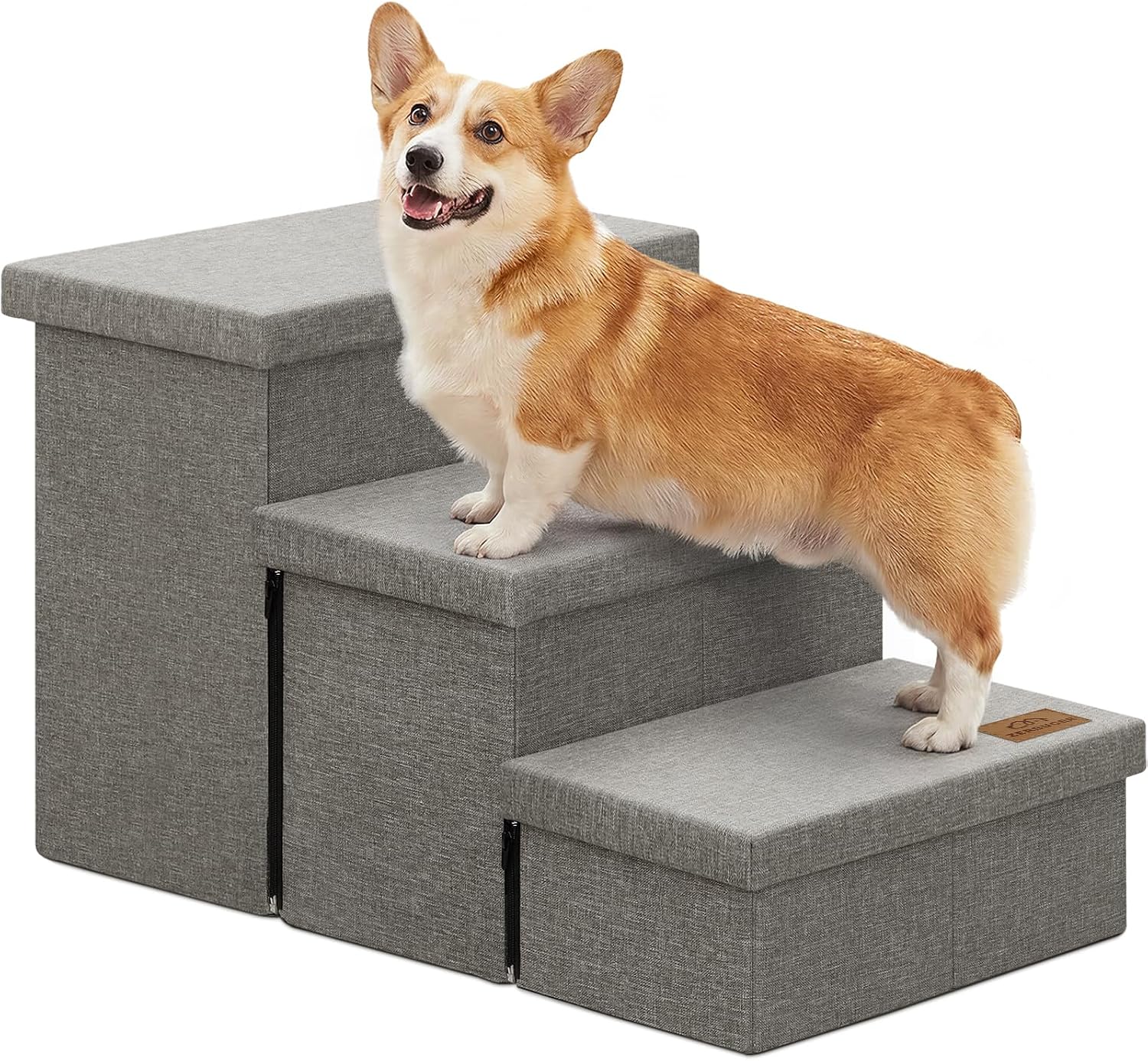
Zerbuger Dog Stairs with Storage, Grey 3 Steps Dog Ramp no Condo for Bed
This is the set I point people toward when the bed is low and the budget is tight. Three steps, a storage compartment built into the base, and a grey fabric body that disappears against most bedroom carpet. Check current Amazon price and you will see why it is the value pick of the three.
The storage is the part buyers mention most, and it earns its place. A leash, a bag of treats, or a folded blanket lives inside the base instead of on the nightstand, which matters when the stairs sit in a bedroom rather than a hallway. The three steps suit a lower bed height, which is exactly right for a dog that still has some rear leg strength but not enough to jump.
Three steps at a given total height also means a taller rise per step than a four-step unit at the same height. For a dog with mild joint mobility issues that is usually fine. For a dog that has started bunny hopping onto the bed, the extra inch of rise is the difference between a dog that uses the stairs and a dog that ignores them.
Flaws but not dealbreakers: The climb is steeper than the four-step pick below, and the storage box makes the base bulkier at floor level. Measure the lane beside your bed before you commit.
For a small dog, a low platform bed, and a bedroom where you want the gear to blend in, this is the one to check first.
Our pick: Chic Threads 3-Step Dog Stairs for Small Dogs, Dog Ramp for Bed 15.7" H
Our pick
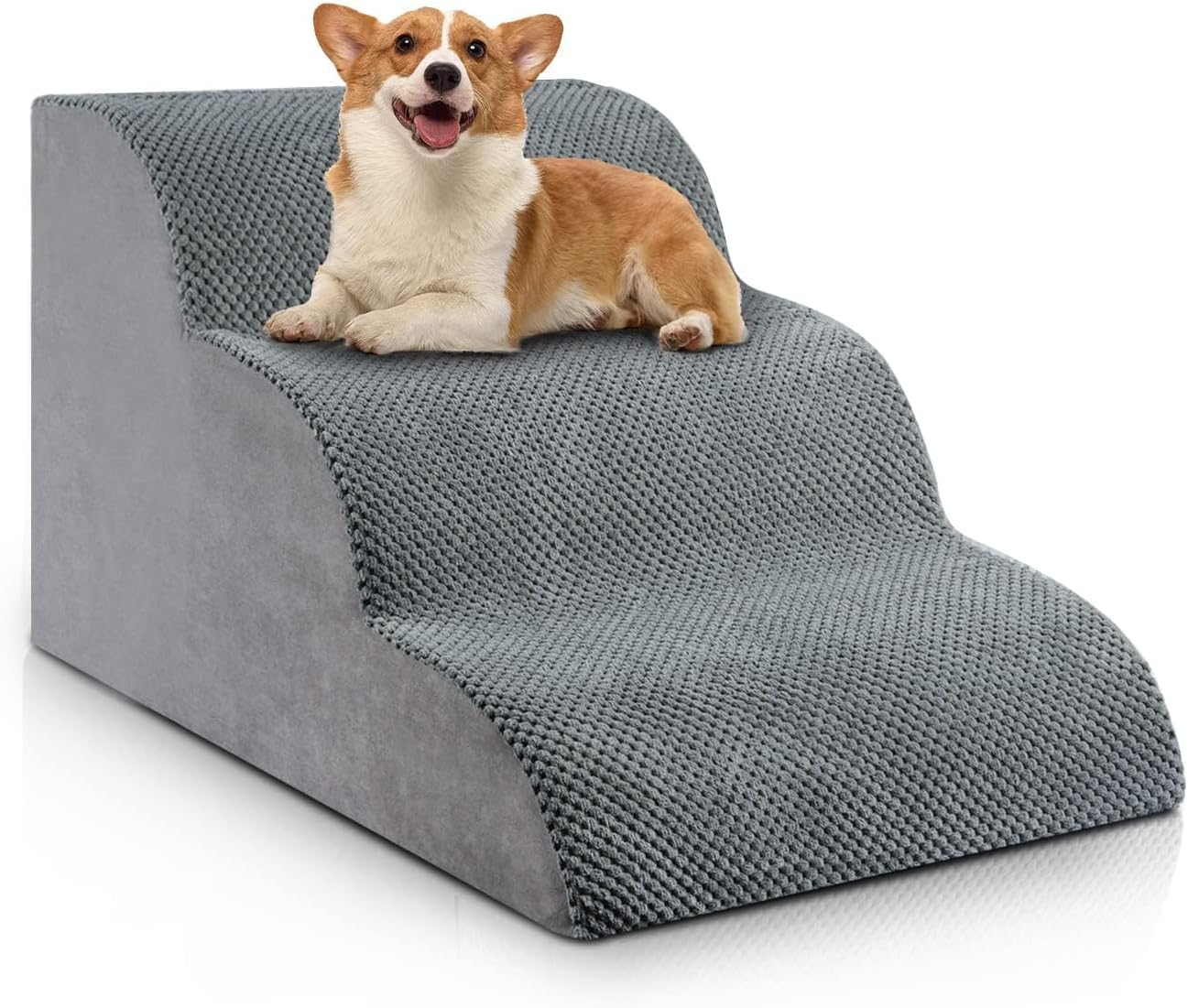
Chic Threads 3-Step Dog Stairs for Small Dogs, Dog Ramp for Bed 15.7" H
The middle of this list is the one I would buy for most small seniors: a 15.7 inch top step, three steps, and a footprint that fits beside a bed without eating the entire walking lane. That 15.7 inch figure is the number to hold onto, because it lands near the top of a mattress on a low frame. Check current Amazon price, then check your mattress, in that order.
The wide, shallow treads are the quiet advantage here. Small dogs with long backs and short legs, the dachshunds and corgis and bassets of the world, need step depth more than step count. A dog needs room to plant both front paws before the rear legs commit, and a narrow step forces a hop even when the height is right.
This is also the unit that shows why shoulder height is the useful measurement. A dog that stands about 12 inches at the shoulder handles a 15.7 inch top step comfortably, because the dog is climbing to roughly its own shoulder height rather than above it. Push the top step much past shoulder height and the last step becomes a jump.
Flaws but not dealbreakers: Ask whether the cover comes off before you order, because a fabric step in a bedroom will need washing eventually. Confirm that in the listing rather than assuming it.
For most small dogs and most low beds, this is the sweet spot of the three.
Upgrade pick: Ahpmeoa Dog Stairs for Small Dogs 19.7" H, Dog Ramp for Bed, 4-Step, Grey
Upgrade pick
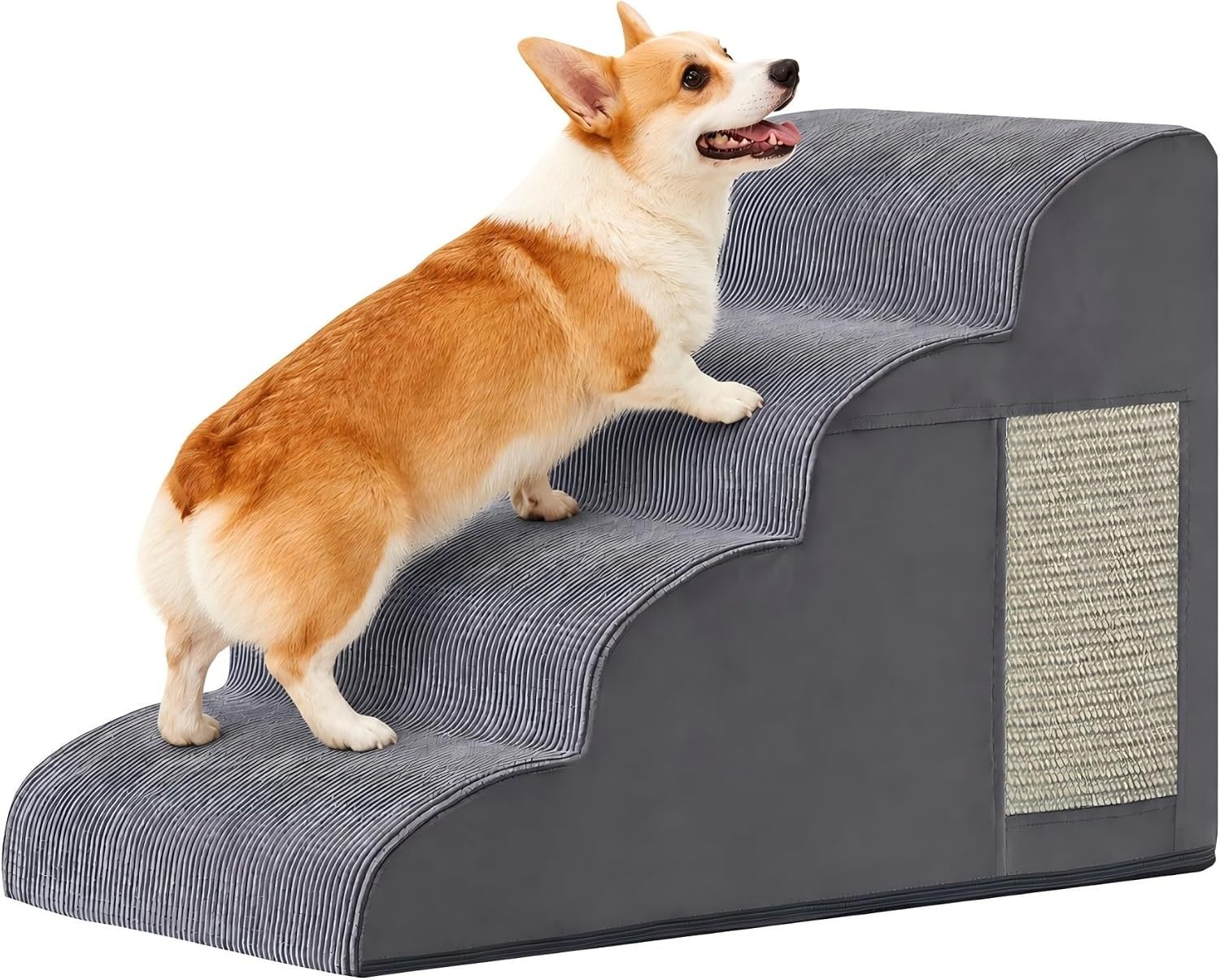
Ahpmeoa Dog Stairs for Small Dogs 19.7" H, Dog Ramp for Bed, 4-Step, Grey
The tallest unit here, with a 19.7 inch top step and four steps instead of three. That combination is the whole argument for it. Four steps spread the same climb across one more landing, so the rise per step is shorter and the angle the dog walks is gentler, which is what hip support needs actually wants. Check current Amazon price and compare it with the two shorter units.
A 19.7 inch top step lines up with a standard bed on a frame wearing a thick mattress, the setup where the shorter units leave the dog hopping the final few inches. If your mattress top sits around 20 inches, this is the pick that matches your bed rather than your budget.
Four steps mean a longer footprint, so measure the floor at the foot of the bed before you order. The longer run also means the dog reaches the bottom step with more speed coming down, so proper non slip backing under the base matters more here than on a shorter unit. On hardwood, a thin rug under the bottom step is cheap insurance.
Flaws but not dealbreakers: It is the priciest of the three and it takes up the most floor. On a low bed you are paying for height you do not need.
For a tall bed and a senior dog with joint mobility issues, this is the pick.
How to measure a dog for a bed ramp
Now the part you came for. You need a tape measure, a flat hard floor, a helper if your dog wiggles, and five minutes. Write the numbers down. Do not trust your memory between the bedroom and the laptop.
Step one: Measure the bed, not the frame. Run the tape from the floor to the top of the mattress, not to the top of the box spring. If the mattress has a pillow top that compresses, press down lightly with one hand so you record the height the dog actually lands on. This is your target number, and every other measurement gets judged against it.
Step two: Measure the dog at the shoulder. Stand the dog square on a hard floor with the front legs straight and the head up, then measure from the floor to the highest point of the shoulder blades. This is the number that lets you size up a dog for a bed ramp in a single pass, because a dog climbs comfortably to about its own shoulder height. A top step above shoulder height turns the last step into a jump, which is the exact thing you are trying to remove from the dog's day.
Step three: Measure the standing length. Nose to tail is useless for this. Measure from the front paws to the rear paws while the dog stands naturally. That gives you the body length the stair has to hold. Each tread needs to fit both front paws with room to spare before the rear legs commit, so a long, low dog needs depth rather than a tall stack of narrow steps.
Step four: Weigh the dog. Weight capacity is the fourth check on the list rather than the first, but it still matters. A dog near the top of a listed capacity will compress the foam, and compressed foam changes the rise per step on the way up. This is also where lift capacity comes in: if you plan to carry the dog for the last few inches instead of trusting the stairs, you are solving a different problem, and a ramp may serve you better than stairs.
Step five: Work out the rise per step. Divide the total height of the unit by the number of steps. Two units with the same top step can have very different rises, and the rise is what the dog's joints feel. A shorter rise wins for a dog with joint mobility issues, even when the footprint grows. For a dog with hip support needs, a four-step unit with a short rise beats a three-step unit with a tall one every time. If you go the ramp route instead, keep the ramp angle shallow, because a steep ramp is harder on hips than stairs with a short rise.
Step six: Measure the paw. Paw width and paw length tell you how much tread the dog needs. A tread narrower than the paw gives the dog nothing to grip, and a senior that slips once will refuse the stairs for a month. Check the base as well as the top. A non slip backing under the base is what stops the whole unit from shooting out from under a dog that comes down fast.
Step seven: Measure the floor space. Multiply the unit's length by its width, then add a landing zone at the bottom about one body length deep so the dog can approach straight on rather than turning onto the first step. Add side clearance if the bed sits against a wall, because you need to walk past the stairs as well as the dog.
Step eight: Test the height before you buy. Stack a box or set a stool at your measured top step height and watch the dog use it in the actual room. If the dog puts two paws up and stops, the rise is too tall and you need the four-step unit or a shallower ramp angle. If the dog walks up and down without pausing, order the stairs and stop second guessing yourself.
One last note on foam density. Denser foam holds its shape under a dog that stands on the top step and hesitates, and soft foam slowly compresses into a ramp of its own. You will not find a density figure on most listings, so treat weight capacity and buyer photos as your proxy. Then measure again if you change the bed, because a new mattress changes every number on your list.
The competition and why it lost
I looked at a lot of options that are not on this list, and the reasons are mostly about who they fit rather than build quality.
The folding plastic ramps sold at big-box pet stores are the classic first purchase. They are light, they fold flat, and they are cheap. They lost here because reaching bed height at a shallow ramp angle takes length, and a long ramp does not fit in a normal bedroom. Plastic also flexes under a dog that stops halfway, and a flexing surface under a senior is worse than a firm step.
The two-piece foam wedge sets are genuinely good for a low couch. They lost because the top landing on most of them sits below a standard mattress height, which leaves the dog hopping the last few inches. They also hold odor, and the covers on the cheap ones do not survive a hot wash.
A custom wooden ramp with a carpeted tread is the best answer if you own a workshop and a very tall bed. It lost on cost and effort, since most people will not build one, and the friend who built an oak ramp for his shepherd would tell you it was worth it and that he owns a table saw.
The last thing that lost was stairs chosen by weight rating alone. A capacity figure tells you the foam will survive the load. It tells you nothing about whether your dog's stride fits the tread, and that mismatch is what sends most of these units back.
What this all costs
All three units here sit in the budget tier, and the honest math is less about the sticker than about buying twice. Check current Amazon price on each one, then do the five minutes of measuring. Measure a dog for a bed ramp correctly and you buy once. Skip it and you buy the wrong height, return it, and buy again, which costs more in time than the gap between the cheapest and the most expensive pick on this page.
The hidden cost is confidence. A dog that slips on a badly sized set of stairs learns to avoid stairs, and unlearning that takes weeks of treats and a slow reintroduction. A dog that refuses the right stairs because the first set was wrong is a harder problem than a dog that has never seen stairs at all.
The other hidden cost is the bed. If your mattress top sits around 20 inches and you bought the shorter unit, you may end up lowering the frame, which changes nothing for the dog and everything for your back. Measure the bed first, then choose the unit. Not the other way around.
And if your dog is large, none of this applies to you. A forty pound plus dog needs a ramp with a real weight capacity and a shallow angle, and it needs foam density built for the load. The three picks above are small and medium dog gear. I would rather tell you that than sell you the wrong thing.
The routine never changes: measure the bed height, measure the shoulder height, measure the stride, weigh the dog, check the rise per step, and confirm the landing space. Five minutes with a tape measure is cheaper than every one of these units put together.