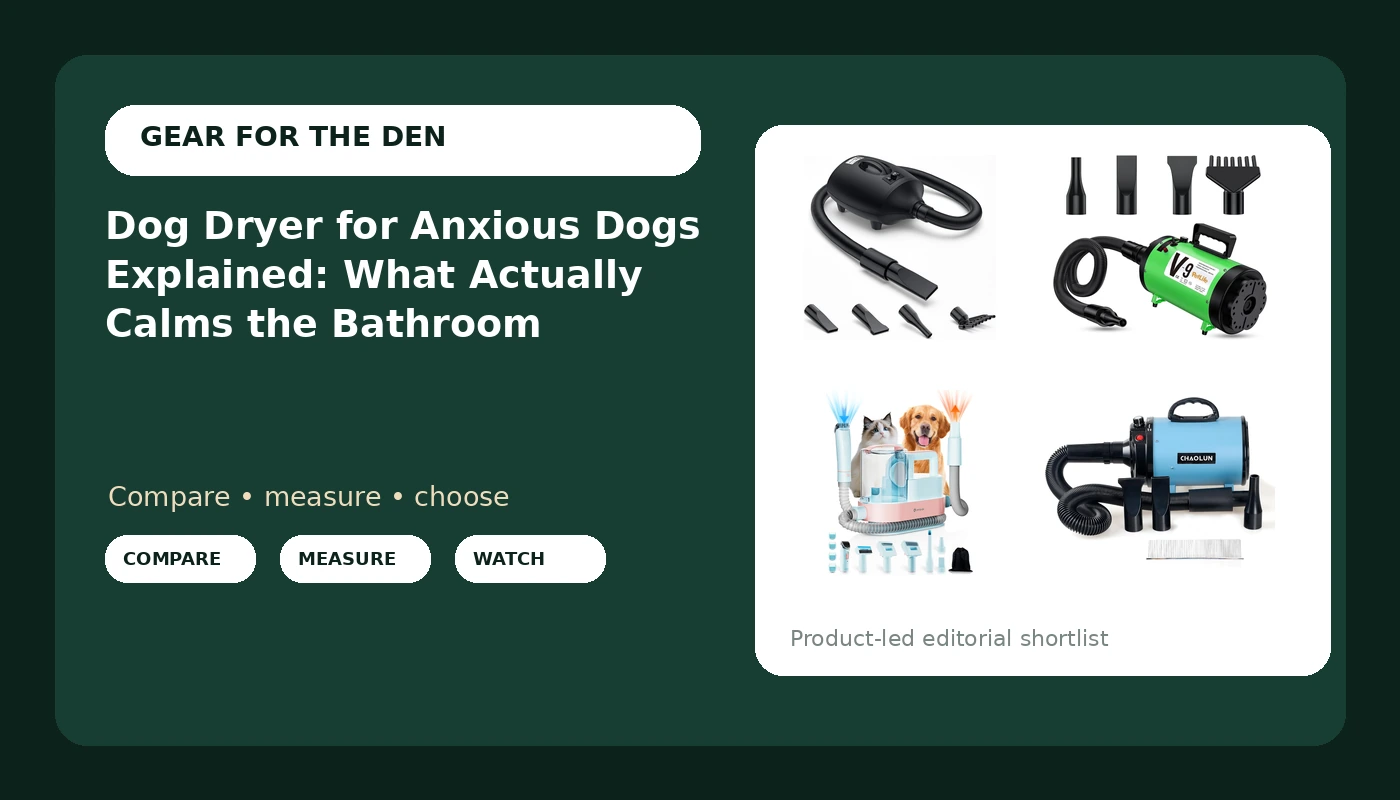
Bath time is the easy part. The drying that follows is where a lot of dogs fall apart: the bathroom door closes, a machine switches on, and the dog that stood still for soap makes a break for the hallway. Most searches for a dog dryer for anxious dogs begin exactly there, somewhere between a wet retriever and a very unhappy terrier. This article is dog dryer for anxious dogs explained in practical terms: what these machines actually do, why sound and airflow cause more trouble than warmth, and how four current grooming dryers differ in the ways that matter for a nervous pet. The machines in this category are high-velocity blowers rather than human hair dryers, and that difference is the whole point. They move a large volume of air at moderate heat so water is pushed out of the coat and the undercoat, instead of being baked off the surface.
Quick answer
There is no single ideal dog dryer for anxious dogs, because a dog's reaction to drying is driven by airflow force, motor noise, and handling far more than by any one brand. The workable approach is to choose a blower with adjustable speed and heat, start on the lowest setting at a distance of a foot or more, and build tolerance over several short sessions. Among the four machines here, the decision comes down to coat type and how much you want a single tool to do: the AETOS dual-motor blower for thick double coats, the 5.2HP blower for one medium-coated dog, the PETGUGU 11-in-1 for homes that also want vacuuming and trimming, and the compact CHAOLUN dryer for small dogs and light coats. None of these is confirmed as the quietest or the most powerful in measured terms; what the listings state is motor rating, heater function, and feature set.
4 useful options
| Model | Best fit | What stands out |
|---|---|---|
| AETOS 6.2HP Dual Motors Dog Dryer, High-Velocity Pet Grooming Hair Blower | Thick double coats and multi-dog homes | Dual-motor design with the highest motor rating in this group |
| Dog Hair Dryer, 5.2HP High Velocity Pet Grooming Blower with Heater(Green) | One medium-coated dog | 5.2HP high-velocity blower with a heater function |
| PETGUGU 11-in-1 Dog Grooming Vacuum & Dryer for Shedding/Grooming/Trimming | Homes that want drying, vacuuming, and trimming from one unit | 11-in-1 kit that combines a grooming vacuum with a dryer |
| CHAOLUN Dog Dryer for Pet Grooming, Pet Hair Dryer with Heater, Blue | Small dogs and light coats | Compact heated pet hair dryer with the simplest feature set here |
For thick double coats: AETOS 6.2HP Dual Motors Dog Dryer, High-Velocity Pet Grooming Hair Blower
More motor means more air, and more air means more sound. With a machine like this, the sensible way to work with a nervous dog is to treat the top speed as a setting you may never need. Let the blower run on the floor a few feet away while the dog is loose in the room, then dry from a distance with the nozzle angled past the dog rather than at it. Dense double coats genuinely need airflow, because water trapped in the undercoat is what keeps a dog damp for hours after the surface feels dry, and a damp undercoat is one of the reasons skin irritation follows a bath. The goal is reaching that undercoat without turning the session into a chase.
For one medium-coated dog: Dog Hair Dryer, 5.2HP High Velocity Pet Grooming Blower with Heater(Green)
The middle of the range is often the right place to land for a single dog with a medium coat. A 5.2HP blower with heat has enough force to move water out of a coat that would otherwise air-dry for half a day, and enough adjustment that a first session can be short and manageable. The heater matters less than most people expect, because drying here is done by moving air rather than by temperature. Warm air mainly keeps a wet dog from getting chilled, which is worth having in a cold bathroom or an unheated garage in winter, and it is a comfort feature rather than the mechanism that dries the coat.
For homes that want one tool: PETGUGU 11-in-1 Dog Grooming Vacuum & Dryer for Shedding/Grooming/Trimming
What makes a multi-tool useful for a nervous dog is not power, it is setup. A grooming vacuum that also dries means fewer unfamiliar appliances, and a good part of the drying prep, brushing loosened undercoat out of the coat, can happen with the vacuum running. The trade-off is that a combined unit asks you to learn one control panel for several jobs, and drying airflow in a vacuum-based design tends to be gentler than a dedicated blower. For light and medium coats that is usually a fair exchange, and the vacuum side keeps the floor from turning into a hair drift.
For small dogs and light coats: CHAOLUN Dog Dryer for Pet Grooming, Pet Hair Dryer with Heater, Blue
Small dogs and light coats have a real advantage at drying time: there is simply less water in the coat to move. A compact heated pet dryer that finishes a small dog in a few passes is often less stressful than a high-velocity blower that overwhelms it before the coat is half dry. Keep sessions short, keep the nozzle moving, and stop while the dog is still relaxed rather than pushing for bone dry in one go. If a larger dryer turns out to be too much for a particular dog, the compact unit still earns its place for touch-ups between full grooms.
Prices and availability may change. Product images, names, and retailer links are matched to verified listings. No current price, rating, stock status, or measured result is stated here without current evidence.
Why airflow, coat type, and motor noise decide the job
Drying a dog with a blower is closer to leaf-blowing a driveway than to blow-drying hair. The machine pushes a high volume of air at speed, and that moving air strips water off the coat and drives it away from the skin. Heat is secondary; many grooming dryers move air with little warmth at all, and the ones that include a heater use it so a wet dog does not get cold.
Coat type decides how much airflow you actually need. A short, single coat sheds water quickly and dries in minutes with almost any tool, which is why small dogs and smooth-coated breeds do fine with a compact dryer. A double coat with a dense undercoat is the hard case: the outer hairs shed water, and the undercoat underneath holds it, so a gentle breeze never reaches the part of the dog that stays wet. Curly and woolly coats trap moisture in a similar way. None of that changes with the price of the dryer; it changes with how much air the machine can move.
Motor noise is the part that decides whether the dog cooperates. A high-velocity blower is loud by nature, and higher motor ratings usually mean more sound, though housing design and motor type change the character of it. That is why variable speed matters more than raw power in a house with a nervous dog: you need a setting low enough to be tolerable today, and a machine that can grow with the dog as the routine becomes familiar.
How to introduce a dog dryer for anxious dogs
Tolerance is built, not bought. A dog that panics at a running blower today can often be dried with the same machine a few weeks later if the introduction is slow and always ends before the dog decides it has had enough. The sequence below is the one most groomers fall back on, and it works because each step is boring rather than dramatic.
- Play the sound from another room first. Run the dryer in a closed room while you feed, play, or train in a different one, so the noise becomes background before it ever points at the dog.
- Bring it in switched off. Let the dog sniff the housing and the hose, reward curiosity, and put it away. Repeat this a couple of times before the machine is powered up in the same room.
- Start at the lowest speed, aimed away. Point the nozzle at a wall or the floor across the room, keep the first powered session under a minute, and end with a reward while the dog is still calm.
- Dry the easy parts first. Legs, shoulders, and the back are less sensitive than the head, ears, and belly, so work outward from the calm zones and leave the face alone entirely.
- Finish with a towel and a treat. Even a partially dried dog ends the session on a good note, and the next session starts from a slightly higher baseline.
Watch for the early stress signals, a tucked tail, lip licking, yawning, or a sudden freeze, and treat any of them as the end of the session. A dryer with a genuinely low first speed is worth more here than a dryer with a high top speed. If a dog's skin is already irritated, how coat and skin care fit together is worth reading before you add more air and heat to the routine.
Practical guidance for calmer drying sessions
- Match the machine to coat type before anything else. A light single coat may never need a high-velocity blower, while a dense undercoat will not dry properly without one, and buying the wrong end of that range creates most of the struggle people blame on their dogs.
- Use the towel first and the dryer second. Toweling removes a surprising amount of surface water, shortens the time the blower has to run, and gives a nervous dog a familiar first step instead of a sudden machine.
- Keep the grip handle in mind when you compare units. A dryer you can hold at arm's length without your wrist tiring is easier to control around a dog that shifts position, and a hose that reaches across the room lets you keep more distance early on.
- Check bristle type on whatever brush you use between drying passes. A soft slicker or a rubber curry lifts damp undercoat into the airflow, while a stiff brush on a wet coat pulls and makes the session worse.
- If you bathe before drying, pick the shampoo for the skin, for example an oatmeal concentration made for sensitive or itchy skin, and rinse until the water runs clear, because shampoo residue holds moisture in the coat and keeps the dryer running longer than it should.
Also worth knowing: if you trim between baths, fit a blade guard on the clippers so a dog that moves suddenly does not get nicked, and skip human hair dryers entirely, since their concentrated heat is designed for a human head and can burn skin through a wet coat.
Which option should you choose?
Choose the AETOS 6.2HP Dual Motors Dog Dryer, High-Velocity Pet Grooming Hair Blower when you have a dense double coat, a multi-dog household, or a dog that stays damp for hours without high-velocity airflow. Choose the Dog Hair Dryer, 5.2HP High Velocity Pet Grooming Blower with Heater(Green) when you are drying one medium-coated dog and want a heated blower that sits below the heaviest machines on power. Choose the PETGUGU 11-in-1 Dog Grooming Vacuum & Dryer for Shedding/Grooming/Trimming when you would rather own one grooming tool than four, and want shedding, vacuuming, and trimming handled by the same unit. Choose the CHAOLUN Dog Dryer for Pet Grooming, Pet Hair Dryer with Heater, Blue when the dog is small or lightly coated and a compact heated dryer with a simple feature set is all the job requires.
The honest limitation is that no specification answers the question for a specific dog. There is no universal correct dog dryer for anxious dogs, only one that matches the coat in front of you and the pace the dog can accept. A dryer that is too powerful for a nervous puppy is worse than a modest one, and a dryer that is too weak for a thick undercoat keeps the dog wet long enough to make every future bath harder. Start with the coat, then the sound level you can control, then the price.
The bottom line
A dog dryer for anxious dogs is not a special category of machine; it is a high-velocity blower used differently. Buy for coat type first, because that decides how much airflow the job needs, then look for adjustable speed so the first sessions can be short and tolerable. Introduce the sound before the airflow, dry the easy body parts before the sensitive ones, and end every session while the dog is still relaxed. The AETOS suits thick double coats, the 5.2HP blower suits one medium-coated dog, the PETGUGU suits a home that wants one tool for everything, and the compact CHAOLUN suits small dogs and light coats. The routine, more than the machine, is what makes drying bearable.