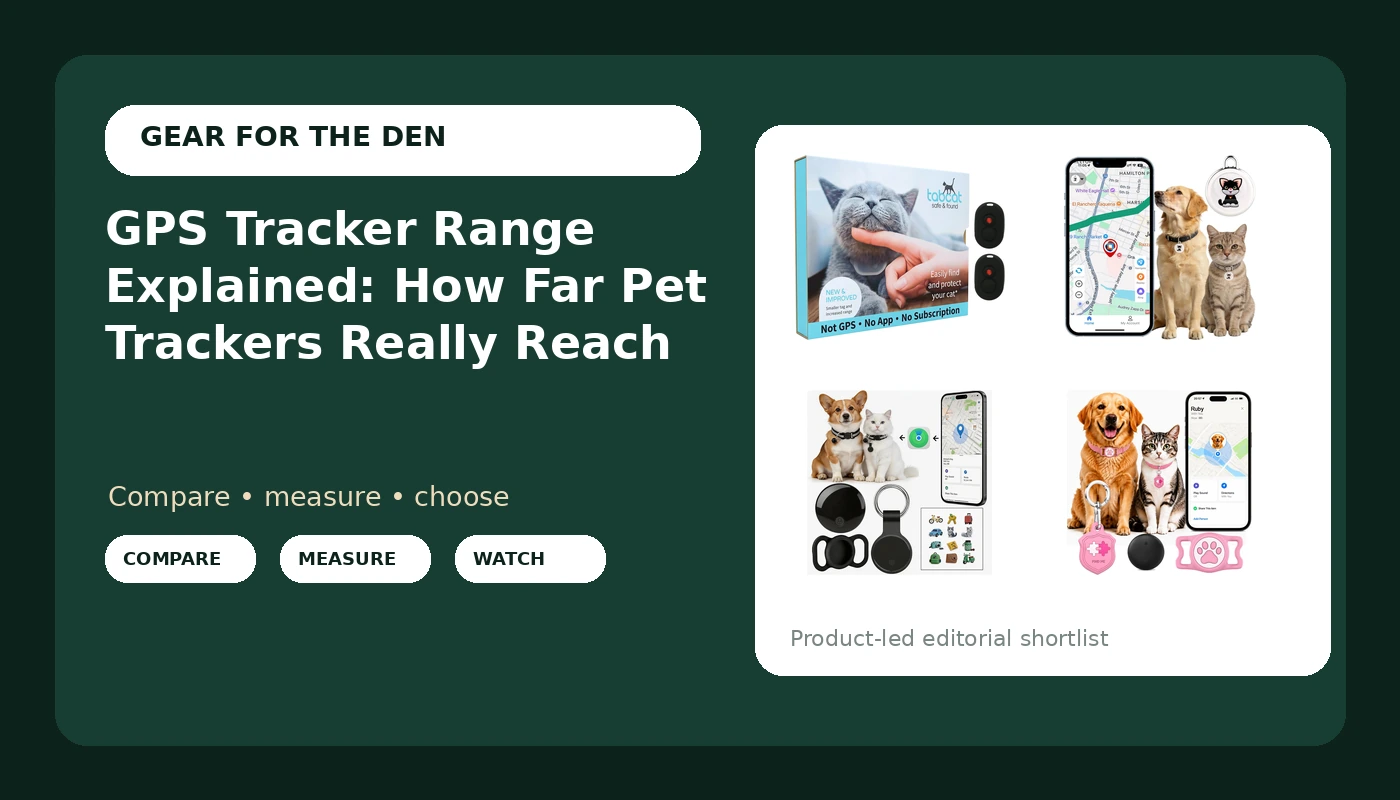
Range is the first number shoppers hunt for and the last one they fully understand. One listing promises a fixed distance, another promises real-time positioning, a third leans on Apple Find My, and those three claims describe three different technologies. The gps tracker range printed on a box is a best-case figure measured in conditions your cat will never cooperate with: open ground, clear sky, a fresh battery, and a handset held at the right angle.
That gap between the label and the back garden is where most disappointment starts. A tracker that reads cleanly in an open car park can lose its position under a dense hedge, and a tag that works through four walls in a demo video can go quiet in a neighbour's garage. This guide unpacks what range actually measures, where each number comes from, and how to match a tracker to the animal you own rather than the marketing you read.
Quick answer
There is no single correct gps tracker range, because the number on a box is a category claim rather than a universal measurement. Radio homing trackers pair a handheld locator with a directional signal, and the Tabcat V2 states up to 150m of range. Satellite GPS trackers need a clear view of the sky for a fix and a phone link to report it, so their useful distance depends on where your pet is standing, not on a printed maximum. Apple Find My trackers have no fixed range at all: they report when a nearby Apple device passes within Bluetooth distance of the tag, so crowd density matters more than distance. If you want gps tracker range explained in a single sentence, it is the distance at which your pet can still be located, and that depends entirely on the technology doing the locating.
Four useful options
| Model | Best fit | What stands out |
|---|---|---|
| Tabcat V2 Cat & Kitten Tracker | Cats that stay close to home | Radio homing with a stated 150m range, two tags included, no monthly fee |
| Smart GPS Tracker for Dogs | Owners who want the longest stated battery life | 365-day battery claim, waterproof and drop-proof, no subscription, Android and iOS |
| Air Tracker Tag | iPhone households on a budget | Apple MFi certified, Find My support, anti-lost alerts, no monthly fee |
| Dog Tracker with Apple Find My (Pink V2) | Small dogs and owners who want a colour choice | Apple Find My support in a pink housing |
Radio homing: Tabcat V2 Cat & Kitten Tracker
Radio homing works differently from everything else here, and that difference is the point. There is no map pin and no position history. You walk with the locator, sweep the direction, and follow the signal until it points at the cat. That makes it excellent for an animal hiding in a shed, a loft, or a neighbour's hedge within a couple of hundred metres, and it does nothing for a cat that has crossed a motorway. Buildings, fences, vehicles, and dense foliage all cut the signal range, so treat the stated maximum as an open-field number rather than a promise for your street. The listing does not state a water resistance rating, so if your cat likes wet grass or rain, check the current product page for that detail before you commit.
365-day battery: Smart GPS Tracker for Dogs|mini Easy to use Cat GPS Tracker|Waterproof and Drop-Proof|Real-time Positioning Smart Alarm pet Tracker|Extra Long Battery Life of 365 Day|No Subscription (Android & iOS)
Battery life and range pull against each other on every satellite tracker, and this listing is the clearest example in the group. A 365-day figure only holds when the device reports rarely, because live updates are what drain a cell. If you want a position every few seconds while your dog is loose, expect to charge far more often than the annual number suggests, and think about a power backup routine such as a weekly top-up. Satellite fixes also need sky above the animal, so a dog under a bridge, inside a barn, or deep in a wooded ravine may drop off the map until it moves. Check the app pairing process for your own phone, confirm the water resistance rating on the current page, and decide how much update frequency you actually need before you let the runtime claim make the decision for you.
Find My tag: Air Tracker Tag, Smart Item Tags,GPS Tracker for Dogs & Cats, No Monthly Fee, Real-Time Positioning & Smart Anti-Lost Alerts,Mini Waterproof Drop-Proof Pet Tracker,for iOS Find My【Apple MFi Certified】
A Find My tag never talks to a satellite. It broadcasts a short-range Bluetooth signal, and any nearby Apple device in the crowd can relay an approximate location back to your account. In a city street or a busy park, that can mean frequent updates with no subscription at all. On a farm, a quiet lane, or a large property with few visitors, the same tag can go hours without a report, because there is nothing nearby to hear it. That is the honest version of range for this category: it is measured in people, not in metres. The other limit is platform. This tag is listed for iOS Find My, so an Android household should look elsewhere. If you want a fallback for those quiet zones, pairing a crowd tag with a satellite tracker gives you two different ways to find the same animal.
Find My tag with a colour option: Dog Tracker with Apple Find My, GPS Pet Tracker for Dogs and Cats (Pink V2)
Two Find My tags in one guide looks repetitive until you put them on real collars. Colour and size matter more than most spec sheets admit: a bright pink housing is easier to spot in long grass, and a smaller tag sits better on a cat or a small dog than a bulky GPS brick. The trade-off is identical to the tag above, because the locating method is the same. There is no satellite fix, no cellular radio, and no subscription, which also means no coverage guarantee in empty places. Before buying, check the attachment point on your collar, the weight of the tag on a small animal, and whether the app pairing flow works with the phone you carry every day.
Prices and availability may change. Product images, names, and retailer links are matched to verified listings. No current price, rating, stock status, or measured result is stated here without current evidence.
What "gps tracker range" actually describes
The word range hides three separate distances, and mixing them up is why buyers end up disappointed. The first is the link between the tag and whatever hears it. For a radio homing tracker that link is the locator in your hand, which is why the Tabcat V2 states a figure like 150m. For a Find My tag that link is the nearest Apple device, which could be a stranger's phone on the pavement or nobody at all. For a satellite tracker that link is a cellular or Bluetooth connection that carries the fix back to your app.
The second distance is the fix itself. A satellite GPS tracker needs several satellites in view before it can calculate a position, and that calculation is about sky, not about how far away you are. A dog lying under a dense canopy or inside a metal shed can sit in an area with excellent coverage and still fail to register a position. Cloud, tall buildings, and steep terrain all degrade the fix in the same way.
The third distance is reporting. A tracker can know where it is and still not tell you for another ten minutes, depending on its update interval and the network it uses. That is why "real-time positioning" on a listing means frequent updates rather than a permanent live feed. The practical constraints around all three are the same ones you will weigh in any pet tech purchase: battery life, water resistance, app pairing, and whether a subscription is required. Signal range is only one column in that table. Camera resolution and portion accuracy belong to cameras and feeders, not to trackers, so ignore those numbers here entirely. A tracker with a 150m stated range that fits your cat's habits beats a tracker with an unlimited theoretical range that dies in two days.
Matching the ideal gps tracker range to your pet
The ideal gps tracker range is not a maximum at all. It is the smallest coverage envelope that still includes everywhere your animal actually goes, backed by a locating method that works in the places your animal actually hides. Work through these five steps before you buy.
- Map the real roaming radius. Track where your cat or dog goes for a week and note the furthest point. Most indoor and outdoor cats stay within a garden or a few neighbouring gardens, which puts them inside radio homing territory.
- Decide whether you need a live pin or a final direction. A map with a pin suits an animal that could be anywhere; a directional signal suits an animal that is probably within a couple of hundred metres and hiding.
- Confirm your phone platform before you look at price. Find My tags are listed for iOS, while the mini GPS tracker here lists both Android and iOS.
- Weigh battery life against update frequency. A long runtime usually means fewer reports per day, so match the interval to how quickly you need to react.
- Check water resistance, mounting, and power backup. A tracker that falls off or fills with water has no range at all.
Practical checks before you buy
- Walk your pet's boundary with the tracker before you trust it, and note where the signal weakens.
- Read the subscription terms carefully, because "no monthly fee" and "no subscription" are the claims these listings make and you should confirm they cover the features you want.
- Test app pairing at home, on your own network, before the first real escape.
- Plan a charging or battery routine so a long stated runtime does not become a surprise.
- Check the collar attachment and the weight on a small animal, especially for cats and toy breeds.
Which option should you choose?
Choose the Tabcat V2 Cat & Kitten Tracker when your cat stays within a garden, a shed, or a couple of streets and you want a directional homing signal with no subscription and two tags in the box. Choose the Smart GPS Tracker for Dogs when you want the longest stated battery life, a waterproof and drop-proof housing, and a tracker listed for both Android and iOS. Choose the Air Tracker Tag when you carry an iPhone, want the lowest-cost way into Find My tracking, and live somewhere with plenty of Apple devices nearby. Choose the Dog Tracker with Apple Find My (Pink V2) when you want the same Find My approach in a pink housing for a smaller dog or a cat.
None of these listings states a measured range test, so every distance figure here is a manufacturer claim rather than a verified result. Coverage also changes with weather, buildings, terrain, and the number of people around, which is why the same tracker can perform well on one street and poorly on the next.
The bottom line
There is no universal number that makes a tracker good, and the search for one is what leads owners to buy the wrong device. A radio homing tracker gives you a direction and a short working radius, a satellite GPS tracker gives you a position wherever the sky is visible, and a Find My tag gives you a location whenever another Apple device is close enough to hear it. Each one solves a different problem.
Start with your pet's habits rather than the box. If your cat hides in nearby gardens, a directional locator with a stated 150m range is a sensible match. If your dog ranges across open ground and you want a long runtime, the mini GPS tracker with the 365-day battery claim is the better fit. If you carry an iPhone and your neighbourhood is busy with people, a Find My tag covers a lot of ground for very little. Whichever you choose, confirm the current details on the listing page, because the numbers that matter most are the ones that fit your animal, not the ones that look biggest on the packaging.