A stainless steel dog fountain is the easiest drinking station in the house to keep sanitary, and learning how to clean a stainless steel dog fountain properly takes about fifteen minutes a week. The catch is that you cannot clean a stainless steel dog fountain the same way you scrub a ceramic bowl. Stainless does not hold odors the way plastic does, but it does hold biofilm, and the pump housing is where that film turns into slime.
Most fountains people complain about are not dirty because the owner is lazy. They are dirty because the pump never comes apart, the filter cartridge sits in a chamber nobody opens, and the basin has a narrow mouth a sponge cannot reach. Water capacity is not the problem. Access is the problem.
This guide covers the eight step routine I use, the parts that actually need scrubbing, and three stainless fountains that come apart far enough to make the job quick. If your dog eats while you work on the water side of the room, the food side matters too, and I cover that in how to build a dog feeding station.
Why you should trust me
I have kept stainless fountains running in a house with multiple dogs for years, and I have thrown out more plastic fountains than I care to count because of what grew inside the pump. Nobody pays me to say nice things about a fountain, and this site does not sell anything. I take the pump apart on every clean, I have learned the hard way which parts survive a dishwasher and which ones warp, and I have replaced enough impellers to know when a unit is worth saving.
I also know the smell test. If a fountain smells like a pond within two days of a refill, the pump is the problem, not the water. That single symptom tells you more about a fountain's design than any spec sheet does.
How I picked and how I tested
The three fountains here are not ranked by how many gallons they hold. They are ranked by how much of the unit comes apart without a screwdriver, because that number decides whether you actually clean it on a Sunday or put it off until the water looks cloudy.
I looked at five things on every unit: whether the basin mouth is wide enough for a hand and a sponge, whether the pump housing opens without tools, whether the removable parts are dishwasher safe, whether the lid seats with an airtight seal so dust and kibble stay out, and whether the base is a non slip base that stays put when a large dog drinks hard. Bowl capacity and water capacity matter, but only after those five.
All three fountains below take the same eight step routine, and the difference between them is how much of the teardown you can do with your bare hands. The fountain that comes apart by hand gets cleaned on schedule. The one that needs a screwdriver does not, no matter how good it looks in a product photo.
What you need before you clean a stainless steel dog fountain
You can clean any of these with a soft sponge, mild dish soap, white vinegar, and a small bottle brush for the pump intake. What supplies cannot fix is a fountain designed so you have to fight it. Here are the three stainless units I would start with, ordered by how easy they are to live with.
Our pick for most homes: SohoTeco 8L/270oz/2Gallon Stainless Steel Dog Water Fountain Pet Fountain
Our pick for most homes
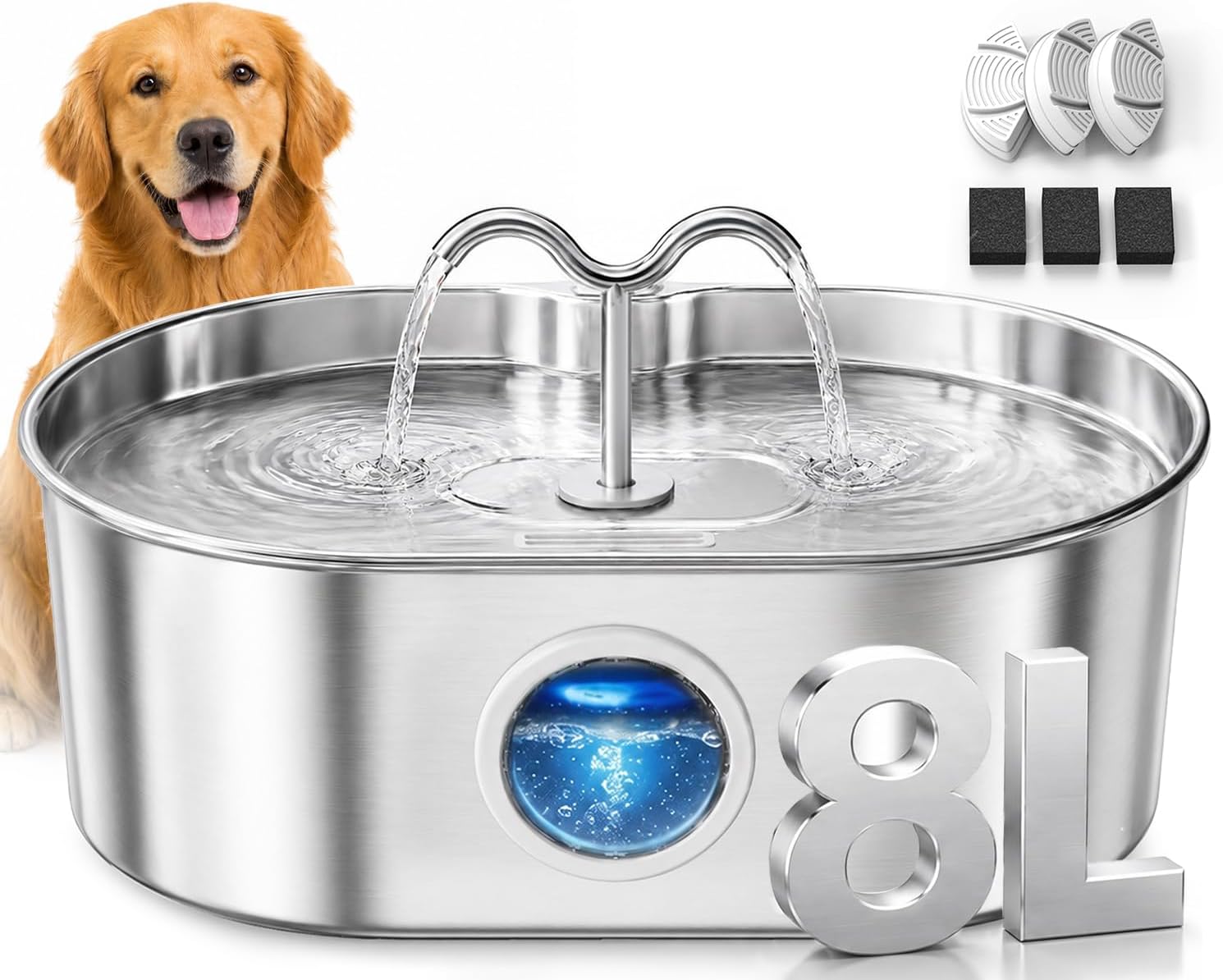
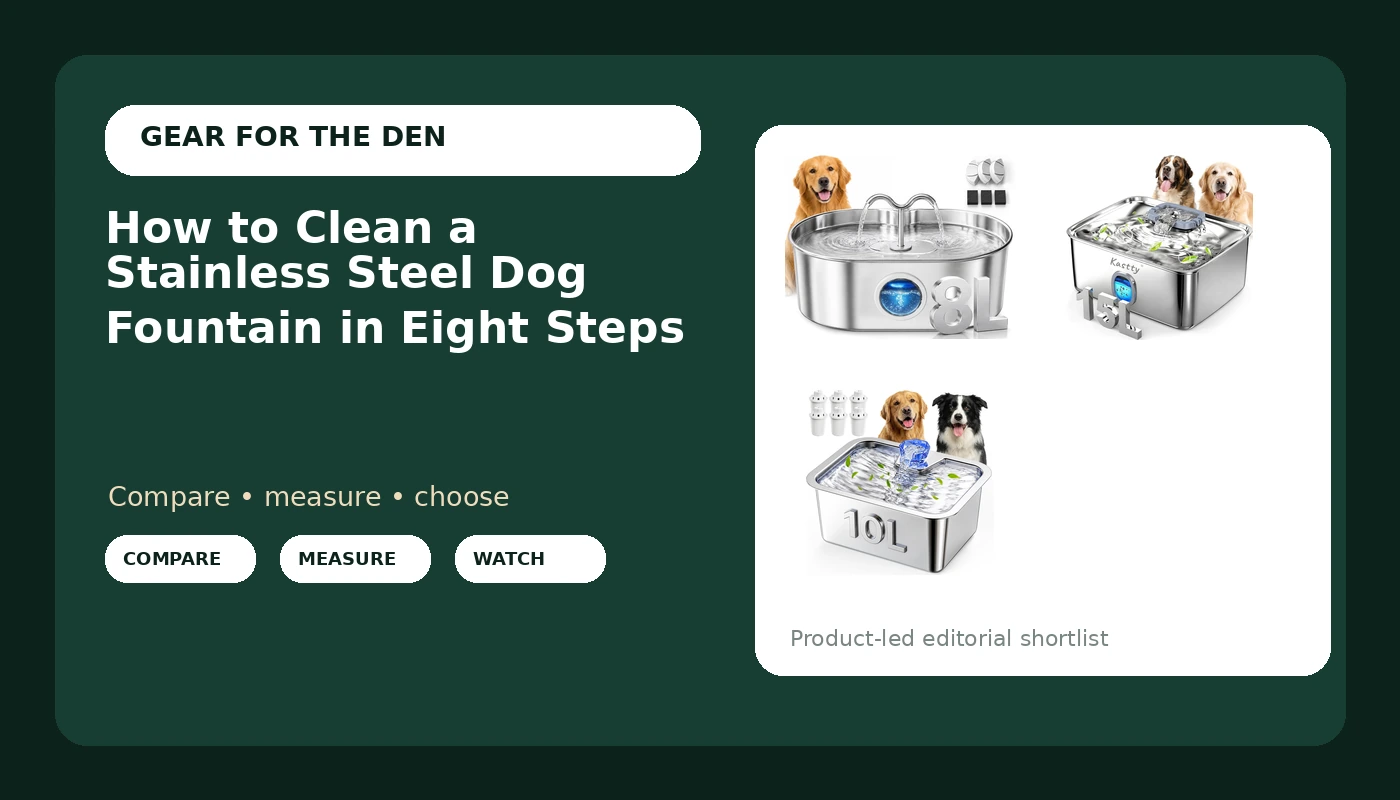
SohoTeco 8L/270oz/2Gallon Stainless Steel Dog Water Fountain Pet Fountain
The SohoTeco is the one I would hand to a first time fountain owner. Eight liters is enough water capacity for a two dog household to get through a day without a top off, and the stainless basin is the part that matters, because stainless does not scratch the way plastic does and scratches are where biofilm anchors.
Check current Amazon price and you will see it lands at the friendly end of this group. The basin mouth is wide enough to get a sponge into the corners, which sounds like a small thing until you have spent a season scrubbing a narrow necked fountain with a bottle brush. The pump lifts out of its well without tools, so the weekly teardown is a countertop job rather than a floor job.
Flaws but not dealbreakers: The basin is heavy when it is full, so drain it where it sits or carry it in two trips. And like every fountain here, the filter cartridge is the recurring cost, not the unit itself.
Anyone with one or two medium dogs who wants a fountain that cleans up in a single sink session should start here.
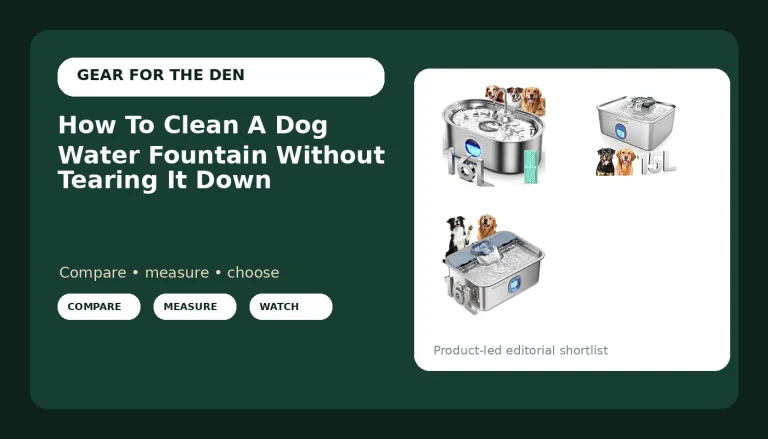
Best for large dogs: Kastty 4 Gal/15L Stainless Steel Dog Water Fountain for Large Dogs
Best for large dogs
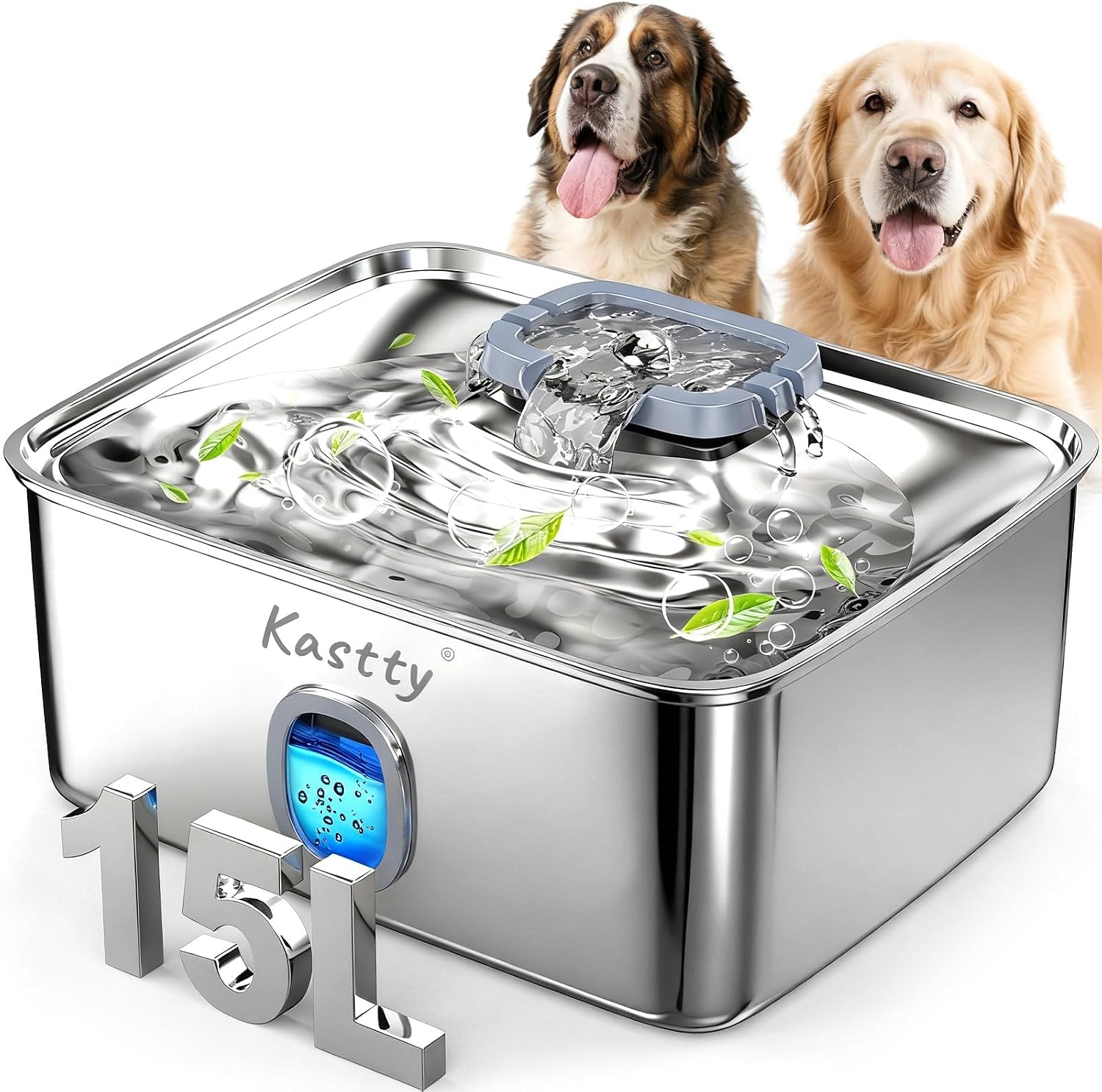
Kastty 4 Gal/15L Stainless Steel Dog Water Fountain for Large Dogs
Fifteen liters is a lot of water, and that is the point. A large dog drinks hard, and a fountain that runs low mid afternoon pulls air into the pump, which is the fastest way to burn one out. That water capacity means fewer refills and less chance of the pump running dry while you are at work.
More water also means more surface to scrub, so the trade is real. The basin is deep enough that you will want it at a comfortable feeding height while you work on it, which usually means the floor or a low bench rather than a countertop. Set it on a non slip base and it stays put when a big dog leans into it.
Check current Amazon price before you commit, because the filter cartridge and any pump replacement are what you live with long term.
Flaws but not dealbreakers: Fifteen liters is heavy when full. Drain it before you lift it, and do not carry it by the rim.
Anyone with a Great Dane, a Labrador, or a multi dog house where the bowl goes dry by lunch should look here first.
Best for multi-pet homes: 2.56Gal Large Dog Water Fountain Dispenser, 10L Stainless Steel Pet Fountain with 6 Filters, Corded Ultra Quiet Automatic Dog Water Bowl for Large and Multi-Pet Homes, 12 x 8.7 in Drinking Area
Best for multi-pet homes
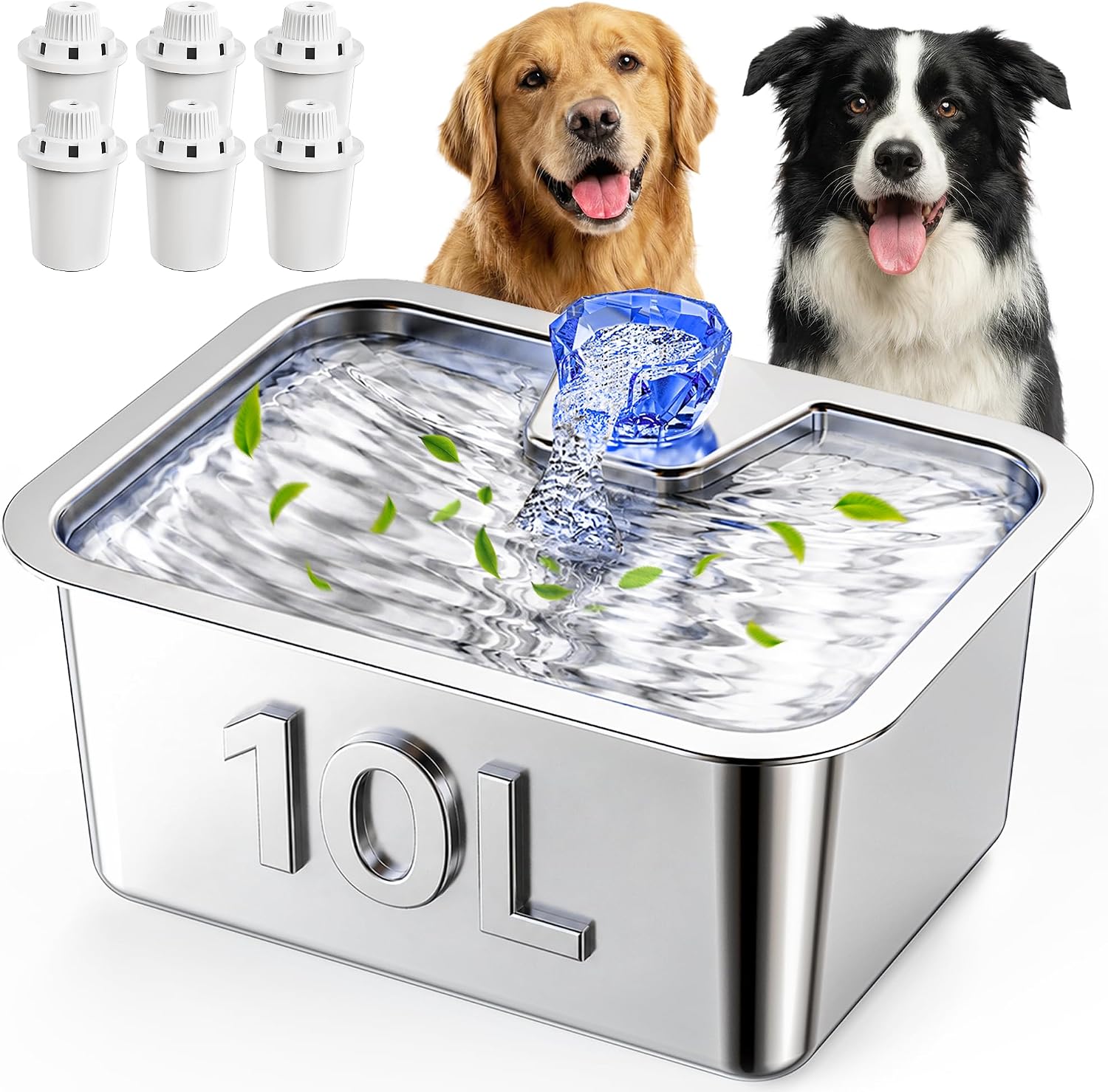
2.56Gal Large Dog Water Fountain Dispenser, 10L Stainless Steel Pet Fountain with 6 Filters, Corded Ultra Quiet Automatic Dog Water Bowl for Large and Multi-Pet Homes, 12 x 8.7 in Drinking Area
This one arrives with six filter cartridges, which matters more than it sounds. The most common reason a fountain gets cleaned less often is that the owner ran out of filters and decided to stretch the old one for another week. A box of six takes that excuse off the table for a few months.
The 12 by 8.7 inch drinking area is the other reason it works in a multi pet house. Two dogs and a cat can drink at once without shoulder checking each other, and a wider surface is easier to wipe down than a narrow spout. It is corded, so plan the outlet before you fill it, and it runs quiet enough that you will forget it is on.
Check current Amazon price for the current listing, and price the filters at the same time.
Flaws but not dealbreakers: Six filters means six filter changes, and each one is a chance to skip the pump. Do the pump every time you swap the cartridge.
Anyone with two or more animals sharing one water source will get the most use out of this one.
The actual cleaning workflow
Here is the routine, and it is also how to wash a stainless steel dog fountain from the lid down to the impeller. Do the deep version once a week and the rinse version every day.
Step one: Kill the power at the outlet before your hands go anywhere near the water, then lift the fountain off its base. If the base is a non slip base, peel it up from a corner rather than dragging the whole unit across the floor, because dragging is how you crack a pump housing. Carry the basin to the sink in two trips if it is full, and keep the cord somewhere it will not trail through the water.
Step two: Empty the reservoir into the sink, not into the dog bowl, and take the unit apart on a towel. Lift out the pump, the spout, the filter housing, and the lid. Put the small parts in a bowl of their own so nothing disappears down the drain, because gaskets and impellers are the two pieces you cannot replace at a hardware store.
Step three: This is the step most people skip when they clean a stainless steel dog fountain, and it is the one that matters. Pop the impeller cover off with a fingernail, pull the impeller out, and rinse both under warm water with a soft brush. Hair, grit, and biofilm collect right there. If the impeller feels gritty when you spin it, that grit is what makes the fountain noisy.
Step four: Wash the stainless basin with warm water, mild dish soap, and a soft sponge. Skip steel wool, abrasive powder, and bleach. Do not leave the basin soaking in vinegar overnight either, because acid left too long dulls the finish. A paste of baking soda and water lifts hard water rings without scratching, and it rinses clean in one pass.
Step five: The filter housing, the gaskets, and the seals get their own warm soapy bath with a bottle brush. Squeeze each gasket and look for cracks, because a cracked gasket kills the airtight seal and the fountain starts weeping at the seam. Check the small silicone pieces too, since they are the first parts to stretch out of shape.
Step six: Rinse every part twice under running water. Soap residue tastes like soap, and a dog will refuse water long before you figure out why the bowl is suddenly unpopular. Let the pump housing air dry while you wipe the basin. If the removable parts are dishwasher safe, the top rack handles the basin and the lid, but never put the pump through a dishwasher cycle.
Step seven: Seat the gaskets flat, drop the impeller back into its well, close the pump cover, and set a fresh filter cartridge in its slot. Swap the cartridge on the maker's schedule rather than waiting for the water to smell, and write the date on the box so you are not guessing next month. A stale cartridge is the most common cause of cloudy water.
Step eight: Fill with fresh water, plug the pump back in, and watch the first minute of flow. A weak stream or a rattle means the impeller is not seated all the way down. Then pick one day a week for the full teardown and treat it as part of the same chore as the floors. The daily job is only a rinse and a top off.
Once a month, run a descaling soak: one part white vinegar to three parts warm water in the basin for twenty minutes, then rinse hard. That handles the mineral film soap alone leaves behind.
The competition and why it lost
Plastic fountains lose on scratches. Every scratch becomes a place for biofilm to anchor, and after a few months of scrubbing you cannot get a plastic basin clean no matter how hard you try. Plastic also holds odor, which is the pond smell people blame on the water.
Ceramic fountains lose on weight and on chips. A chipped glaze is a rough edge, and rough edges in a water bowl are the same problem as scratches. Many ceramic basins are also not dishwasher safe, which means every single clean is a hand clean.
Gravity waterers and bottle style dispensers lose on the pump, which sounds like a win until you remember there is nothing moving the water. Standing water grows film faster, and a gravity jug has a narrow neck a sponge cannot reach, so you end up with the bottle brush routine you were trying to avoid in the first place.
A slow feed bowl with slow feed ridges is a different cleaning job entirely, and those ridges are exactly the kind of detail that traps kibble dust. That is a dry bowl problem, and it belongs in slow feed bowls for fast eaters, not in the fountain routine.
The bottom line: if you want to wash a stainless steel dog fountain without dread, buy a fountain whose parts come apart by hand and whose basin is stainless. Everything else is a design tax you pay every Sunday.
What this all costs
The fountain is the cheap part. The recurring cost is the filter cartridge, and the hidden cost is your time, which is why teardown design matters more than the price tag on the box.
Budget for a filter every two to four weeks per fountain, a bottle brush, a spare impeller if the maker sells one, and a bottle of white vinegar. Over a year, filters will cost more than the fountain did in most setups. Check current Amazon price on filters before you buy the fountain, not after, because a fountain with expensive or hard to find filters is a fountain that ends up in a cabinet.
The time math is simple. The daily rinse is under a minute. The weekly teardown is ten to fifteen minutes, and it drops to five once you know the order of operations. The monthly descale is twenty minutes of soaking you are not standing over.
If you are still deciding between a fountain and a plain bowl, the honest answer is that a plain stainless bowl is easier to clean and a fountain is easier to keep full. The fountain wins when the dog will not drink enough, and that is the only reason to take on a pump.
Cleaning a stainless steel dog fountain is not hard. It is a job that rewards buying the right unit once and then doing fifteen minutes of work on a schedule. Pick the fountain that comes apart, keep the filters in the house, and the pond smell never comes back.