Green spot algae on the front pane is not proof that your tank is dirty. It is proof that light, nutrients, and temperature have drifted out of balance, and the glass is simply where that imbalance shows up first. If you want to stop algae on aquarium glass for good, you have to fix the water behind the pane, not just the pane itself.
Most people attack the symptom. They buy a stronger scraper, scrub twice a day, and the green dots are back inside a week. The algae is not growing because the glass is dirty. It is growing because there is more light energy and more dissolved nutrient in the water than the plants in the tank can use, so every hard surface gets colonized by whatever eats the leftovers.
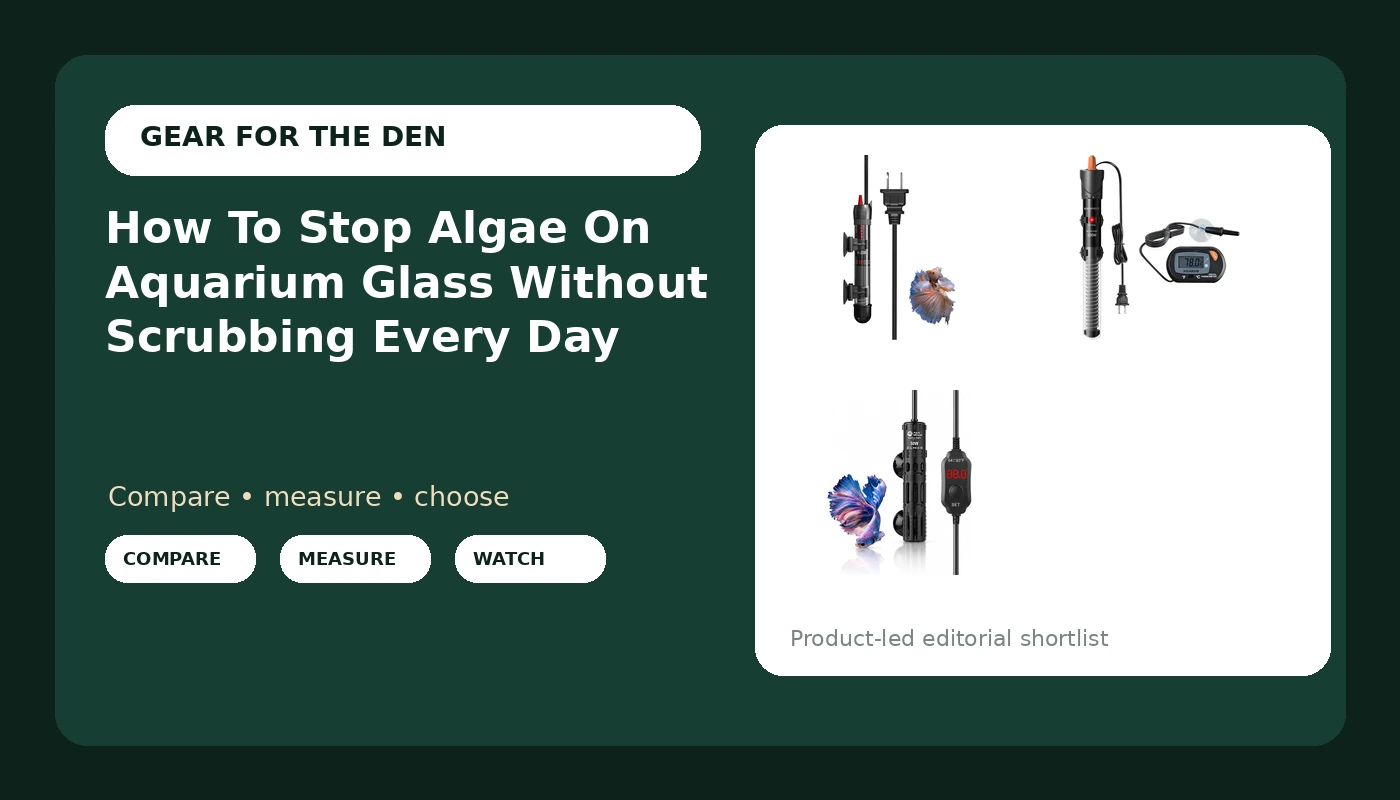
Temperature sits in that same equation and almost nobody connects it. A tank that swings four or five degrees between morning and night pushes fish metabolism up and down, stresses plants, and changes how much waste the system produces. That is why the gear in this guide is heaters. They are the cheapest way to remove one variable from a problem that has four. Below is what I use, followed by the eight-step routine I run on my own tanks.
Why you should trust me
I keep freshwater tanks, and I have spent more evenings than I want to admit scraping green spot off a pane that looked clean two days earlier. Everything in this guide comes from the maintenance routine that finally worked, the specs on each listing, and the patterns in what other keepers report about the same gear.
I do not sell anything here, I do not get paid to like a heater, and where a claim cannot be checked from the listing, I say so instead of guessing. The goal is a routine you can actually run every week, because the routine you skip is the one that stops working.
How I picked and how I tested
Aquarium heaters are a boring category, which is exactly why they are worth picking carefully. I scored the three units here on four things: whether the wattage matches the tank volume they are sold for, how wide the thermostat range is, what happens when the heater runs dry during a water change, and whether the mount keeps the unit off the substrate.
This is not a guide to how to stop algae on aquarium glass with a chemical. It is a guide to removing the variables that let algae win, and temperature stability is the variable most keepers skip. For the wider setup context, the freshwater aquarium setup checklist covers the rest of the tank.
Where a safety claim could not be verified without running a unit in a live tank, I say so and point you at what the listing shows. Read the buyer reviews on each page for your own tank volume before you order.
The gear that helps stop algae on aquarium glass
A heater does not eat algae. What it does is hold the thermostat range steady so the tank's biology runs at one speed instead of three. Stable temperature keeps fish from burning through oxygen and food at a variable rate, and it keeps plants growing steadily, which is what you want, because a growing plant is the best algae prevention you can put in a tank. Match the wattage to the tank volume, mount the unit where the flow rate carries heat through the tank, and check it against a thermometer once a month.
Budget pick: KINGYEENUO Aquarium Heater 50W, 20 Gallons Tank Submersible Aquarium Heater, Temperature Adjustable, Betta Turtle/Fish Tank Heater, Built-in Thermostat Control, with Extra Sucker Cup
Budget pick
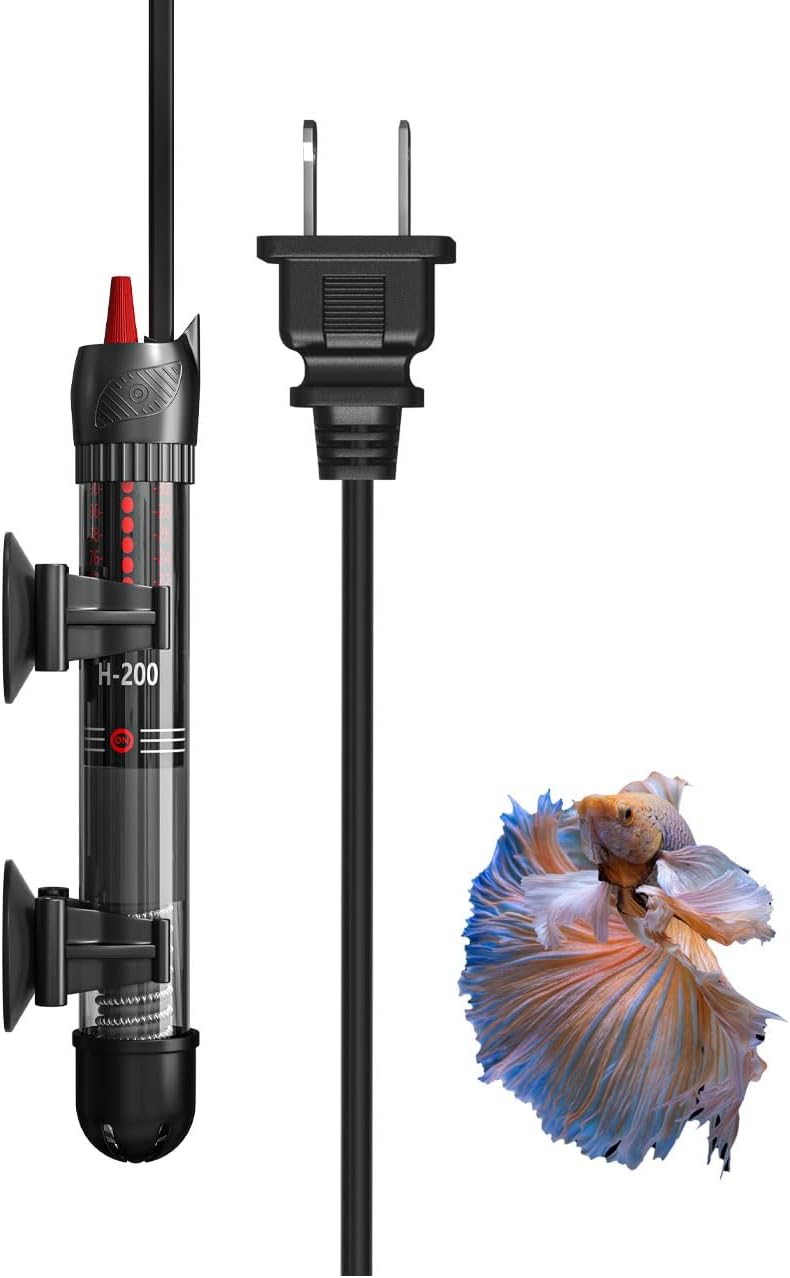
KINGYEENUO Aquarium Heater 50W, 20 Gallons Tank Submersible Aquarium Heater, Temperature Adjustable, Betta Turtle/Fish Tank Heater, Built-in Thermostat Control, with Extra Sucker Cup
Check current Amazon price.
This is the one I would hand to someone with a 20-gallon tank who wants the temperature question closed and does not want to think about it again. Fifty watts is the size sold for that tank volume, the thermostat control is built in and adjustable, and the extra sucker cup is a small thing that stops being small the first time a heater comes loose at 6 a.m. It is submersible, it is sold for betta and turtle setups as well as community fish, and it runs on the simple principle of set the dial and check the thermometer.
The honest limitation is that a fixed 50W unit does not scale. If you move up to a 40-gallon breeder or a 55-gallon, this heater becomes the backup, not the main unit. Buy it for the tank you have now.
Flaws but not dealbreakers: A dial thermostat is not a digital controller. You set it, then you verify with your own thermometer, and you re-verify when the seasons change and the room temperature moves.
Anyone with a single 20-gallon tank in a room that stays within a few degrees year round will be happy here.
Our pick: HiTauing Aquarium Heater 25W/50W/100W/200W/300W, Adjustable Knob Fish Tank Heater with Digital Thermometer, Submersible Betta/Turtle Tank Heater for Freshwater and Saltwater Tanks
Our pick
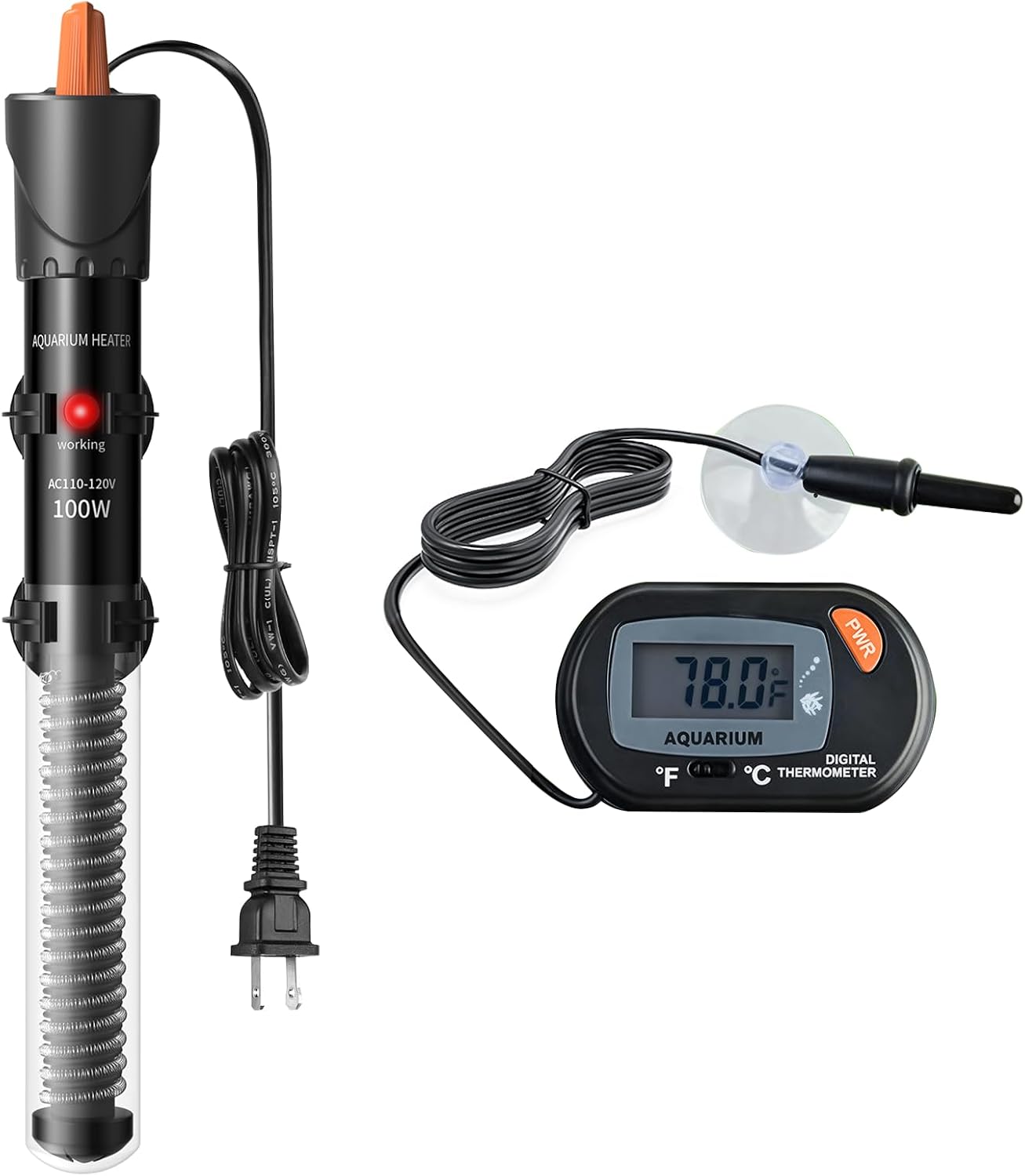
HiTauing Aquarium Heater 25W/50W/100W/200W/300W, Adjustable Knob Fish Tank Heater with Digital Thermometer, Submersible Betta/Turtle Tank Heater for Freshwater and Saltwater Tanks
Check current Amazon price.
This is the pick because it solves the sizing problem. The same heater is sold in 25W, 50W, 100W, 200W and 300W, so when you move from a 10-gallon quarantine tank to a 55-gallon community tank, you buy the same unit in a different wattage instead of learning a new product. The adjustable knob is the control, the digital thermometer in the box is what you use to confirm it, and it is rated for freshwater and saltwater, which matters if you keep a brackish or marine tank and do not want a second set of gear.
The wider wattage range also means you can size it to your room rather than to a sticker on the box. A cold basement needs more watts for the same tank volume than a warm apartment does.
Flaws but not dealbreakers: The knob is analog, so the markings are approximate. Trust the digital thermometer, not the dial.
Anyone running more than one tank, or planning to, gets the most value here.
Upgrade pick: AquaMiracle Aquarium Heater Dry-Run Auto Power-Off & Overheat Protection
Upgrade pick
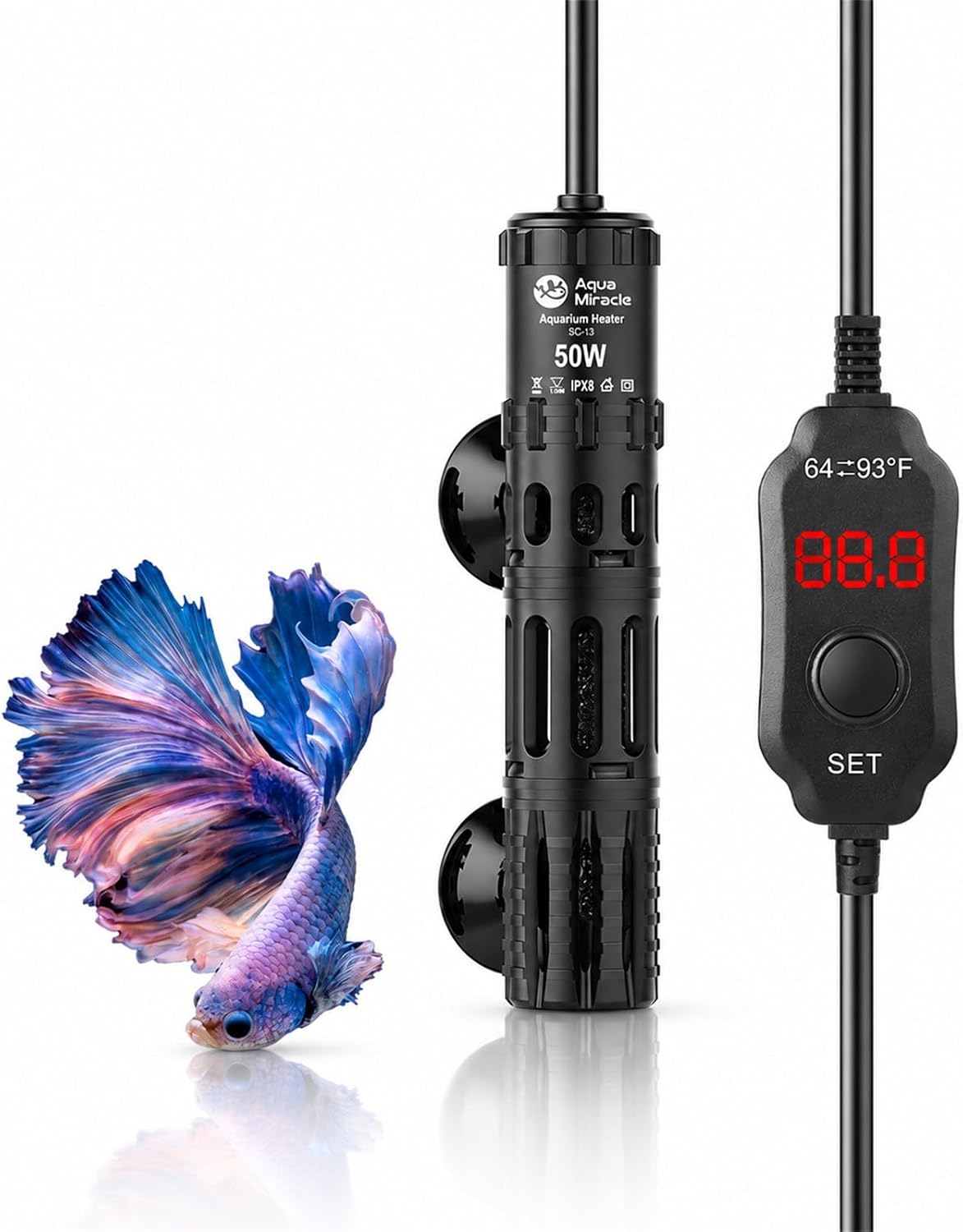
AquaMiracle Aquarium Heater Dry-Run Auto Power-Off & Overheat Protection
Check current Amazon price.
Dry-run auto power-off and overheat protection are the two features that make this the pick for tanks where the water level moves. If you are fighting algae, you are doing larger and more frequent water changes, and a heater that stays plugged in while the water line drops below it is the classic way to crack glass and cook a tank. The dry-run cutoff and the overheat protection are the whole reason to pay more for this unit than for the budget pick.
It is the heater I would put in a tank with a sump, an open-top rimless setup, or any system where the water level is not constant.
Flaws but not dealbreakers: Safety electronics do not make it a smart heater. It still needs to be matched to tank volume and checked against a thermometer.
Anyone with an open tank, a sump, or a habit of draining a third of the water without unplugging anything should look here first.
The actual eight-step routine
Now the part that actually clears the glass. This order matters: diagnose first, change one variable at a time, and keep the temperature stable while you do it.
Step one: Identify which algae you are fighting. Green spot algae is the hard, dotted film that clings to glass in bright tanks. Diatoms are the brown dust that shows up in new setups and usually fades on its own. Green water is free-floating and turns the whole tank into soup. Black beard algae arrives on plants and hardscape and points at flow problems. The fix is different for each, and scrubbing is the same for all of them, which is exactly why people convince themselves scrubbing is the answer.
Step two: Put the light on a timer. Six to eight hours a day is the starting point for a low-tech planted tank. If you have been running ten or twelve, cut it back an hour a week until you are at eight. For a plant-focused tank, a kelvin rating around 6500K is the usual target, and a light that reads much bluer or much redder is pushing growth you did not ask for. Move the tank out of direct sun if you can, because sunlight through a window does not respect your timer.
Step three: Cut the food before you cut the light further. Feed what the fish finish in about two minutes, once or twice a day, and net out anything that reaches the substrate. Every gram of food that is not eaten becomes nitrate and phosphate, and those are the two things the algae is actually eating. Fasting the tank one day a week is harmless for most adult fish and it does more for water quality than any bottle on the shelf.
Step four: Test before you change water. Test nitrate and phosphate with a liquid kit, write the numbers down, then do a 25 to 30 percent water change with a gravel vacuum. Repeat weekly and watch the trend. If nitrate stays high after a month of weekly changes, you are overstocked or overfeeding, and no amount of scrubbing fixes either one.
Step five: Fix the dead spots. Algae grows first where the flow rate is lowest, and on most tanks that is the front pane. You want the filter turning over the tank volume several times an hour, measured in gallons per hour, with the return aimed so water sweeps across the glass rather than straight down the back. If your filtration stage is a single sponge, adding a second stage or a small powerhead is often the difference between algae on the glass and algae nowhere.
Step six: Scrub, but do it right before the water change. Use a soft sponge on acrylic and a blade or pad on glass, work in overlapping passes, and stop before you feel grit dragging. Scrub ten minutes before you drain the tank so the loosened algae and the nutrients it holds get siphoned out instead of settling back onto the substrate and feeding the next bloom.
Step seven: Hold the temperature steady while you work. This is where the heaters earn their place. Match the wattage to the tank volume, set the thermostat range once, and check it against a thermometer monthly rather than trusting the dial. During big water changes, unplug the heater, or use a unit with dry-run protection, because a heater running in air is a broken heater. Every temperature swing is a stress event, and stressed plants lose the nutrient race to algae.
Step eight: Make the plants win, then repeat. Add fast-growing stems, keep the substrate grain in a range your plants can root into, and feed the roots rather than the water column. A tank with healthy plant mass outcompetes algae for the same nutrients. Once the glass is clear, the way to prevent algae on aquarium glass is boring: same light hours, same feeding, same weekly water change, same temperature. If you want to know how to prevent algae on aquarium glass after a vacation or a missed week, expect a bloom, and start again at step two.
The competition and why it lost
None of these products will stop algae on aquarium glass on its own, and that is the point. A UV sterilizer will clear green water and do nothing for the green spot film on your glass, because the algae that grows on a pane is not floating in the water column. An algae magnet is a tool, not a fix: it removes the evidence and leaves the cause. Algaecides kill algae in the tank and stress everything else in it, and the bloom usually comes back harder because the nutrients are still there. Phosphate removers work in specific tanks with specific problems and are the wrong first move for a beginner. A bigger filter does not fix an eight-hour light problem or an overfeeding problem.
On the heater side, an inline heater for a canister filter is a fine piece of gear and it belongs in a different guide, because it only makes sense if you are already running a canister. A standalone heater controller is a reasonable add-on for a large tank with expensive fish, but it is an extra box on the wall solving a problem the three heaters above already solve.
What this all costs
The three heaters here sit at the cheap end of the freshwater hobby, and each one is priced on its listing, where you can check current Amazon price before you commit. None of them is the expensive part of this fix. The expensive part is time, and it is not really expensive: a timer you probably already own, a liquid test kit, a sponge, and twenty minutes a week.
- The heater: a one-time purchase, and the smallest line item in the tank.
- The timer: the best money you will spend on algae control.
- The test kit: one-time, and it is what stops you from guessing.
- The scrubbing: free, weekly, and it stops being a chore once the cause is fixed.
Compare that to the alternative. A UV sterilizer, an algaecide, and a replacement plant order every few months cost more than the heater and the test kit together, and they do not prevent algae on aquarium glass. They just reset the clock. The routine is what holds.
Set the light, feed less, change water, keep the temperature steady, and the glass stays clear. Your tank was never dirty. It was out of balance, and balance is a weekly habit.