Walk into any pet store and the bedding aisle looks like a wall of identical paper shreds. If you want to know how to choose bedding for a rabbit, the decision comes down to four things: how much dust the bedding throws, how fast it pulls moisture off the surface, whether it is safe if your rabbit nibbles it, and how it holds up under a rabbit that uses one corner as a litter box. Everything else on the bag is packaging.
Most first-time owners pick by color, because the pastel paper blends photograph well. That is the wrong end of the decision. Your rabbit's nose, feet, and hocks are in contact with bedding more than with any other part of the setup, and a poor choice shows up as sneezing, damp fur, or a cage that smells sour by the second morning. If you are still assembling the habitat itself, my rabbit cage setup guide covers the frame. This article covers what goes inside it.
There is no single best bedding, only a best bedding for your cage size, your cleaning schedule, and your rabbit's habits. Below are the three bags worth buying, the reasons the usual chain-store options lose, and the eight-step routine that keeps a cage dry between full changes.
Why you should trust me
I have kept indoor rabbits for more than a decade, from a single dwarf in a corner pen to a bonded pair with the run of a living room. Before that I worked rescue intake, which meant morning bedding changes for a rotating cast of rabbits with respiratory issues, sore hocks, and litter habits nobody had ever taught them. That is where I learned that bedding dust is not an abstract concern and that a bag claiming to be dust-free still deserves a check in your own hand.
I do not run a lab. I run a cleaning routine, and I read labels the way a skeptic reads a warranty. My standard is simple: if bedding makes me cough when I pour it, or stays wet on the surface after a rabbit uses it, it does not go in my cage.
How I picked and how I tested
Every bedding I recommend here earned its place through the same three checks, and those checks are also how I choose bedding for a rabbit in general.
The dust check. I pour a cupful from waist height over a dark surface and watch what settles. Paper bedding should throw almost nothing. If a visible cloud hangs in the air, the bag is not dust-free no matter what the front panel says.
The moisture check. I pack a two-inch layer the way it would sit in a litter corner, pour water across it, and watch the surface. Good bedding wicks downward and leaves the top mostly dry. Bad bedding puddles, and a puddle is what your rabbit stands in overnight.
The safety check. Bedding is not food, but rabbits eat it anyway. Paper is the safest common material because a swallowed strand passes through. Clumping clay litters, cedar shavings, and anything with added fragrance do not belong in a rabbit cage.
Those checks are only part of the picture, because bedding does not exist in isolation. Cage size and floor area decide how deep you can layer it without burying the whole habitat. Hideout size decides where waste concentrates. A hay rack hung over the litter corner catches the stray hay that would otherwise mix into bedding and sour it. Bottle capacity and tunnel diameter matter the same way: a dripping bottle soaks a bedding corner regardless of bedding quality, and a tunnel sitting flush to the floor traps a wet ring underneath it.
Bar spacing deserves its own note. Wide bars plus lightweight paper means bedding ends up outside the cage, so the lighter the bedding, the more you want a solid base panel or a deep tray lip.
The shortlist: how to choose bedding for a rabbit
Three bags cover almost every rabbit setup. I list them by role: the budget option for small pens, the pick most owners should buy, and the upgrade for large cages and heavy use.
Budget pick: Hamster Bedding 15L, Truly 99% Dust-Free Small Animal Paper Bedding Odor Control, Cozy Hamster Litter for Rabbit Rat Syrian Dwarf Hamsters Gerbils (Cotton Candy)
Budget pick
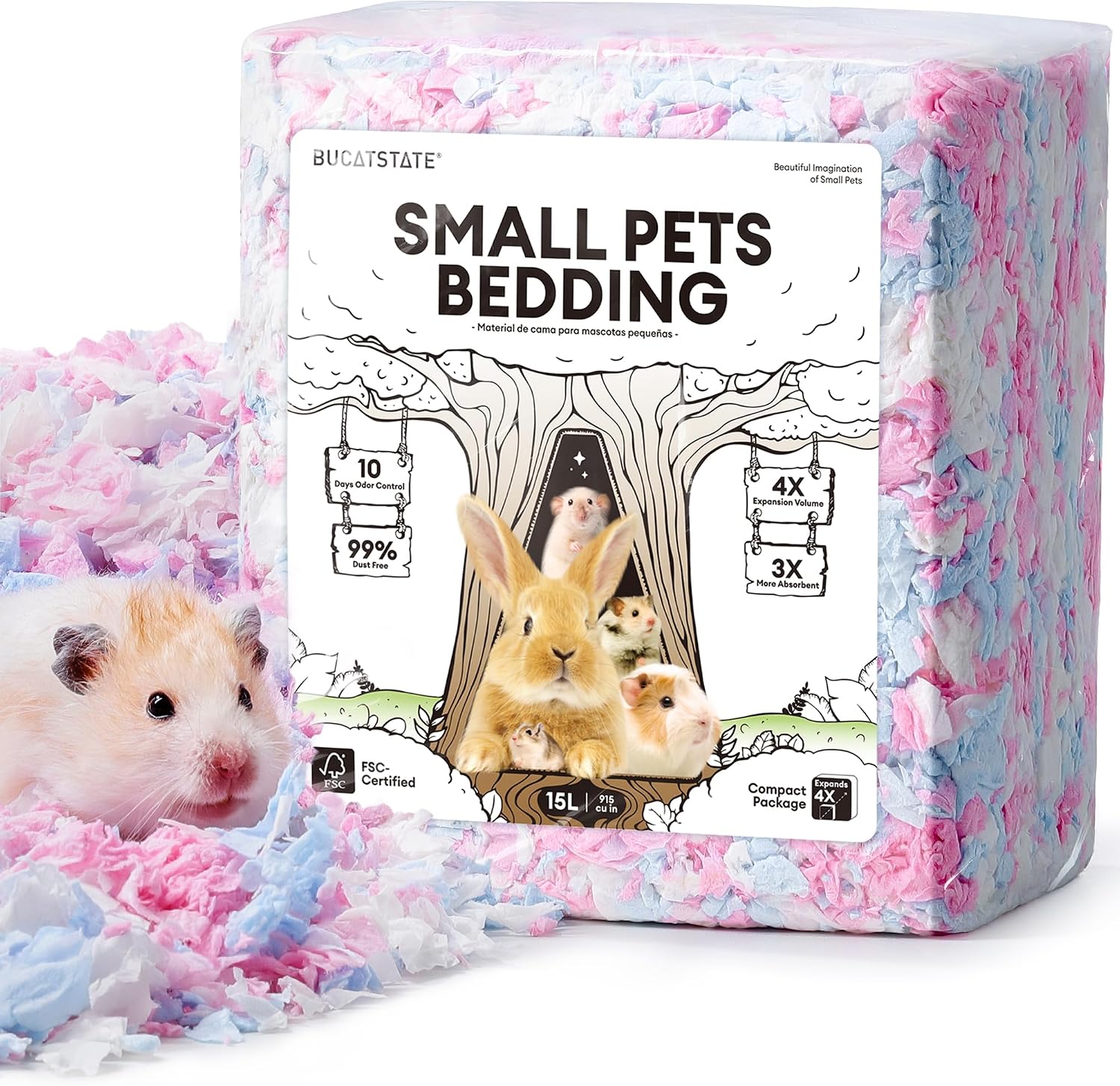
Hamster Bedding 15L, Truly 99% Dust-Free Small Animal Paper Bedding Odor Control, Cozy Hamster Litter for Rabbit Rat Syrian Dwarf Hamsters Gerbils (Cotton Candy)
This is the bag I point people to when they are setting up a small pen for one rabbit and do not want to commit to a 60-liter sack. The paper is fine-cut and soft, and the dust claim holds up reasonably well when you pour it slowly. Odor control is the other selling point, and paper bedding genuinely does better than wood shavings at keeping a litter corner from smelling of ammonia by day three.
Volume is the limitation, not the material. Fifteen liters covers a small cage or a single litter pan at a two-inch depth and nothing more. If your rabbit has free roam or a large floor area, you will be reordering constantly. The Cotton Candy color is cosmetic, and if your rabbit chews and swallows bedding, added dye is the one detail I would think twice about. Check current Amazon price before you compare it against the larger bags below.
Flaws but not dealbreakers: Small bag, so the cost per change climbs in a big cage.
Anyone with a single rabbit in a compact pen, or a new owner who wants to test whether paper bedding works before buying in bulk, will be happy here.
Our pick: Oxbow Small Animal Bedding, Hamster, Guinea Pig, Rabbit, White, USA, 36 L
Our pick
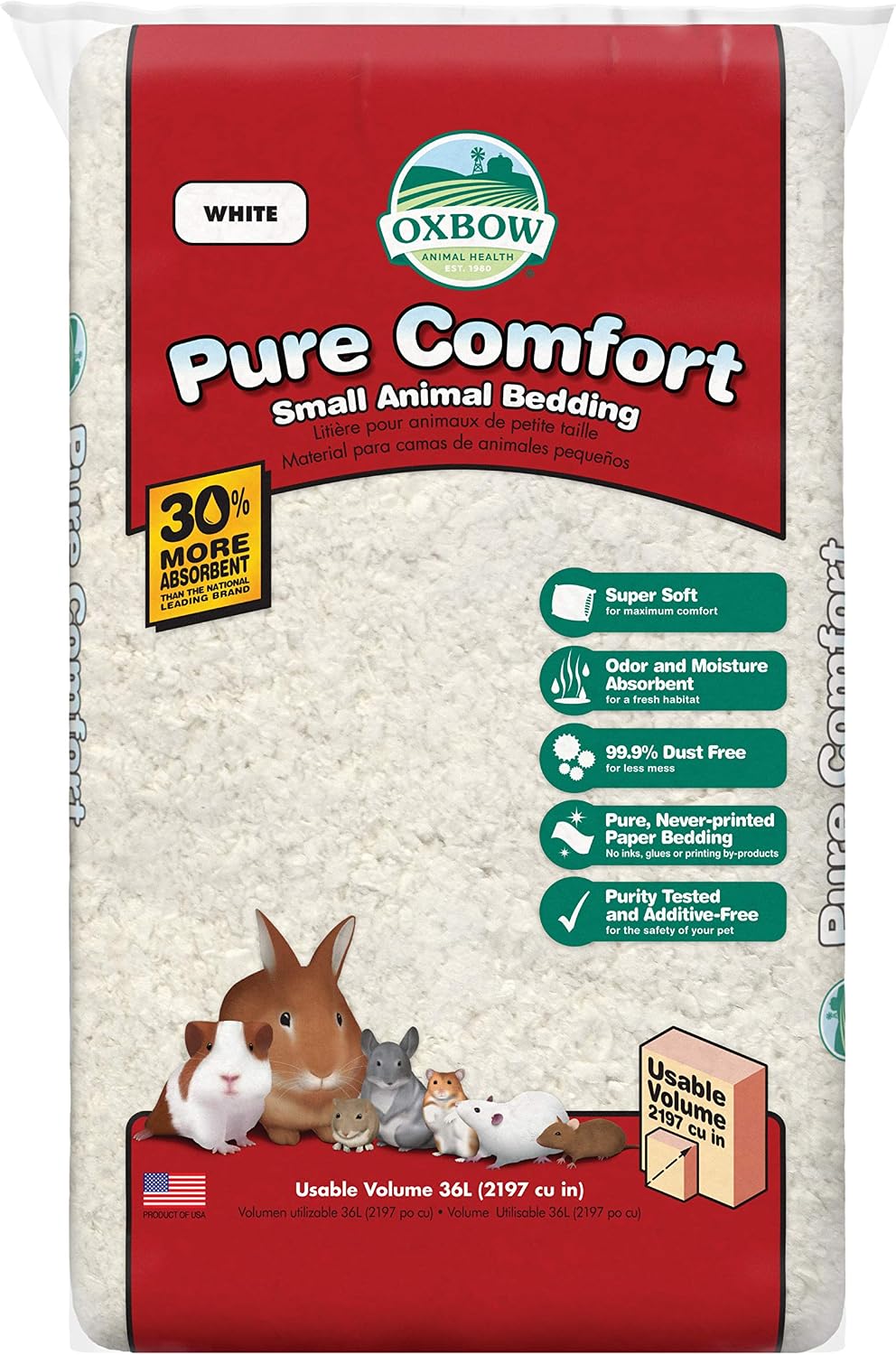
Oxbow Small Animal Bedding, Hamster, Guinea Pig, Rabbit, White, USA, 36 L
Oxbow is the name most rabbit owners already trust, and this bag is why. Thirty-six liters of plain white paper bedding, no dye, no fragrance, made in the USA. It sits between the small budget bag and the bulk bale, and for most single-rabbit and bonded-pair setups it is the only bag you need.
Three things make it the pick. First, no added color, which removes one worry for rabbits that chew. Second, the cut is short and consistent, so it packs into a litter corner without turning into a cloud. Third, the volume suits a standard cage: at a two-inch depth across a typical floor area, one bag handles several full changes with some left for spot cleaning.
It is not the cheapest per liter and not the softest. The shorter cut means less fluff under a rabbit that likes to nest, and the white shows soil faster than a darker blend, which some owners dislike and I consider a feature, because you see exactly what needs cleaning. Check current Amazon price, since the per-liter math shifts with whatever else is on sale.
Flaws but not dealbreakers: Not the softest for nesting, and the plain white looks dirty quickly.
Anyone with one or two rabbits in a standard cage who wants a safe, unscented paper bedding with no guesswork should buy this.
Upgrade pick: Niteangel Aspen Shaving Hamster Beddings for Syrian Dwarf Hamster Gerbil Mice Degu Rat Rabbit Bunny Guinea Pig Chinchilla Hedgehog or Other Small Pets (65L – White Paper Bedding)
Upgrade pick
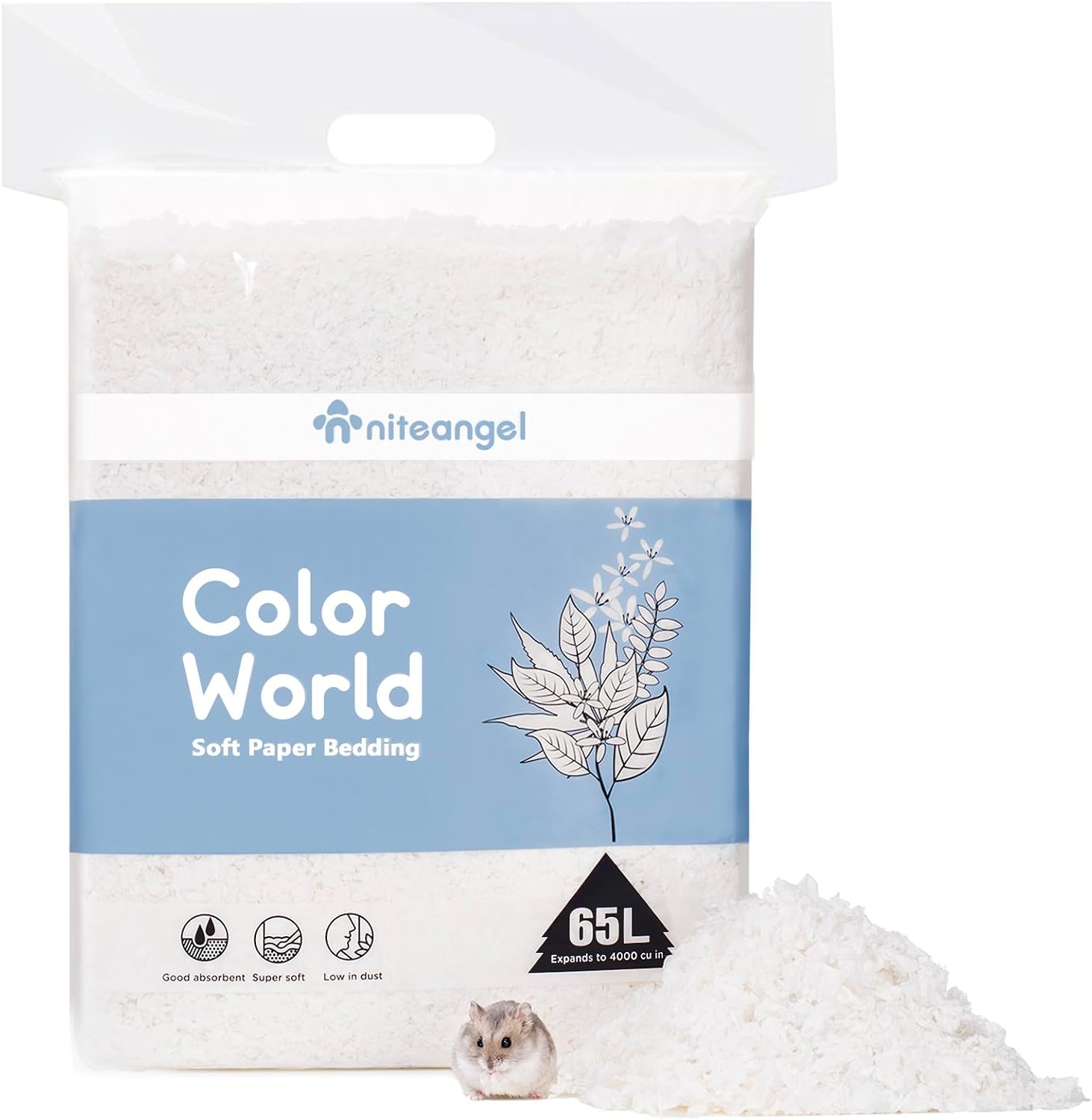
Niteangel Aspen Shaving Hamster Beddings for Syrian Dwarf Hamster Gerbil Mice Degu Rat Rabbit Bunny Guinea Pig Chinchilla Hedgehog or Other Small Pets (65L – White Paper Bedding)
The name says aspen and the bag says white paper, which tells you how this listing is built: one bedding line marketed across a long list of small pets, with variants labeled by volume. Buy the paper variant and you get a 65-liter bale, the largest bag here and the one that makes sense if you are changing a big cage twice a week.
The appeal is volume and consistency. Paper at this quantity lets you lay a deeper layer, and depth is what actually keeps a rabbit's feet dry: it gives moisture somewhere to go, while shallow bedding is why so many cages smell. With a large floor area or a bonded pair, the deeper layer is not a luxury. It is the difference between a full change every three days and every five.
Two honest caveats. A 65-liter bag takes real storage space, so measure your shelf before it arrives. And the aspen-versus-paper naming is confusing enough that you should confirm you are buying the paper variant before checkout. Check current Amazon price to see how it lands against two smaller bags.
Flaws but not dealbreakers: Bulky to store, and the multi-species listing makes the variant easy to mix up.
Anyone with a large cage, a pair of rabbits, or a cleaning schedule that eats through bedding should go straight here.
The actual bedding workflow
Here is the routine, start to finish. It takes about fifteen minutes the first time and five minutes a day after that.
Step one: Measure the floor area. Take the inside dimensions of the cage or pen in inches and multiply them. That number is your bedding budget: it decides how much you pour per change, how often you reorder, and whether a 15-liter bag is a bargain or a false economy. While you are measuring, note the bar spacing and the tray lip. Wide bar spacing with a shallow lip means lightweight bedding ends up on the carpet, and no bedding is cheap if half of it goes in the vacuum.
Step two: Decide your depth. Two inches across the floor area is the working depth for most rabbits, with three to four inches packed into the litter corner where the moisture actually lands. Depth is the single variable that decides whether the surface stays dry. Shallow bedding lets urine spread sideways across the floor; deep bedding gives it somewhere to drain. Rabbits under four pounds can vanish in four inches of fluff, so scale depth to the animal, not to the bag.
Step three: Pick the material. Paper is the default for indoor rabbits: soft, absorbent, and safe if a curious rabbit swallows a strand. Aspen is the only wood shaving I would consider, and only if your rabbit leaves bedding alone. Cedar is out. Pine is out. Anything fragranced, dyed for scent, or sold as clumping is out. If you are working out how to pick bedding for a rabbit with a history of respiratory trouble, low-dust paper is the safer starting point.
Step four: Check the dust. Pour a cupful from waist height over a dark table, or over the cage floor if you already opened the bag. If a visible cloud hangs in the air, send it back. This is the fastest way to pick bedding for a rabbit that sneezes, and it takes ten seconds. Retailers take bedding returns more often than people assume, but it is easier to check before you slit the bag wide.
Step five: Set the litter corner first. Rabbits choose a corner, usually the one farthest from the hideout and nearest a wall. Put a shallow pan there, add bedding, and drop a handful of soiled bedding into it for the first week so the scent marks the spot. A reliably litter-trained rabbit is the difference between a weekly full change and a daily scramble.
Step six: Layer around the furniture. Set the hideout size you have on the cage floor, then bed around it rather than under it. A hideout pressed into bedding sinks and traps moisture beneath it. Hang the hay rack above the litter corner so dropped hay lands in the pan instead of scattering across the floor area, where it mixes into clean bedding and shortens its useful life.
Step seven: Manage water and tunnels. A bottle with a worn valve drips, and one drip above a bedding corner means a wet patch by morning. Match bottle capacity to how long you are away, and test the valve with a fingertip before you leave. A tunnel that sits flush against the floor traps a ring of damp bedding underneath, so lift it a quarter inch or rotate it during spot cleaning.
Step eight: Spot clean daily, change fully on a schedule. Scoop the litter corner every morning and stir the remaining bedding so the top layer dries. Do a full change when the bedding no longer springs back under your hand. For one rabbit that is usually four to seven days; for a bonded pair, or in humid weather, it can be three. Press a palmful in the middle of the cage to check. If it stays compressed, the bedding is finished.
The competition and why it lost
Several beddings that turn up in every rabbit group did not make the list.
Cedar and pine shavings are the classic mistake. Aromatic softwoods are the last thing you want next to a rabbit's nose, and the dust profile is worse than any paper bag here. Cedar is out entirely, and pine is only arguable when it is kiln-dried, which is why aspen is the one wood I name.
Clumping clay cat litter is fine in a cat box and dangerous in a rabbit cage. The clumps harden into solid masses that can block a rabbit's gut if swallowed, and rabbits nibble everything.
Corn cob bedding absorbs well and grows mold fast in a humid room, and rabbits eat it. It solves one problem and creates two.
Fragranced paper blends lose for the same reason as cedar: whatever makes the bag smell like a meadow is an irritant sitting inches from your rabbit's face.
Fleece liners deserve an honest mention. They are excellent for a litter-trained rabbit in a large pen, and I use them in one setup, but they are not loose bedding. They need daily sweeping, a spare set, and a washing routine, which is a different article and a different budget.
What this all costs
Bedding is one of the few recurring costs in rabbit care, so give it a real line in the budget instead of a shrug at the register.
Think in liters per change, not price per bag. A two-inch layer across a 24-by-24 pen eats roughly 10 to 15 liters per full change. That means the 15-liter bag covers about one change in a compact cage, the 36-liter bag covers two or three, and the 65-liter bale covers four or more. If you change bedding weekly, the bigger bag wins on math almost every time, provided you have somewhere to store it.
The cheap bedding trap is real. A bag that undercuts the others but throws dust and stays damp will cost you in extra changes, in cleaning time, and possibly in a vet visit for a respiratory flare. What you pay for here is dust control and depth, not decoration.
None of the three bags is expensive in absolute terms, and all three go further than a bag of shavings of the same volume, because paper compresses and wicks differently. Check current Amazon price on each before you commit, since bedding pricing swings with the season and with whatever multi-bag deal is running.
Keep a spare bag in the closet. Running out on a Sunday night means a cage with no bedding, and that is the moment people reach for cedar shavings, which is the one choice this whole article is trying to talk you out of.