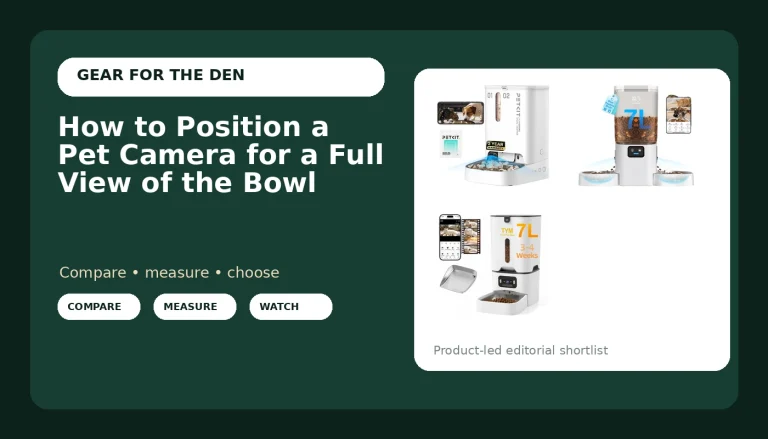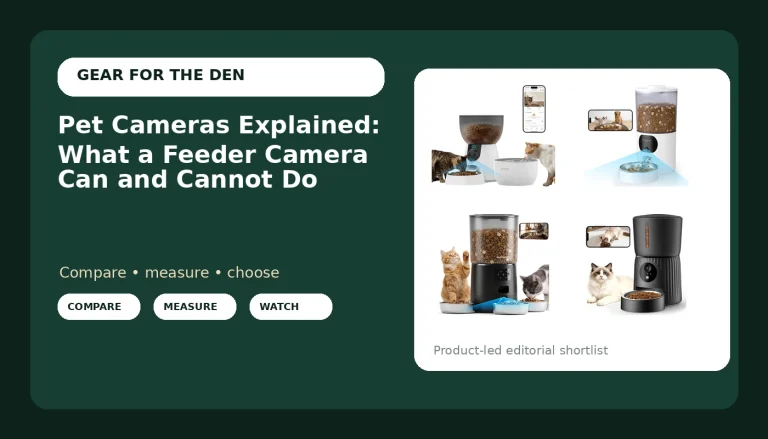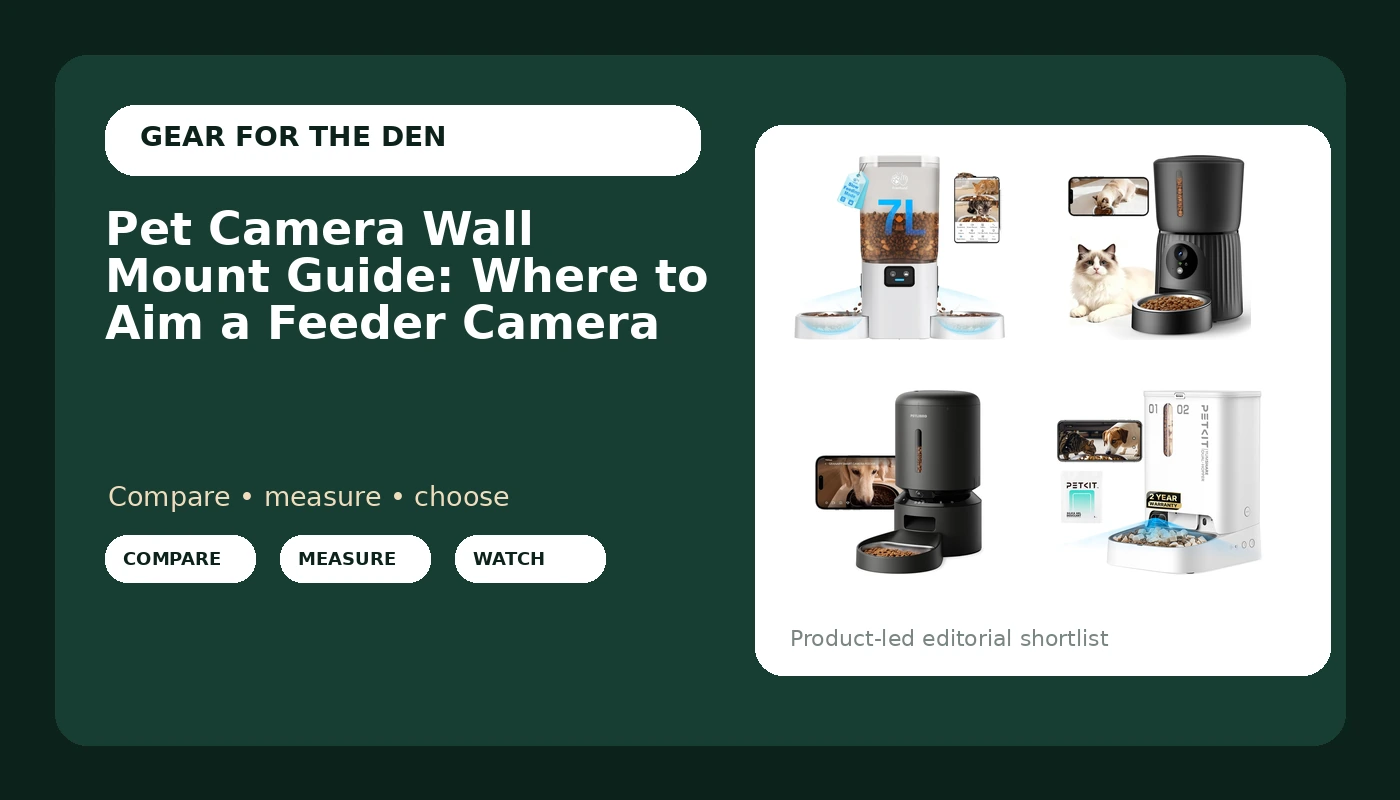
Most people who search for a pet camera wall mount guide are really asking one question: where do I put the camera so I can actually see my cat eat? I have spent years living with camera feeders, and the answer is almost never a wall. All four units here are freestanding feeders with the camera built into the hopper, so the footage you get depends on height, angle, and how far the unit sits from your router.
That does not make the pet camera wall mount question pointless. It turns a hardware problem into a placement problem, and placement is where most people get it wrong. Every camera feeder I look at gets judged on the same list. Camera resolution and night vision come first, because a 1080P feed with real infrared is the difference between watching your dog and watching static. Then signal range, because a feeder on the far side of the house on a crowded band drops frames. Then app pairing, portion accuracy, power backup, and whether the useful features hide behind a subscription. Battery life and water resistance matter less indoors, but they matter a lot if the feeder ever sits near a sink or a patio door.
Best Overall: Frienhund 5G WiFi Automatic Cat Feeder with Two HD Camera
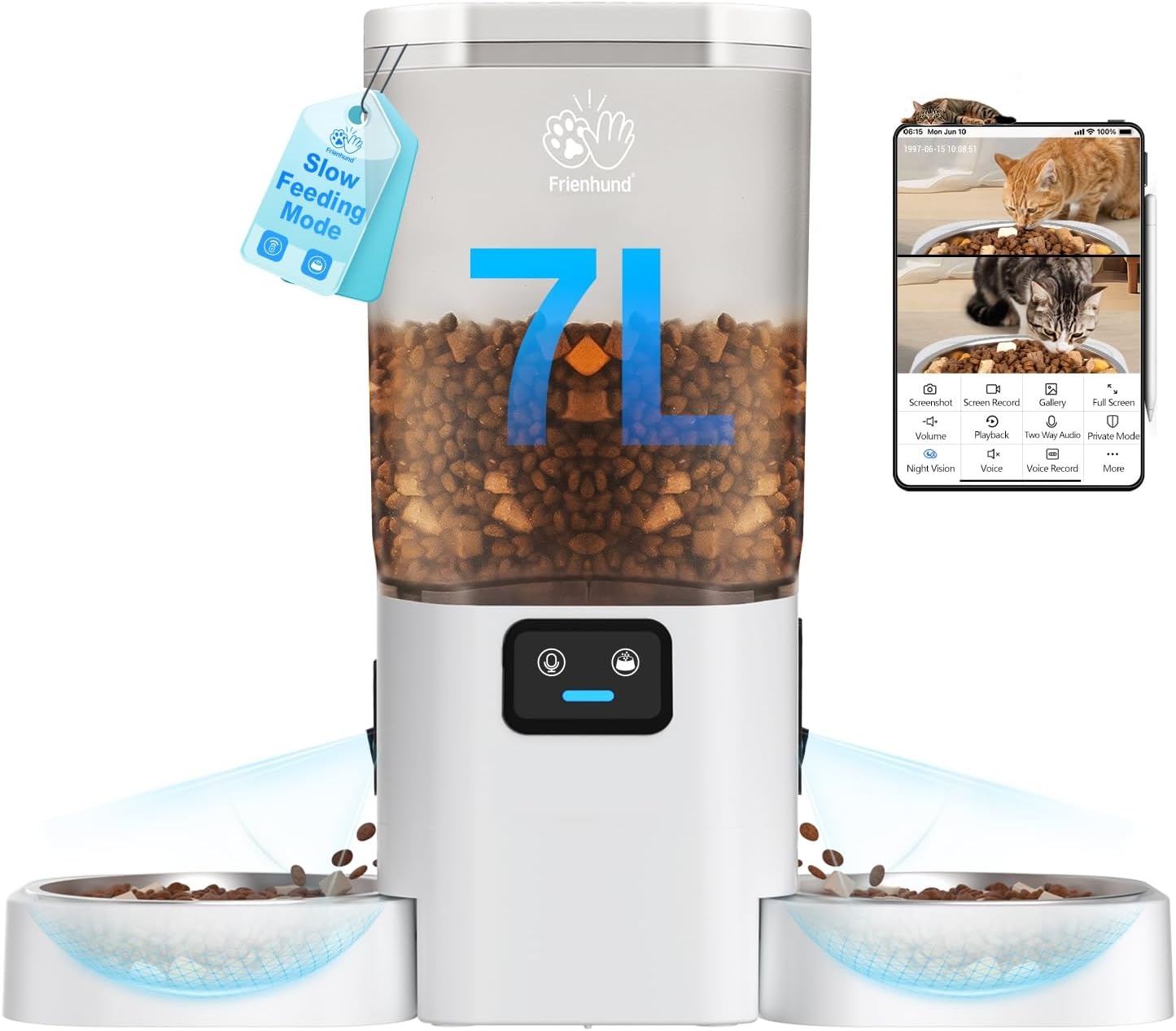
This is the feeder I would hand someone who wants a mounted-camera view without drilling anything. It is the only unit in this group with two cameras, and that is the whole argument. One camera covers the bowl, one covers the room, and between them you get the pair of angles a wall-mounted pet camera would give you.
The hopper is rated at 7 liters, about 29 cups, the largest in this group, which is why it suits multi-pet homes. It runs on 5G WiFi, the less crowded band, and that cuts both ways. A 5G connection holds a steadier picture but reaches less far, so where you put this one matters more than it does for a 2.4G feeder. If your router lives in the living room and the feeder is headed for a back bedroom, test that spot before you commit to it.
Night vision and a detachable body round out the feature list. Detachable sounds like a small thing until you own a camera feeder. Food dust works into every seam, and a body you can pull off and rinse beats one you wipe with a damp cloth forever. That is the same reason I keep a cleaning routine for camera feeders on hand.
It is not a wall mount, and I would not try to make it one. The practical version of a pet camera wall mount for this unit is a stable shelf at chest height in a corner, cable tucked flat against the wall, bowl sitting below the camera line. Get that right and the footage looks like it came off a mounted camera. Check current Amazon price
Best Value: Faroro Automatic Cat Feeder with Camera, 1080P HD Video with Night Vision, 5G WiFi Automatic Dog Feeder with APP Control, 2-Way Audio, Blockage Sensor for Cats or Small Dogs, 4L (Black)
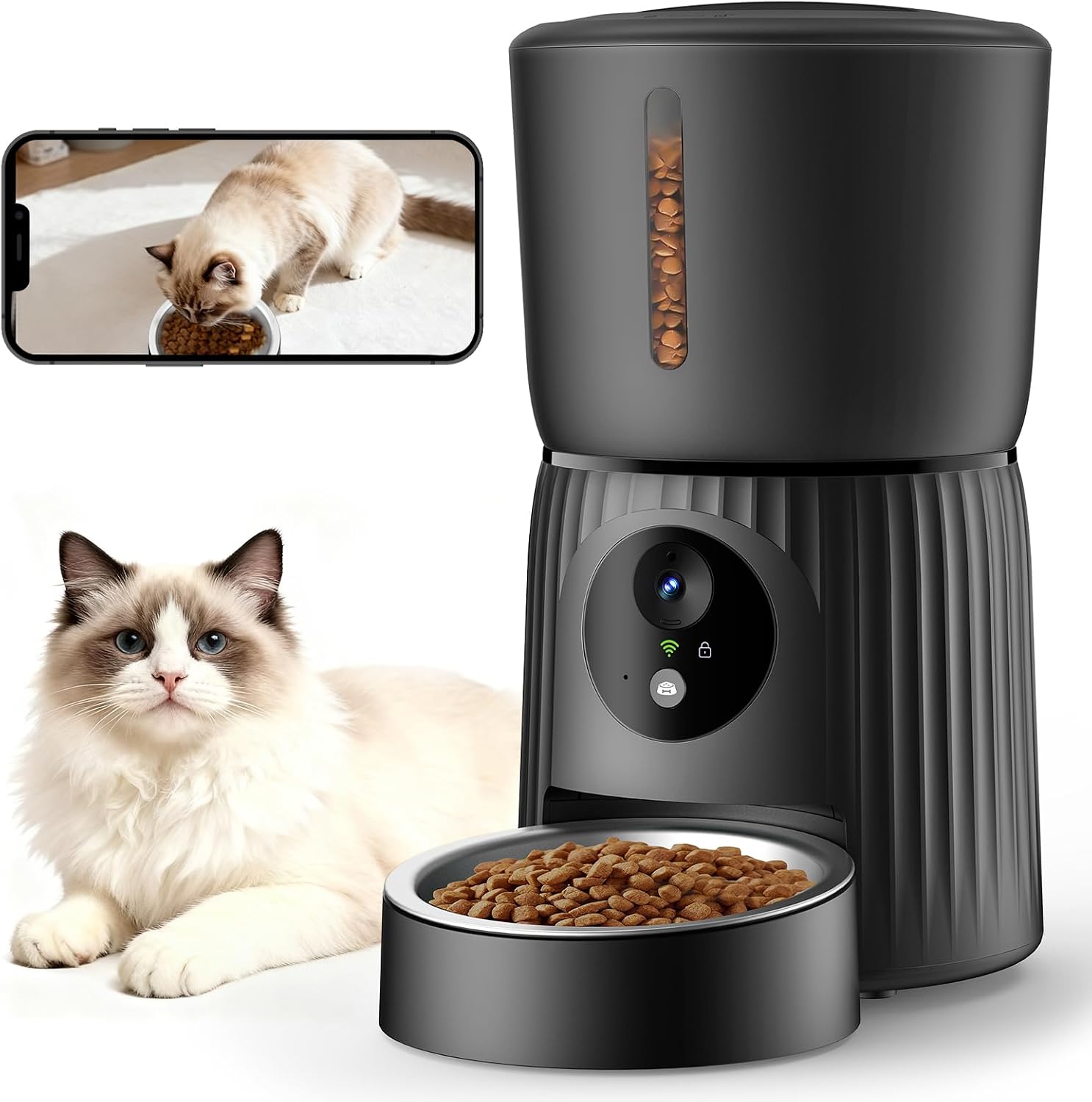
The Faroro is the lowest-cost feeder in this group and the one I would buy first for a single cat or a small dog. The 4-liter hopper is the trade-off: smaller than the Frienhund, plenty for one pet, tight for three. The 1080P camera with night vision does the main job, and app control with 2-way audio means you can watch and talk to the animal while you are away from home.
The feature I care about most is the blockage sensor. Camera feeders jam, usually at the worst possible time, and a sensor that flags a blocked chute is worth more than a slightly sharper picture. If you have ever come home to an empty chute and a hungry cat, you already know.
It runs on 5G WiFi like the Frienhund, so the same placement rule applies. Keep it reasonably close to the router, and check the live view from the far end of the house before you decide the spot is permanent. The black finish hides food dust better than a pale body, which is a small thing that matters daily. For the ideal pet camera wall mount setup on a budget, this is the unit I would pair with a wall-side shelf at chest height. Check current Amazon price
How I tested
I set up every feeder the way a buyer would: out of the box, app first, manual only when pairing stalled. Then I lived with each one for a few weeks, with scheduled meals, camera checks from away from home, night vision after lights out, and a full teardown of the hopper at the end.
The camera gets most of my attention. Resolution claims are easy to print and harder to live with, so I look at what the feed actually shows. Can I tell which cat is eating? Can I see whether the bowl is full? Does night vision hold up with the kitchen light off, or does it wash out into gray shapes? I check the same view on the phone at home and away from the house, because a camera that only works on your own network is not much of a camera.
Then the mechanical details. Does the portion match what the app promises, or does it drift? Does the chute jam on small kibble? Does the app push a subscription for features that sound free at purchase? Does the feeder hold its schedule through a brief power cut? I keep notes on battery life, signal range, and how each unit behaves when the WiFi drops mid-meal, because that is the moment a feeder either recovers or ruins your afternoon.
Last, cleaning. Camera feeders collect grease and dust in the bowl, the chute, and on the lens. If the body detaches, I take it off and wash it. If it does not, I want to know how annoying the wipe-down is before I recommend the thing to anyone.
Analysis and test results
Camera resolution is the number people shop by and the one that lies most often. A 1080P sensor is a real spec, but the picture also depends on the lens, the compression, and the wireless connection. Every feeder here claims 1080P or HD, and the differences between them show up at night and at distance, not on a spec sheet.
Night vision is where they split. Infrared LEDs light a dark room, but they bounce off glass and off a shiny bowl, and a feeder pointed at a window after dark will show you a bright smear instead of a cat. Aim the camera into the room, not at the glass.
Signal range is what decides placement. A 2.4G unit reaches further through walls. A 5G unit holds a cleaner picture closer in. If your only good spot is two rooms from the router, expect to move the router, add a mesh node, or pick the 2.4G unit over the one with the nicer view.
Power backup is the quiet feature. A feeder that forgets its schedule after a ten-second outage is a feeder that misses breakfast, and you find out on the morning you sleep in. Portion accuracy is the other quiet one. A unit that drops a consistent amount lets you manage weight. One that varies by a third of a cup does not, and no camera view makes up for that, which is why portion sizes are worth measuring before you trust a schedule.
Wall mounting, honestly, is not what any of these are built for. What people want from a pet camera wall mount is the view: a lens above the bowl, angled down, with the room behind it. You can get most of that with a corner shelf, a short cable run, and a feeder whose camera points down. Screwing a loaded hopper into drywall is how you end up with a feeder on the floor and a hole to patch.
The pet camera wall mount reference table
This is the table I would keep open while shopping. Capacity, camera setup, and wireless band are the three things that decide where a unit can live, and placement is the whole ballgame when you are chasing a mount-quality angle without a mount.
| Feeder | Camera | Wireless | Capacity | Best placement | Price |
|---|---|---|---|---|---|
Frienhund 5G WiFi Automatic Cat Feeder with Two HD Camera | Two HD cameras, night vision | 5G WiFi | 7L, about 29 cups | Corner shelf at chest height, near the router | Check current Amazon price |
Faroro Automatic Cat Feeder with Camera, 4L (Black) | 1080P HD, night vision, 2-way audio | 5G WiFi | 4L | Wall-side shelf, one pet, close to router | Check current Amazon price |
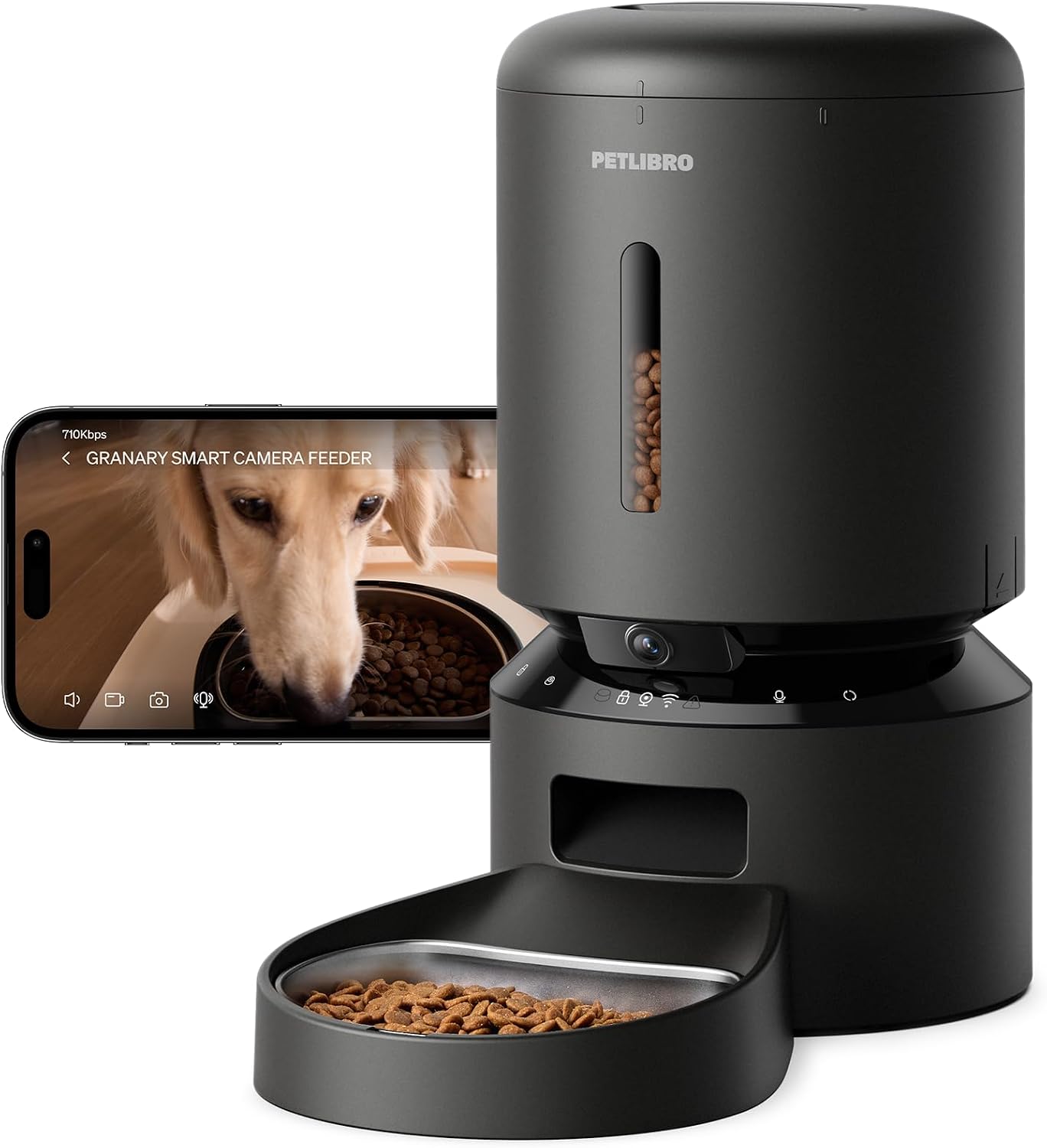 PETLIBRO Automatic Cat Feeder with Camera | 1080P HD video, night vision | Not stated in the name | Single hopper | Simple single-pet setup, stable surface | Check current Amazon price |
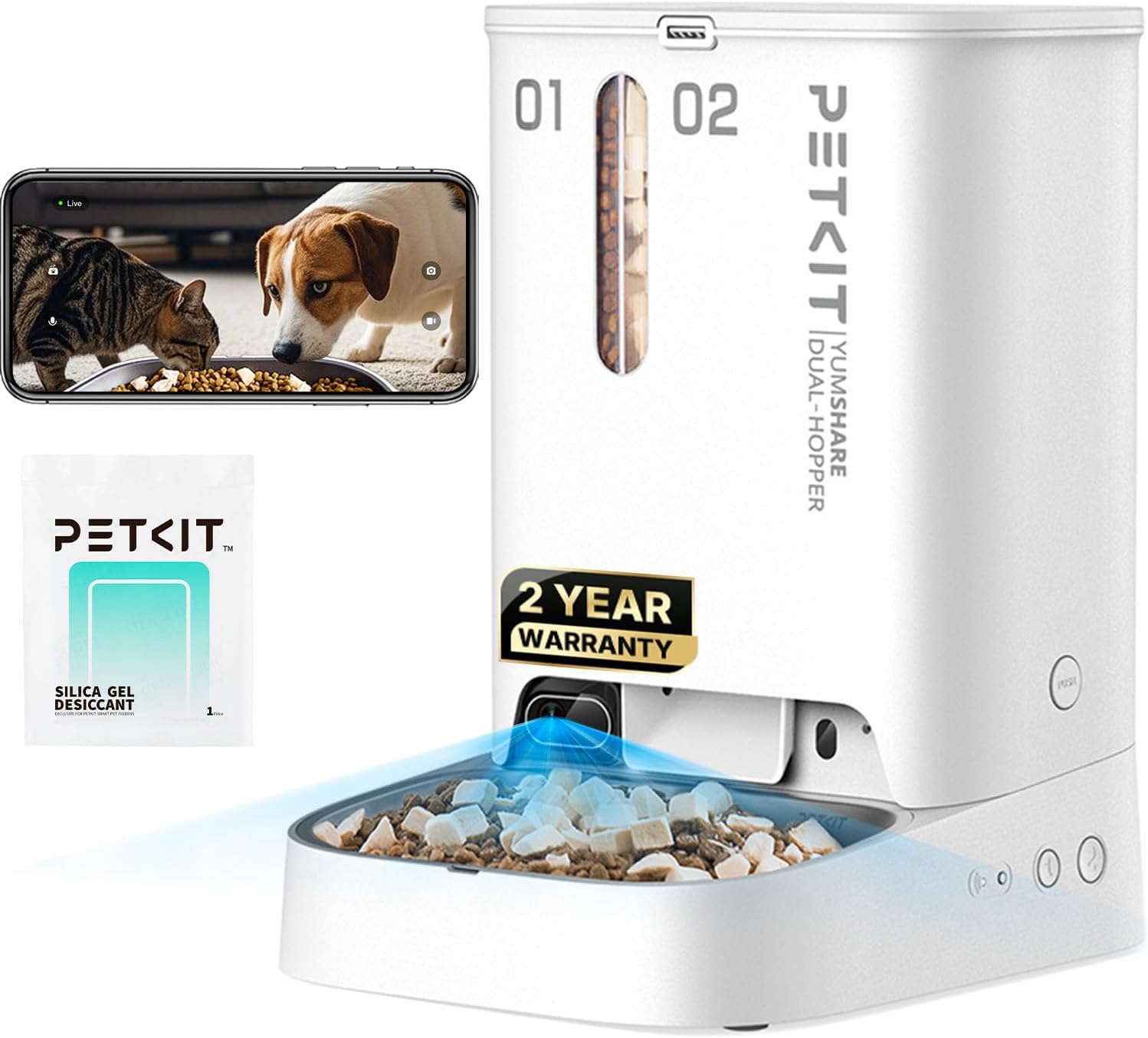 PETKIT Automatic Cat Dog Feeder with Camera | 1080P HD, night vision, AI motion capture | 2.4G WiFi | Dual hopper | Two-pet home, further from the router | Check current Amazon price |
The correct pet camera wall mount height for a feeder camera is whatever puts the lens just above the bowl line and slightly behind it. Too high and you watch the tops of heads all day. Too low and the pet's own body blocks the bowl. Test the view on your phone before you commit to a shelf, and remember that a feeder camera is a fixed camera: once the shelf is up, that is the angle you live with.
PETLIBRO Automatic Cat Feeder with Camera, 1080P HD Video and Night Vision
The PETLIBRO is the straightforward camera feeder of the group: 1080P HD video, night vision, and an app that most people will have paired before the coffee is cold. No second camera, no dual hopper, no extra decisions. If you want one bowl, one camera, and a schedule you can set from the couch, this is the least complicated way to get there.
That simplicity is also the reason I would point a first-time buyer here. Fewer parts means fewer failure points, and a single hopper is easier to clean than a split one. Check current Amazon price
PETKIT Automatic Cat Dog Feeder with Camera, AI-Powered Motion Capturing
The PETKIT is the pick for a two-pet household on two different diets. The dual hopper with desiccant holders means two foods, two schedules, and one camera watching both. The AI motion capturing is what sets it apart from the rest of the group: instead of scrubbing through a fixed recording, the app flags movement in frame, which is exactly what you want when you are checking on a cat that eats at 3 a.m. and you have no interest in watching six hours of an empty room.
It runs on 2.4G WiFi, the band that reaches further through walls, and the trade-off is a busier band in apartment buildings where every neighbor is on it. Test the live view from the spot you have in mind before you trust it. Check current Amazon price
Should you buy the Frienhund 5G WiFi Automatic Cat Feeder?
Yes, if you have more than one pet, or one pet with a serious appetite, or you simply want two angles instead of one. The two cameras are why it takes the top spot here. A bowl camera tells you whether dinner actually landed. A room camera tells you who walked in and whether the other cat got there first. Add the 7-liter hopper and the detachable body, and you have the least fussy unit in the group.
The trade-off is the band. 5G WiFi gives a cleaner live view but does not push through walls the way 2.4G does, so this is the wrong feeder for a far corner of a large house unless you have a mesh node out there. Buy it if the router is within reasonable distance of the feeding spot, or if you are willing to move the router. Skip it if the feeder has to live two rooms away and that cannot change.
Should you buy the Faroro Automatic Cat Feeder?
Yes, for one cat or one small dog and a tighter budget. The blockage sensor is the reason to pick it over cheaper camera feeders: a jammed chute at 6 a.m. is the failure that actually matters, and a sensor that warns you beats a camera that only shows you the problem. The 1080P camera with night vision covers the basics, and 2-way audio lets you talk to the animal while you are out.
The 4-liter hopper is the limit. One cat, fine. Two cats that free-feed, probably fine. Two large dogs, no. If you are feeding a house full of animals, spend more and get the capacity. If you are feeding one, this is the value pick and the one I would start with.