Goldfish are heavy waste producers for their size, and most first year problems in a goldfish tank trace back to filtration rather than to the fish. The aquarium filter for goldfish has to do two jobs at once: move enough water to keep ammonia and nitrite from building up, and hold biological media where nitrifying bacteria can live without being rinsed away every week. Getting that wrong shows up as cloudy water, climbing test readings, and fish that sit at the surface. This explainer covers what filtration actually does in a goldfish tank, how tank volume and stocking change the math, and where four pieces of starter gear fit around the decision.
Quick answer
The correct aquarium filter for goldfish is one rated for the tank you actually have, not for the fish you plan to add later. In practice that means a filter rated at several times the tank volume in gallons per hour, with media you can rinse in removed tank water instead of replacing. The ideal aquarium filter for goldfish also spreads flow rather than pushing a single jet, because fancy goldfish are slow swimmers that tire in strong current. For most beginners, a hang-on-back or internal power filter with a sponge and a biological stage covers a 10 to 20 gallon tank. Larger tanks and heavy stocking are easier to manage with a canister, which holds more media in one place.
Four useful options
The four products below are not all filters. Two are complete starter tanks with a filter pump included, one holds temperature steady on a small tank, and one lights live plants. Together they cover the hardware side of a small goldfish setup, and each one is listed with the role it plays.
| Model | Best fit | What stands out |
|---|---|---|
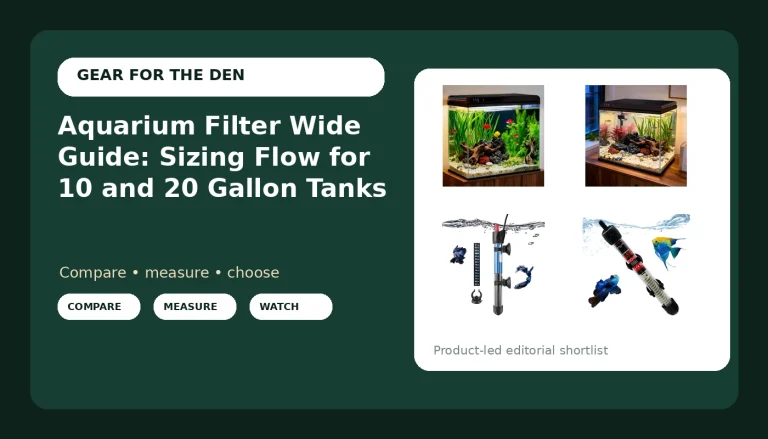
| Coospider 20 Gallon Glass Fish Tank, Aquarium Starter Kit, Simple Self-Cleaning Aquarium with 3-Color LED Lights, with Quiet Filter Pump, with Temperature Monitoring for Fish, Shrimp, Kids Gift Ideas | A first goldfish tank with filtration included | 20 gallon glass kit with a quiet filter pump, 3-color LED lighting, and temperature monitoring |
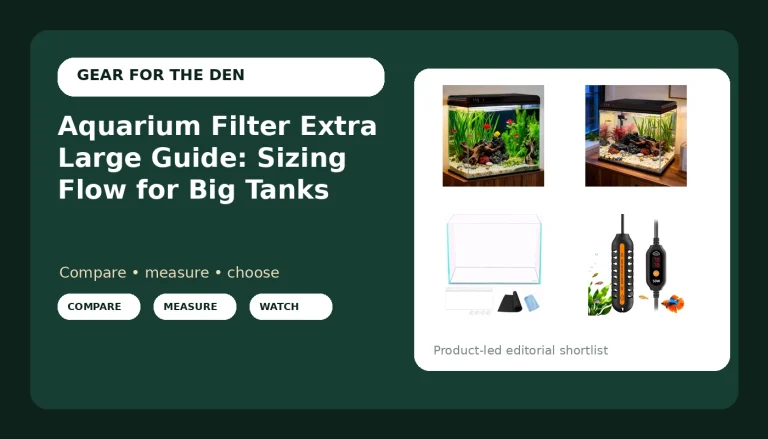
| Coospider 10 Gallon Glass Fish Tank, Aquarium Starter Kit, Simple Self-Cleaning Aquarium with 3-Color LED Lights, Quiet Filter Pump, Temperature Monitoring for Fish, Shrimp, Kids Gift Ideas | A smaller starter tank for one fish or a quarantine setup | Same starter kit layout in a 10 gallon glass tank |
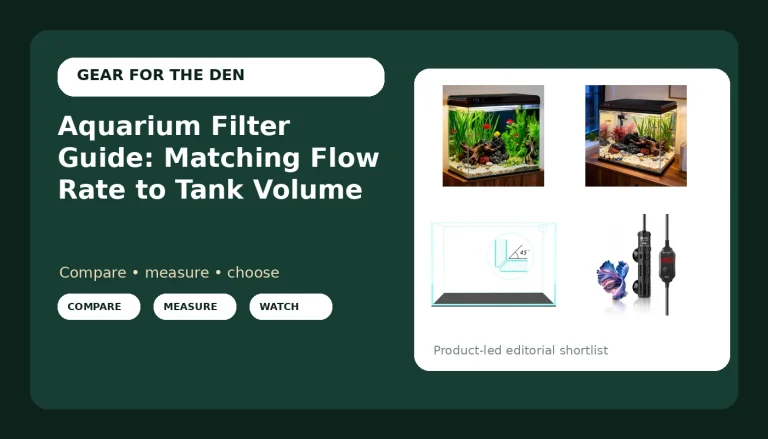
| AquaMiracle 50W Small Aquarium Heater Dual LED Display for 5-10 Gal Tanks | Holding a steady temperature on a 5 to 10 gallon tank | 50W heater with a dual LED display |
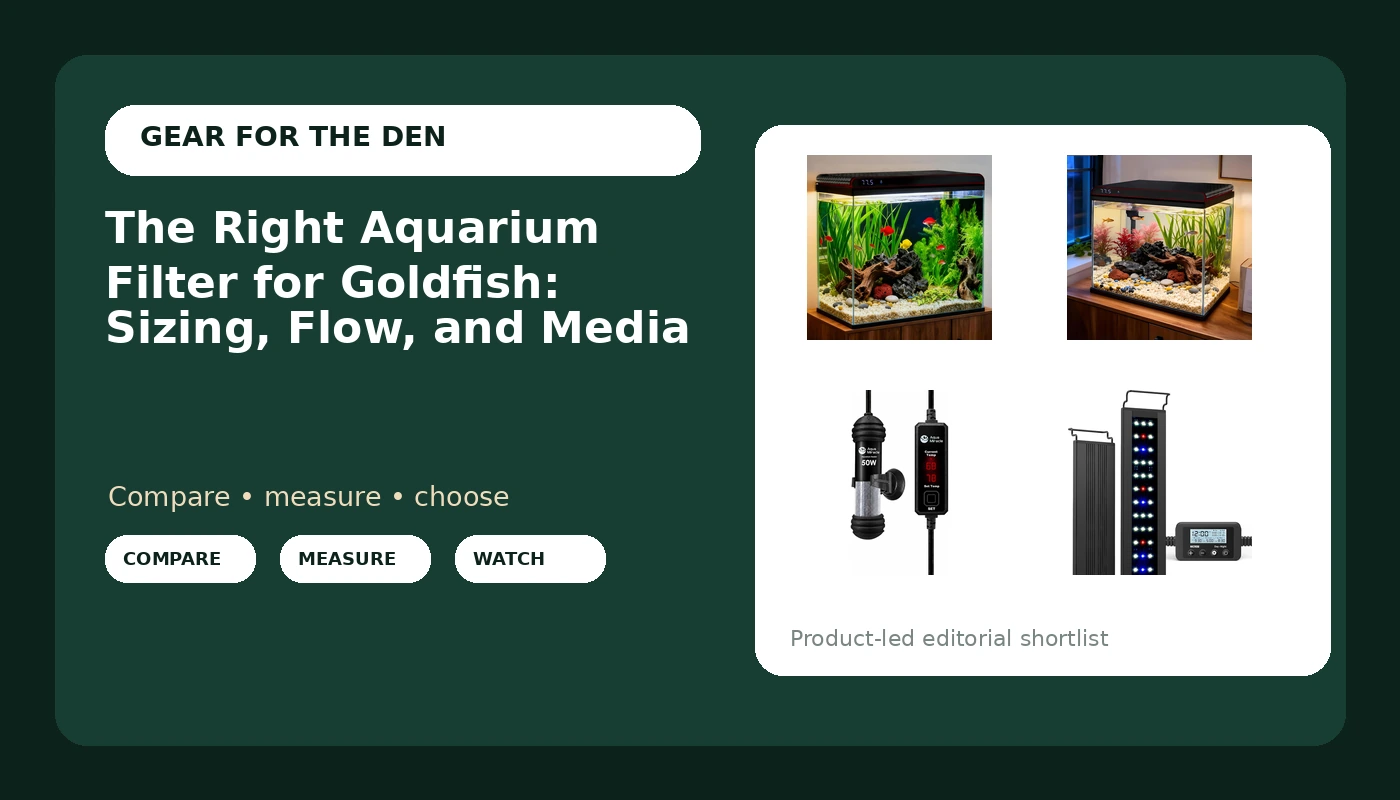
| NICREW C10 Plant Aquarium Light, 12-18 in, 9W, Full Spectrum with Timer | Lighting live plants over a 12 to 18 inch tank | 9W full spectrum light with a built in timer |
The 20 gallon starting point: Coospider 20 Gallon Glass Fish Tank
A 20 gallon tank is a more forgiving starting point than a 10 because water chemistry shifts more slowly as waste accumulates, and there is room for a filter that holds a real biological stage. The trade-off is space, weight, and a larger volume of water to change each week. Because the pump comes with the kit, you are not matching a filter to a tank from scratch, but you should still check what media the pump holds and how easily that media can be rinsed. Plan the filtration around the adult size of the fish you intend to keep, not the size of the fish you bring home.
The 10 gallon starting point: Coospider 10 Gallon Glass Fish Tank
A 10 gallon kit suits a single small fish, a quarantine tank, or a desk setup where a larger tank will not fit. The trade-off is dilution: with less tank volume, a given amount of waste raises ammonia faster, so a smaller tank needs more frequent testing and more frequent partial water changes. Goldfish also grow, and a 10 gallon tank is best treated as a starting point or a temporary home rather than a long term one for a full grown fancy goldfish. If you keep this tank, keep the stocking light and the maintenance schedule tight.
The small tank heater: AquaMiracle 50W Small Aquarium Heater
Goldfish tolerate cooler water than most tropical fish, but a heater is still useful because stable temperature matters more than warm temperature. A heater that is oversized for the water volume cycles on and off in short bursts, and one that is undersized runs constantly without holding the set point. Check the thermostat range before buying if you need a specific temperature, and remember that wattage ratings assume a normal room temperature around the tank. In a cold room, a 5 to 10 gallon tank will lose heat faster than the same tank in a warm one.
The plant light: NICREW C10 Plant Aquarium Light
Filtration comes first in a goldfish tank, but light matters once you keep live plants, which compete with algae for the same nutrients. The kelvin rating tells you the color temperature of the output and how the tank will look, while wattage and tank length tell you how much light actually reaches the plants. At 9W over a 12 to 18 inch tank, this is a modest fixture that suits low and medium light plants. Push the photoperiod too long on any small tank and algae will take advantage, so the timer is doing real work here.
Prices and availability may change. Product images, names, and retailer links are matched to verified listings. No current price, rating, stock status, or measured result is stated here without current evidence.
What the aquarium filter for goldfish actually does
A filter in a goldfish tank is not one device doing one job. It is usually three jobs stacked in a single housing, and knowing which is which explains most of the confusion that shows up in filter shopping.
Mechanical filtration catches solid waste, uneaten food, and plant debris in a sponge, floss, or foam pad. This is the stage you rinse, and it is the stage that clogs fastest in a goldfish tank because goldfish produce a lot of solid waste.
Biological filtration is the part that matters most. Water passes over media with a large surface area, and colonies of nitrifying bacteria convert ammonia into nitrite and then into nitrate. Those bacteria live on the media, not in the water, which is why rinsing media under tap water or replacing all of it at once can crash a tank.
Chemical filtration is optional. Carbon or resin media pulls out odors, discoloration, and some dissolved compounds, and it is useful after medication or when water yellows, but it is not a substitute for the biological stage.
Water movement is the fourth thing a filter does, even though nobody calls it a stage. Surface agitation drives gas exchange, which keeps oxygen available to the bacteria and to the fish. That is why flow rate matters beyond waste removal, and why a filter that is technically large enough can still be a poor match if it turns the tank into a washing machine.
Tank volume, flow rate, and the numbers on the box
The numbers on a filter box rarely match what happens in a running tank. A rating in gallons per hour is usually measured with no media installed and no vertical lift, so the real flow rate in a tank with a loaded media basket is lower. That gap is the reason most keepers buy one size up rather than matching the tank volume exactly.
Tank volume sets the baseline, and it is smaller than the label suggests. A 20 gallon kit with gravel, decor, a filter, and a light displaces a meaningful amount of water, and a 10 gallon tank holds 10 gallons only when it is filled to the rim. Goldfish also grow, so a filter that keeps up with a juvenile fish may not keep up with the same fish a year later.
Stocking changes the calculation more than volume does. Goldfish are heavy ammonia producers relative to their size, so a tank that would be lightly stocked with small community fish can be heavily loaded with two goldfish. Biological capacity, not gallons per hour alone, is the limit that matters.
Substrate grain plays a smaller but real role. Fine gravel and sand trap less waste on the surface and are easier to siphon, while coarse gravel lets debris settle into the gaps where it decays.
If you add a heater, wattage and the thermostat range matter more than the wording on the box. A 50W heater rated for 5 to 10 gallon tanks is sized for small water volumes, and a larger tank needs more wattage to hold a steady temperature.
For lighting, the kelvin rating describes color temperature and the wattage describes output. A 9W full spectrum light over a 12 to 18 inch tank is a modest fixture suited to low and medium light plants, not a high light setup that demands injected carbon dioxide.
- Measure the tank and decide the adult stocking, not just the fish you plan to buy this week.
- Compare the filter's gallons per hour rating to the tank volume and allow margin for loaded media and vertical lift.
- Look at what media the filter holds and how easily each filtration stage can be rinsed.
- Match heater wattage and thermostat range to the water volume if you plan to heat the tank.
- Pick lighting by tank length, wattage, and kelvin rating for the plants you intend to keep.
Practical guidance for a goldfish tank
- Rinse mechanical media in water you removed during a water change, never under the tap, so the bacteria on it survive.
- Keep the filter running during maintenance so the biological stage stays oxygenated and the colony is not disturbed.
- Test ammonia and nitrite while the tank cycles, and expect a new filter to take weeks before it handles a full goldfish waste load.
- Never replace every media cartridge at the same time; rotate them so the bacteria always have somewhere to live.
- Soften the return flow with a prefilter sponge, spray bar, or a raised outlet if the fish are being pushed around.
- Siphon the surface of the substrate grain during water changes, since trapped waste is the part a filter never sees.
Which option should you choose?
Choose the Coospider 20 Gallon Glass Fish Tank when you want a larger water volume and a filter pump, lighting, and temperature monitoring included in a single purchase. Choose the Coospider 10 Gallon Glass Fish Tank when space is tight, when you want a lighter tank to move, or when you need a small setup for one fish or a quarantine period. Choose the AquaMiracle 50W Small Aquarium Heater when you need to hold a 5 to 10 gallon tank at a steady temperature instead of letting room temperature swing it. Choose the NICREW C10 Plant Aquarium Light when the tank measures 12 to 18 inches and you want a timed full spectrum light over live plants.
None of these listings replaces knowing your own tank volume and stocking. A filter pump included with a kit still has a rated flow rate you should check against the tank, and the heater and the light are sized for small tanks, so a larger setup will need different hardware.
The bottom line
The aquarium filter for goldfish explained in one line comes down to this: match the media and the turnover to the adult tank, then keep the media alive. Volume sets the baseline, stocking raises the demand, and real flow rate is lower than the number on the box once media is loaded. On a small tank, a kit that already includes a quiet filter pump removes one decision, and a heater or a timed plant light rounds out the setup. Whatever you buy, regular water changes and gentle rinsing of the biological media are what keep a goldfish tank stable.