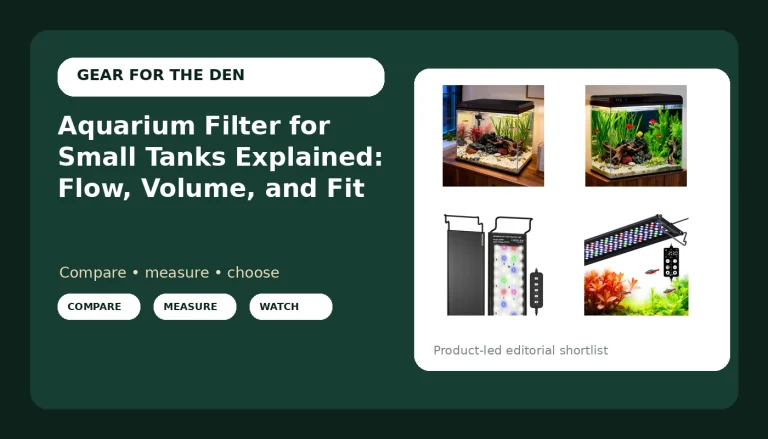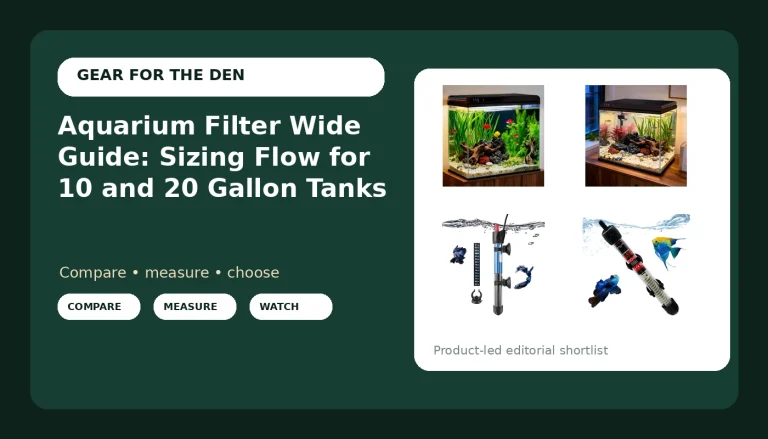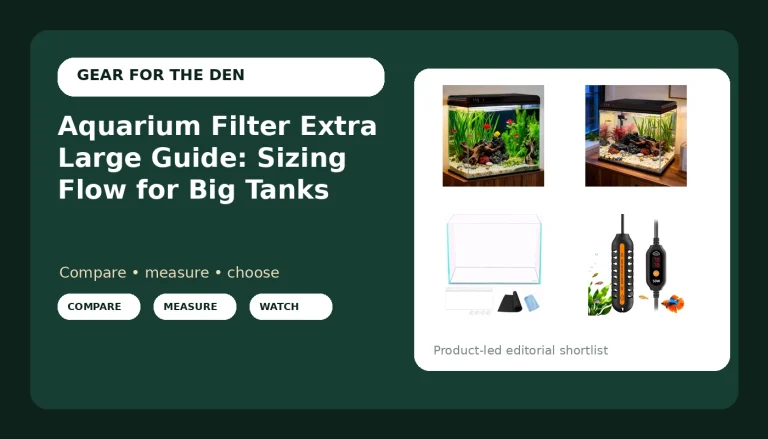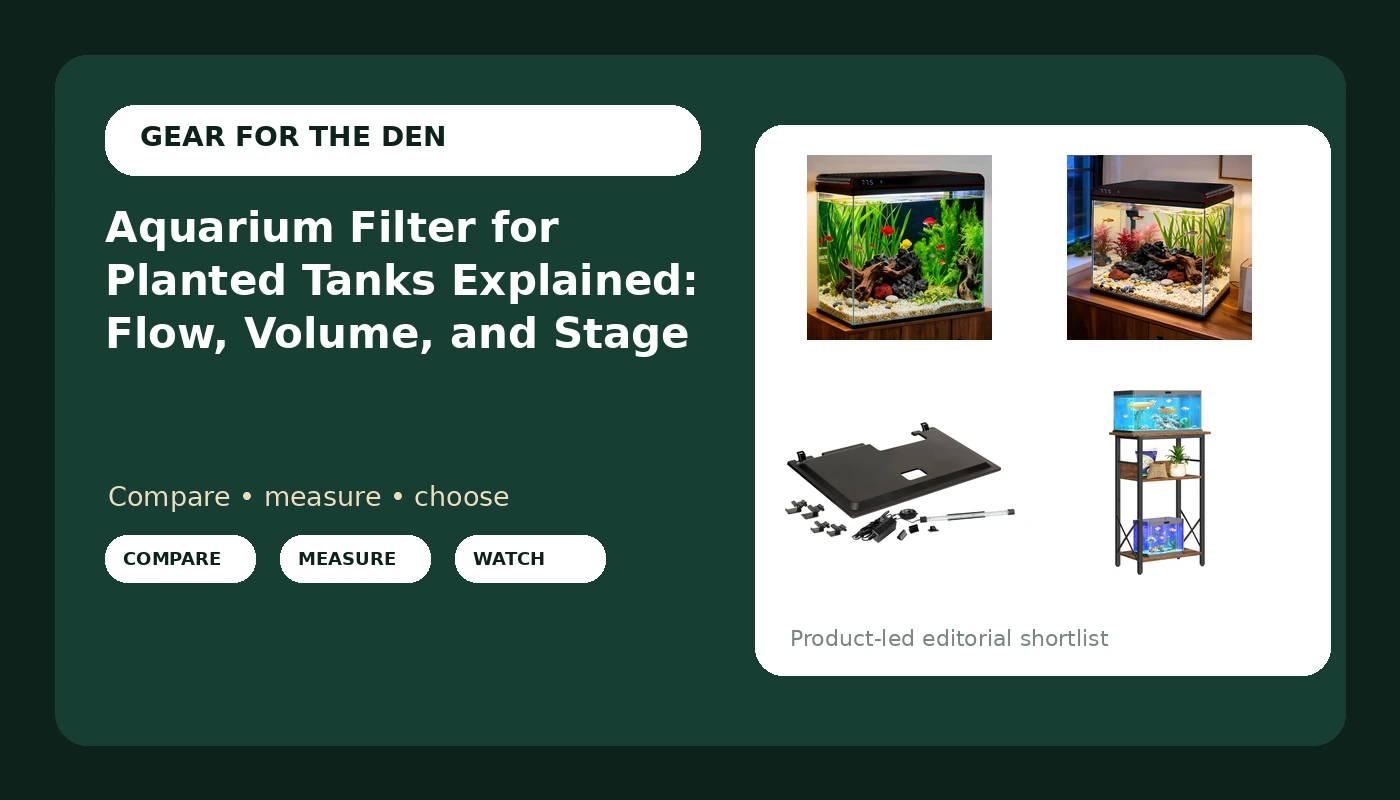
Filtration is the part of a planted tank that most new keepers get backwards. In a bare tank the goal is simple: strip waste out of the water as fast as the pump can move it. In a planted tank the filter has a second job that works against the first one, because the same surface agitation that keeps oxygen high also drives dissolved carbon dioxide out of the water your plants are trying to use. So the real question is never just how much flow. It is how much flow, delivered how, through how many filtration stage compartments you can actually fill. Tank volume, flow rate, and the media behind them decide almost everything else. What follows is aquarium filter for planted tanks explained in the order you will make those decisions, along with four pieces of gear that settle the tank, lid, and stand side of the same problem.
Quick answer
The correct aquarium filter for planted tanks is one that turns over roughly four to six times the tank volume per hour with a gentle, spread-out outflow, and that gives you separate mechanical and biological filtration stage compartments instead of a sealed cartridge. A hang-on-back or canister filter with an adjustable flow rate and a spray bar or diffuser fits that description far more often than a high-velocity internal pump aimed at the front glass. Because the filter has to fit the tank you already own, the tank itself is part of the decision, so the options below cover complete glass tanks, a low-profile LED hood, and a stand that holds the whole setup.
Four useful options
| Model | Best fit | What stands out |
|---|---|---|
| Coospider 20 Gallon Glass Fish Tank, Aquarium Starter Kit, Simple Self-Cleaning Aquarium with 3-Color LED Lights, with Quiet Filter Pump, with Temperature Monitoring for Fish, Shrimp, Kids Gift Ideas | Planted setups around 20 gallons | Starter kit that pairs a glass tank with a quiet filter pump, 3-color LED lights, and temperature monitoring |
| Coospider 10 Gallon Glass Fish Tank, Aquarium Starter Kit, Simple Self-Cleaning Aquarium with 3-Color LED Lights, Quiet Filter Pump, Temperature Monitoring for Fish, Shrimp, Kids Gift Ideas | Small planted tanks and desktop setups | The same kit features in a 10 gallon glass footprint |
| Tetra LED Aquarium Hood 20 in x 10 in, Low-Profile Fish Tank Cover | Covering a 20 in x 10 in tank opening | Low-profile LED cover sized for that footprint |
| HOOBRO 10 Gallon Aquarium Stand, 3-Tier Fish Tank Stand with Storage | Holding a 10 gallon tank and its supplies | Three tiers with storage built in under the tank |
The larger planted tank: Coospider 20 Gallon Glass Fish Tank, Aquarium Starter Kit, Simple Self-Cleaning Aquarium with 3-Color LED Lights, with Quiet Filter Pump, with Temperature Monitoring for Fish, Shrimp, Kids Gift Ideas
Twenty gallons is the size where a planted tank stops being a desk ornament and starts behaving like an ecosystem. There is enough water volume that a small mistake in flow rate does not swing the whole tank overnight, and enough room for rooted plants to spread without crowding the intake. The kit covers the pump and the light, which is the part most people underestimate, because a mismatched pump is the single most common reason a first planted tank turns into a washing machine. What the kit does not decide for you is flow direction. Aim the outflow along the long glass rather than into the plants, and if the pump has any adjustment, start at the lower end and raise it only if you see dead spots. Pair it with a timer and a sponge prefilter and the hardware side is largely done. The larger footprint also gives you room to choose a substrate grain that suits rooted stems instead of settling for whatever fits.
The compact planted tank: Coospider 10 Gallon Glass Fish Tank, Aquarium Starter Kit, Simple Self-Cleaning Aquarium with 3-Color LED Lights, Quiet Filter Pump, Temperature Monitoring for Fish, Shrimp, Kids Gift Ideas
Ten gallons is the more common entry point and the harder one to filter well, because a smaller tank volume makes every gallon per hour of flow feel stronger relative to the water it is moving. A pump that behaves gently in a 20 can look like a current in a 10. That is why the compact kit rewards a light touch: keep the water level high so the outflow diffuses against the surface instead of plunging, and let the plants carry more of the nutrient load. If shrimp are part of the plan, fit a prefilter sponge over the intake on day one, since shrimplets and fry are the first casualties of an open intake. The size also makes placement easy, which is where a dedicated stand with storage earns its place. One thing to note about both kits: temperature monitoring tells you what the water is doing, but a heater with an adjustable thermostat range is a separate purchase if your room swings overnight.
The lid and lighting: Tetra LED Aquarium Hood 20 in x 10 in, Low-Profile Fish Tank Cover
An open-top planted tank loses water quickly, and every top-off shifts the mineral balance in the water column a little. A cover slows that evaporation, keeps jumpy fish where they belong, and stops dust and pet hair from landing in the tank. The Tetra hood carries LEDs, so it handles lighting and covering at once, and the low profile keeps the setup visually quiet. The kelvin rating of any light matters for plant growth, but the practical order of operations is fit first, spectrum second: a hood that sits correctly on a 20 in x 10 in opening is more useful than a brighter fixture that leaves gaps. If your plants stretch toward the light after a few months, that is the point to add a dedicated plant light rather than to replace the cover.
The furniture base: HOOBRO 10 Gallon Aquarium Stand, 3-Tier Fish Tank Stand with Storage
A 10 gallon glass tank carries roughly a hundred pounds once water, substrate, and hardscape are in it, so the surface it sits on is part of the filtration conversation in a practical sense. You need somewhere stable, and you need space under the tank for the pump body, spare media, and a bucket. The HOOBRO stand is a three-tier unit with storage built in and sized for a 10 gallon aquarium. That storage sounds like a small thing until you have owned a planted tank for a season: the clutter that builds up around a tank is exactly what makes people skip a water change. Keeping the supplies under the tank, rather than in a cupboard across the room, is a maintenance decision disguised as furniture.
Prices and availability may change. Product images, names, and retailer links are matched to verified listings. No current price, rating, stock status, or measured result is stated here without current evidence.
Matching the correct aquarium filter for planted tanks to tank volume
Turnover is the starting number, and it comes from tank volume, not from a manufacturer's claim. Multiply the tank's gallons by four to get a minimum target in gallons per hour, and by six to get the upper end you would want in a heavily planted tank with a large fish load. A 10 gallon tank therefore wants somewhere in the range of forty to sixty gallons per hour of real movement, and a 20 gallon tank wants roughly eighty to a hundred and twenty. Those numbers are not a specification you can read off a box, because advertised pump ratings are measured with no media in the housing and no head height. Expect the real figure to be lower, and choose a filter whose flow rate you can dial back rather than one that is already at the top of its range.
Delivery matters as much as the number. A pump pushing sixty gallons per hour through a narrow nozzle creates a jet. The same sixty gallons per hour through a spray bar or a wide diffuser creates a slow, even current that carries waste to the intake without folding every plant in the tank flat. In a planted setup, the goal is water movement through the foliage, not surface chop. Surface agitation is where dissolved carbon dioxide leaves the water, so a filter that churns the top like a waterfall is working against the light and the fertilizer you paid for. Point the outflow horizontally along the back glass, keep the water level close to the rim, and let the return current do the circulation work.
The filtration stage count is the other half of the answer. Mechanical media traps particles, biological media houses the bacteria that process ammonia and nitrite, and chemical media is optional and situational. A cartridge that combines all three into one disposable pad forces you to throw away your bacteria every time the pad clogs. Separate compartments let you rinse the mechanical sponge in old tank water and leave the biological media alone. That single design difference decides whether a filter is pleasant or miserable to own, and it matters more in a planted tank, where uprooting and replanting sends a burst of debris into the water.
Why the ideal aquarium filter for planted tanks starts with filtration stage
The ideal aquarium filter for planted tanks is adjustable, serviceable, and slightly oversized rather than exactly sized. Oversizing gives you headroom to add fish later without replacing hardware, and an adjustable flow rate lets you turn it down while plants establish. It also lets you run a sponge prefilter on the intake, which keeps shrimp and fry out of the impeller and gives you a second, easily rinsed mechanical stage before the main media ever sees the debris.
Wattage is worth a glance, not because a filter draws much power, but because a tank usually ends up on one power strip with a light, a heater, and possibly a pump for top-off. Add the numbers up before you commit to a strip and a timer. If the kit you bought includes temperature monitoring, treat that as information, not control: it tells you the water temperature, while a heater with an adjustable thermostat range is what actually holds it steady.
The decision sequence that works:
- Measure the inside of the tank and confirm the actual tank volume in gallons, since a "10 gallon" tank rarely holds exactly ten.
- Multiply that volume by four and by six to set your target gallons per hour window.
- Choose a filter whose flow rate is adjustable and whose outflow can be spread out with a spray bar or diffuser.
- Count the filtration stage compartments and plan mechanical, biological, and optional chemical media separately.
- Set the outflow along the back glass, keep the water level high, and watch plant growth and fish behavior for a week before adjusting anything.
Practical guidance for planted tank filtration
- Keep the intake above the substrate grain layer so a fine planted substrate is not pulled into the filter during planting.
- Fit a prefilter sponge if you keep shrimp, fry, or small snails, and rinse it in old tank water at every water change.
- Never rinse biological media under tap water; chlorine kills the bacteria you spent weeks growing.
- Trim plant mass before it blocks the outflow, because a clogged spray bar turns a gentle current into a dead spot.
- Check the combined wattage of the filter, light, and heater before loading one power strip, and use a timer for the light.
Which option should you choose?
Choose the Coospider 20 Gallon Glass Fish Tank, Aquarium Starter Kit, Simple Self-Cleaning Aquarium with 3-Color LED Lights, with Quiet Filter Pump, with Temperature Monitoring for Fish, Shrimp, Kids Gift Ideas when you want a planted display in the 20 gallon class and would rather start with the pump and the light already matched to the glass. Choose the Coospider 10 Gallon Glass Fish Tank, Aquarium Starter Kit, Simple Self-Cleaning Aquarium with 3-Color LED Lights, Quiet Filter Pump, Temperature Monitoring for Fish, Shrimp, Kids Gift Ideas when space is tight and you want the same kit hardware in a smaller footprint. Choose the Tetra LED Aquarium Hood 20 in x 10 in, Low-Profile Fish Tank Cover when your tank has a 20 in x 10 in opening and you want cover and light in one low-profile piece. Choose the HOOBRO 10 Gallon Aquarium Stand, 3-Tier Fish Tank Stand with Storage when the tank needs a stable base and you want the media, test kits, and tools stored with it.
One honest caveat: none of these listings states a measured flow rate, wattage, or kelvin rating, so the numbers above are planning targets rather than product specifications. Verify the pump's stated rating on the listing and treat it as an upper bound.
The bottom line
The right answer to aquarium filter for planted tanks explained is not a single model, it is a set of properties: turnover of four to six times the tank volume per hour, an adjustable flow rate, a spread-out outflow, and separate filtration stage compartments you can service independently. The kits above handle the tank, pump, light, and temperature monitoring in one purchase, the hood closes and lights a 20 in x 10 in opening, and the stand gives a 10 gallon setup a stable home with storage for the gear that keeps maintenance from being skipped. Match the flow to the tank volume, keep surface agitation gentle, and the plants will do the rest.