Most bird cages ship with one straight dowel perch and a plastic dish, and that is the whole furniture package. Before you choose a stand for a bird cage, meaning the surface your bird actually stands on for most of its waking hours, you are really answering one question: where does the bird spend its day? A single smooth dowel means the same grip, the same pressure point, and the same wear on the same foot from the moment the lights come on.
That is why the perch platform matters more than the cage it hangs in. A flat shelf gives a bird a place to rest a whole foot instead of gripping. A sanded stick gives it something to grind its beak and claws against. A feeding platform gives it a station that is not the cage floor, which matters a great deal when the tray liner has not been changed since Tuesday. Get those three roles right and the cage stops being a box and starts being a habitat.
The parts are cheap and the mistakes are not. A platform mounted too high goes unused. A perch that is too wide for the foot causes pressure sores. A food cup that tips dumps a day of seed into the tray. What follows is how I sort the options, how I mount them, and what I skip.
Why you should trust me
I have set up and re-set up small-parrot cages for years, mostly budgies, lovebirds, and one cockatiel that treats every new object in its cage as a personal insult. The mistakes I made early are the same ones I see in the cage photos people send me: a perch that is too wide for the foot, a platform screwed so high the bird never touches it, a food cup a budgie can flip in four seconds flat. I do not sell bird gear and I do not run a rescue, so I have no reason to push a part that does not work. What I have is a short list of pieces that survived contact with a real bird and a much longer list of pieces that did not. When I write about bar spacing or perch diameter, I am telling you what I check with a caliper and a camera, not what a spec sheet claims.
How I picked and how I tested
Everything below is judged on the same six things: perch diameter, how the piece mounts, the bar spacing it fits, how easy the surface is to clean, whether it carries a food cup, and how much work the bird has to do to eat off it.
For a flat platform, the check is simple. Can a budgie or a small conure stand with both feet flat and its toes clear of the edge? A platform that is too narrow turns into a perch with extra steps. I also look hard at the hardware, because a platform that wobbles when the bird lands teaches the bird not to use it, and a bird that avoids a platform has told you everything.
For sanded grip perches, the check is the grit. A sanded surface should be fine enough to wear claws and beak without abrading the foot pad. I rub it against the back of my hand. If it scratches me, it will scratch a foot.
For a feeding platform, the check is food cup size and depth. A cup that is too shallow means seed on the cage floor. A cup that is too deep means a small bird has to climb inside to reach the bottom, and a bird that has to climb into its dish will eventually stop eating from it.
I do not have a lab and I am not going to pretend a perch needs one. I have a caliper, a kitchen scale, and a habit of watching a bird for the first ten minutes after I change anything in its cage. If a bird ignores a new platform for three days, the platform is in the wrong place, not the bird.
How to choose a stand for a bird cage: mounts you'll need before you start
The three pieces below cover the three jobs: a flat platform, a pair of sanded grip sticks, and a feeding platform. If you also need to choose a riser for a bird cage so the whole setup sits at a height you can clean without bending, settle that first, because the height of the stand decides how high you can mount anything inside. The same logic applies to the cage itself: cage height and door size limit what will fit through the opening, and a great platform that does not fit is a return label.
Budget pick: MUYG Platform Perch for Parrots, 7.87 x 5.90 Inch Bird Flat Perches Stainless Steel Budgie Stand Shelf Rectangle Anti-Chewing Bird Cage Accessories for Small Cockatiel Budgie
Budget pick
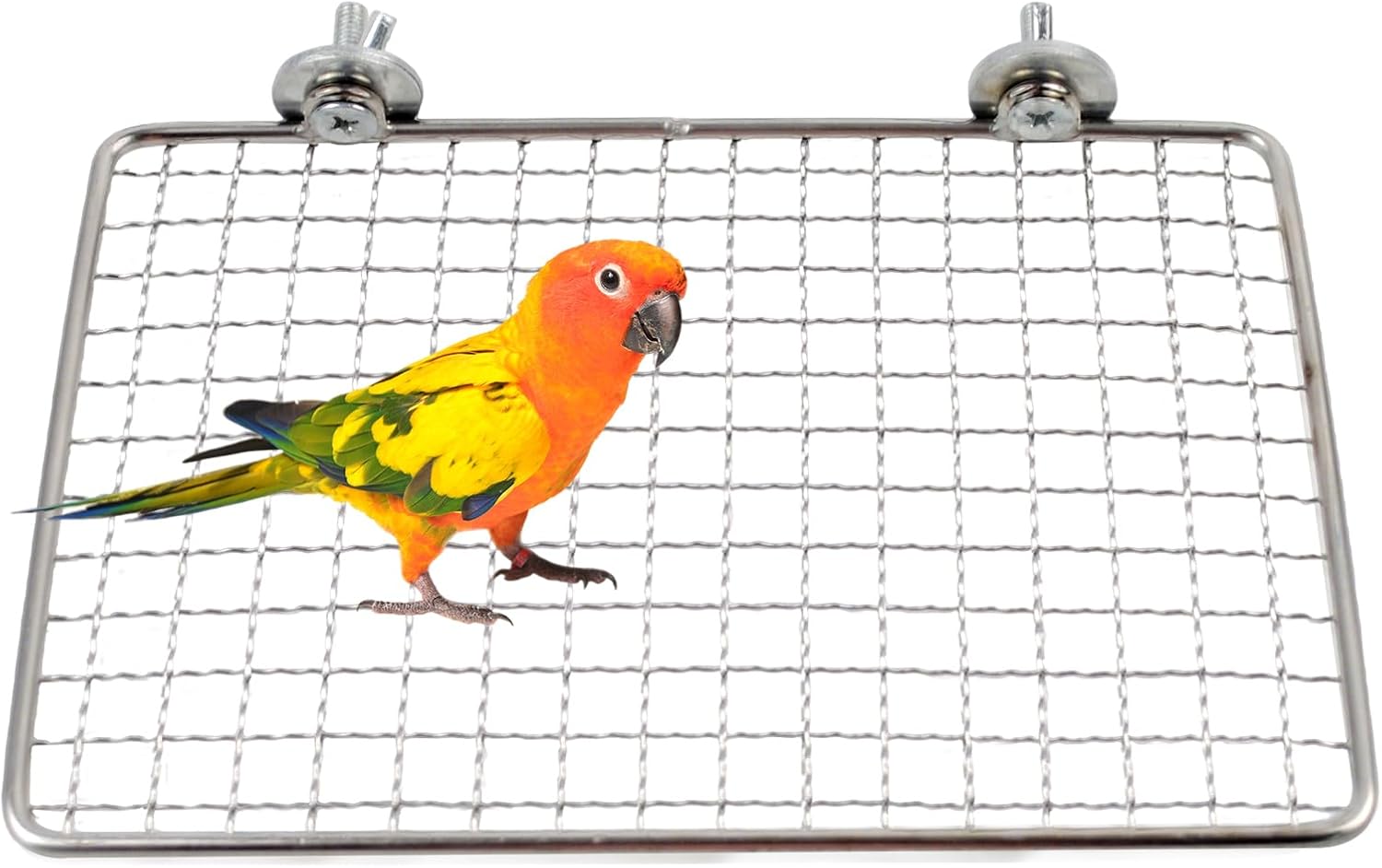
MUYG Platform Perch for Parrots, 7.87 x 5.90 Inch Bird Flat Perches Stainless Steel Budgie Stand Shelf Rectangle Anti-Chewing Bird Cage Accessories for Small Cockatiel Budgie
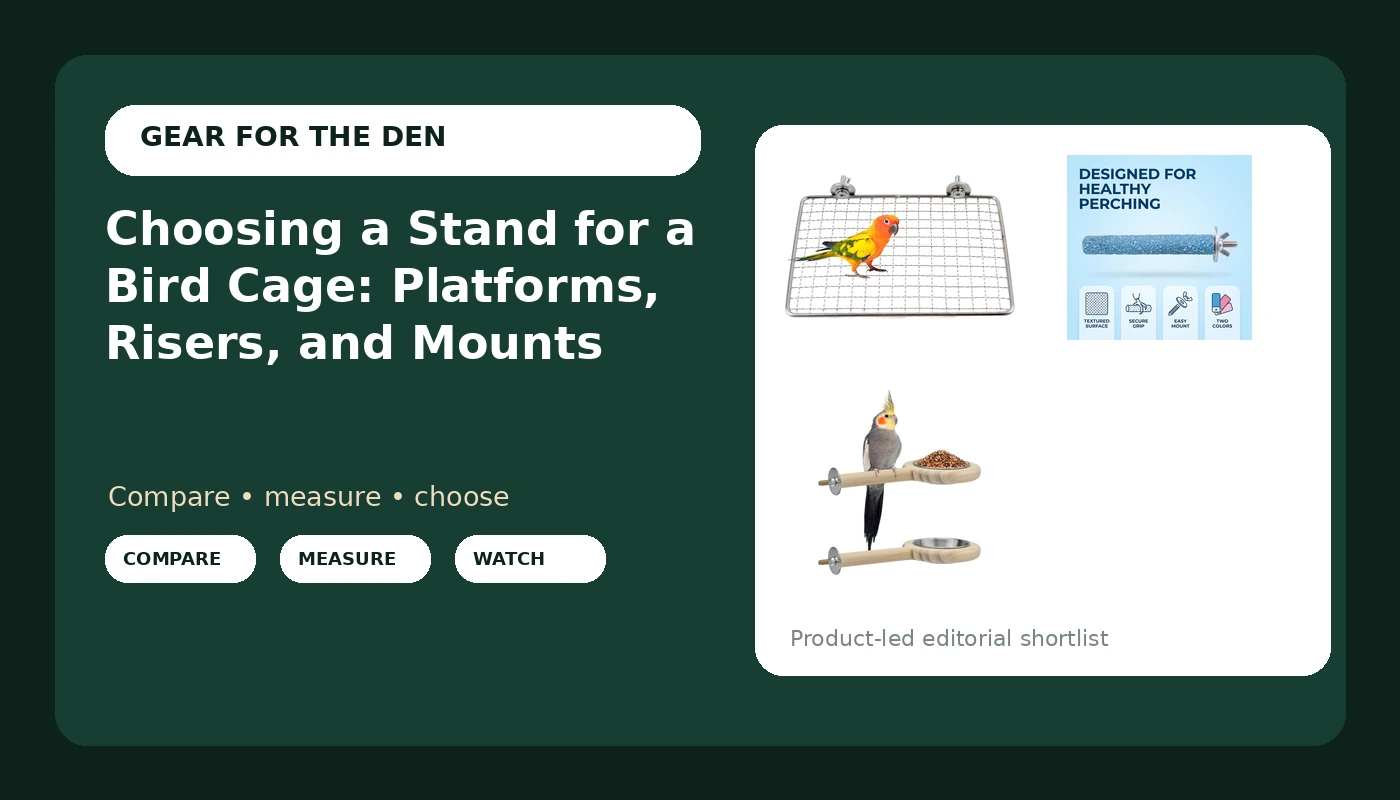
The MUYG platform is the piece I would buy first, and it is the least expensive way to give a small parrot a real resting surface. It is a flat rectangular shelf, 7.87 by 5.90 inches, stainless steel, with a raised lip and a bracket that bolts to the cage bars. Check current Amazon price.
The stainless steel is the reason it earns the budget slot. Wood platforms soak up droppings and stay damp, and a damp platform under a bird is a bacterial problem. Metal wipes clean with a vinegar spray and holds no odor. The anti-chewing framing is real too: a determined budgie will chew a wooden platform edge into splinters in a season, and there is nothing here for it to chew.
Mounting is the part people get wrong. Put the platform in the upper third of the cage, on the wall opposite the door, at a height where the bird can hop across from a perch instead of climbing up to it. If you have to choose a mount for a bird cage, pick the one that keeps the shelf level and tight, because a platform that tips when the bird lands is a platform the bird stops using.
Flaws but not dealbreakers: The 7.87 by 5.90 inch footprint is a one-bird size. Two budgies will argue over it, and the second bird will lose.
Anyone with a single budgie, lovebird, or small cockatiel who wants one solid resting surface without spending real money should start here.
Runner-up: 2 Pcs Multi-Color Random Bird Perch Stand Toy Wood Parrot Perch Stand Grinding Claw Sticks Sanded Surface Cage Toy for Parakeets Finches Parakeet Toys Birdcage Accessories
Runner-up
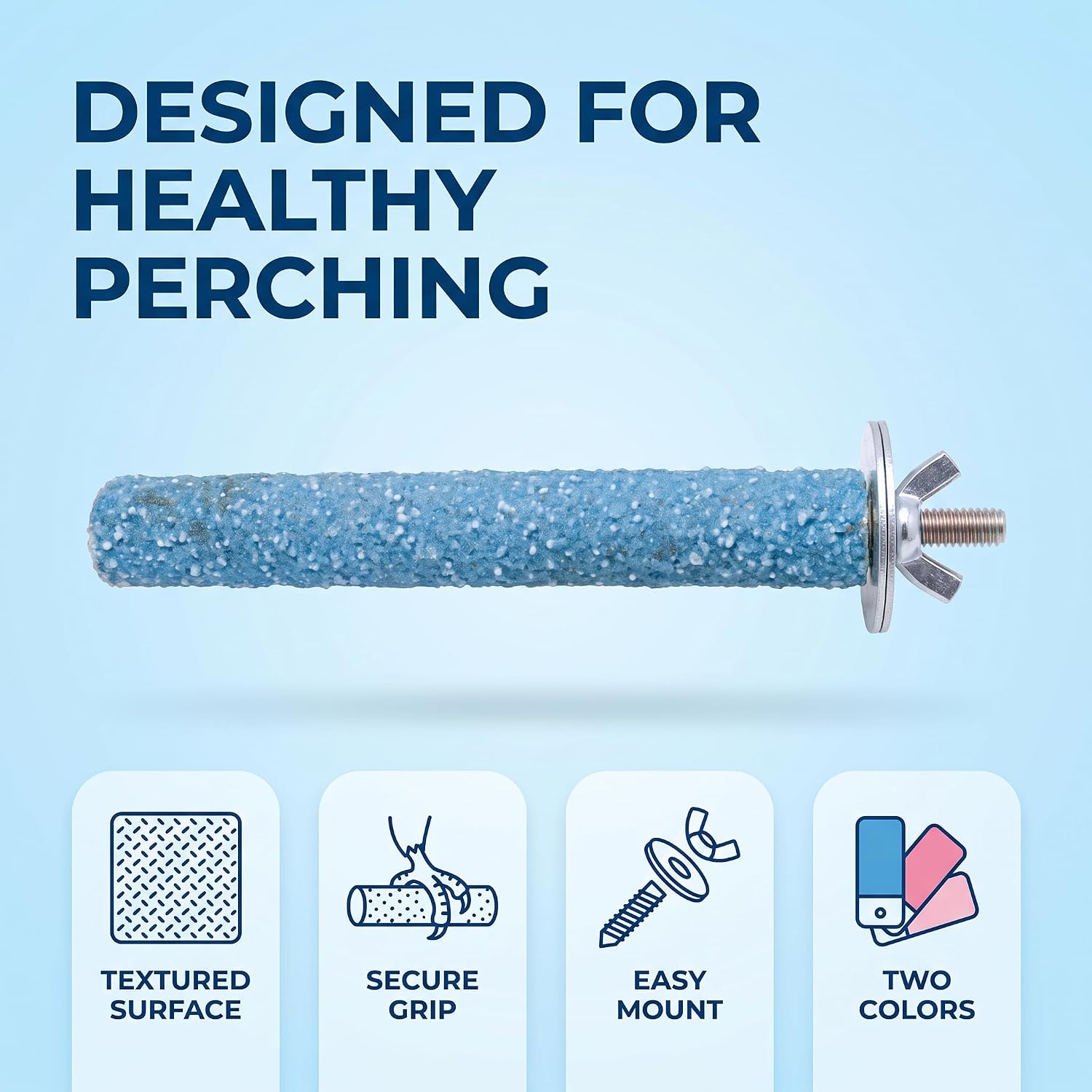
2 Pcs Multi-Color Random Bird Perch Stand Toy Wood Parrot Perch Stand Grinding Claw Sticks Sanded Surface Cage Toy for Parakeets Finches Parakeet Toys Birdcage Accessories
This two-pack is the grip half of the equation. Two sanded wooden perch sticks, random colors, sized for parakeets and finches, and they do the one job a flat platform cannot: keep claws and beak worn down a little at a time. Check current Amazon price.
The sanded surface is the selling point. Bare dowel is smooth, and a smooth dowel gives the foot nothing to hold, so the bird slides and the claws keep growing. A sanded stick gives traction and a little abrasion with every step. Because you get two, you can put one high near the sleeping spot and one low near the food, which spreads the wear across the whole foot instead of concentrating it on one pressure point.
Two things to check before you mount them. First, perch diameter. The stick should let the bird's toes wrap most of the way around without the tips meeting underneath. Too thin and the foot cramps. Too thick and the bird cannot close its grip at all. Second, the ends. Screw-on ends with a wing nut are steadier than spring clips, and a perch that spins when the bird lands is worse than no perch.
Flaws but not dealbreakers: The colors are random, so you do not get to match your cage. Buy two packs if the mismatch bothers you.
Anyone running parakeets or finches who wants natural grip surfaces instead of plastic dowels will get the most out of this pair.
Upgrade pick: KATUMO Bird Perch Feeding Cup Birds Platform Parrot Wood Perch Stand Toy Cage Accessory for Parakeet Lovebird Cockatiel Conure Budgie Small Parrots (L Perch (Pack of 2))
Upgrade pick
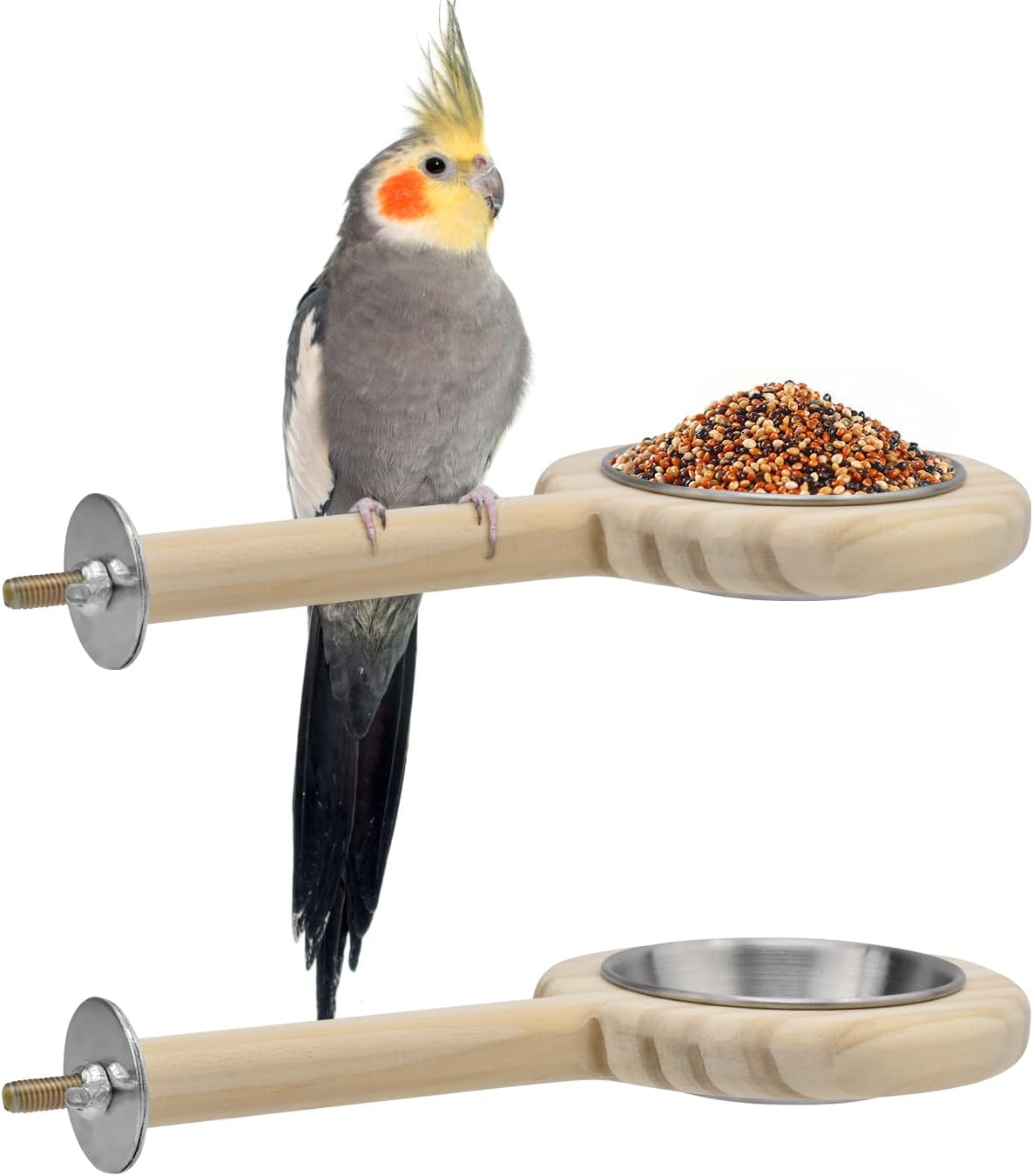
KATUMO Bird Perch Feeding Cup Birds Platform Parrot Wood Perch Stand Toy Cage Accessory for Parakeet Lovebird Cockatiel Conure Budgie Small Parrots (L Perch (Pack of 2))
The KATUMO feeding platform is the one piece here that changes behavior rather than just comfort. It is a wooden platform perch with an integrated feeding cup, sold as a pack of two in the large size, and it turns a plain perch into a feeding station. Check current Amazon price.
Food cup size is the first thing to check on any feeding platform. The cup should be wide enough that a cockatiel can dip its head in without climbing, and shallow enough that a budgie can reach the bottom without falling in. This one seats the cup into the platform itself, which means no tipping and no seed avalanche when the bird lands hard on the edge.
The platform also gives you somewhere to put foraging difficulty to work. Scatter a few seeds in the cup and a few across the platform surface and a small parrot has to move, look, and pick, which is the closest thing to a job you can give a cage bird. Rotate the contents daily and the same perch stays interesting for months.
Because you get two, the second one goes on the other side of the cage. Two feeding stations mean one bird can eat without crossing the whole cage, and if you ever add a second bird, it means two birds can eat without a fight over the cup.
Flaws but not dealbreakers: Wood needs checking. Run a finger along the cup edges monthly and replace the piece if a bird has chewed a lip down to a sharp edge.
Anyone with a lovebird, conure, or cockatiel who wants feeding and perching in one footprint should look here first.
The actual setup workflow
Here is the order I do it in. It works in any cage with horizontal bars and a door wide enough to get a hand and a bracket through.
Step one: Measure the cage before you buy anything. Bar spacing comes first, because it decides what hardware fits and what a bird can squeeze through. Then cage height, because it decides how many levels you can build. Then the door opening, because a platform you cannot get through the door is a return. If the bird travels with you, note your carrier size too, since a perch that fits the travel carrier is a separate purchase.
Step two: Decide the stand or riser height, which is the half of how to choose a stand for a bird cage that most people skip. If you plan to choose a holder for a bird cage cup that clamps to the bars rather than a cup built into a platform, set the cage so the cup lands where you can reach it with one hand. Waist height at the cage top is the usual target, and it is the difference between a cage you maintain and a cage you avoid.
Step three: Map the cage into zones before you mount anything. Sleeping zone at the top, eating zone in the middle, floor for the tray liner and nothing else. Birds move upward when they are nervous, so the highest perch should be the most secure one in the cage, not the most exposed.
Step four: Mount the flat platform first. Upper third, opposite the door, dead level. Test it with your hand before the bird tests it with its feet. A shelf that holds your weight on a push will hold a budgie.
Step five: Add the sanded grip perches. One high, one low, set at different angles so the feet work in more than one position. Keep them clear of the platform so a bird sitting on the platform is not blocked by a stick at eye level.
Step six: Set the feeding platform at middle height, near the sleeping perch but not directly under it, so droppings do not land in the cup. If you are running two, put the second one on the opposite wall.
Step seven: Work up to foraging difficulty. Start easy with food sitting in the cup. Then scatter part of the portion across the platform surface. Then wrap a little in paper and let the bird tear it open. If the bird stops eating, you moved too fast, so back up a step.
Step eight: Clean and check weekly. Wipe the metal platform, scrub the wood perches, change the tray liner, and check every mount for wobble. A swing mount that has worked loose is how a bird ends up on the floor at two in the morning.
That is the whole system: one flat surface, two grip surfaces, one feeding station, and a stand height that keeps your back intact.
The competition and why it lost
A few things did not make the list. The plain dowel perch that comes in the box is the first casualty: smooth, uniform, and the fastest route to a foot problem, because the bird puts pressure on the same spot all day long.
Rope perches are popular and fine for grip, but they fray, and a frayed rope perch is a crop impaction waiting to happen once a bird starts pulling threads loose.
Cement perches do wear claws down, but they are unforgiving on the foot pad and most birds will not sleep on one, which means they end up as decoration.
Full floor stands with wheels are a separate purchase and a separate article. If you are still deciding on the cage itself, the budgie cage setup guide covers bar spacing and door size in more detail.
Corner platforms are the closest competitor to the flat platform above. They save space, but most of them are plastic, and plastic flexes under a landing bird. The stainless shelf does not.
A plain food dish that hangs on the bars is cheaper than a feeding platform. It also gives the bird nothing to stand on while it eats, which is the entire point of the upgrade.
What this all costs
All three pieces are add-ons, not cage purchases. Check current Amazon price on each listing, because these are the kind of items that move a little with the season and the color.
The number that matters is not the purchase price. It is the replacement interval. A wooden platform gets chewed and replaced. A sanded perch stick wears smooth and gets replaced. A stainless platform gets wiped and stays. Over a few years, the metal piece is the one that costs the least per month of use, which is why it is the first thing I would buy even though it is the least interesting thing in the box.
Set that against the alternative. One vet visit for a foot problem costs more than every item on this page combined, and the treatment for most foot problems is the same three checks that matter when you choose a stand for a bird cage in the first place: a flat surface to rest on, a varied grip to stand on, and a perch diameter that actually fits the bird.
Do the setup once, check the mounts weekly, and the cage stops being a chore and becomes a habitat. That is the job. Your bird was built to stand on something better than a dowel.